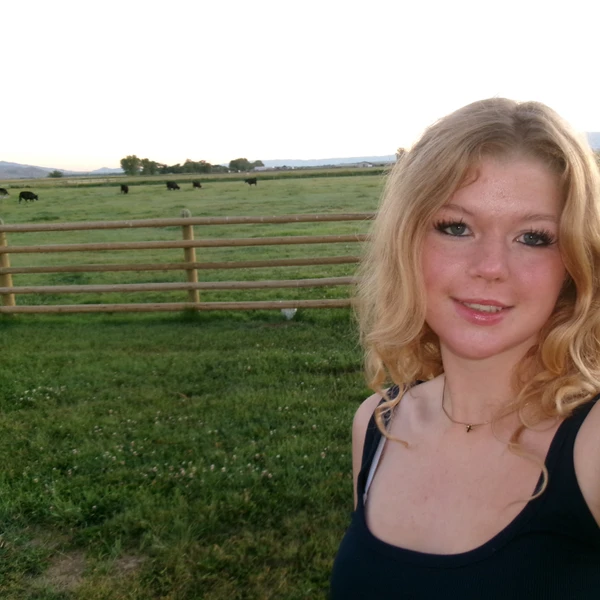
Hobbies and interests
FFA
Horseback Riding
Speech and Debate
Community Service And Volunteering
Weightlifting
Showing Livestock
Stocks And Investing
Dog Training
Business And Entrepreneurship
Agriculture
Animals
Art
Spanish
Hiking And Backpacking
Conservation
Reading
Literary Fiction
I read books multiple times per month
Sarah Moredock
1x
FinalistSarah Moredock
1x
FinalistBio
I’m an FFA exhibitor who raises and markets pigs and show lambs at the Campbell FFA farm and the Santa Clara County Fair. I work horseback riding and barn jobs involving care leases, training, camp counseling, and equine physical therapy. I also volunteer and foster for animal rescues and handle my Greater Swiss Mountain Dog in AKC shows.
I’m the founder and president of Trend Trackers, a student club focused on media and industry trends, and the founder of MentorU, a teen-run college mentoring platform that published a student guide and pitched for a $10,000 investment. I serve as Secretary of Speech & Debate, am an active member of CSF and CJSF, and participate in my school’s Stock Market Club. I’ve also attended an all-girls cattle ranching camp in Montana and other agricultural programs that strengthened my interest in sustainable agriculture.
After escaping an abusive father and being raised by a single, disabled mom, I learned early how to work hard, stay focused, and find independence through animals and community. I’m a need-based applicant planning to study Agricultural Business to create a future rooted in responsibility, leadership, and sustainability within the agricultural industry.
Education
Westmont High
High SchoolMiscellaneous
Desired degree level:
Bachelor's degree program
Majors of interest:
- Agricultural Business and Management
Career
Dream career field:
Ranching
Dream career goals:
I plan on owning my own farms and ranches someday and potentially developing products in the agricultural industry.
Private care, training, and physical therapy for privately owned horses.
Self-employed2023 – Present3 yearsHorse Groom and Camp Counsoler
Isola Riding Academy2023 – 20241 year
Sports
Equestrian
Club2015 – Present11 years
Soccer
Club2013 – 20218 years
Public services
Volunteering
Pets In Need — Yellow Volunteer- highest role available under 182024 – PresentVolunteering
13th Street Cat Rescue and through no organization — Foster2020 – 2025
Future Interests
Advocacy
Volunteering
Philanthropy
Entrepreneurship
Made for More Educational Scholarship: A Truly Wicked, Inc. (TWSC) Initiative
Growing up in Campbell, I did not experience stability as something assumed. I experienced it as something fragile. My father’s abuse and constant legal harassment defined much of my childhood. Court filings became routine. Thousands of dollars were drained from our household simply to defend ourselves. Plans were repeatedly disrupted. Even our attempt to move to a more affordable state during my senior year was blocked after months of legal battles, leaving us financially strained and emotionally exhausted.
At the same time, my mother became disabled and unable to work. I am not only a first-generation college student. I am the primary support system in a household where income is limited and daily functioning can be unpredictable. I manage school, livestock responsibilities, and caregiving simultaneously. There is no financial safety net behind me. There is no extended family funding tuition. Every step forward has required calculation.
Yet when I imagine my future, I do not see chaos. I see structure.
In a region defined by venture capital and software startups, my decision to pursue Agricultural Business is highly uncommon. Silicon Valley does not center ranching, livestock production, or equine enterprise. Choosing agriculture here often feels isolating. But adversity trained me to build in environments that do not naturally support me. If I could raise and market livestock while navigating legal instability at home, I can build a business in an unconventional space.
Agriculture became the one area of my life where effort directly produced results. Through FFA, I raised pigs and lambs from start to sale. I tracked feed costs ounce by ounce because mistakes meant financial loss we could not absorb. I negotiated with private buyers because I needed the best return possible. I woke up early for barn chores after nights spent helping my mother manage her health. When projects succeeded, they represented more than ribbons. They represented proof that I could create stability through discipline.
As a first-generation student, college represents more than a degree. It represents breaking a cycle of instability. My mother never had the chance to pursue higher education without interruption. My father’s actions repeatedly threatened to derail my academic focus. Choosing college is a deliberate act of independence. It is a refusal to let chaos dictate my trajectory.
Living in one of the most expensive regions in the country while barely scraping by exposed me to sharp economic contrast. I witnessed extraordinary wealth in the same area where I worried about court costs and housing affordability. That contrast strengthened my resolve to build a business grounded in sustainability, ownership, and long-term security. My long-term goal is to develop a diversified ranching enterprise that integrates livestock production, equine services, and animal rescue while offering mentorship to youth who, like me, may not see traditional pathways reflected in their lives.
This scholarship would ease immediate financial pressure as I transition into college. Securing dog-friendly housing so I can bring my 110-pound Greater Swiss Mountain Dog while continuing to support my disabled mother increases my expenses significantly. Every dollar reduces strain and increases my ability to focus on academics and business development.
Adversity has shaped me, but it has not limited me. I am building a future defined by ownership, structure, and independence.
God Hearted Girls Scholarship
Faith, for me, has been survival. It has been steadiness when my life felt unstable. My relationship with Jesus was not formed in comfort, but in crisis. Growing up in a home marked by abuse and fear, I learned early what it meant to feel powerless. There were seasons when safety felt fragile, when legal control and authority were used to intimidate rather than protect, and when I had to grow up faster than most of my peers. I clung to Christ not because life was easy, but because He was constant.
When my father’s behavior created chaos, it was prayer that steadied me. When systems that were supposed to protect confidentiality failed me, I had to rely on God for courage rather than control. Watching my mother navigate disability while still remaining my greatest source of strength taught me what quiet perseverance looks like. Jesus became my model for that perseverance. He endured suffering without surrendering His identity, and that truth shaped how I handled mine. I learned that strength is not loud. It is consistent.
My faith also shaped how I chose to respond to pain. Instead of becoming hardened, I turned outward. Animals became both refuge and responsibility. Through kitten fostering, rescue work with Town Cats, and volunteering with Pets In Need dog rescue, I found healing in service. Caring for vulnerable animals mirrored what Christ calls us to do for one another: protect the voiceless, steward what is entrusted to us, and act with compassion even when it is inconvenient. My work in animal rescue is not separate from my faith; it is an expression of it.
Academically, my faith has grounded my discipline. Balancing rigorous coursework with caregiving responsibilities at home has required endurance. Because of financial and family obligations, I have not always had the flexibility to work as much as peers, yet I have remained committed to excellence in school and leadership roles. Whether in FFA agricultural projects, entrepreneurial initiatives, or animal science pursuits, I approach my work with the belief that my calling is stewardship. Agricultural business is not just a career path for me, it is a way to create sustainable systems that care for animals, land, and community.
As I enter college, I plan to implement my faith not through words alone, but through action. I want to build agricultural enterprises that are ethical, financially responsible, and community-centered. I want to integrate rescue work into long-term ranch operations. I want my professional success to reflect integrity. Faith will guide my decision-making, my leadership, and my treatment of others. I plan to serve the homeless in my community and preach the gospel as I deliver them care packages. I also plan to be an active part of a Christian club or community in college.
Jesus has shaped my identity in a simple but powerful way: I am not defined by the harm I endured, but by the grace I extend. My educational journey is not just about personal advancement; it is about purpose. Wherever I go, I intend to carry that light with me.
Raise Me Up to DO GOOD Scholarship
I was five years old the first time I understood what fear felt like in my own home. It started with shouting. Voices rising. A fight that seemed like others before it, until it wasn’t. I remember the sound of my mother’s back hitting the wall after my father shoved her. I remember her face, shocked and in pain. I remember standing there, small and frozen, realizing that something had broken that could not be fixed with an apology.
That night changed everything.
Within days, we were running. Police were called. Doors slammed. My father chased after us as we tried to leave. I remember the rush of being hurried into a car, my heart pounding so loudly it felt like it filled my ears. I did not fully understand the legal language adults used afterward, but I understood this: we were not safe, and staying would only make it worse.
Since then, my life has been shaped by court dates and constant harassment. Instead of family trips without worry, there were legal battles. Instead of peace, there were threats. Childhood, for me, carried paperwork and police reports. Growing up meant staying alert. It meant learning what words like custody and violation meant before I could spell them.
Although leaving was necessary, it did not make life easy. My mother is disabled and unable to work. With no stable income and ongoing legal expenses, survival required planning. As I grew older, responsibility became second nature. I take my mom to appointments appointments. I help manage finances. When she is in pain, I step in. When something breaks, I figure out how to fix it. Because there is no second parent to rely on, I learned to become stable.
There were nights when I felt overwhelmed. There were mornings when exhaustion followed me to school. Yet even in the chaos, I found direction. Turning eighteen feels like a light at the end of a long tunnel. For years, my father has had access to my records and legal authority over parts of my life. Adulthood means autonomy. It means protection. It means finally closing a chapter that has defined too much of my childhood.
Despite everything, I refuse to let fear define my future. Instead, it fuels my ambition. Through my work in animal rescue, fostering vulnerable kittens and volunteering with local shelters, I see the same pattern over and over. Trauma leaves marks, but stability restores confidence. A scared animal can learn to trust again. A chaotic beginning does not determine the ending. Patiently, consistently, with care, healing happens.
Looking forward, I plan to pursue agricultural business and sustainable ranching. With discipline and compassion, I want to build enterprises that provide security to others. Financial independence is not simply a goal for me; it is protection. Stability is not just comfort; it is freedom. By creating ethical businesses that employ people and support rescue efforts, I intend to turn survival into service.
When I think back to that five year old girl watching her mother get hurt, I feel anger. I also feel resolve. She did not get a peaceful childhood, but she gained strength. She learned to act instead of freeze. She learned that leaving takes courage. And now, standing at the edge of adulthood, I am determined to use that courage to build a life defined not by violence, but by purpose.
Jessie Koci Future Entrepreneurs Scholarship
I want to pursue a degree in Agricultural Business because I have already run small agricultural businesses and learned that sustainability depends on strategy. When I began raising commercial pigs and fair lambs to sell, I assumed hard work alone would be enough. Instead, I quickly realized that profit depends on managing input costs, timing sales correctly, building a reputation, and marketing effectively. By tracking feed expenses, comparing weight gain to cost, and positioning my animals to serious buyers, I learned that agriculture is as much about economics as it is about labor. A degree in Agricultural Business will give me the tools to scale responsibly, manage risk, and diversify income so that what I build can last.
Through hands-on experience, I discovered that entrepreneurship is about accountability. I am self-employed through my horse care business, where I provide exercise, feeding, grooming, and individualized care for clients. From coordinating multiple schedules to pricing services competitively, every decision directly affects my reputation and income. Because each client places trust in me, I have learned to deliver consistent results. That responsibility shaped the way I approach every venture.
Beyond agriculture, I sought formal entrepreneurial training at Beta Camp Entrepreneurship Camp. There, I developed and pitched a startup idea in a competitive environment. I learned how to design revenue models, outline customer acquisition strategies, and evaluate scalability. At the same time, my experience in Speech and Debate strengthened my ability to pitch under pressure. Arguing in competition trained me to think quickly, respond clearly, and defend my ideas confidently. I also co-founded MentorU, a student-run mentorship initiative. Together, we wrote and published a book to guide students through school-specific application processes. From editing drafts to coordinating distribution and marketing, I experienced the full process of turning an idea into a tangible product.
Behind my ambition is necessity. My mother is disabled and unable to earn income. She has no financial safety net. Ongoing legal harassment from my abusive father has repeatedly drained our limited resources. I learned early how fragile financial stability can be. Because of family responsibilities at home, traditional employment was not always possible. Instead, I built flexible income streams that allowed me to contribute while meeting those obligations. In difficult circumstances, entrepreneurship became the way I created stability and control.
Persistence defines how I operate. Livestock projects require months of investment before seeing any return. Client-based services demand consistency long before growth occurs. Startup development involves revision after rejection. Many businesses fail because founders stop when progress feels slow. Balancing academics, leadership roles, agricultural enterprises, and family responsibilities has required discipline and long-term thinking. I am accustomed to sustained effort.
To me, a successful life means autonomy, financial security, and impact. It means building a strong agricultural business that supports my family, withstands market challenges, and creates opportunities for others. Higher education in Agricultural Business will refine the skills I have already developed through experience. I am not pursuing entrepreneurship casually. I am building toward it with preparation shaped by work, adversity, and persistence.
Matthew E. Minor Memorial Scholarship
I am entering higher education carrying responsibilities that have shaped me far beyond academics. My mother is disabled, and I help manage daily responsibilities at home that many students my age do not face. I also grew up in a household impacted by an abusive father. That environment required me to mature quickly, develop emotional awareness, and learn how to maintain stability even when circumstances were unpredictable. Due to my father's abusive nature, he still continues to harass us in court to drain our last finanaces. My mother is unable to generate income due to her disability. Because of my mother’s disability and the number of dependents I help care for, I do not have unlimited flexibility to work traditional jobs. My time is divided between school, caregiving responsibilities, and commitments I have made to others. As I prepare for college, I face significant financial need. I cannot rely on consistent parental financial support, and scholarships are essential to ensuring that I can pursue higher education without placing additional strain on my family.
Outside of school, my primary community involvement is animal rescue. I foster kittens, volunteer with Town Cats, and work with Pets In Need dog rescue. Foster work often includes bottle-feeding neonatal kittens, administering medication, socializing fearful animals, cleaning and preparing living spaces, and coordinating with adoption teams. Through Town Cats and Pets In Need, I assist in caring for animals that have been abandoned, neglected, or surrendered. Rescue requires consistency and patience. Animals that have experienced instability often need calm structure and steady reassurance before they can trust again.
Working in rescue has shaped how I approach bullying prevention. Many animals enter rescue because they were mistreated or discarded when they became inconvenient. That pattern of targeting the vulnerable is similar to what occurs in both in-person bullying and cyberbullying. I am intentional about not participating in online behavior that humiliates or isolates others. In group chats or social spaces, I avoid sharing harmful content or engaging in ridicule. If I see exclusionary or aggressive behavior, I address it directly and privately when possible, encouraging accountability rather than escalation. When someone appears withdrawn after an online incident, I check in with them rather than assuming someone else will.
In rescue, safety is built through small, repeated actions: consistent feeding, gentle handling, reliable boundaries. I believe youth protection works the same way. Creating safer environments, both online and in person, requires modeling respect, setting expectations, and intervening when necessary.
My long-term goal is to build a career that integrates ethical animal care with community impact. The mission of the Matthew E. Minor Awareness Foundation resonates with me because harm often occurs quietly before anyone intervenes. I have learned that protection requires attention, courage, and consistency. That is the standard I hold myself to as I move forward into higher education and beyond.
Proverbs 3:27 Scholarship
Shop Home Med Scholarship
I am a high school senior planning to study agribusiness, with the long term goal of owning farms and developing agricultural products. I am also a full time caregiver. Those two identities are not separate. They were built together, out of necessity, responsibility, and love.
Four years ago, my mother and I escaped my abusive father. Leaving was not the end of the hardship. It was the beginning of a new reality where my mother’s health rapidly declined while our financial and emotional safety depended on stability we did not yet have. My mother cannot work and is on disability. Her medical conditions are extensive and worsening. She needs two full knee replacements, two shoulder surgeries, back surgery for three dislocated discs, and thumb surgery. She has severe arthritis, fibromyalgia, sleep apnea, PCOS, extreme thyroid dysfunction, and obesity that she cannot medically reverse. Doctors require weight loss before surgery, yet she cannot walk, eats very little, and still does not lose weight. She is trapped in a body that will not heal fast enough to keep up with medical demands.
Because of this, I became her primary caregiver.
I prepare her meals. I help her stand, walk, and transfer safely. I manage errands and medical appointments. I push her wheelchair, steady her walker, load her mobility scooter, and adjust our days around pain levels. I organize schedules when brain fog from trauma and abuse makes complex tasks overwhelming for her. At the same time, I help shield her from ongoing legal harassment from my father, which continues to drain her emotionally and cognitively.
Caregiving is not one task. It is constant awareness, planning ahead, and pushing through even when exhausted. Caring for my mom has made me realize how difficult it is to live with a disability. Whenever we leave the house together, we must jump through hoops to search for accommodations.
My responsibilities extend beyond my mother. Because she cannot physically help, I also assist with caring for my grandparents when needed. At home, I am the sole caregiver for our animals. Feeding, cleaning, lifting, scheduling, and monitoring their health fall entirely on me. At seventeen, I have more dependents than most adults I know.
These responsibilities have shaped how I move through the world. While my peers leave school and rest, I shift into caregiving. While others plan freely, I must think about the care of my animals and mother.
Despite everything, my mother pushes herself relentlessly. She works harder than her body allows. She refuses to give up, even when pain makes simple movement exhausting. Watching her determination has shaped my own ambition. I want an education that allows me to build financial stability so that I can take care of my mother and my animals.
Caring for my mother has taught me responsibility and empathy. It has taught me how to lead quietly and endure without complaint. This scholarship would directly support my ability to continue my education while carrying responsibilities that do not pause for school schedules.
Mark Suren Melkonian Memorial Scholarship
Anxiously, I tugged my mom’s hand at Westmont High School’s Farm Fun Fest. I was 5 years old, and I couldn't take my eyes off the livestock pens, even though the bouncy house was alluring. Goats, cattle, crops, and rabbits spread across the unusual property in the middle of the suburbs of Silicon Valley. I listened as FFA students in blue corduroy jackets talked about their animals. At that moment, I decided that I would raise livestock, too.
What captivated me wasn’t just the animals themselves, but the sense of responsibility that the students had. Their words reflected a level of ownership, pride, and accountability that I hadn’t seen before. I wanted to be part of a place where effort translates into results.
10 years later, breathless and dusty, I wear that same jacket. My commercial hogs grew quickly, and I sold them to private buyers I negotiated with. Their value was measured in weight and profit. My show lambs needed something else: customized feed routines and hours of practice in the ring. Even when the lamb fought for the lead in shows, I kept my feet square while the lamb braced against my leg.
From those experiences, I realized that agriculture encompasses both manual labor and business decision-making. Raising livestock required me to think critically about cost management, evaluating potential markets, and adapting strategies in order to achieve my goals. As such, I learned that while the care of animals is essential in agriculture, making educated decisions regarding their management is equally important.
Simultaneously, I stepped into a different type of show ring with Hazel, my stubborn Greater Swiss Mountain Dog. Instead of trotting neatly beside me, she often plopped in the middle of the floor, forcing me to stay calm and keep trying. After many hours of practice, her skills have improved, and, as a team, we have won many ribbons.
She taught me patience and perseverance, two qualities that are critical to successfully participating in the field of agriculture, where progress is not always immediate, and success depends on long-term commitment.
At a women’s ranching camp in Montana, I rotated through the cattle chute, vaccinating cattle and assisting the vet with castrations. Later, penning cattle required wide gestures and quick thinking as I tried to anticipate the movements of the herd of bulls before me. By the end of my week-long camp, I had developed the skills necessary to own my own ranch someday.
The World Ag Expo, held annually in Tulare, California, provided me the opportunity to see agriculture on a larger scale than what I had previously experienced. Walking through acres of exhibits at the expo, I observed agricultural business in operation, including machinery designed for maximum efficiency, feed and genetics programs developed to increase overall productivity, and companies focused on creating sustainable products and practices that support long-term growth. While walking through the various exhibits, I realized how innovation, economics, and production are intertwined to create an industry based on strategy rather than manual labor alone. This experience reinforced my decision to pursue a career in agriculture.
Although agriculture began as a childhood curiosity, today it is my reality: feeding before school, training animals after school, and hauling hay until my back aches. If five-year-old me, holding my mom’s hand— who excitedly watched the big kids with their project animals— could see me now, she’d know I kept my promise; she’d see me inside the pens, blue corduroy jacket on, doing the work she once only dreamed of doing.
Ava Wood Stupendous Love Scholarship
Prompt 1:
To me, kindness is quiet and unassuming. It's being there for an animal consistently when an animal has been overlooked long enough that people stop expecting progress. I have learned this from my experiences in animal rescue and rehabilitation with dogs that other people had deemed "too far gone" to help.
The majority of my volunteer work at a local animal shelter was with dogs that were classified as "reactive" or "unadoptable." There was one dog who had extreme anxiety & fear-based reactions. She didn't trust people and would often retreat completely if anyone came close to her. Most of the volunteers wouldn't interact with her because of how slowly & unpredictably she progressed. I chose not to push her boundaries and focus on patience. I would sit with her and go at her pace and allow her to determine whether or not she wanted to interact with me.
Her progress wasn't anything spectacular, some days it was just that she stayed present and didn't retreat. As time went on, she became more willing to participate and tolerated touch and handling better. Eventually she was adopted by a family who understood how to provide for her needs and continue her training.
Kindness is showing up again and again, even when you don't know what will happen, and even when your actions are unseen.
I bring this same way of thinking to all of my animal-related work, meeting the animals where they are at and honoring their boundaries.
Ava Wood's legacy represents wholehearted love, and I attempt to live out this spirit of love in my care for animals.
Prompt 2:
My home is in Silicon Valley, a place known as the epicenter of technology, with an economy built on innovative companies with massive wealth and prestige. Farming/ agriculture is not seen as prestigious or valuable in this environment. As such, students studying agriculture are often viewed as having lower aspirations than children of corporate executives/ engineers. Equine sports are dominated by individuals from families with the financial means to purchase horses valued at six figures. By taking the path of agriculture, I knew that I would be deviating from the social norm, but also that I didn’t have to be like everyone else.
I do not have any family members in the field of agriculture. If I desired to ride horses, I needed to earn the opportunity. Therefore, I cleaned stables, fed horses, worked jobs that other people wouldn't touch and learned through trial and error. When I rode with the wealthy families with horses costing $100,000+ and unlimited funds, I was working ten times harder than they were and still showing up.
There were moments when the contrast was isolating. It would have been much easier to pursue a career that would provide me with a sense of accomplishment that was accepted by society and/or provided me with a polished financial appearance. However, I chose to continue being genuine and authentic regarding who I am and what I believe. I chose to value accountability over image and to choose purpose over perception.
Being unapologetically myself has taught me to find a way to create my own sense of belonging, and one that is based upon my being authentic. Ava Wood's legacy will honor the courage and whole-hearted love she embodied in her life, and I hope to demonstrate that same courage and whole-heartedness in my own life by continuing to make choices based upon the substance of my actions and not based upon the status I achieve.
Linda Kay Monroe Whelan Memorial Education Scholarship
I was seven years old when I discovered that Muffin, the tiny black kitten I rescued from being stuck inside the motor of my mom's car at Classic Car Wash, was just one of many ways that I would give back to those in need, especially the ones who cannot speak for themselves.
At home, however, there was no such protection from my dad's controlling nature that influenced almost all aspects of my life, including the people I could see, places I could go, and even the things I could believe about my own mother. During this time, I found a way to establish stability for myself through the only source I knew to provide that: helping animals. Initially, volunteering was a form of survival, but eventually it evolved into the ultimate representation of the type of individual I intended to become.
As a 14-year-old, I left my father and moved in with my mom, and he responded by attempting to take the animals I had been caring for and raising. Due to my age, the courts ruled in favor of my father, and losing the animals I loved was devastating, but it also helped clarify the importance of another element of service - that service is typically the most effective and fulfilling when it stems from empathy, and that empathy is developed from our struggles.
Eventually, once I reached legal age, I began to volunteer at a local cat rescue. Day after day I cleaned animal cages, calmed frightened cats, and fed newborn kittens every few hours. Eventually exhausted but dedicated, I continued to foster entire litters of kittens until they were mature enough to be adopted. Later, while working at Pets in Need, I worked training dogs with behavioral issues, and my supervisors advanced my status to the highest volunteer level possible to someone under the age of 18. Time and again, the animals reminded me that growth is rarely dramatic; most of the time, it consists of a series of small, incremental steps repeated over and over again.
At the same time, my interest in agriculture developed from curiosity into purpose. Over time, I created my own pathway through various equine positions, through raising FFA pigs and lambs, and through participating in ranch camps which provided me with the discipline needed to manage a livestock operation. Individually, I sought mentors and resources for young farmers of the first generation and recognized how structure, stewardship, and community are interconnected in the context of agricultural work. Through my service to others, I learned how to endure; through my experience in agriculture, I learned where to apply that endurance.
These experiences informed my academic goals. I intend to pursue an Agricultural Business degree, as it utilizes the skills and knowledge I require for managing a business. Finally, I want to open and operate a large-scale livestock enterprise that promotes humane treatment, sustainability, and financially responsible practices. In addition, I envision building an operation that supports rural communities, produces high-quality products, and demonstrates the values upon which I have based my life.
Ultimately, providing service has given me more than a sense of self; it has given me a model for my future. My dedication to vulnerable animals taught me persistence, accountability, and compassion. My involvement in agriculture has shown me the value of precision, planning for the long term, and leadership. Together, these two paths have defined the life that I am committed to creating, and the education I am pursuing will enable me to develop that commitment into a career that serves others daily.
Second Chance Scholarship
Rescuing Myself
When I was seven, I spotted a pair of glowing eyes beneath a rock at Classic Car Wash. A tiny black kitten, no larger than my hand, darted into my mom’s car engine. Using a jack, we hoisted the car to retrieve the oily, screeching kitten from the engine. I named him Muffin, and in that moment, I discovered how natural it felt to protect animals.
At home, though, no one rescued me. My dad’s control shaped nearly everything—who I could see, how I spent my time, even what I believed about my mom. He alienated my mom and me from each other, and for years, I lived under his anger. To find stability, I turned to animals.
At fourteen, I found the courage to leave and move in with my mom. Determined to punish me, my dad fought to seize the animals I owned at his house, even though I was their sole caretaker. The court ruled in his favor because I was still a minor. Losing them crushed me, and showed just how far he would go to maintain control. Since then, he has tried to void my driver’s license, interfere with my healthcare, drain my finances, and even sabotage my first job. His attacks continue, yet I’ve learned to build a life in the spaces where he has no power.
The same year, I finally turned old enough to volunteer at a cat rescue. At first, I cleaned cages and socialized shy cats. I bottle-fed newborn kittens every few hours, exhausted from sleepless nights, fostering both litters and single rescues until they were adopted. Each animal was fragile, but every adoption felt like I was moving forward, too. At sixteen, I began volunteering with Pets in Need, walking and training dogs. The staff noticed my hard work; they promoted me directly to the highest level available for volunteers under 18.
Leaving my father was my “second chance.” Because of my efforts, I am able to blossom in a stable environment that allows me to further my interest in helping animals. Much of my success can be attributed to my mother, who fights constant legal battles to keep me safe. In return, I offer a “second chance” to animals by giving them the opportunity to thrive in a stable environment. I nurture kittens who would have otherwise died on the street and I teach fearful dogs that the world is not as scary as it may seem.
Muffin was my first rescue, but not my last. Animals have anchored me through years of instability. By caring for animals, I’ve found the steadiness to keep choosing growth over control.
Harvest Scholarship for Women Dreamers
My "pie in the sky" dream is to develop a long-lasting agricultural business model that includes successful, self-sustaining farms and ranches, an integrated dog rescue, and sufficient financial resources to provide for my single, disabled mother. The three objectives appear unconnected at first glance; however, they represent a single vision of developing a way of life in which land, animals, and family members are protected through my labor.
I did not grow up in an agricultural setting. I am the first member of my family to choose to pursue this career path and the first to attend college. As a result, my experience with agriculture began as simple experiences and not as a family farm or a generational operation. At a very young age, I became interested in agriculture after visiting a horse barn and later as a youth employee at Isola Riding Academy. While working at the riding academy as an hourly employee, I experienced for the first time what daily animal care entails. In addition to feeding the horses, cleaning the stalls, filling the water buckets, sweeping the aisles, and assisting in preparing the horses for their lessons, I learned that agriculture is based upon routines, timing, and accountability.
Today, I take care of horses for private owners, which involves greater independence. Observing how a horse walks, eats, or acts has allowed me to understand how decisions made by managers affect the welfare of the animal. Additionally, I have gained knowledge of agriculture through raising FFA pigs and lambs, as well as understanding the economic aspects through FFA. I realized that agriculture is not merely a series of tasks but a complex system during ranch camp in Montana. When standing in an open pasture, I knew that I wanted to operate my own land and not work for another individual.
This realization solidified my goals. I intend to own and manage multiple sustainable farms and ranches. I want each operation to include livestock production, smart grazing strategies, healthy soils, and long-term financial planning. I also intend to develop a dog rescue associated with my ranch-based operations. I have always worked with dogs, particularly larger breeds, and I am aware of the number of dogs that end up in shelters simply due to lack of space or training. The ranch environment will provide the opportunity for these dogs to decompress and receive the necessary training before being adopted.
My third objective motivates every aspect of the others. I desire to generate enough income to completely support my mother. She raised me alone while dealing with a disability and has never had financial stability. Providing her with this level of security is something I must do. That is why I want to have my enterprise scale beyond a single ranch.
To achieve my goals, I plan to major in Agricultural Business in college. I need a solid base of knowledge in livestock systems, land management, enterprise budgeting, and the economic implications of operating mid-size to large-scale enterprises. After completing my degree, I plan to seek employment on various ranches to gain experience in multiple management approaches and determine which practices lead to long-term success. From there, I hope to begin by purchasing land, reinvesting profits, expanding gradually, and establishing the dog rescue once financially stable.
Through persistence, continued education, and the willingness to start from the ground up, I believe I can develop the agricultural business I envision.
No Essay Scholarship by Sallie
Charles Bowlus Memorial Scholarship
Cancer didn’t enter my life through my own diagnosis, but through the people and animals I’ve cared for. When I began helping a woman named Gladys as she went through breast cancer treatment, I didn’t realize how much it would teach me about resilience and empathy. While she recovered, I cared for her horses—feeding, grooming, and exercising them every day. Despite her pain, she still asked about her horses before herself. Her compassion, even in weakness, showed me what it means to give selflessly. When she recovered, she told me I had given her a reason to heal. That moment made me realize that care—quiet, consistent care—can change lives.
At home, I learned the same lesson in a different way. My mom raised me alone while living with a disability that prevents her from working. She’s currently unemployed, and our financial and emotional struggles have been made worse by my abusive father, who we left years ago. He continues to drain our limited resources by dragging us into costly court battles, trying to accuse her of things she didn’t do. Each hearing, each legal bill, chips away at what little we have, yet my mom refuses to give up. She has no retirement or savings, but she still finds ways to support me. When the rent goes up, we sell old items online to make ends meet. Through every challenge, she finds strength in persistence, and I’ve learned to do the same. Her sacrifices taught me that real love isn’t shown through comfort—it’s shown through endurance.
Being first-generation has meant figuring out almost everything on my own: financial aid forms, college applications, scholarship essays, and the confusing systems that seem designed for people with more guidance. But the independence I’ve had to build has also given me drive. I’ve learned to work for every opportunity I get, even when the odds are stacked against me.
Those experiences shaped how I view both compassion and ambition. I’ve learned that empathy isn’t just about being kind—it’s about doing what needs to be done, even when it’s hard or unnoticed. That belief has carried into everything I do, from volunteering at animal rescues to caring for foster animals at home. I’ve bottle-fed newborn kittens through sleepless nights and trained anxious shelter dogs until they trusted again. I’ve seen how consistency and gentleness can rebuild what fear destroys.
That same mindset is what I want to carry into my future. I plan to major in agricultural business, where I can combine compassion with practical problem-solving. I want to help create more humane, sustainable systems within agriculture—spaces where animals are treated responsibly and small producers can still thrive. Coming from a background where every dollar and decision matters has given me a deep respect for both people’s work and the living beings they depend on.
The challenges I’ve faced—growing up in a single-parent household, navigating financial hardship, and watching illness and injustice test the people I love—have not weakened me; they’ve defined my purpose. They taught me to lead with empathy, to see value in every life, and to persist when giving up would be easier. My future in agricultural business isn’t just a career path—it’s a way to turn the lessons of struggle into something that sustains and uplifts others.
Michael Rudometkin Memorial Scholarship
When I was seven, I spotted a pair of glowing eyes beneath a rock at Classic Car Wash. A tiny black kitten, no larger than my hand, darted into my mom’s car engine. Using a jack, we lifted the car and freed him—oily, terrified, but alive. I named him Muffin. In saving him, I felt an instinct I didn’t yet have words for: compassion.
At home, though, no one rescued me. My dad’s control dictated nearly everything—who I saw, what I believed, even how I felt about my mom. His anger filled the house, and I learned early how easily kindness could be silenced. When I couldn’t change my circumstances, I turned to animals. Their trust was fragile, their needs simple, and their love never conditional.
When I was fourteen, I found the courage to leave and live with my mom. My dad retaliated by taking the animals I had raised, using them to remind me of his control. Losing them hurt more than I expected, but it strengthened my belief in care that asks for nothing in return.
Not long after, I began volunteering at a local cat rescue. I started with small jobs—scrubbing cages, refilling food bowls, and calming the shy cats who pressed themselves into corners. Soon, I began fostering newborn kittens. They arrived cold, underweight, and sometimes hours from death. Every two to three hours, I woke up through the night to bottle-feed them, rubbing their tiny bodies with a towel to mimic the warmth of a mother cat. I learned to syringe-feed those too weak to eat and comfort them through coughing fits and tremors. Some didn’t make it—but most did. Watching them open their eyes for the first time or take their first wobbly steps made every sleepless night worth it.
Each adoption felt like a small victory—not just for the animal, but for me. Every cat I nursed to health and sent into a new home became proof that broken things could heal.
At sixteen, I began volunteering at Pets in Need, where I worked with anxious dogs who flinched at movement and barked out of fear. Teaching them to trust again taught me just as much about resilience as it did about patience. I spent hours kneeling on concrete floors, whispering softly to trembling dogs until they dared to take a treat from my hand. Compassion, I learned, isn’t always gentle—it’s persistence, care repeated over and over until fear gives way to peace.
That same compassion deepened when I helped a woman named Gladys, who was fighting breast cancer. While she recovered, I cared for her horses—feeding, grooming, and exercising them daily. Her gratitude reminded me that compassion extends beyond species; it’s about giving strength where it’s needed most. When she returned to the barn, healthy again, she told me I had given her horses a reason to stay calm—and her a reason to heal.
Across every life I’ve touched, human or animal, I’ve seen how empathy restores what fear takes away. The animals I’ve rescued have rescued me right back, teaching me that compassion isn’t weakness—it’s the quiet courage to care, even when life makes it hard to.
YOU GOT IT GIRL SCHOLARSHIP
Where I Belong
Most kids wrinkle their noses at manure. I am thrilled by it. On my first visit to a horse stable, the smell, the noise, even the arena dust in the air elated me. My friend’s mom brought me to work with her in kindergarten, and from that day forward, nothing felt the same. Exhausting, dirty work felt like more of a privilege than a burden. Horses became the place where I belonged.
However, not all stables were as welcoming. At one stable, people paid their way to the top, where the horses were more valuable than homes. I owned neither my own horse nor any fancy equipment when I arrived; instead, I applied for a job. I studied the inner workings of the stable while doing the dirtiest jobs and serving the most entitled customers. I watched for the signs of colic, practiced wrapping legs, and memorized feed plans. I learned that real skill doesn’t come from money or lessons but from showing up, even when no one notices. The barn I was excluded from became the one that taught me the most.
I later worked for a woman, Gladys, who was fighting breast cancer. While she was recovering, I fed her horses, cleaned their stalls, and trained them. No ribbon or score could adequately describe how much she and her horses relied on me. After years of working for people who paid for their position in the equestrian community, my perception of horsemanship had become warped. After working for Gladys, I came to understand that horsemanship is based more on responsibility and community than it is on winning the most prizes.
Yet, an ache persists in me. I know that I ride well—both in show jumping and a bit of western—but while others advance through lessons and competitions, I'm stuck because I cannot afford their way of life. Still, I wouldn’t trade what I’ve learned for anything. I’ve trained green horses, exercised the difficult ones, and improved with every ride, even when no one is watching. I practice my sport with what I have and take pride in every small victory. Money cannot buy the patience, timing, and feel that come from experience. My goal is to ride on a college equestrian team and prove that hard work and skill can matter more than ownership. Through every setback and sacrifice, I have proved a simple truth: horses are where I belong—not despite the difficulties, but because of them.