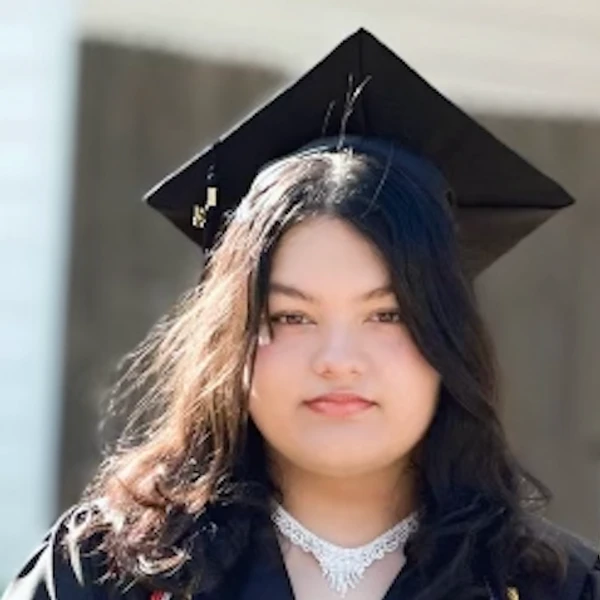
I chose civil engineering because I’ve seen the effects of systemic failure. I grew up in Nepal, where the fragility of the built environment is a reality. I can’t forget the floods that filled miles of streets with water, my relatives losing their possessions, or their fields being flooded. The earthquake that split buildings in half, or the continuous absence of safe roads and reliable water systems. These were not merely environmental events; they were lived experiences that demonstrated the importance of engineering, especially in often-invisible settings. At a young age, I had knowledge of the fact that good design and infrastructure save lives. It was not that I was scared; it gave me direction.
For the time being, I am concentrating on establishing a strong academic foundation and obtaining relevant experience through internships. I also hope I will be able to engage with groups like Engineers Without Borders who are focused on underrepresented communities and obtaining basic human needs through sustainable engineering projects. As part of projects that have high impact, and with peers who are also hoping to learn about using engineering to promote global equity. After completing my bachelor's degree, I hope to pursue a master's or minor that qualifies me to go further and achieve more. My long-term goals are to work on projects that serve underrepresented or underserved communities, either in the U.S. or abroad. I do not have a dream company, I have a dream to make an impact.
As a woman, an immigrant, and a person of color in this position, I am frequently told, sometimes directly, sometimes otherwise, that I am not the default. In classrooms, I sometimes feel like what I am saying is being diffused into a space that was not made to receive what I am putting out. But that’s exactly why I keep going. I want to help shape the field to make room for more voices like mine. I want other young women, especially from places like mine, to know they belong here too, not as guests, but as contributors and leaders.
Financially, the path hasn’t been easy. I am a full-time student navigating the costs of tuition, textbooks, and daily living, all while carrying the quiet hope of being able to support my parents one day and give back some portion of what they sacrificed for me to be here. This scholarship would relieve some of that pressure. It wouldn’t just fund my education, it would buy me and my family peace of mind, and give me time, and focus, to keep building toward what I know I’m capable of.
Future Women In STEM Scholarship
When I first arrived in the U.S. from Nepal, everything felt temporary: the language in my mouth, the streets beneath my feet, even my voice in the classroom. I was fluent in Nepali, Hindi, and knew enough English to succeed, but not well enough to feel heard. I quickly saw that in some rooms, people don’t always expect someone like me to speak up, and sometimes, they don’t expect you to be there at all. I knew my parents gave up so much to be here to give me a better future, but it felt so lonely, and soon after, a disaster struck Nepal.
I still remember the earthquake that cracked open the earth and the rhythm of our lives with it. For some time, it was as if it had taken away any and all feelings of safety and joy from the communities. Even the recent flood that swept through our community in Nepal, the water didn’t just wash away homes, but the sense of safety we had loved, yet taken for granted. I was young, but even then, I understood that they weren't just natural events; they were also failures of preparation, failures of infrastructure, failures of systems that were supposed to protect us. These experiences weren't just events, they left a mark on me. They showed me that engineering isn’t just technical; it’s deeply human. It’s the difference between shelter and ruin, between access and isolation. I carry those memories with me in every class, every assignment, as a quiet reminder of why this work matters.
I had started my college journey in Nursing. I knew nursing was a good major; it had job security, and I could help others. They helped in the flood, in the earthquake, and continue to help every day, but my mind was more fixed on one thing: the devastating impact natural disasters have on so many people because they weren’t prepared. In Nepal, I saw both the absence of infrastructure as well as the determination of people living without it. I can now see that this contrast shaped my values early on.
The turning point wasn’t dramatic. I saw a group, Engineers Without Borders, designing a water system for a village in another country. They weren’t just engaging in solving equations, they were helping to solve issues that affect lives. Something clicked. I realized that civil engineering wasn’t just about numbers or models, it was about service. It was about building things that people rely on, often without realizing who made them work. That’s the kind of work I want to do, quietly powerful, deeply useful. When I changed majors, even though most of those around me were freshmen as well, I felt like a beginner in every way, more lost, navigating new systems, new terminology, and new expectations. I’d sit in engineering classes and be able to count how many women were in the room using just one hand. I felt more alone than ever before, maybe more than when I first moved here, but I didn’t and will not be letting that stop me from achieving my goals.
I want to be the kind of engineer who uses design to uplift underserved communities, whether through safer roads, sustainable water systems, or accessible public spaces. I want to pursue a master’s degree eventually, or possibly add a minor that strengthens my understanding of the social impact side of engineering. As an immigrant woman in STEM, I carry the weight of these challenges with pride. I want to build paths for others like me, not just the roads and bridges.
Minority Women in STEM Financial Need Scholarship
Every time I drive, I look at the form of the road, I can’t help but wonder, not just about the structure itself, but at the way it holds everything and why it was built the way it is. Steel, tension, movement, and gravity all work quietly beneath the surface. That’s what I want to build. Not just physical structures, but systems that hold people up. Systems that make daily life smoother, safer, and more stable. After college, my goal is to become a civil engineer who designs infrastructure that people rely on without even thinking, because it works.
To get there, I know I need more than theory. I want to see where the drawings become materials, where the mathematics become beams, where the models become communities. I need experience in the field. I plan to pursue internships before graduation to immerse myself in an active environment, and hopefully, get to shadow and ask questions, and be a part of any meaningful segment in the projects themselves. I want to be on construction sites, in planning meetings, at the drafting table to understand how each detail fits into the picture as a whole.
When I finish my undergraduate studies, I want to continue my education, whether it may be a master’s in civil engineering or something else. Whatever it may be, continued learning will allow me to take on more complex projects, ones that involve sustainability, smart design, and equity. Being a woman in this field means that there are spaces we have to learn how to navigate that were never designed for women. It means stepping into a room and seeing how unfamiliar it is, and despite that, deciding to stay. Sometimes it means having to explain yourself twice, prove yourself three times, and still be the one who gets overlooked. But it also means redefining the blueprint. I carry the weight of that challenge with pride. I want to build paths for others like me, not just roads and bridges.
In the long run, I wish to work on infrastructure projects that intentionally focus on underrepresented communities; projects that ensure the everyday experience of living is safer, smoother, and more human. I believe the result of the built environment is a reflection of the values of the person who designed it; I just want to ensure those values include inclusion, beauty, and purpose. My goals are big, but I’ve learned that every road starts with a blueprint. And I’m already building mine.
Ginger Riley Gift Scholarship
I didn’t always know I would study civil engineering. I started in nursing, drawn by the desire to help others, to build something meaningful. But somewhere along the way, the path I was on felt misaligned, like walking through a hallway built for someone else. I realized I didn’t just want to support systems. I wanted to create them.
From an early age, I was captivated by the intricacies of design, not only the surface beauty but the functioning of the objects themselves. The inherent value of the design and also that the forms produced could function or withstand a hurricane. I paid attention to the bridges, the highways, the buildings, and all the public spaces that surrounded me. I studied them as someone trying to decode the intention behind each line, not just as a tourist who happened to be visiting. Why was this overpass continuous when there was no reason for it? What held the skyscraper up through time while others crumbled? I didn't have the words for it, but I was looking at structures that held more than concrete and steel. They held stories, purpose, problems, and solutions.
When I made the switch to civil engineering, it felt like unlocking a system file I didn’t realize had been running in the background all along. Suddenly, my interests in design, logic, and large-scale impact aligned. I began to see engineering not just as calculations and codes, but as a language—one spoken through infrastructure, through safety standards, through load-bearing walls and flood-resistant foundations.
My career plan is to obtain an internship while in school, preferably one that lets me collaborate with clients on real projects impacting how people live and move. I want to transition that into a full-time position after I graduate, again, an opportunity to continue learning while contributing to the real world. Eventually, I want to continue my education, either in civil engineering or an adjacent field such as urban planning, project management, or environmental systems. I want my career to reside at the intersection of design and impact, function and humanity.
The people who have influenced me the most are my parents. They taught me how to build, not with steel or CAD software, but with resilience. They gave up their lives in their home country to give me a chance to succeed. When I changed majors, they didn’t hesitate. They said, “Build something that lasts,” and “do what you find passion in,” and that’s exactly what I intend to do.
Artense Lenell Sam Scholarship
Throughout my life, I have loved observing buildings, roads, parks, and things of that nature, not just for how they appear but how they create human feelings, movements, and behaviors. I find it interesting how places communicate, without communication, it's as simple as a bench encouraging me to sit down or the slight curve of a path that makes a destination feel closer, or further. That interest led me to discover and investigate the world of design and landscape, and the ecosystem services that quietly bring a community together. Over the years, I recognized civil engineering was the path I could take in the physical sciences that was all about creativity, problem solving, and taking action with purpose.
I want to be a civil engineer because I believe in the power of infrastructure to improve lives, not just functionally but emotionally and socially. I want to help design the surroundings in a way that is functional, efficient, and as kind to mankind and the environment as possible. And that means designing with a long-term sustainable goal, being conscious of resource management, and always putting the human experience as a priority, no matter if I'm designing a structure, road, or bridge.
Moving forward, I aim to focus on and work on projects that reflect these values. I see myself designing roads that improve accessibility and the flow of traffic while also retaining the values of the natural landscape. I want to design parks that bring together neighbors and build community, and stormwater systems that protect but do not harm people and the natural surroundings. Community means a lot to me, and I want to design spaces that feel safe, welcoming, and like people belong.
For me, civil engineering is not just construction. It is about listening to the needs of the people you are designing for. It’s about putting the environment first and creating spaces that serve the needs of people and ecology. Civil engineering, at the core, should not only solve problems but should elevate communities.
As a civil engineer in training, I aspire to employ my skills on behalf of the underdeveloped areas, regions, and countries of the world, to gain access to the basic infrastructure most of us take for granted. Potable water systems, safe roadways, and sustainable public spaces. My aim is to develop infrastructure that is affordable, maintainable, and uniquely designed for the needs of each community. My hope is to create lasting benefits that provide people with dignity in their communities, access to the local economy, and opportunities for success, because every person deserves to live, operate, and grow in safety and support.
I am excited about this future because I know moving into a profession where I can leave a real lasting impact, I see that as a huge privilege to influence the future. I also aim to address, through civil engineering, those issues of highest priority to create a better, more purposeful, more connected, more sustainable future.