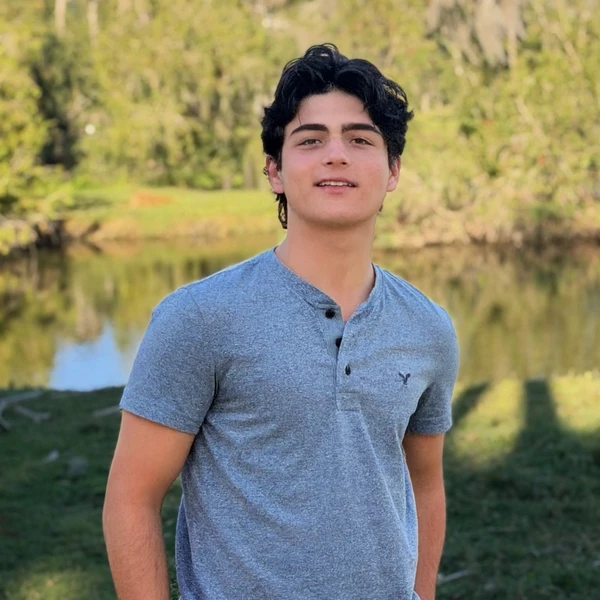
Hobbies and interests
Reading
Legos
Reading
Science
I read books daily
Ryan Deselich
1x
Finalist
Ryan Deselich
1x
FinalistBio
I am passionate about the development of new technology to explore what was previously unexplorable. My exposure to the sciences, specifically that of physics has provided me the confidence I require to complete my degree. I have not committed to a university as of yet, but I am considering Penn State University for a degree in Aerospace Engineering.
In college I plan to meet those who differ from me and learn to lead projects and research.
Education
Gateway High School
High SchoolMiscellaneous
Desired degree level:
Bachelor's degree program
Majors of interest:
- Mechanical Engineering
- Aerospace, Aeronautical, and Astronautical/Space Engineering
Career
Dream career field:
Mechanical or Industrial Engineering
Dream career goals:
Umpire
Monroeville Baseball and Softball Association2024 – 20251 yearLawnmower
Deselich Landscaping2023 – 20263 years
Sports
Golf
Varsity2022 – 20264 years
Baseball
Varsity2022 – 20264 years
Arts
Pittsburgh Glass Center
Stained GlassYes2023 – 2026
Public services
Volunteering
Pittsburgh Food Bank — member2024 – 2026Volunteering
SAT Tutor — teacher/tutor2025 – 2025Volunteering
Pittsburgh Food Bank — member2025 – 2026
Future Interests
Volunteering
Philanthropy
Gail Lynne Huber S.T.E.M. Scholarship
What interests me most about STEM is its power to turn curiosity into understanding and wonder into progress. Long before I could define lift, thrust, or aerodynamics, I was drawn to flight. While other children cried at airport gates, I stood watching airplanes rise into the sky, captivated by how something so massive could defy gravity. I did not yet know the science behind it, but I felt the pull of unanswered questions. I needed to understand why some machines could fly while others could not, and how humans made that possible.
For years, however, I kept that curiosity at a distance. Aerospace engineering felt impossibly far away, too difficult, too specialized, reserved for someone braver or smarter than me. As I entered high school, I convinced myself that interest alone was not enough to justify such an ambitious STEM path. Instead, I imagined a safer future in civil engineering, a field I respected for its tangible results and visible impact. Flight remained something I admired from afar, more fascination than ambition.
That mindset changed when I began independently studying the principles of flight. What started as casual reading quickly became an obsession. Hours passed as I learned about propulsion systems, aerodynamic forces, and innovations such as hypersonic aircraft capable of traveling at extraordinary speeds. STEM suddenly felt alive. It was no longer abstract information or memorized formulas; it became a framework that explained the fascination I had carried since childhood. I realized aerospace engineering was not an unrealistic dream, but a challenge worth pursuing. Encouraged by peers who embraced similarly demanding paths, I stopped asking whether aerospace engineering was “too hard” and instead asked myself whether I could imagine doing anything else. I could not.
I saw this same principle reflected outside the classroom through my role as captain of my high school golf team. Golf demands precision, honesty, and consistency, particularly in an environment where players largely regulate themselves. Leading my teammates required more than strategy or instruction; it required accountability and example. By consistently holding myself to high standards, even when it meant calling penalties on myself, I helped foster a culture of integrity within the team. Over time, that shared commitment, built trust, reduced tension, and led to stronger overall performance. While golf is not a traditional STEM discipline, it reinforced what I find compelling about STEM itself: disciplined effort, clear standards, and incremental decisions producing meaningful, measurable outcomes.
Looking ahead, I plan to pursue aerospace engineering with a focus on propulsion research, aiming to help make missions to Mars and beyond more efficient and achievable. Advancements in propulsion and fuel efficiency are not just technical accomplishments; they determine whether exploration is realistic, sustainable, and accessible.
For me, STEM is where wonder becomes work and work becomes progress. It challenges me intellectually while offering the opportunity to contribute to something larger than myself. That balance, between curiosity and impact, is why I know STEM is where I belong.
Change of Heart Scholarship
For much of my childhood, I was captivated by flight without fully understanding why. While other children cried at airport gates, I ran toward them, fascinated by how massive machines could rise into the sky. Despite this curiosity, aerospace engineering once felt impossibly distant and too difficult, too specialized, meant for someone else. Entering high school, I envisioned a more practical future in civil engineering, convincing myself that wonder alone could not justify a career.
That belief changed during high school as I began to challenge my own self-doubt. A turning point came when I seriously began studying the principles of flight on my own. What started as curiosity quickly became commitment. Hours disappeared as I learned about propulsion systems, aerodynamics, and innovations like hypersonic aircraft capable of traveling faster than Mach 5. For the first time, aerospace engineering felt achievable. Encouragement from peers who pursued ambitious academic paths helped me accept that difficulty was not something to fear, but something to pursue. From that moment on, I stopped asking whether aerospace engineering was too hard and started asking whether I could imagine myself doing anything else. I could not.
This shift in mindset extended beyond academics and shaped how I approached service and leadership in high school. Through my involvement in monthly food drives organized by my school’s Interact Club, I learned that meaningful impact often begins where effort feels overwhelming. Each “Pop-Up Pantry” began with what seemed like an impossible amount of food, yet by the end of the day we had served hundreds of families. Being able to see and speak with the people we helped gave me a sense of purpose and reinforced my desire to contribute to something larger than myself.
I intend to pursue a degree in aerospace engineering at Penn State University and eventually work in propulsion research to help make missions to Mars and beyond more efficient and attainable. I am particularly interested in advancing propulsion technologies that reduce costs and improve efficiency, making space exploration more realistic and sustainable. The perseverance I developed in high school by embracing challenges, serving my community, and trusting my curiosity continues to shape who I am.
High school transformed me from someone who avoided risk into someone who actively seeks it. As I move forward, I carry with me the belief that progress begins when fear gives way to purpose, both in engineering and in life.
Scott A. Ross Memorial Golf Scholarship
My favorite part of playing golf is the feeling of calm focus that comes when I step onto the course. Golf demands patience, honesty, and resilience, and those qualities have shaped my character more than any other activity I’ve been part of. The game has a way of revealing who you are when things aren’t going your way. A bad bounce, a missed putt, or a rough hole can test your composure, but it also gives you the chance to respond with integrity. Over the years, golf has taught me to stay steady, to own my mistakes, and to keep moving forward with a clear mind.
One of the most meaningful experiences I’ve had in the sport came when I served as a standard bearer at the 2025 U.S. Open. Walking inside the ropes with players I had looked up to for years was surreal. Meeting golfers like Jordan Spieth—people I had watched on TV, studied, and admired—made the game feel even more personal. Seeing how they carried themselves under pressure, how they treated fans, and how they respected the course reminded me why I fell in love with golf in the first place. It showed me that the qualities I try to practice—patience, humility, and honesty—are the same qualities that define the professionals I admire. That experience deepened my love for the game and made me want to represent it well, both on and off the course.
Golf has also shaped my character through the leadership roles I’ve taken on. As captain of my high school team, I learned how important it is to lead by example. High school golf relies on players to call penalties on themselves, and it can be tempting to look the other way when no one is watching. I made it a priority to be honest about every stroke, even when it hurt my score. Over time, my teammates followed that example. Leading a team built on trust taught me that real leadership comes from consistency and integrity, not from titles or authority. Those lessons have stayed with me far beyond the course.
Like anyone who plays golf seriously, I’ve faced challenges along the way. Some were physical, like dealing with the aches and strains that come from long practices and tournament days. Others were mental, like learning how to recover from a bad round without letting it define me. Golf forced me to confront frustration, doubt, and pressure, and it taught me how to stay grounded through all of it. The game has a way of humbling you, but it also gives you the chance to grow stronger each time you pick up a club.
Golf has shaped me into someone who values honesty, patience, and resilience. It has taught me how to lead, how to stay composed, and how to keep improving even when progress feels slow. Meeting my heroes at the U.S. Open reminded me why I love the game, and the challenges I’ve faced have made me appreciate it even more. As I move forward, I know the lessons golf has given me will stay with me, guiding how I work, how I lead, and how I carry myself in everything I do.
William L. Keltz Engineering Scholarship
Pursuing a career in engineering interests me because it gives me a way to turn curiosity into progress. My fascination with space began long before I understood the science behind it. I remember listening to my grandfather describe the Apollo 11 moon landing and the sense of unity that swept across the country. He talked about how, for a moment, people looked past their differences and felt connected by the triumph of discovery. That story stayed with me. It made me realize that exploration is more than a scientific achievement. It is something that brings people together. I hope to help create that feeling again through the next great chapter of exploration, whether it is a mission to Mars or a breakthrough that pushes us deeper into the unknown.
As I grew older, my interest in space became more focused. I found myself drawn to the engineering behind propulsion and thruster technology. The idea that a carefully designed engine can lift a spacecraft off the ground, carry it through the vacuum of space, and guide it across millions of miles fascinates me. I want to help make those systems faster, more efficient, and more reliable. I believe that one of NASA’s biggest challenges today is not a lack of talent or technology, but a lack of public engagement. If we can make space travel more efficient and more accessible, we can inspire people again and earn the support needed to push exploration forward. I want to be part of that effort.
My experiences in high school have prepared me for this path in ways I did not expect. As captain of my golf team, I learned how to lead through honesty and example. High school golf relies on players to call penalties on themselves, and it can be tempting to cut corners when no one is watching. I made it a point to hold myself accountable, even on my worst days. Over time, my teammates followed that example. Leading a team built on trust taught me that real leadership comes from consistency and integrity. Those qualities matter just as much in engineering, where precision and accountability are essential.
My community service work taught me something equally important: progress is a team effort. Organizing food drives and working with volunteers showed me how to bring people together around a shared goal. It taught me how to communicate, how to listen, and how to keep a group moving in the same direction. These are the same skills I hope to use one day in research labs, engineering teams, or mission planning rooms.
Isaac Newton once said that he could see further by standing on the shoulders of giants. I hope to do the same. I want to build on the work of the generations before me—people like my grandfather, who believed in the power of exploration, and the engineers and scientists who turned impossible ideas into reality. Engineering gives me the chance to contribute to something larger than myself. It gives me a way to help humanity take its next step into the unknown, and maybe even its next giant leap.
Tom LoCasale Developing Character Through Golf Scholarship
The biggest life lesson I have learned through golf is the importance of leading with honesty, even when no one is watching. Golf is a sport built on trust. There are no referees walking every hole, no cameras catching every stroke, and no scoreboard operator checking your math. In high school golf especially, where coaches can only monitor so much, players are responsible for calling penalties on themselves. That responsibility can bring out the best in people, but it can also reveal the temptation to cut corners. Being captain of my team for the past two years showed me how powerful honest leadership can be, and how much it matters to set the tone for others.
I am most proud of the moments when I helped my teammates choose integrity over convenience. Everyone has bad rounds. Everyone has days when the ball finds every tree and every bunker. It can be tempting to shave a stroke or “forget” a penalty when frustration sets in. I made it a point to show through my own actions that honesty matters more than the number on the scorecard. I called penalties on myself, even when it hurt my score. I owned my mistakes, even when no one else saw them. Over time, my teammates began to do the same. They trusted me because I never asked anything of them that I wasn’t willing to do myself. That trust created a team culture where honesty wasn’t just expected—it was normal.
Leading a team like that taught me that real influence comes from example, not authority. Being a senior or a captain might earn you a title, but it does not earn you respect. Respect comes from consistency, humility, and doing the right thing even when it costs you something. I learned that people follow leaders they believe in, not leaders who simply hold a position. That lesson has shaped the way I see myself and the kind of person I want to be in the future.
I plan to carry this lesson with me into every part of my life, especially my future in aerospace engineering. The field demands precision, accountability, and trust. Mistakes cannot be hidden, and shortcuts can have serious consequences. Whether I am working on propulsion systems, collaborating with a research team, or mentoring younger engineers, I want to be someone others can rely on. The honesty I practiced on the golf course will guide how I approach challenges, how I communicate, and how I take responsibility for my work.
Golf taught me that integrity is not something you show only when others are watching. It is a habit you build through small choices, round after round, day after day. It is the foundation of leadership and the reason people trust you. As I move forward, I plan to use that lesson to shape the way I work, the way I lead, and the way I contribute to the world around me. The scorecards from high school golf will fade, but the character I built through those honest moments will stay with me for the rest of my life.
Bobie Bao Memorial Scholarship
Hearing Neil deGrasse Tyson speak changed something in me. His books opened a kind of curiosity I had never felt before. Tyson is an astrophysicist, author, and science communicator whose passion for discovery has inspired millions, yet his influence on me feels personal. Through his books, lectures, and podcasts, he has become a role model. His enthusiasm for the cosmos has shaped who I am and guided the direction I want my life to take. He has a rare ability to show the vastness of the universe while also explaining why it matters to us, and that ability has played a major role in my decision to pursue aerospace engineering.
What draws me to Tyson is not only his intelligence but the way he communicates. He can take ideas like black holes, dark matter, or the expansion of the universe and explain them in a way that sparks curiosity instead of confusion. When he speaks, he does more than share information. He invites people to think differently about their place in the cosmos. His passion is contagious. Listening to him describe how stars create the elements in our bodies or how the universe changes over billions of years helped me see science as a story. It is a story about where we come from, what we are made of, and what our future might look like. Tyson made me want to be part of that story, not as someone watching from the outside but as someone who helps move it forward.
Tyson’s influence has shaped the person I am today in several important ways. First, he taught me the value of curiosity. He often says that children are born scientists because they ask questions without fear, and that adults lose this instinct when they stop wondering. Hearing him say that made me reflect on my own curiosity—how I used to ask endless questions about airplanes, rockets, and stars. Instead of letting that curiosity fade, Tyson encouraged me to nurture it. Today, I approach challenges with the mindset of a scientist: I ask questions, I explore possibilities, and I am not afraid to admit when I do not know something. That mindset has helped me grow academically and personally.
Tyson has shaped the person I am today in several meaningful ways. He reminded me of the importance of curiosity. He often says that children are natural scientists because they ask questions without hesitation, and that adults lose this instinct when they stop wondering. Hearing him say that made me think about my own childhood and the questions I used to ask about airplanes, rockets, and stars. Instead of letting that curiosity fade, he encouraged me to protect it. Today, I approach challenges with the mindset of someone who wants to learn. I ask questions, explore possibilities, and accept when I do not know something. That mindset has helped me grow both academically and personally.
He also helped me understand that science carries responsibility. Tyson often talks about the importance of scientific literacy and how understanding the universe can help us make better decisions here on Earth. His perspective changed the way I think about aerospace engineering. It is not only about designing rockets or studying propulsion systems. It is about contributing to something larger than myself. It is about advancing technology, expanding human exploration, and inspiring others to imagine what might be possible. His emphasis on the value of science in society has shaped my long‑term goals. I want to work on propulsion systems and thruster technology because they fascinate me and because they are essential to pushing humanity further into space.
Tyson also showed me that passion and purpose can work together. He built a career around what he loves and uses that career to educate and inspire others. His example gives me confidence as I pursue aerospace engineering. I know the path will be challenging, but his journey reminds me that difficulty is part of the process. When you dedicate yourself to something meaningful, you create opportunities for yourself and for others.
Just as Tyson has inspired me, I hope to inspire others one day. My dream is not only to contribute to aerospace technology but also to help people see the beauty and importance of exploration. I want to mentor younger students who are curious about science, the same way Tyson has mentored millions through his work. I want to show them that the universe is not distant or unreachable. It is something they can study, explore, and help shape. Whether I am working on propulsion systems that make space travel more efficient or speaking to students about scientific discovery, I hope to spark the same sense of wonder that Tyson sparked in me.
I also hope to contribute to a future where exploration brings people together. Tyson often talks about how the Apollo 11 moon landing united the world, even if only for a moment. That idea stays with me. In a time when society often feels divided, space exploration has the power to remind us of our shared humanity. By working in aerospace engineering, I hope to play a role in missions that inspire unity, curiosity, and hope. These missions show what we can achieve when we look beyond our differences and toward the stars.
Neil deGrasse Tyson has had a profound impact on my life. He strengthened my curiosity, gave me a sense of purpose, and helped shape my future goals. His passion for understanding the universe guided me toward aerospace engineering, a field where I can turn my fascination into meaningful work. Just as he inspired me to dream bigger, I hope to inspire others to look up, ask questions, and follow their own paths of discovery. If I can help humanity take even one small step into the unknown, I will be following the example he set for me.