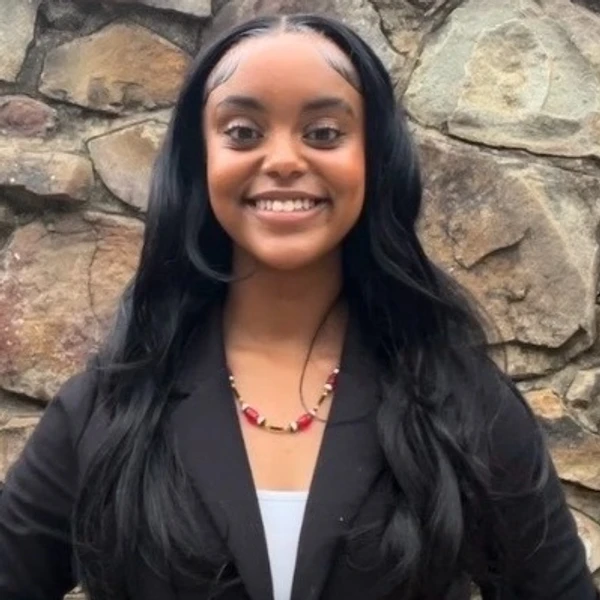
I am the daughter of Ethiopian immigrants who arrived in the United States with no connections, no community, and no safety net. We settled in Arkansas, where we were often the only Black family in many spaces. I did not meet another Ethiopian my age until college. Despite these challenges, my parents worked tirelessly to provide for us, my dad as a hospital aide and my mom working multiple jobs wherever she could. They taught me that opportunity is not given, but created. That lesson has shaped every step of my educational journey.
Today, I am studying Economics and Politics at Pomona College, with the goal of using my education to create practical, data-informed solutions that empower Black people, especially Black immigrants, in business and beyond. I believe deeply in access, visibility, and self-determination. For too long, Black entrepreneurs and professionals have navigated systems not built for us. I want to change that.
My focus is on economic empowerment through technology and community-rooted resources. This summer, I am conducting independent research on the economic integration of Ethiopian immigrants in the United States. I am interviewing immigrants across three major cities—Portland, Washington DC, and New York—to understand how they find work, navigate language barriers, and access opportunity. Through this research, I am building a foundation for a digital platform that will connect Black immigrants with employment resources, legal assistance, financial literacy tools, and culturally competent support systems.
Approximately 4.6 million Black people in the United States are immigrants, yet their unique challenges are often overlooked in conversations about equity. This platform will center the needs of Black immigrant entrepreneurs and workers, who often face compounded challenges including racial bias, lack of generational wealth, and limited professional networks. By providing accessible tools and information, I aim to close those gaps and help people build thriving careers and businesses, no matter where they start.
In the business world, access to capital, mentorship, and market information often determines success. That is why I plan to use my economics training to analyze systemic disparities and develop new models that support Black business growth, whether through targeted microloans, mentorship programs, or localized business hubs. I want to build networks that uplift Black excellence and create pathways where there were none before.
My education also equips me with the political lens to advocate for inclusive economic policies. I understand that entrepreneurship does not exist in a vacuum. It is shaped by policy, regulation, and institutional access. By combining my policy knowledge with business insights, I hope to be part of a generation that builds equitable economic ecosystems that empower Black business leaders.
Representation also matters. I am one of only three students from my graduating class in Arkansas to attend college out of state. I was the only Black student in many of my AP classes, in debate, and at Girls State. Still, I showed up. I led. I succeeded. I want Black students who come after me to see that they belong in boardrooms, start-ups, and research labs. They belong everywhere decisions are made.
Long term, I want to turn my research and platform into a nonprofit that not only supports Ethiopian immigrants but expands to serve the broader African and Black diasporic communities. The goal is not just access. It is ownership, leadership, and lasting impact.
I believe business can be a tool for justice. With my education, I intend to use it that way.