Hobbies and interests
Artificial Intelligence
Business And Entrepreneurship
Coding And Computer Science
Stocks And Investing
Athletic Training
Fashion
Photography and Photo Editing
Reading
Academic
Action
Fantasy
Thriller
Science Fiction
I read books multiple times per week
Rishith Ravi
1x
Nominee2x
Finalist
Rishith Ravi
1x
Nominee2x
FinalistBio
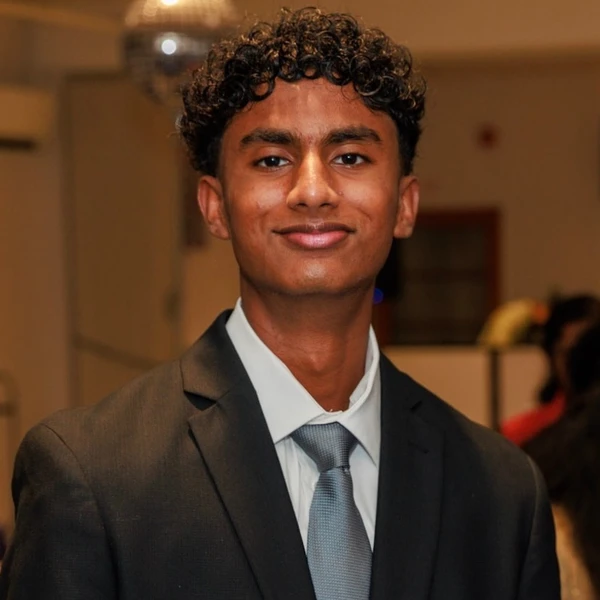
I'm Rishith, a high school senior from Massachusetts. I built Dream Safety, an AI-powered school threat detection system backed by Georgia Tech's Create-X program, after experiencing the fear of a lockdown firsthand. I also co-founded Assets for Aspirers, a nonprofit serving 450+ students, and spend my time between coding, Varsity Track, Tamil dance, and filming cool events like New York Fashion Week. I am also very active in my community, serving as the President of the Science National Honor Society (SNHS) and the Vice President of the Société Honoraire de Français (SHF). At my core, I'm passionate about using technology to protect communities and close gaps that shouldn't exist.
Education
Billerica Memorial High School
High SchoolMiscellaneous
Desired degree level:
Bachelor's degree program
Majors of interest:
- Computer Science
- Business Administration, Management and Operations
- Finance and Financial Management Services
- Entrepreneurial and Small Business Operations
Career
Dream career field:
Computer Software
Dream career goals:
CEO
Event Videographer & Live-Streaming Lead
Rare Event Productions2024 – Present2 yearsCEO, Founder
Dream Safety2024 – Present2 yearsSoftware Engineering Intern
Innovate Loop2022 – Present4 years
Sports
Track & Field
Varsity2022 – Present4 years
Awards
- 5th Place at D3 State Relays '25
Public services
Volunteering
Assets for Aspirers — Co-Founder & Media/Outreach Director2021 – 2024
Future Interests
Volunteering
Philanthropy
Entrepreneurship
K-POP Fan No-Essay Scholarship
John Woolley Memorial Scholarship
This past summer, I hiked 103 miles across New England. Somewhere on Mt. Monadnock, the tree line disappeared and it was just rock and wind and nothing else. I stood there for a while, not thinking about anything. No code to debug, no emails to send, no models to fix. Just standing there. That doesn't happen much for me.
Most of my time is spent building things. I am a high school senior pursuing computer science who built an AI system called Dream Safety that detects firearms through school security cameras. I've spent eighteen months staring at screens, debugging models at 2 AM, and pitching to people who are hard to convince. I love it. But the version of me that works best is the one who occasionally closes the laptop and goes outside.
That's not something I always understood. I used to think being productive meant never stopping. Then I started noticing that my best ideas didn't come from grinding longer. They came after hikes, after sitting on my porch watching nothing in particular, after drives with the windows down and no destination. Nature doesn't ask you to optimize anything. It just exists. And being around that, even briefly, resets something in my brain that screens can't.
I'm also a photographer, though not the traditional kind. I started filming at New York Fashion Week, covering South Asian designers at the Silk Road showcase. Seven cameras, a team of students, a live runway. That experience taught me how to see things. Not just frame a shot, but notice what matters in a scene. The way light hits fabric. The expression on a designer's face right before the show starts. The small details that tell the bigger story.
I bring that same eye outdoors. When I hiked this summer, I wasn't just walking. I was noticing how morning fog sits differently in valleys versus ridgelines. How the color of a trail changes after rain. I don't always have a camera with me, but I'm always composing shots in my head. It's become how I process the world.
I do track and field too, specifically long jump. It’s taught me so much, such as that the best performances come from trusting your preparation and not overthinking in the moment. That applies to everything. Hiking, photography, and engineering. The good stuff happens when you stop forcing it.
My family's kitchen has always been a portal. My mom cooks dishes from Chennai, Sichuan, Germany, anywhere she's curious about. Growing up in that house taught me that the world is worth paying attention to, whether that means traveling somewhere new or just noticing what's already around you.
I would use this scholarship to help cover tuition as I pursue computer science in college. The financial relief would let me focus on building technology that protects communities while continuing to explore the outdoors and creative projects that keep me grounded. Equipment costs for both photography and computing add up fast, and this scholarship would make it easier to invest in both.
John Woolley's life was about being fully present, whether on a tennis court, behind a camera, or out in nature. I aspire to live the same way. Some days that means debugging code until 3 AM. Other days, it means standing on a mountain doing nothing at all. I want to do it all.
Simon Strong Scholarship
During COVID, schools shut down overnight. If I felt behind with WiFi and a quiet room, I couldn't stop thinking about kids without either. So in August 2021, three other students and I started Assets for Aspirers, a nonprofit to get school supplies to underserved students. We raised money through school drives, gathered textbooks, desks, calculators, everything we thought kids needed to keep up from home.
Then I started emailing. Shelters, school districts, community organizations. I wrote what I thought were thoughtful, professional pitches explaining what we had to offer and why they should partner with us.
150 emails. Zero responses.
Not a single one. Not even a "no thanks." Just silence.
At first I blamed them. They're too busy. They don't check email. They don't care. I kept sending the same message, tweaking a word here and there, convinced that volume would eventually break through. It didn't.
One night, probably around email 130, I sat at my desk and actually reread what I'd been sending. And I cringed. Hard. Every message was the same: here's what we have, here's why you need it, here's how we'll fix your problems. I was a teenager who required bathroom passes to leave class telling overwhelmed professionals how to run their organizations. Every email radiated a confidence I hadn't earned about problems I didn't fully understand.
I tried to imagine being on the other end. You're a shelter director. You're understaffed, underfunded, fielding half-baked offers from well-meaning strangers every week. And then some teenager emails you a three-paragraph pitch about how he's going to solve educational inequity with a box of books. You'd delete it too.
That realization hurt more than the silence did. Because the problem wasn't that nobody cared about what we were doing. The problem was me. I'd been so focused on what I wanted to give that I never once asked what they actually needed.
My 151st email was completely different. No pitch. No list of supplies. No assumptions. I just asked for 15 minutes to learn about their situation and what kind of support would actually help.
Harvard Homeless Mission replied within minutes. After months of nothing, minutes.
That call was supposed to be 15 minutes. It went over an hour and a half. The director explained what I never would have guessed on my own. Shelters needed flexible, easy-to-distribute resources because staff turnover was constant and complicated programs fell apart within weeks. Trust with families mattered more than the quality of donations.
We redesigned everything. Instead of pre-packaged kits we thought were helpful, we shifted to modular resources shelters could actually deploy on their own terms. We ended up distributing 450+ books, desks, and calculators to students in Massachusetts and India, and supported over 200 kids.
That experience shaped everything about how I operate now. When I later built Dream Safety, an AI system to detect school gun threats, I didn't assume I knew what schools needed. I went to my principal first and asked. His pushback completely changed the design. That instinct to listen before building came directly from email 151.
My advice to anyone facing similar adversity is this: when nothing is working, resist the urge to just push harder. Sometimes the obstacle isn't effort. It's perspective. The hardest thing I've ever done wasn't sending 150 emails. It was rereading them and admitting the problem was me. But that honesty is what turned months of silence into a partnership that actually helped people. Stop assuming. Start asking. The answers are usually on the other side of a question you haven't thought to ask yet.
Lyndsey Scott Coding+ Scholarship
My computer science goal is specific: build technology that protects communities and is something they can actually afford.
Firearms are the leading killer of children and teens in America. After a lockdown at my school, I started building Dream Safety, an AI system that detects firearms through existing security cameras. I taught myself PyTorch from YouTube, collected 30,000 training images, and after eighteen months, hit 94% accuracy. Two schools pilot-tested it. Georgia Tech's Create-X program backed us with a $5,000 grant and $150,000 in services. But it still runs on hardware that costs more than some Title I schools spend on technology in an entire year. Figuring out how to crush that $2,000 system into something a school can buy for $200, through model compression, quantization, and edge inference, is the technical problem I want to spend the next four years solving.
But the more I've worked on this, the more I've realized that the engineering is half the problem.
When I pitched Dream Safety to my principal, he didn't care about 94% accuracy. He cared about the kid who got falsely flagged and pulled out of class by police. That conversation completely changed how I build. We redesigned the system together: alerts go to trained administrators first, not 911. Human verification before any escalation. The technical specs didn't convince him. Talking about real kids did.
And then there's my grandmother. I built her a plant disease detection app from 8,000 miles away. Accurate, fast, clean interface. She opened it in her garden in Chennai, stared at "87% confidence of fungal pathogen," and never used it again. She didn't need a probability. She needed someone to tell her, in Tamil, whether to water less or buy fungicide. I'd built something technically impressive that was completely useless to the one person it was for.
Each of these failures taught me the same lesson: building isn't the same as helping.
So my non-computer science goal is understanding why good technology fails to reach the people who need it most, and becoming someone who can change that. I want to study technology policy and institutional decision-making: the specific mechanisms that determine whether a school board adopts a safety system, whether a hospital allocates budget for AI triage, whether a transit authority upgrades infrastructure in a low-income corridor or a wealthy one. The technology already exists for all of these. The breakdown happens in procurement meetings, risk assessments, and funding cycles, rooms where engineers are rarely present, and community voices are even rarer. I want to be in those rooms.
The combination is where I want to live. Not just building tools, but shaping the decisions about whether those tools ever get used. Dream Safety started because I was scared in a bathroom during a lockdown. It keeps going because the gap between those who have safety and those who don't isn't a technology problem. It's a systems problem. And closing it requires someone who can write the code and sit at the table where the budget gets decided.