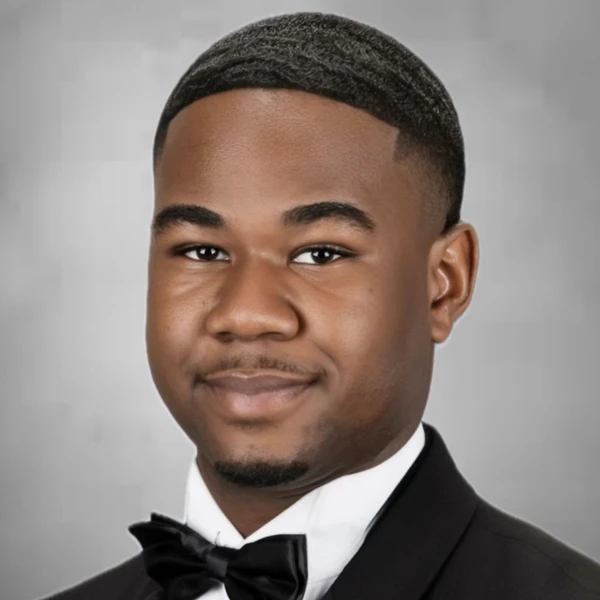
user profile avatar

Re’Shad Higgins

1x

Finalist

1x

Winner

General information

Location
Atlanta, GA
Gender
Male
US Citizenship
US Citizen

Hobbies & Interests

  • Church
  • Beach
  • Concerts
  • Football
  • Mentoring
  • Public Speaking
  • Law
  • Student Council or Student Government

Bio

My name is Re’Shad Higgins, and I am a sophomore at Morehouse College majoring in Political Science with a minor in Sociology. Growing up in South Florida, I learned the importance of representation, mentorship, and creating opportunities for underserved communities. Throughout my journey, I have remained committed to leadership rooted in service and advocacy. As a Freshman Class Senator, I advocated for student needs and worked to improve the Morehouse experience. I have since expanded my involvement through the Student Government Association, Black Youth Empowerment Network, and NAACP, strengthening my commitment to civic engagement and community development. My passion for public policy and social justice extends beyond campus. Through the Bullard Center for Environmental and Climate Justice, I researched the effects of AI data centers on residential communities, with a focus on public health and environmental equity. My team earned first-place recognition for our research. As a Political Organizer with Students for Voting Justice, I also work to engage young voters and encourage civic participation. Looking ahead, I aspire to pursue a legal education and a career in government and public service, helping shape policies that address inequities and expand opportunity. I believe leadership is not defined by the positions we hold, but by the impact we make and the people we serve.

Education

Morehouse College

Bachelor's degree program

2025 – 2029

Majors:
  • Political Science and Government

Miscellaneous

Desired degree level:
Doctoral degree program (PhD, MD, JD, etc.)
Graduate schools of interest:
Columbia University in the City of New York
Majors of interest:
Law
Desired degree modality:
In-Person
Medical school interest:
No
English as first language:
Yes
Homeschooled:
No

Career

  • Freshman Class Senator

    Civic & Social Organization · Morehouse College Student Government Association

    Jan 2025 – Jan 2026

  • Chartered Chapter Member (Morehouse College)

    Civic & Social Organization · Black Youth Empowerment Network

    Jan 2026 – Present

  • Student Ambassador

    Program Development · Morehouse College Career Services and Development

    Jan 2026 – Present

  • Student Ambassador

    Staffing and Recruiting · Morehouse College Office of Admissions

    Jan 2026 – Present

  • Research Intern

    Public Policy · Bullard Center for Environmental & Climate Justice

    Jan 2026 – Jan 2026

  • Political Organizer

    Political Organization · Students for Voting Justice

    Jan 2026 – Present

  • Team Member

    Food & Beverages · Chick-Fil-A

    Jan 2022 – Jan 2026

  • Golf Services Team Lead

    Entertainment · TopGolf

    Jan 2023 – Jan 2025

Miscellaneous

Dream career field:
Law Practice
Dream career goals:
Congressman
Work experience:
4 years
Has nursing license:
No
Leadership experience:
Yes

Future Interests

  • Advocacy
  • Politics
  • Volunteering
  • Entrepreneurship
RonranGlee Literary Scholarship
The Problem of Evil Richard Swinburne "Sometimes the problem with great evils is not the number of sufferers but the degree of the suffering. If there is a God, is not the suffering which he imposes or allows others to impose sometimes too intense for the good which it makes possible? But evils wouldn’t matter so much if only the lesser evils occurred, and so it wouldn’t matter so much if we ignored them. By allowing the more serious evils to occur God forces on people who have allowed themselves to live easy lives (and so become insensitive to more ordinary moral demands) the hard choices which alone (given their moral torpor) will allow them to begin to become holy people rather than sink into a subhuman selfishness. So many ordinary selfish people who see evils of serious torture or very painful disease are moved to make those life-changing choices (which no ordinary evils would move them to make), choices by which they eventually become saints. What the objector is asking for is, yes, there should be diseases, but not ones which maim or kill; accidents which incapacitate people for a year or two but not for life; we should be able to cause each other pain or not help each other to acquire knowledge, but not to damage our own or each other’s characters. And our influence should be limited to those with whom we come into contact; there should be no possibility of influencing for good or ill distant generations. And most of our beliefs about how to cause effects, good or evil, should be beliefs with which we would be born. Such a world would be a toy- world; a world where things matter, but not very much; where we can choose and our choices can make a small difference, but the real choices remain God’s. The objector is asking that God should not be willing to be generous and trust us with his world, and not give us occasional opportunities to show ourselves at our heroic best." What if the existence of a world without evil also meant the end of great acts of good? In The Problem of Evil, Richard Swinburne challenges the assumption that a good God must put a stop to every case of pain and wrongdoing. Also, in his “toy-world” example, Swinburne puts forward that God’s tolerance of us making significant choices is not a sign of God disinterest, but of his faith in us. I see his argument as saying that the true value of free will is not in the fact that we are able to do as we please, but in the choice we have to do what is right when we have the freedom to do otherwise. Swinburne’s use of the word “toy” is very telling. A toy is a representation of something real, but it also has limitations that the real thing does not. A child may play with a toy car, which he can push around at will, but in the end, he has no control over where a real car goes in the world. Also, in the world Swinburne presents, we see humans making choices that appear to be free will in action, but in reality, God is the one who has control over what truly counts. While this may present a more secure world, our freedom in it would be in name only. We may play a role in life’s events but never really be charged with the responsibility of truly shaping them. What I am most drawn to in Swinburne’s argument is that God has to give up some control over human actions for us to have free will, which is what gives our choices true value. This does not mean God gives up power, but that He chooses at times not to exercise it. There is a great beauty in a God who has the power to stop wrongdoing yet still puts the choice out there for us to do good. It suggests that moral character is not a given. Instead, it is something that is developed through the choices we make, which in turn reveal who we are when the choice to do good is available to us. But I do think that this freedom of ours also brings with it a responsibility we ignore at our own peril. As we go about making decisions that may hurt others, we must at the same time be in the business of protecting, serving, and bettering their lives. We can’t trumpet our freedom and at the same time turn a blind eye to what it does to others. To me, what Swinburne is saying goes beyond theology and becomes a guide for how we should live. In leadership, in relationships, and in the little interactions of daily life, the choices we make have far-reaching effects. Also, it is easy to mistake the fact that we have the ability to influence another’s life for a green light to act without thought. In Swinburne’s work, I see a complex issue. The suffering that results from human free will at times does not affect the one who made the wrong choice. At other times, the innocent bear the brunt of choices that were never really theirs to make. This, in turn, puts greater importance on the issue of responsibility that free will brings with it. If God has given us the power to mold our world, we must take that very seriously. Our freedom isn’t only in what we do for ourselves, but also in how we factor in the ways our choices affect others’ lives. In the end, it is my take that Swinburne’s “toy-world” challenges us to rethink what we as a society consider freedom. A life that does not include the option of failure may bring comfort, but it also does not call for the same courage, integrity, or accountability. God did not make goodness a given. What He did was make it available, and in that, made us responsible for our choices. Perhaps the greatest proof of our free will is not that we have the choice to do what is wrong, but that we as free agents still choose what is right.
Sherman S. Howard Legacy Foundation Scholarship
My time at the 15th Street Church of Christ has formed not only my approach to community service, but also who I am today. My connection to the church began with Pastor Brian Campbell who is also the founder of ADIMU Men of Excellence, and he has been a mentor of mine since I was in 7th grade. At that young age I didn’t fully grasp the impact that mentorship, faith and service would have on my life. Over the years however Pastor Campbell played a role in my personal and professional growth also in my relationship with God. Through ADIMU Men of Excellence I learned that to be a successful young man is about more than academic achievement. It is about character, integrity, leadership and using what you have been given to help someone else. As I grew within the organization I went from a mentee to eventually the President and I served in that capacity for 2 years after being elected to serve as Mr.Adimu, making me the official student representative for the organization. That transition was huge for me as I was able to pay forward some of what I had received. Whether through mentoring, community service, or leadership roles I began to see service as a responsibility instead of a requirement. My faith plays a large role in that. A key value I live by is, “To whom much is given much is expected.” I have been fortune enough of having mentors, great educational and leadership opportunities thanks to people that believed in me before I proved to myself what I was truly capable of. Out of that comes a responsibility to create opportunities for others and to advocate for the communities around me, and those values which was built in high school followed me to Morehouse College. Today service is at the core of what I do in most of the roles I play out, from speaking for the student body, to helping prospective students and their families, to supporting professional development of students, to encouraging civic action, to advocacy for issues that affect under served communities. Pastor Campbell’s mentorship and my tie into the 15th Street Church of Christ taught me that faith is to be lived out in how we treat and serve others. My village also showed me how one person can transform another’s life through investment of time and energy. That I experienced first hand from the age of 12 and it has shaped the man I am today. As I go through my educational journey and into my career I hope to pass that on and use my education, leadership experience and my faith to serve others as I was served.
HBCU Legacy & Excellence Scholarship
Attending Morehouse College I’ve learned that what it means to be a part of an HBCU is far beyond just getting a degree. It is about becoming a part of a legacy. Each day I am surrounded by the story of Black leaders which used their education to break barriers, create chances, and serve over looked communities. That environment has pushed me to think more seriously about the type of man and leader I want to be. Morehouse has reinforced my view that leadership isn’t just about what position you hold, it’s in how you use that position to create opportunities for others. The greatest impact my HBCU experience has been through service and student leadership. In my freshman year I took on the role of a Freshman Class Senator in the Student Government Association. That role gave me a stage to work on legislation policies which addressed issues like safety, facilities and student connection. In addition I serve as an official Morehouse College Admissions Student Ambassador and Career Services Ambassador. Through those roles I have come to see that leadership plays out differently based on the situation. At times it is about speaking out for hundreds of students, at other times it might be advocating for opportunities that support their professional growth and development. Beyond that my Morehouse legacy grows beyond the campus gates. This summer I was fortunate enough to land an internship at the Bullard Center for Environmental and Climate Justice. Working with students from HBCUs all over the country I was exposed to communities that are dealing with environmental injustice first hand. I looked at issues of air pollution, industrial growth, public health, and the siting of facilities in under served communities. Our team did in depth study of the development of AI data centers in residential areas and what policies may protect residents from those environmental impacts. That experience showed me the power of research, policy, and community advocacy to bring about change. Those experiences have molded my interest in sociology, urban policy, environmental justice, law and public service. I want a career in what determines the look of our communities, which resources go where, which voices are heard and who is protected. Whether I am in policy, law, government or community development I want to push for affordable housing, environmental justice, economic opportunity and equitable access to resources. I wish to carry on the HBCU tradition of creating opportunities. Beyond myself I’ve had the support of mentors, teachers, and youth development organizations. All people and spaces who believed in me and what I didn’t see within myself and thus gave me chance to grow. I think it’s my duty to pass that on to the next. At Morehouse we are learn what it means to achieve for yourself and also open doors for others. In my career I aim to leave each community I am a part of with more chances, better representation, and a greater access for the next generation.
Re’Shad Higgins Student Profile | Bold.org