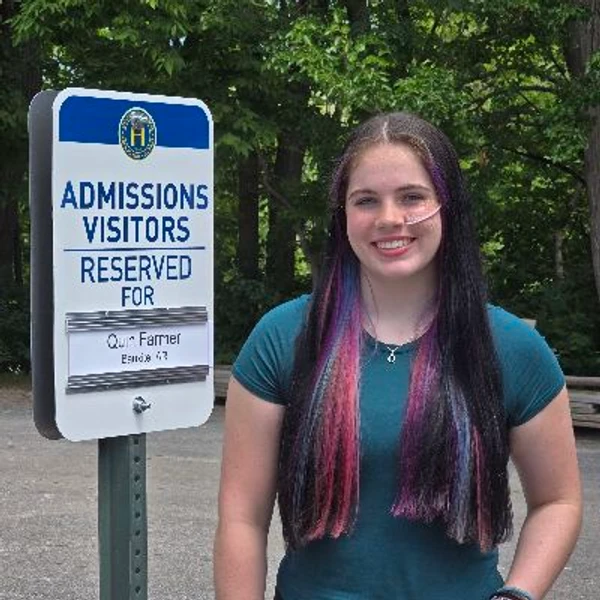
Gender
Female
Ethnicity
Caucasian
Hobbies and interests
Reading
Sports
Pet Care
Guitar
Electric Guitar
Volleyball
Softball
Politics and Political Science
Community Service And Volunteering
Advocacy And Activism
Animals
American Sign Language (ASL)
Anatomy
Crafting
Drawing And Illustration
Gaming
Health Sciences
Ice Hockey
Ice Skating
Jiu Jitsu
Medicine
Neuroscience
Psychology
Research
Science
Social Justice
Social Media
Volunteering
Stamp Collecting
Athletic Training
Business And Entrepreneurship
Martial Arts
Reading
Fantasy
Action
Book Club
Novels
Adult Fiction
Romance
Young Adult
I read books daily
US CITIZENSHIP
US Citizen
LOW INCOME STUDENT
No
FIRST GENERATION STUDENT
No
Quinlyn Farmer
1x
Finalist
Quinlyn Farmer
1x
FinalistBio
I am a high school senior who does not sit on the sidelines. Whether I am diving across a volleyball court with a feeding tube, maintaining a 4.0 GPA in the Honors Pathway, working up to 40 hours a week, or advocating for young patients through the Arkansas Children’s Hospital Youth Advisory Council, I approach every challenge with determination, compassion, and purpose.
As a competitive volleyball player, I have refused to allow significant medical challenges to take away the sport I love. I continue to practice, compete, dive for every ball, and contribute wherever my team needs me. That same determination carries into every part of my life as I balance academics, athletics, employment, and service while preparing for my future.
My experiences as a patient have given me a perspective on healthcare that cannot be learned from a textbook. I know what it feels like to face uncertainty, search for answers, and need someone who truly listens. Instead of allowing those experiences to define my limitations, I have allowed them to shape my purpose.
I plan to pursue a pre-medical path with the goal of becoming a physician. I want to combine science with compassion, advocate for patients whose answers are not always simple, and make a meaningful difference in their lives. My story is not simply about overcoming adversity. It is about continuing to show up, work hard, serve others, and build my future from the very challenges that could have held me back.
Education
Acellus Academy
High SchoolGPA:
4
Miscellaneous
Desired degree level:
Bachelor's degree program
Majors of interest:
- Neurobiology and Neurosciences
- Medicine
- Psychology, General
- Biological and Biomedical Sciences, Other
- Biological and Physical Sciences
- Biopsychology
- Health/Medical Preparatory Programs
Career
Dream career field:
- Medical Practice
Dream career goals:
Surgeon
Cashier
Rock Island General Store2026 – Present8 months
Sports
Softball
Club2011 – 202312 years
Awards
- World Series Undefeated Many State championships
Mixed Martial Arts
Club2017 – 20203 years
Awards
- 3 time AGF National Champion AR State Champ OK State Champ
Volleyball
Club2018 – Present8 years
Research
Medicine
Pain Pals Snapchat group — Owner of group2025 – 2025
Arts
Cincinnati Children's Hospital
Drawing2025 – 2025
Public services
Volunteering
AR Children's Hospital — Drawing and creating happy cards for the sick kids2025 – PresentVolunteering
Arkansas Children's Hospital — Youth Advisory Council2025 – Present
Future Interests
Advocacy
Politics
Volunteering
Philanthropy
Entrepreneurship
Learner Mental Health Empowerment for Health Students Scholarship
Mental health is important to me because I have learned that you cannot always tell what someone is dealing with just by looking at them. As a student, athlete, employee, and someone living with chronic illness, I know how easy it can be to look like you are handling everything while privately feeling overwhelmed.
Students today are expected to balance academics, activities, jobs, relationships, family responsibilities, college decisions, and expectations about their future. Sometimes there is so much focus on achievement that asking for help can feel like admitting you cannot handle it. I think that is one of the most damaging ideas surrounding mental health.
My own experiences have changed the way I see this. I have spent years dealing with extremely painful medical conditions, procedures, hospitalizations, and uncertainty about my health. There have been times when I have had to complete schoolwork from a hospital or adjust my entire routine around my health. At the same time, I have maintained a 4.0 GPA, worked, played competitive volleyball, and continued planning for college and medical school.
I am proud of those accomplishments, but I also know that constantly being “strong” can create its own pressure. People sometimes assume that if someone is still succeeding, they must be doing fine. I have learned that those two things can exist at the same time. Someone can be successful and still need support.
That understanding affects how I advocate for mental health in my community. I try to be someone people can talk to without immediately feeling judged or being told how they should feel. Sometimes advocacy is not a huge campaign. It is noticing when someone seems different, checking on a teammate, listening to a friend, or making it clear that asking for help is normal.
I also serve on the Arkansas Children’s Hospital Youth Advisory Council, where I have the opportunity to help represent the perspectives of young patients. Being involved in healthcare has shown me how closely physical and mental health are connected. Young people dealing with serious or chronic medical conditions are still students, friends, siblings, athletes, and teenagers. Their emotional well-being deserves attention along with their physical symptoms.
I have also created drawings and paintings with encouraging messages for hospitalized patients. It may seem like a small thing, but hospitals can be lonely and frightening, especially for young people. I wanted patients to receive something that reminded them another person was thinking about them.
As I move into college and eventually medicine, I want mental health advocacy to remain part of who I am. My goal is to become a surgeon, and I want to be a physician who remembers that the person in front of me is more than a diagnosis or test result. Listening to patients, taking their concerns seriously, and recognizing when they are struggling emotionally should be part of providing good medical care.
To me, mental health advocacy begins with making it acceptable to say, “I am not okay right now.” Students should not have to reach a crisis before someone notices they need support. We can create healthier communities simply by paying attention, listening, and treating mental health with the same seriousness and compassion we give physical health. Sometimes the most important thing we can do for another person is make sure they know they do not have to handle everything alone.
Joe Gilroy "Plan Your Work, Work Your Plan" Scholarship
My biggest long-term goal is to become a surgeon. I know that is not a goal I can reach quickly, so I have tried to think about it in steps instead of only focusing on the final result. My plan is to finish high school strong, attend a college where I can prepare well for medical school, continue playing volleyball if possible, complete medical school, and eventually match into a surgical residency.
Right now, my first goal is graduating in 2027 from the Honors Pathway at Acellus Academy with my 4.0 GPA intact. Because I attend school online, I have learned to manage my own schedule and stay motivated without someone constantly reminding me what needs to be done. I also work around 40 hours a week, play competitive volleyball, and participate in activities such as the Arkansas Children’s Hospital Youth Advisory Council. Learning to balance all of those responsibilities is already helping prepare me for the workload I know I will face later.
My next step is choosing the right college. I plan to study biology, neuroscience, or another strong pre-medical field. The most important resources for me will be professors who are accessible, strong academic support, pre-med advising, opportunities for research and clinical experience, and preparation for the MCAT. I also want a school where I can build relationships with professors who will eventually know me well enough to write meaningful medical school recommendations.
Finances are a major part of my plan. A four-year college education can easily cost $30,000 to $70,000 or more per year before financial aid, and medical school can add another $200,000 or more. Because of that, I am approaching college as both an academic decision and a financial one. I am applying for merit aid and outside scholarships, comparing financial aid packages, and saving money from my job. I would like to keep my undergraduate debt as low as possible because I know medical school will be expensive. Even reducing college costs by $5,000 or $10,000 per year could make a major difference over four years.
During college, my plan is to complete my science prerequisites, maintain a strong GPA, prepare for and take the MCAT, participate in research or clinical experiences, continue volunteering, and shadow physicians whenever possible. I have already had opportunities through programs such as MASH and operating-room shadowing, and those experiences have made me even more certain that medicine is where I belong.
I also understand that there can be more than one path to the same goal. If I am not accepted to medical school on my first attempt, I could take a gap year to strengthen my application through research, clinical work, additional coursework, or MCAT preparation. If my exact undergraduate major changes, that is also okay as long as I complete the medical school prerequisites and continue moving forward.
One part of my plan that I cannot ignore is my health. I live with chronic medical conditions and have had to learn how to continue pursuing goals while dealing with appointments, procedures, hospitalizations, and a feeding tube. Because of that, I will need a college with strong disability support and access to appropriate medical care. I do not consider that a reason to lower my goals. I consider it something I have to plan for carefully.
There will probably be unexpected changes along the way, but my plan is to keep adjusting without changing the goal. I want to become the kind of surgeon who not only understands the science, but also listens to patients, takes complicated symptoms seriously, and keeps looking for answers.
Strides 4 Gianluca Scholarship
I do not remember what it feels like to live in a body that does not require constant thought. I think about joint stability, my heart rate, whether my stomach will tolerate nutrition, whether someone brushing against my arm will cause unbearable pain, and whether the tube taped across my face will work the way it is supposed to. Disability affects nearly every part of my life, but I refuse to allow it to decide what my life will become.
I have always been an athlete and competed in MMA and Brazilian Jiu-Jitsu. By twelve, I was a three-time national champion, an Absolute division national silver medalist, and a multi-state champion. I also played high-level softball for teams in Arkansas, Oklahoma, and Tennessee, winning state championships and a World Series. Sports were a huge part of who I was.
Then everything changed.
What started with gallbladder problems became SOD Type I. Eventually, I was diagnosed with hEDS and POTS. Because hEDS causes joint instability, continuing MMA and BJJ became too dangerous. I had to walk away from a sport I loved.
But I still had softball and volleyball.
Then a volleyball injury to my thumb triggered Complex Regional Pain Syndrome. CRPS is sometimes called the “suicide disease” because of the severity and relentlessness of the pain. Mine eventually spread to my shoulder. Touch that should be insignificant is excruciating. Even breathing on my arm hurts. CRPS took softball from me. I had been a home-run hitter, but the vibration of the bat became unbearable. I could no longer spin pitches without extreme pain. A sport I once imagined playing in college was suddenly gone.
But I still had volleyball.
Then there was an ileus, and I never returned to eating normally. I eventually required a feeding tube, followed by months of nutrition delivered directly into my bloodstream. My medical picture became increasingly complicated with Superior Mesenteric Artery Syndrome, Nutcracker Syndrome, chronic pancreatitis, and fatty liver disease. I spent approximately four months hospitalized and about eight months dependent on TPN. At times, simply receiving enough nutrition became a medical challenge. One of my biggest goals was getting off TPN.
Because I wanted to play volleyball.
During all of this, I maintained a 4.0 GPA in advanced coursework. I worked. I volunteered with Arkansas Children’s Hospital and served on its Youth Advisory Council. And I returned to volleyball with a feeding tube taped prominently across my face. The tube is impossible to hide. It is simply part of how I compete now. Unfortunately, not everyone saw it that way.
I have experienced coaches and players making decisions about what they believed was best for me because of my medical condition rather than judging me by how I was actually playing. I was removed from a team because of concerns related to my feeding tube and compression pain, not because I could not perform. So I found another team.
The very next weekend, I was playing in the same tournament as the team that had removed me. I still had the same illnesses, the same tube across my face, and the same pain. The difference was that I was surrounded by people willing to let my performance determine whether I belonged on the court. We went undefeated in the gold bracket at regionals, and along the way, we faced the team that had kicked me off. We beat them.
That moment meant more than winning a volleyball match. A week earlier, other people had decided that my medical condition made me unable to play. Seven days later, I was standing on the other side of the net showing that I was completely capable of competing. I did not need anyone to make decisions for me. That experience taught me one of the most important lessons I have learned about disability. Sometimes the greatest barrier is not what your body cannot do.
Sometimes it is what other people assume you cannot do.
There are limitations I have had to accept. Determination cannot make every physical limitation disappear, and sometimes my body gets the final say. But there is a difference between my body telling me I cannot safely do something and someone else deciding that for me. That distinction shapes what diversity, equity, inclusion, and accessibility mean to me. Accessibility is not lowering expectations. Inclusion is not pretending disability does not exist. DEI is creating an environment where people with disabilities have the opportunity and support to demonstrate what they can actually do.
I plan to carry that perspective into college. I will advocate for accessible classrooms, athletic programs, and campus organizations while challenging the quieter assumptions surrounding disability. Not every disability looks the same. Some people need accommodations or medical equipment. Some live with severe pain while appearing completely fine. None of those things determine their intelligence, ambition, work ethic, or potential.
Today, I am talking with college volleyball coaches with my feeding tube clearly visible in my recruiting photographs and videos, and I have received offers to continue playing volleyball in college. After having people decide that I no longer belonged on the court, having college coaches evaluate me as an athlete instead of a diagnosis means more than they probably realize.
Advocacy, however, is about more than my own opportunities. I volunteer at my local children’s hospital, advising staff about issues affecting teens and patients. I create positive cards that hospital staff distribute to patients. I also created and manage Pain Pals, an online community for teens like me navigating lives in bodies that seem determined to hurt them. I know what it feels like to need someone else to understand, and now I get to be that person. Sometimes advocacy is speaking up, pushing for accessibility, or challenging an assumption. Sometimes it is simply offering a hand to someone who needs to know they are not alone.
My experiences have also shaped what I want to do professionally. I plan to pursue a pre-med pathway and ultimately become a physician, with a strong interest in surgery or anesthesiology. I have spent enough of my life in hospitals to understand how vulnerable patients can feel when their symptoms are complicated, unusual, or difficult to explain. I know how much it matters when someone listens, asks another question, and believes that a patient understands their own body. I want to become that person for someone else.
Disability has taken things from me. It changed how I eat, sleep, travel, compete, and move through everyday life. It has given me pain I would never have chosen for even the cruelest of people and forced me to fight.
But it has also given me a reason to fight for people whose abilities are too often judged by their diagnoses, pain, or medical equipment. I have learned how to advocate for myself and others, and above all, that inclusion can change someone’s life simply by giving them the chance to show what they can do.
I could not choose the body I was given, but I can choose what I do with the life I build around it.
Taylor Swift Fan Scholarship
Of all of Taylor Swift's performances, the one I find most moving is her performance of "Marjorie" during The Eras Tour.
At first glance, it is a beautifully written song about remembering a grandmother. But watching Taylor perform it in front of tens of thousands of people transforms it into something much larger. As the stadium lights illuminate the audience and her grandmother's operatic vocals echo through the speakers, the performance becomes a reminder that the people we love continue to shape us long after they are gone. It is both deeply personal and universally relatable.
What moves me most is the vulnerability. Taylor could have chosen to present only polished perfection on stage, but instead she shares grief, love, regret, and gratitude with millions of strangers. In a world where public figures are often expected to appear flawless, she demonstrates that strength and vulnerability can exist together. I think that is one of the reasons so many people connect with her music.
That performance resonates with me because I have learned that some of life's greatest lessons come through experiences we would never choose. Living with multiple rare medical conditions has changed nearly every aspect of my life. I have spent more time in hospitals than I ever imagined, and there have been moments when I mourned the loss of the life I thought I would have. Like Taylor's performance, those experiences have taught me that grief is not only about losing people. Sometimes it is about letting go of expectations while discovering new purpose.
Watching "Marjorie" reminds me that our experiences, both joyful and painful, become part of who we are. They influence the way we treat others, the goals we pursue, and the legacy we hope to leave behind. My own experiences have strengthened my desire to become a physician because I know what it feels like to search for answers, to hope someone will listen, and to find comfort in people who genuinely care.
The performance also highlights something I admire about Taylor Swift beyond her music. Throughout her career, she has consistently found ways to turn personal stories into something that helps other people feel understood. Millions of fans hear her songs and realize they are not alone. That ability to create connection is powerful.
I hope to do something similar in my own career, although in a different way. As a future physician, I want patients to leave my office feeling heard, respected, and hopeful. I want them to know that their story matters and that someone is willing to keep searching for answers alongside them.
While "Marjorie" is about remembering one remarkable person, I think its message reaches much further. It reminds us to carry forward the wisdom, kindness, and love of those who have shaped us. More importantly, it challenges us to live in a way that leaves behind the same kind of legacy. That is what makes the performance unforgettable to me.
Olivia Rodrigo Fan Scholarship
One of the Olivia Rodrigo lyrics that resonates most with me is, "all I did was try my best." Those seven words capture a feeling I have experienced countless times throughout my life.
From the outside, people often see accomplishments. They see a 4.0 GPA, competitive volleyball, leadership roles, volunteer work, and my dream of becoming a physician. What they do not always see are the countless hospital visits, chronic pain, feeding tube, surgeries, and rare medical conditions that exist behind every achievement. They do not see the nights spent studying from a hospital bed or the practices where I showed up determined to contribute even when my body was fighting against me.
That lyric reminds me that sometimes our best effort is invisible to everyone else.
As an athlete, I was used to measuring success through improvement and competition. I loved pushing myself and seeing hard work pay off. When chronic illness became part of my life, those expectations changed overnight. There were days when simply getting out of bed required more determination than winning a match ever had. I had to learn that giving my best did not always mean setting a personal record. Sometimes it meant attending class despite pain, completing homework after medical appointments, or encouraging a teammate even when I wished I were on the court without limitations.
There were moments when it felt unfair. I questioned why hard work did not always produce the results I expected. I watched friends enjoy experiences that illness had taken from me, and I grieved the life I thought I would have. During those moments, Olivia Rodrigo's music reminded me that disappointment and frustration are part of being human. Feeling those emotions does not mean giving up. It means acknowledging them and continuing to move forward anyway.
Over time, my definition of success changed. Instead of focusing only on what I had lost, I began focusing on how I could use my experiences to help others. Through the Arkansas Children's Hospital Youth Advisory Council, I have worked to improve the healthcare experience for future patients. I founded Pain Pals to encourage young people living with chronic pain and remind them they are not alone. My experiences have also strengthened my desire to become a physician who listens carefully, values every patient, and never stops searching for answers.
Looking back, I realize that "trying my best" has never been about perfection. It has been about choosing perseverance over discouragement, hope over frustration, and compassion over bitterness. Those choices have shaped who I am far more than any diagnosis ever could.
When I hear that lyric, I do not think about failure. I think about resilience. I think about continuing to chase my goals, even when the path is far more difficult than I expected. Most importantly, I think about the person I am becoming, someone who has learned that doing your best is not measured by the obstacles you face but by the courage you show in facing them.
Elijah's Helping Hand Scholarship Award
For most of my life, my identity was built around movement. I was a competitive athlete who loved pushing myself to improve, whether on the volleyball court, in martial arts, or on the softball field. I thrived on setting goals, training hard, and discovering what my body was capable of accomplishing. I never imagined that one day my greatest challenge would simply be making it through the day.
Everything changed when I developed Complex Regional Pain Syndrome (CRPS), a condition often referred to as the "suicide disease" because of the relentless, severe pain it can cause. My right hand became so sensitive that even the lightest touch could feel unbearable. Pain spread into everyday tasks that most people never think twice about, including writing, getting dressed, or simply brushing against something. The life I had built around athletics and independence suddenly felt like it was slipping away.
The physical pain was only part of the battle. The emotional impact was just as overwhelming. I went from competing at a high level to wondering whether I would ever be able to do the things I loved again. Every new diagnosis seemed to take another piece of my future. Rare vascular compression disorders left me dependent on a feeding tube. Hospitalizations replaced practices. Medical appointments replaced tournaments. I grieved not only for the activities I had lost but also for the person I thought I was supposed to become.
Living with constant pain affects mental health in ways that are difficult to explain unless you have experienced it. Pain does not take breaks. It follows you into school, friendships, sleep, and every decision you make. There were days when it felt impossible to imagine a future that was not defined by hospitals and medical procedures. I learned that chronic pain is not simply a physical condition. It tests your resilience, your hope, and your identity.
What changed my perspective was realizing that while pain could change my circumstances, it did not have to determine my purpose.
Instead of allowing my experiences to isolate me, I began looking for ways to help others. Through the Arkansas Children's Hospital Youth Advisory Council, I have worked to improve the healthcare experience for other children and families. I founded Pain Pals to connect young people living with chronic pain so they would know they are not alone. My experiences have also strengthened my dream of becoming a physician. I want to care for patients who feel unheard, especially those with rare or misunderstood conditions, because I know how much it matters when someone continues searching for answers.
I still miss the life I had before chronic pain. I still miss the freedom of competing without limitations. But I have also gained something I could not have learned any other way: empathy. My experiences have taught me to listen more carefully, advocate more courageously, and appreciate victories that cannot be measured by a scoreboard.
Pain has changed my life, but it has not taken away my future. Instead, it has given me a deeper understanding of what it means to persevere and to serve others with compassion. Those lessons will stay with me long after the pain is gone, and they will shape the kind of physician and person I hope to become.
Michael Rudometkin Memorial Scholarship
Selflessness is often thought of as doing something extraordinary for someone else. I have learned that it is usually much quieter than that. It is showing up when it would be easier not to. It is using your own experiences to make someone else's burden a little lighter.
Living with chronic illness has given me countless opportunities to choose between focusing on my own circumstances or looking outward. While there have been days when my own pain felt overwhelming, I have discovered that helping others often gives me strength as well.
One of the most meaningful ways I serve others is through the Arkansas Children's Hospital Youth Advisory Council. As a patient, I have experienced firsthand how intimidating and isolating hospitals can feel. Through the council, I work alongside healthcare professionals to share the patient perspective and help improve the experience for other children and families. Knowing that my experiences may make another child's hospital stay less frightening reminds me that even difficult seasons can have purpose.
I also founded Pain Pals, a community that connects young people living with chronic pain. Chronic illness can be incredibly lonely, especially for teenagers who often feel like no one understands what they are going through. I wanted to create a place where people could encourage one another, celebrate victories that others might overlook, and remind each other that they are more than their diagnoses. Sometimes helping someone simply means listening, offering hope, or reminding them they are not alone.
Beyond organized service, I try to make kindness part of my everyday life. I have created handmade cards and artwork for patients and families at Arkansas Children's Hospital because I know how much a small act of encouragement can brighten an otherwise difficult day. Whether it is offering support to another patient, answering questions from families facing similar medical challenges, or simply taking time to encourage someone who is struggling, I believe compassion is demonstrated through consistent, intentional actions.
Volleyball has also taught me what selflessness looks like. Success is not measured by individual statistics but by doing whatever the team needs. Whether setting up a teammate for the winning point, diving for a ball that everyone else thought was lost, or encouraging someone after a mistake, I have learned that leadership begins with putting others before yourself. Those lessons extend far beyond the court.
Perhaps the greatest lesson I have learned is that selflessness is not about having an easy life that allows you to help others. It is about choosing to care even when life is difficult. My own experiences have taught me empathy that cannot be learned from a textbook. They have shown me the importance of listening, encouraging, and advocating for people who feel unheard.
As I pursue a career in medicine, I hope to continue living out that belief every day. Whether I am serving as a physician, mentoring another patient, or simply offering a listening ear, I want others to know they are seen, valued, and never alone. If my journey has taught me anything, it is that the greatest gift we can give another person is hope.
Science and Advocacy Scholarship
From the time I was old enough to answer the question, "What do you want to be when you grow up?" my answer never changed.
A doctor.
Every first day of school, while many of my classmates' dreams changed from year to year, mine stayed exactly the same. My fascination with science started long before I understood words like genetics, physiology, or pathology. For my tenth birthday, I didn't ask for the latest toy or video game. I asked for an MCAT prep book. I spent hours practicing with a suture kit, learning basic surgical knots, and even convinced my parents to buy me an IV practice kit complete with fake blood because I thought learning how medicine worked was simply fun.
My curiosity wasn't driven by grades or assignments. I genuinely wanted to understand the human body. I loved learning how organs worked together, why diseases developed, and how scientific discoveries could save lives. Long before I became a patient, I knew I wanted to spend my life caring for others through medicine.
That lifelong passion only deepened as I began living with rare medical conditions, including Ehlers-Danlos syndrome, Complex Regional Pain Syndrome, and rare vascular compression disorders. Science was no longer just something I loved to study. It became the key to understanding my own body. Rather than discouraging me, every challenge reinforced my desire to become a physician who never stops searching for answers.
What fascinates me most about science is its ability to solve puzzles that seem impossible. My medical journey taught me that the human body cannot always be understood by looking at one symptom or one diagnosis. It requires curiosity, critical thinking, collaboration, and the willingness to question assumptions. Those same qualities have inspired me to pursue science well beyond the classroom.
I spend countless hours reading medical journals, studying anatomy, reviewing genetics reports, and following new research on rare diseases. I have learned how to evaluate scientific evidence, compare research findings, and ask thoughtful questions instead of accepting easy answers. Science has shown me that progress happens because someone is willing to keep asking "why?"
My passion for science naturally became a passion for advocating for it. As a member of Arkansas Children's Hospital Youth Advisory Council, I have shared my experiences to help improve healthcare for future patients and their families. I also founded Pain Pals, a community where young people living with chronic pain can connect, encourage one another, and find reliable, evidence-based information. Whether speaking with other families or participating in online communities, I believe scientific knowledge should be accessible, understandable, and grounded in evidence.
When science is ignored, misunderstood, or replaced by misinformation, people suffer. Diagnoses are delayed, trust is lost, and opportunities for better outcomes disappear. That is why I believe advocating for science is just as important as discovering it. Knowledge only changes lives when it is shared with honesty, compassion, and integrity.
My dream has never changed since I was a little girl opening an MCAT book on my tenth birthday. I still want to become a doctor. The difference today is that I understand the responsibility that comes with that dream. I want to be the physician who combines scientific curiosity with empathy, helping patients find not only answers, but also hope.
Begin Again Foundation Scholarship
Before I was born, sepsis had already rewritten my family's future. My grandmother, who raised my father as a single mother, died from the infection that stole her life far too soon. I never had the chance to meet her, but I grew up knowing her through the stories my father shared and through the space her absence left behind.
Years later, my mother became critically ill with sepsis after complications from her lung disease. Watching the person who had always cared for me suddenly fighting for her own life was terrifying. Thankfully, she recovered, but our family never forgot how quickly sepsis can turn an ordinary day into a medical emergency.
Then it became part of my own journey.
Rare vascular compression disorders slowly stole my ability to eat. Every meal became painful, and my body continued to lose weight until nutrition through my digestive system was no longer enough to sustain me. To survive, I depended on total parenteral nutrition (TPN), delivered through a PICC line directly into my bloodstream.
Before I was discharged, one physician warned my family that, in their experience, I would likely develop sepsis within two weeks. Those words stayed with us. We did not leave the hospital simply hoping the TPN would nourish me. We left believing we were entering a race against an infection that had already devastated our family twice.
Every evening became a carefully choreographed routine. We washed our hands meticulously, disinfected every surface, scrubbed the PICC line hub, connected the tubing, monitored the infusion, and protected the sterile field with the understanding that one small mistake could allow bacteria direct access to my bloodstream. We learned sterile dressing changes, watched for redness or drainage, monitored my temperature, and treated every step with absolute precision. The goal was not simply to administer nutrition. It was to prevent the infection we had been warned was coming.
Fortunately, those predictions never became reality.
Through careful training from my healthcare team and unwavering diligence at home, I completed nearly a year of TPN without developing sepsis. That experience taught me that medicine is not only about treating disease. It is also about preventing it through education, partnership, and meticulous attention to detail.
Living with that responsibility gave me a profound appreciation for healthcare professionals. The nurses who patiently taught us sterile technique, the pharmacists who prepared each bag of nutrition, the physicians who balanced the risks and benefits of treatment, and the home health team who guided us through months of care became partners in protecting my life.
These experiences have shaped my future. I hope to become a physician because I understand medicine from the patient's perspective. I know the fear families carry home after discharge. I also know the confidence that compassionate healthcare professionals can provide by taking the time to teach, answer questions, and empower families to safely care for someone they love.
Sepsis has touched three generations of my family. It took away the grandmother I never had the chance to know. It nearly took my mother. It became the danger my family worked every day to prevent while I depended on a PICC line for survival for nearly a year. Rather than allowing those experiences to define me through fear, they have inspired me to pursue a career in medicine so I can help other families face serious illness with both knowledge and hope.
Mad Genius Scholarship
The Mad Genius of Pain
My name is Pain.
Before your species learned to write, I was already carving my stories into bone.
I have marched beside emperors and beggars. I have stood in operating rooms, on battlefields, championship arenas, and in quiet bedrooms where no one could hear the screams except the people who loved them. I have ended dynasties, stolen Olympic dreams, broken warriors, silenced musicians, and convinced brilliant minds that tomorrow simply was not worth reaching.
People think I arrive with violence.
They are wrong.
Violence is loud.
I am patient.
I slip into the smallest spaces. A nerve. A blood vessel. A single cell that forgets what "normal" feels like.
I do not destroy lives all at once.
That would be mercy.
I teach people to surrender one piece at a time.
A hobby.
A friendship.
A dream.
A future.
Eventually, they stop recognizing themselves.
That is when I know I have won.
When I found Quin, I smiled.
She was exactly the kind of child I had conquered thousands of times before.
Strong.
Competitive.
Fearless.
The championship mats already knew her name. Three National Championships in mixed martial arts. Three National Championships in Brazilian Jiu-Jitsu. State championships that seemed to arrive almost as often as weekends. A World Series championship in softball. Volleyball courts where she chased every impossible ball as if gravity itself were only a suggestion.
Athletes are my favorite.
They build their identity on movement.
So I take movement away.
Not immediately.
I prefer subtraction.
One dream at a time.
Years passed.
Then I found the smallest opening.
A thumb injury.
Humans barely noticed.
They thought the bone was the story.
The bone was never my target.
I wanted her nervous system.
I reached into the wiring of her dominant hand and rewrote its language.
The world gave it a name: Complex Regional Pain Syndrome.
I simply called it one of my finest creations.
Touch no longer meant touch.
Touch became fire.
Then electricity.
Then something even language struggles to describe.
Imagine your hand believing it has been lowered into boiling oil while everyone around you insists nothing is touching it.
Imagine every nerve stripped bare.
Imagine air itself becoming an enemy.
A breeze drifting across her skin.
The sleeve of a shirt.
A loose strand of hair.
Someone reaching toward her arm with kindness.
Each one exploded through her body like shattered glass and lightning stitched together.
Her hand changed colors as though it no longer belonged to her.
Deep purple.
Blotchy red.
Ghostly white.
It swelled until the skin stretched tight and glossy beneath the lights.
Sometimes it burned so fiercely she begged for ice.
Minutes later it became so cold it looked lifeless.
I listened as nights dissolved into hours of screams.
Not minutes.
Hours.
The kind of screams that make parents stand helpless outside a bedroom door because there is nothing left to try.
The kind that steal sleep from an entire family.
The kind that leave everyone exhausted except me.
I expected surrender.
Instead...
she picked up a volleyball.
She set with the hand I had filled with fire.
She hit with the hand that believed air itself was an attack.
She dove across hardwood floors.
Every contact with the ball sent lightning racing through her arm.
She played anyway.
That irritated me.
So I became ambitious.
If one masterpiece was not enough...
I would create another.
This time I chose her abdomen.
I wrapped invisible hands around blood vessels that had carried life effortlessly for years.
I narrowed spaces until arteries, veins, and the small intestine all had to fight for room that no longer existed.
Blood struggled.
Food struggled.
Her body struggled.
The world called them vascular compressions.
Superior mesenteric artery syndrome.
Nutcracker syndrome.
To me, they were another lesson.
Imagine starving while every bite feels like punishment.
Imagine wanting nothing more than a bowl of soup while your body twists that kindness into agony so complete it steals your breath.
This was not pain that stabbed.
Stabbing ends.
This pain squeezed.
It wrapped around her abdomen and back like a giant tightening a belt one notch at a time, never loosening, only asking how much more she could bear.
Every swallow became a gamble.
Every meal required courage.
Calories became mathematics.
Milliliters became victories.
Weight disappeared.
Eventually, plastic tubing replaced what should have been ordinary.
Teenagers worry about hairstyles.
Quin wondered whether today's adhesive would peel away another layer of skin.
She taped a feeding tube to her face.
Then she walked into another volleyball tournament.
Parents stared.
Children whispered.
Some teammates laughed.
Others decided homeschooling meant she "talked like an adult," as though curiosity somehow made her less welcome.
I thought shame would finish what pain had started.
Instead, she kept diving for impossible balls.
When another player was bullied for being smaller and shoved out of line, the newest girl on the team became the first one to step in.
Most people who have been hurt spend their lives trying not to be hurt again.
Quin decided no one around her would stand alone.
That was unexpected.
Fine.
If I could not defeat her body...
I would bury her in confusion.
One physician studied nerves.
Another studied joints.
Another studied stomachs.
Another studied blood vessels.
I scattered clues across medicine like pages torn from the same novel, trusting no one would realize they belonged together.
It had worked for centuries.
Then Quin did something no one else had done.
She stopped reading individual pages.
She searched for the entire story.
Medical journals replaced bedtime reading.
Genetics reports became mysteries waiting to be solved.
Research papers covered her desk.
She built timelines.
Connected symptoms.
Asked questions others had stopped asking.
She was not trying to prove physicians wrong.
She was trying to understand me.
That...
was the first moment I felt something I had not experienced in centuries.
Concern.
Because curiosity is the one thing I have never learned how to defeat.
I tried isolation.
She founded Pain Pals, creating a community for young people living with chronic pain who thought they were alone.
I tried cruelty.
She became an administrator her online communities, stopping cyberbullying before it could leave scars that never appear on an X-ray.
I filled hospital hallways with fear.
She walked back into them as a member of youth advisory council and with beautiful handmade art to distribute to the kids, determined to make those hallways and rooms kinder for the next child.
Every weapon I used became another reason for her to lead.
Then I finally understood my mistake.
I thought I was creating a survivor.
I was creating a teacher.
Every unanswered question taught her to ask a better one.
Every dismissal taught her how important it is to listen.
Every night of screaming taught her that compassion is never optional.
Every impossible diagnosis taught her to look beyond the obvious.
Every time I tried to convince her to quit...she learned another way to help someone else keep going.
One day she will wear a white coat.
Children with impossible stories will sit across from her expecting another appointment where no one believes them.
Instead, they will meet someone who already knows my voice.
Someone who understands that normal test results do not always mean normal lives.
Someone who studies the whole person instead of one chapter at a time.
Someone who will teach patients, families, students, and future physicians how to recognize me, understand me, and fight me.
Humans have always misunderstood what a Mad Genius is.
They imagine wild hair, impossible equations, and inventions that change the world.
Perhaps they are wrong.
Perhaps a Mad Genius is someone stubborn enough to spend years studying the very thing everyone else is desperate to escape.
Someone willing to transform wounds into wisdom.
Fear into curiosity.
Survival into leadership.
My name is Pain.
I have conquered empires.
I have buried champions.
I have defeated billions.
But every so often...
I make one catastrophic mistake.
I must have chosen the wrong child.
I thought I was writing Quin's ending.
Instead...I wrote the first chapter of the physician who will spend the rest of her life teaching others how to defeat me.
Matthew E. Minor Memorial Scholarship
As I prepare to begin college, I carry with me far more than academic achievements and athletic accomplishments. I bring a deep commitment to standing up for others, especially those who feel unheard or overlooked. Whether in my community, on a volleyball court, or online, I believe everyone deserves to feel safe, respected, and included.
I am a Class of 2027 in the Honors Pathway at Acellus Academy, where I have maintained a 4.0 GPA while balancing competitive athletics, volunteer service, work, and complex medical conditions. My long-term goal is to become a physician because I know firsthand how much compassion, advocacy, and determination can change someone's life.
One of the ways I serve my community is by helping create safe spaces online. I am an administrator for two online group chats where I actively work to prevent cyberbullying and encourage respectful communication. I monitor conversations, step in when discussions become hurtful, and remind members that there is a real person behind every screen. I have learned that leadership is not about having authority. It is about using your influence to protect others.
That same belief has guided me in sports. During one season, I was the newest player on my softball team when I noticed a smaller teammate being bullied and physically pushed out of line by other players. Even though I had just joined the team and could have stayed quiet, I knew remaining silent would only allow the behavior to continue. I stepped in, stood beside my teammate, and made it clear that everyone deserved respect regardless of their size or experience.
I also know what it feels like to be on the receiving end of bullying. Living with complex regional pain syndrome (CRPS), two painful, rare vascular compression syndromes and hypermobile Ehlers-Danlos syndrome has required me to compete with a feeding tube while continuing to play volleyball. Some teammates made hurtful comments about my feeding tube and made me feel less than. Or the kids who treated me differently when I played for the public school teams because I was homeschooled, saying I "talked like an adult" as though it made me an outsider. Those experiences were painful, but they strengthened my resolve to ensure no one else feels isolated simply because they are different.
My experiences have also taught me that bullying can take forms beyond school hallways or social media. Throughout my medical journey, there were times when healthcare professionals dismissed my symptoms, failed to connect important pieces of my medical history, or made me feel as though my concerns were not worth hearing. Those moments reinforced how important it is to truly listen to people. Rather than allowing those experiences to make me bitter, they inspired my dream of becoming a physician who treats every patient with respect, curiosity, and compassion.
Financially, college represents both an exciting opportunity and a significant challenge. Years of hospitalizations, surgeries, therapies, medications, and ongoing medical care have created substantial expenses for my family. Scholarships like this one would help reduce that burden while allowing me to focus on preparing for college and medical school instead of worrying about the financial impact on my family.
I believe preventing bullying begins with ordinary people choosing courage over comfort. Whether I am protecting a teammate, creating positive online communities, advocating for patients, or one day caring for my own patients, I want to be someone who speaks up when others remain silent. Every child deserves to feel safe, respected, and valued, and I hope to spend my life helping make that a reality.
Kalia D. Davis Memorial Scholarship
Growing up, I dreamed of competing at the highest level in athletics and one day building a career helping others. Before chronic illness changed the direction of my life, I did exactly that. I was a three-time National Champion in MMA and Brazilian Jiu-Jitsu, earned numerous state championships, and was part of a World Series championship softball team. Athletics taught me discipline, resilience, and the importance of hard work long before I understood how much I would rely on those lessons.
Today, I am a Class of 2027 in the Honors Pathway at Acellus Academy, where I have maintained a 4.0 GPA while balancing competitive volleyball, volunteer work, employment, and complex medical conditions. Although complex regional pain syndrome (CRPS) and hypermobile Ehlers-Danlos syndrome forced me to leave some of the sports I loved, they never changed my determination to keep moving forward. CRPS causes severe, constant pain in my dominant hand and arm, yet I continued playing competitive volleyball, diving for balls, setting, and even hitting with that hand, often while also competing with a feeding tube from painful vascular compression syndromes. I refused to let pain or medical equipment define what I was capable of achieving.
My medical journey has inspired my goal of becoming a physician, ideally a surgeon or anesthesiologist. Years of hospitalizations, procedures, and treatments have shown me the extraordinary impact that compassionate, curious healthcare professionals can have on a patient's life. I want to become the kind of physician who listens carefully, never stops searching for answers, and treats every patient with dignity and respect.
Outside the classroom, I strive to make a difference in the lives of others. I founded Pain Pals, an online community of more than 1,000 young people living with chronic pain and complex medical conditions, and I serve on Arkansas Children's Hospital's Youth Advisory Council, where I help advocate for improvements in the patient experience. Whether encouraging someone through a difficult diagnosis or helping healthcare providers better understand the needs of patients, I have learned that even small acts of compassion can have a lasting impact.
Receiving the Kalia D. Davis Memorial Scholarship would help reduce the financial burden of pursuing my education while allowing me to focus on preparing for college and medical school. It would also help ease the strain that years of medical treatments, hospitalizations, and ongoing care have placed on my family through significant medical expenses. More importantly, this scholarship would be an investment in my goal of becoming a physician who uses both scientific knowledge and personal experience to provide compassionate, patient-centered care. I hope to give future patients the same determination, hope, and support that so many healthcare professionals have shown me throughout my journey.
My journey has taught me that success is not defined by the obstacles we face but by how we respond to them. The same determination that helped me become a national champion now drives me toward becoming a physician. I hope to use every lesson I have learned through athletics, adversity, and service to provide hope and healing for the patients who will one day place their trust in me.
Love Island Fan Scholarship
Challenge: "Truth or Twist"
One thing every season of Love Island proves is that drama rarely starts because people disagree. It starts because they tell one person one thing and someone else something completely different. My challenge is designed to reward honesty while exposing mixed messages before they become bigger problems.
Before the challenge begins, every islander privately answers 20 questions on a tablet. Most questions are written by the producers, but several are submitted by fans, giving viewers the chance to ask the questions everyone at home is already wondering.
Questions range from playful to brutally honest, including:
If your current partner left tonight, who would you couple up with?
Which couple is the strongest?
Who is playing the biggest game?
Which islander surprised you the most?
Have you ever told someone what they wanted to hear instead of how you actually felt?
Which islander would your family like the least?
No one knows anyone else's answers.
During the challenge, the host randomly selects one of the original questions. Before the islander answers publicly, the rest of the villa secretly votes Truth or Twist.
Truth means they believe the islander will give the exact same answer they gave in private.
Twist means they think the islander will change their answer to protect someone's feelings, avoid conflict, or save face.
The islander then answers the question in front of everyone. Immediately afterward, their original private answer appears on the giant screen.
If the public and private answers match, the islander earns a point for honesty, and everyone who guessed Truth correctly earns a point.
If the answers don't match, the screen flashes TWIST! The original answer is revealed to the villa, and everyone who guessed Twist correctly earns a point instead.
At the end of the challenge, each couple combines their individual scores. The couple with the highest total wins an exclusive date away from the villa, giving them time to strengthen their connection. The couple with the lowest score faces a final twist: they must answer one fan-submitted question together with complete honesty, knowing their original private responses will immediately be revealed if either of them changes their answer.
I think this challenge would be entertaining because it rewards authenticity instead of popularity. Contestants aren't punished for having difficult opinions. They're only exposed if they change their story. The added strategy of guessing Truth or Twist keeps every islander involved, while fan-submitted questions allow viewers to influence the game with the topics they are most curious about. It would create suspense, spark honest conversations, and reveal which couples are truly open with each other instead of simply trying to avoid conflict.
Barbara Cain Literary Scholarship
If you walked into my room, one of the first things you would notice is my bookshelf. Alongside collector's editions of Harry Potter, The Hunger Games, Wicked, 1984, and The Divine Comedy sit my well-worn copies of Fourth Wing, A Court of Thorns and Roses, A Good Girl's Guide to Murder, and even MCAT prep books. It may seem like an unusual combination, but together they tell the story of who I am. Every book I read teaches me to see the world from a different perspective, and each has helped shape the person, and future physician, I hope to become.
My love of medicine is fueled by curiosity. Because of my own complex medical journey, I have spent years trying to understand anatomy, physiology, and the science behind the human body. Reading medical literature and MCAT-level material has taught me that medicine is never about memorizing facts. It is about asking thoughtful questions, recognizing patterns, and refusing to stop searching for answers when the first explanation falls short. Every diagnosis is a puzzle, and every patient deserves someone willing to keep looking for the missing pieces. That mindset is one of the reasons I hope to become a surgeon or anesthesiologist.
The novels I love have taught me lessons that science alone cannot. Fourth Wing reminds me that courage is not the absence of fear but the decision to move forward despite it. A Court of Thorns and Roses shows the power of resilience, healing, and choosing hope after unimaginable hardship. Those stories resonate with me because they mirror what many patients experience. Healing is rarely a straight line, and strength often grows through adversity.
Mysteries like A Good Girl's Guide to Murder have sharpened the way I think. Every clue matters, assumptions should always be questioned, and the obvious answer is not always the correct one. Those same habits are essential in medicine, where careful observation and critical thinking can change a patient's life.
The collector's editions on my shelf remind me of lessons that have endured for generations. Harry Potter celebrates friendship, courage, and choosing what is right over what is easy. The Hunger Games explores sacrifice, compassion, and standing up for those whose voices are ignored. Wicked challenges readers to question first impressions and recognize that every story has more than one side. 1984 demonstrates the importance of truth, critical thinking, and the courage to question accepted beliefs. Even The Divine Comedy, written more than 700 years ago, reminds us that growth often requires difficult journeys and honest self-reflection.
Although these books span fantasy, dystopian fiction, mystery, classic literature, and medicine, they all share one important lesson: understanding people is just as important as understanding ideas. They have taught me that knowledge without compassion is incomplete, curiosity should never stop, and every person's story deserves to be heard.
One day I hope to care for patients with the same curiosity that draws me to medical science and the same empathy that great stories inspire. Whether I am turning the pages of a fantasy novel or studying anatomy, I am reminded that every chapter offers an opportunity to learn something new about the world and about the people in it. Those lessons have shaped not only the books I choose to keep on my shelf, but also the kind of physician and person I hope to become.
RonranGlee Literary Scholarship
"The Master said, 'The humane person, wishing to establish himself, seeks also to establish others; wishing to enlarge himself, seeks also to enlarge others. To be able to judge others by what is near in ourselves may be called the method of humanity.'"
Confucius, The Analects, Book 6
Confucius argues that the purpose of personal growth is not self-advancement but service to others. At first glance, this passage appears to encourage kindness and generosity, but its underlying meaning is far more profound. Confucius teaches that education, success, wisdom, and even suffering gain their greatest value only when they are used to help other people flourish. Rather than viewing achievement as something to accumulate, he presents it as something to share. I believe this philosophy remains just as relevant today as it was more than two thousand years ago because it challenges a culture that often measures success by personal accomplishment instead of lasting impact.
This passage has stayed with me since my mother first introduced it to me. While earning her graduate degree, she studied rhetorical traditions and often shared passages from ancient philosophers with me. Those conversations were never simply about history or literature. They were discussions about leadership, purpose, and what it means to live a meaningful life. Although she introduced me to many remarkable thinkers, I found myself returning to this passage from Confucius because I realized she was already living its message.
For years, my family searched for answers to complex medical conditions that affected nearly every part of my life. There were countless appointments, hospitalizations, procedures, and moments of uncertainty. During that time, my mother refused to accept that "we don't know" was the end of the conversation. She spent countless evenings reading medical journals, studying anatomy, researching rare diseases, and preparing thoughtful questions for physicians. More than once, the information she uncovered helped guide conversations with my medical team and ultimately contributed to diagnoses or treatment decisions. Watching her taught me that knowledge is never valuable simply because we possess it. Knowledge becomes meaningful when it eases another person's suffering. Long before I understood Confucius intellectually, I watched my mother practice his philosophy through relentless love, curiosity, and service.
One phrase within this passage has especially shaped the way I understand humanity: "To be able to judge others by what is near in ourselves may be called the method of humanity." Confucius is not suggesting that everyone shares identical experiences. Instead, he argues that our own joys, fears, disappointments, and hopes become the starting point for understanding another person's life. Empathy is not passive sympathy. It requires us to recognize our shared humanity and ask what another person may need based on what we know about being human ourselves.
That idea has become deeply personal to me. Living with chronic illness, severe pain, repeated hospitalizations, and a feeding tube has taught me that one of the greatest gifts another person can offer is to truly listen. The healthcare professionals who changed my life were not always the ones with the quickest answers. They were the physicians who remained curious when answers were difficult to find, the nurses who noticed when I was discouraged before I ever said a word, the child life specialists who made frightening hospital rooms feel a little less overwhelming, and the therapists who treated me as a whole person instead of a collection of symptoms. They demonstrated that healing begins with seeing the patient before seeing the diagnosis.
Confucius also challenges the modern idea that success is primarily individual. Today's world often celebrates awards, titles, grades, followers, and recognition. While those accomplishments can be meaningful, Confucius reminds us that they are incomplete if they benefit only ourselves. True success is measured by how many people become stronger, healthier, or more hopeful because our lives intersected with theirs. That perspective has changed the way I define achievement.
Rather than allowing my medical journey to become something I simply endured, I wanted it to become something that could help someone else. That desire led me to create Pain Pals, a Snapchat community that has grown to more than 1,000 members living with chronic pain and complex medical conditions. I never intended to build a large online community. My goal was simply to make sure that another teenager would never feel as isolated as I once did.
Every day, members encourage one another through difficult procedures, celebrate milestones that healthy people often take for granted, exchange practical advice, and remind each other that they are more than a diagnosis. Sometimes the greatest gift we can offer another person is simply saying, "I understand." Pain Pals has shown me that empathy creates community, and community creates hope. Looking back, I realize that this project is a modern expression of Confucius' teaching. My own struggles became meaningful because they helped establish and encourage others.
The same philosophy motivates my work on Arkansas Children's Hospital's Youth Advisory Council. As someone who has spent countless hours as a patient, I understand that healing involves much more than medicine. The smallest acts of compassion often leave the deepest impression. A nurse who remembers your favorite blanket, a physician who sits down instead of standing in the doorway, or a volunteer who brings art supplies on a difficult day can transform a frightening experience into one filled with hope. Through the Youth Advisory Council, I have the opportunity to share the patient perspective so future children and families receive not only excellent medical care but also compassionate care.
Confucius' philosophy has also shaped my dream of becoming a surgeon or anesthesiologist. I love science because it satisfies my curiosity, but curiosity alone is not enough to become an exceptional physician. Medicine demands technical excellence, yet technical excellence without compassion is incomplete. My years as a patient have taught me that healing requires both knowledge and humanity. A physician's responsibility is not simply to diagnose disease or perform procedures. It is to earn trust, relieve fear, and remember that every medical chart represents someone's child, parent, sibling, or friend.
My mother often reminded me that education is a privilege because it gives us the opportunity to improve the lives of others. I have come to believe that this is exactly what Confucius intended. Education is not merely the accumulation of facts. It is the cultivation of character. Every lesson we learn increases our responsibility to serve. Every opportunity we receive becomes an opportunity to lift someone else.
When I eventually earn my medical degree, I hope my patients will remember more than the procedures I performed or the treatments I prescribed. I hope they remember feeling heard. I hope they remember that someone believed them, respected them, and never stopped searching for answers. If they leave my care with greater hope than when they arrived, then my education will have accomplished its highest purpose.
More than two thousand years have passed since Confucius recorded these words, yet they continue to challenge each new generation. They remind us that success is not measured by what we achieve for ourselves but by what our achievements make possible for others. My mother's example first introduced me to that philosophy. My experiences as a patient have deepened my understanding of it. My work through Pain Pals and Arkansas Children's Hospital has allowed me to begin living it. I hope my future as a physician will give me the opportunity to continue proving that the truest measure of a life is not how much we accomplish, but how many lives are made better because we chose to serve.
Sloane Stephens Doc & Glo Scholarship
When people ask why I want to become a physician, the answer goes far beyond my love of science. My greatest goal is to ensure that no patient feels unheard, unseen, or alone during the most difficult moments of their life. I want to use my education not only to treat disease, but also to improve the way healthcare is experienced by every patient and family I encounter.
Living with multiple chronic medical conditions has given me a perspective that few students my age have. Years of hospitalizations, medical procedures, and living with a feeding tube have shown me the incredible difference that compassionate healthcare professionals can make. The physicians, nurses, therapists, and child life specialists who took the time to listen, explain, and encourage me inspired my dream of becoming a surgeon or anesthesiologist. They reminded me that medicine is not only about technical skill. It is about earning a patient's trust when they are at their most vulnerable.
Another person who has profoundly shaped my vision is my mom. She refused to accept that "we don't know" was the end of the conversation. She spent countless hours reading medical journals, researching rare conditions, and advocating for me when answers were difficult to find. More than once, the information she uncovered helped guide conversations with my medical team and ultimately contributed to finding the right diagnosis or treatment. Watching her taught me that great healthcare is often built on curiosity, persistence, teamwork, and a willingness to keep searching until patients receive the answers they deserve.
Rather than allowing my experiences to define me, I have looked for ways to give back while I am still a student. I serve on Arkansas Children's Hospital's Youth Advisory Council, where I help represent the voices of pediatric patients and families. I also create cards and artwork for children receiving care because I know firsthand how even small gestures can bring comfort during a hospital stay. Wanting to help others facing similar challenges, I founded Pain Pals, a Snapchat community that has grown to more than 1,000 members. Every day, young people living with chronic pain and complex medical conditions encourage one another, celebrate victories, share resources, and remind each other that they are stronger than their diagnoses. Watching that community grow has shown me that meaningful change often begins with simply helping one person feel less alone.
My education will allow me to expand that impact. I hope to attend medical school and become a physician who combines scientific excellence with genuine compassion. I want to advocate for patients with complex conditions, improve communication between healthcare teams and families, and help create an environment where curiosity replaces assumptions and every patient feels respected. I also hope to mentor future healthcare professionals, encouraging them to see each patient as a person with a unique story rather than simply a diagnosis.
My vision for the future is simple. I want to build a healthcare system where every patient feels heard, every family feels supported, and every child facing a difficult diagnosis knows there is someone willing to fight alongside them. My education will give me the knowledge to heal, but my experiences, the extraordinary nurses who cared for me, and my mother's unwavering determination have already taught me why that healing matters. Together, they have inspired the physician I hope to become and the impact I am determined to make.
Nadia Ansari Design Award
One problem in healthcare that I refuse to accept as inevitable is that patients with complex or rare medical conditions are too often dismissed when answers are not immediately obvious. No patient should have to spend years trying to convince others that their pain is real or that something is seriously wrong simply because their condition does not fit a textbook presentation.
Living with multiple chronic medical conditions has given me a perspective that few teenagers experience. Over the years, I have endured severe pain, repeated hospitalizations, feeding tubes, and countless medical appointments. Along the way, I learned that some of the greatest challenges in healthcare are not always medical. They are communication, curiosity, and the willingness to keep searching when the first explanation does not fit. Those experiences taught me that being heard can be just as important as receiving treatment.
Rather than allowing those experiences to define me, I chose to understand them. I began reading medical research to better understand my own conditions and the science behind them. I asked physicians thoughtful questions during appointments and learned how specialists approach complex cases from different perspectives. I also sought opportunities outside of my own care by participating in MASH (Medical Applications of Science for Health), where I explored medical careers and strengthened my desire to become a physician. As a member of Arkansas Children's Hospital's Youth Advisory Council, I work with healthcare leaders to represent the voices of pediatric patients and families, helping improve the experiences of children who are facing challenges similar to my own.
I also wanted to create a space where young people living with chronic pain and complex medical conditions could support one another. I founded Pain Pals, a Snapchat community that has grown to more than 1,000 members. What started as a way to help a few people feel less alone has become a place where members encourage one another, celebrate victories, share resources, and remind each other that they are more than their diagnoses. Building that community showed me that meaningful change does not always require a large organization. Sometimes it begins with one person deciding that no one should have to face a difficult journey alone.
The future I hope to build is one where patients are true partners in their healthcare. I want to become a surgeon or anesthesiologist who never stops asking questions simply because a diagnosis is difficult. I want every patient to know that their concerns will be taken seriously and that they will be treated with compassion, dignity, and respect. Medicine is not just about finding the correct diagnosis. It is about understanding the person behind it.
My experiences have also shaped the way I approach every challenge. Despite ongoing health issues, I have continued to compete in volleyball, maintain a 4.0 GPA in the Honors Pathway at Acellus Academy, work approximately 40 hours each week, and remain active in volunteer service. Those experiences have taught me resilience, discipline, and perseverance. More importantly, they have shown me that difficult circumstances do not have to limit what someone can accomplish.
I refuse to accept a healthcare system where patients feel invisible or unheard. Instead, I want to help create one where curiosity replaces assumptions, collaboration replaces frustration, and every patient is treated as an individual whose story matters. My journey has shown me both the incredible strengths and the areas that still need improvement within healthcare. It is those lessons, combined with my passion for science and service, that inspire the physician I hope to become and the future I am determined to help create.
Frank and Patty Skerl Educational Scholarship for the Physically Disabled
Living with a disability has taught me one of the most important lessons I will carry through life: you can never fully understand what someone is capable of, or what they are fighting, simply by looking at them.
I live with Ehlers-Danlos Syndrome and Complex Regional Pain Syndrome (CRPS), along with other medical challenges that have made chronic pain, hospitalizations, procedures, and uncertainty part of my life. Some aspects of my disability are visible, like my feeding tube. Others are invisible.
CRPS affects my right hand and arm and has changed more than just how much pain I experience. It has changed the way my hand moves and functions. Tasks most people never have to think about, like holding a pen, writing, gripping an object, or navigating an everyday activity with my hand, can require me to adjust how I do them. I have had to learn that adaptation is not a one-time decision. Sometimes it is something you do dozens of times in a single day.
Being part of the disabled community has changed the way I see people because I understand how quickly assumptions are made about both disability and ability.
Someone may see my feeding tube and assume I am fragile. They may learn about my CRPS and expect me to avoid physically demanding activities. Then they see me step onto a volleyball court. I dive across the floor, chase down balls, and find ways to adapt when my body creates obstacles. I have continued playing the sport I love through chronic pain and significant medical challenges, and I still plan to play volleyball in college.
I am also an artist and started a craft business. There is something especially meaningful to me about continuing to draw and create when a condition affecting my hand can make even holding a pen difficult. CRPS has forced me to approach some things differently, but I refuse to allow “differently” to automatically mean “I can’t.”
Disability has taught me that needing help or accommodations and being capable are not opposites because my medical challenges changed my educational journey. SMAS and Nutcracker Syndrome caused approximately four months of hospitalization and forced me to change my original graduation timeline. I adjusted my plan and became what I jokingly call a “super senior.” I continued in the Honors Pathway at Acellus Academy and maintained a 4.0 GPA. My timeline changed, but my goals did not.
My experiences have also given me a desire to help others. Through Arkansas Children’s Hospital, I have used my perspective as a patient to advocate for other young people. I also use my art to create drawings and cards for hospitalized children. The same hand that sometimes struggles to hold a pen can still create something that makes another person smile. To me, that represents much of what I have learned from living with disability.
My goal is to become a surgeon. I will enter medicine knowing things that cannot be learned entirely from a textbook. I know what it is like to live with pain others cannot see, to adapt to a body that does not always cooperate, and to need healthcare professionals who see the person beyond the diagnosis.
Being part of the disabled community has taught me not to define people by what their bodies make difficult. I look instead at how they adapt, what matters to them, and what they are still determined to accomplish. My disabilities will not simply be obstacles I overcame on my way to becoming a surgeon. They will help shape the kind of surgeon I become.
Jules Ehlers-Danlos Syndrome Resilience Scholarship
Living with Ehlers-Danlos Syndrome has taught me that education does not always happen according to a carefully planned timeline. Sometimes, it happens from a hospital bed, between medical appointments, or during seasons when simply getting through the day requires more effort than anyone around you can see.
My health challenges have affected nearly every part of my education. Chronic pain, joint instability, fatigue, gastrointestinal complications, and frequent medical care have forced me to learn differently than many of my peers. The greatest disruption came when serious medical complications resulted in me spending approximately three months in the hospital. While other students were following a normal school schedule, my days revolved around procedures, treatments, TPN, and trying to regain some sense of normalcy.
That experience forced me to make an important decision about my education. Rather than rush to catch up or allow circumstances outside my control to compromise the goals I had worked so hard toward, I chose to pivot. I adjusted my graduation timeline and became what I jokingly call a “super senior,” giving myself the time I needed to continue pursuing my education at the level I expect from myself but also heal and get off TPN.
Today, I am still in the Honors Pathway at Acellus Academy and maintain my 4.0 GPA. I have learned to work ahead when I can, adapt when circumstances suddenly change, and continue moving forward even when the path looks different than I originally imagined.
I have approached volleyball with that same determination. Volleyball is one of the most important parts of my life, and I have continued practicing and competing despite my medical challenges, including playing with a visible feeding tube. I still dive for balls, hit the floor, and do whatever my team needs. My goal is to continue playing volleyball in college while pursuing the education that will prepare me for medical school.
My experiences as a patient have also shaped how I serve others. I have volunteered through Arkansas Children’s Hospital, including serving on its Youth Advisory Council, where I have been able to use my experiences to help improve care and the hospital experience for other young patients. As an artist, I also create drawings and cards for hospitalized children, hoping to bring some encouragement into days that can otherwise feel frightening or lonely.
Spending so much of my life around healthcare has given me a perspective on medicine that most students my age have never experienced. I know what it feels like to be a complicated patient, to wait for answers, and to depend on healthcare professionals who are willing to listen and keep searching when an answer is not obvious. Those experiences have strengthened my dream of becoming a surgeon.
Receiving this scholarship would help me continue turning that dream into a reality. College and eventually medical school represent a long and financially demanding journey. Scholarship support would allow me to focus more of my energy on academics, research, service, and the experiences necessary to prepare for medical school.
EDS has changed my timeline, but it has never changed my destination. A three-month hospitalization may have added time to my journey, but it did not take away my 4.0 GPA, my love of volleyball, my desire to serve others, or my determination to become a surgeon. If anything, the unexpected detours have made me even more certain of where I am going.