
Hobbies and interests
Robotics
Coding And Computer Science
Artificial Intelligence
Machine Learning
Biomedical Sciences
3D Modeling
Softball
Drawing And Illustration
Upcycling and Recycling
Reading
Romance
I read books multiple times per week
Priscilla Munoz
1x
Finalist
Priscilla Munoz
1x
FinalistBio
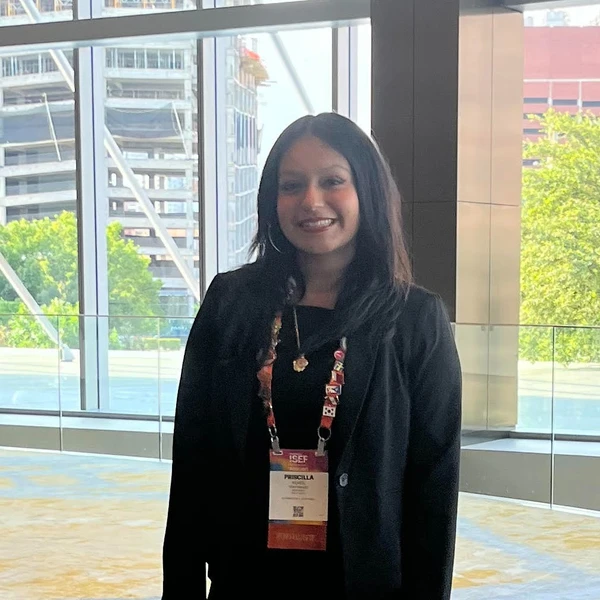
Priscilla Muñoz is an aspiring astrophysicist and AI/ML developer passionate about creating technology that improves accessibility for people with disabilities. With experience in machine learning, Raspberry Pi systems, and human-centered engineering, she has developed projects including a gesture-controlled accessibility glove, an object-detection assistant for the visually impaired, and a terrain-adaptive, Mars-Rover-inspired wheelchair. A former ISEF finalist and Caltech CTME collaborator, Priscilla is driven by a commitment to innovation, empathy, and using science to change lives.
Education
Arizona State University-Tempe
Bachelor's degree programMajors:
- Aerospace, Aeronautical, and Astronautical/Space Engineering
Miscellaneous
Desired degree level:
Doctoral degree program (PhD, MD, JD, etc.)
Graduate schools of interest:
Transfer schools of interest:
Majors of interest:
Career
Dream career field:
Aviation & Aerospace
Dream career goals:
Office Assistant
Grand Terrace City Hall2023 – 20241 year
Sports
Softball
Club2014 – 20228 years
Research
Biomedical/Medical Engineering
Leader/Inventor2022 – 2024
Imm Astronomy Scholarship
I am pursuing a career in Astrophysics, with a focus on using artificial intelligence and machine learning to study black holes, exoplanets, and other cosmic phenomena. Astronomy has always been more than a subject to me—it has been a source of wonder, comfort, and purpose. Ever since I was a child analyzing stars, pointing out facts about the universe, and feeling drawn to the mysteries of black holes, I knew my future would involve understanding the cosmos. Learning that the supermassive black hole at the center of our galaxy is named Sagittarius A*, the same as my zodiac sign, only deepened that connection. It felt like astronomy had always been calling me.
What truly sparked my interest in a career in astronomy was realizing how much the universe mirrors the curiosity inside me. Black holes, the event horizon, relativistic jets, accretion disks—these are not just scientific concepts; they’re beautiful puzzles. They challenge our understanding of physics, time, and the limits of reality. My fascination grew even more when I completed an AI course using NASA Kepler data to train a model that detects exoplanets. That experience showed me that astronomy and AI can work together to unlock discoveries that would otherwise be impossible.
But my interest in astronomy also comes from a place of wanting to help people. Space science inspires technologies that improve life here on Earth—like the Mars Rover wheels that inspired my all-terrain wheelchair project. Astronomy pushes innovation, and innovation pushes accessibility. I want to stand at the intersection of these fields: exploring the universe while using that knowledge to build solutions for people who are often overlooked.
In ten years, my ideal job is to be an Astrophysicist and AI Researcher working at NASA’s Jet Propulsion Laboratory or a major observatory such as the Event Horizon Telescope or the Vera Rubin Observatory. I see myself developing machine learning models that analyze black hole data, detect exoplanets, and process telescope imagery in new ways. I want to contribute to missions that map the structure of our galaxy, study gravitational waves, or image black holes with higher resolution than ever before.
At the same time, I want to lead a research division or startup that applies aerospace and astrophysics technologies to accessibility engineering. In ten years, I want to be known not only for contributing to space science, but also for transforming how people with disabilities move, navigate, and experience the world using robotics and AI inspired by space exploration. My dream career balances both: studying the universe and using its innovations to empower people on Earth.
Astronomy gives me purpose, creativity, and a lifelong challenge. It is a field built on curiosity, resilience, and wonder—the same qualities that have shaped my journey. In ten years, I hope to be living the career I’ve always imagined: reaching for the stars scientifically and helping people rise higher with me.
Stitt Family Aeronautics & Aerospace Scholarship
I want to be at the forefront of aeronautics and aerospace innovation because I have always been drawn to understanding the unknown and building technologies that push beyond what seems possible. My fascination began with black holes and the physics that govern our universe, but it grew into something deeper when I realized how aerospace engineering mirrors the same curiosity and problem-solving that drives me. Just as spacecraft explore the impossible edges of our universe, I want to design systems that push the boundaries of independence, accessibility, and mobility here on Earth. Whether it's robotics inspired by Mars rovers or AI systems that support mission-level precision, aerospace offers the ideal combination of physics, engineering, and innovation—everything I love.
One of my proudest projects, and the one that shaped my direction the most, is my Mars Rover–inspired wheelchair for individuals with lower-body paralysis. As I learned about the engineering behind NASA’s Perseverance rover—its wheel design, terrain handling, and decision-making systems—I realized that aerospace technology could change lives in ways far beyond space exploration. That connection made me want to be part of the aerospace field not only to explore space, but to bring its innovations back home to improve accessibility on Earth. Aerospace is the place where creativity meets purpose, and I want to contribute to that frontier.
Getting to this point, though, was not easy. My journey has come with obstacles that forced me to grow academically, emotionally, and personally. For years, I struggled with confidence in my abilities. In science fairs, I repeatedly stopped at the county level and assumed my work simply wasn’t good enough. What I eventually learned was that my barrier wasn’t intelligence—it was fear. I had to overcome my public speaking anxiety, the feeling of being underestimated, and even the experience of a partner taking credit for my research. Instead of giving up, I kept learning, kept presenting, and kept creating until I became an ISEF finalist and gained the confidence I once lacked.
Most of my engineering and computer science learning has been self-taught. I taught myself how to code, how to work with Raspberry Pi systems, how to integrate AI models, and how to design mechanical systems. When I didn’t have access to advanced courses, I found online resources, built my own projects, and reached out to mentors like the AI technicians at Caltech CTME. Every obstacle only pushed me to work harder and find new ways to keep moving forward.
However, the financial challenges I face remain significant. As a first-generation student, I am responsible for funding my own education. My family cannot afford the full cost of college or the equipment I need to continue my engineering projects. Every tool, every computer component, every board or sensor I’ve used has been saved up for, pieced together, or borrowed. Pursuing a career in aerospace—one known for its rigorous academics and expensive materials—requires financial support that I currently don’t have. Scholarships are not just helpful for me; they are essential. They would allow me to focus on advancing my education, conducting research, and continuing to create accessibility-focused technology inspired by aerospace engineering.
I want to be part of the future of aerospace not only to explore new worlds, but to build a better one. With financial support, I can continue turning curiosity into innovation and adversity into fuel for something meaningful.
Kristinspiration Scholarship
Education is important to me because it has always been my pathway to possibility. It is the bridge between where I started and the future I’m determined to build—not just for myself, but for others. Growing up, I didn’t have every advantage, but I had curiosity. I had questions. I had a desire to understand the world, from the stars above me to the challenges people face right here on Earth. Education gave me the language to turn that curiosity into real knowledge, real skill, and real impact.
For me, education isn’t just about learning facts or completing assignments. It’s about empowerment. It’s the reason I discovered my love for astrophysics, engineering, and AI. It’s the reason I learned how to code, how to troubleshoot a Raspberry Pi, how to build devices that can actually help someone. Education gave me opportunities to enter science fairs, to become an ISEF finalist, to present to Caltech engineers, and to design projects I never imagined I could create. Every class, every project, every late night spent researching has shaped me into someone who believes deeply in the power of knowledge to change lives.
But the true importance of education became clear when I started applying what I learned to help people with disabilities. When I met students who wanted more independence, when I heard someone say they wished daily life could be easier, something changed in me. Education stopped being just my personal ladder—and became a tool to lift others. It allowed me to design an object-detection glove, build accessibility devices, and imagine a Mars Rover–inspired wheelchair that can handle rough terrain and help people navigate the world with dignity and freedom. Education gave me the ability to transform empathy into innovation.
The legacy I hope to leave is one built on impact, empathy, and accessibility. I want to be remembered not just as an engineer or scientist, but as someone who used their knowledge to make life better for people who are often overlooked. I want the technologies I build to outlive me—to help someone see, move, communicate, or feel independent in ways they once thought impossible. I want younger students, especially girls in STEM, to look at my journey and believe they can create, invent, and lead too.
Most of all, I want my legacy to show that science is for people. That innovation is most powerful when it comes from a place of love. And that education—no matter where you start—can open doors to change the world in both big and small ways.
My education is not just my own success story. It is the beginning of the impact I hope to leave behind.
Pete and Consuelo Hernandez Memorial Scholarship
From a young age, I’ve been fascinated by the universe—first through stars, then black holes, and now through the mysteries that connect astrophysics and artificial intelligence. This curiosity shaped my prospective major in Aerospace, with a strong focus on AI/ML-driven research and engineering. But my academic interests didn’t form in a straight line. They grew out of adversity, reinvention, and the courage to keep going when I felt invisible or underestimated.
One of the earliest challenges I faced was learning how to believe in myself. I spent years in science fairs, from sixth grade to my senior year, only making it to the county level. For a while, I thought my projects weren’t good enough. But in my sophomore year, something changed—I became a finalist at the International Science and Engineering Fair (ISEF). The difference wasn’t my ideas; it was my confidence. I had to overcome the fear of speaking, the fear of being wrong, and the fear of being judged. With the help of my engineering teacher, I learned to present with honesty, even saying, “That’s beyond my research,” without shame. That shift taught me that success isn’t just technical skill; it’s self-trust.
Another major challenge came when a research partner took credit for my work. It shook me. I had poured months of effort into a project, only for my contribution to be overlooked. Instead of letting it break me, I used it to push myself further. I realized no one could take away my creativity, my work ethic, or the joy I felt when building something meaningful.
What ultimately transformed me, though, was the moment I started creating for others—not just for competition. As a DJ at school events for students with disabilities, I became close to many of them. Their strength, kindness, and trust made me see engineering differently. One girl told me she wished she could feel more independent. That moment changed everything. I redesigned my colorblind glove to help people with visual impairments. I built an object-detection assistant that recognizes items even in complex environments. I later added gesture controls, AI safety features, and most recently, began developing a Mars Rover–inspired wheelchair designed for tough terrain, including stairs. Now I’m working with former JPL engineers to bring it to life, using machine learning and Raspberry Pi systems for navigation and accessibility.
These experiences didn’t just make me a better engineer—they made me a better person. I grew from someone who doubted herself into someone who refuses to give up. I learned that adversity isn’t a barrier; it’s a teacher. Every setback taught me a new skill: perseverance, empathy, confidence, and the ability to redefine my purpose.
Today, my goal is to combine astrophysics, engineering, and AI to solve real-world problems and bring independence to people with disabilities. I want to use science the way it changed me—by helping people feel seen, supported, and capable.
My adversities didn’t weaken me; they clarified who I am. They reminded me that innovation is about heart, that science is about people, and that I am strongest when I’m creating something that makes someone else’s life better.