
Hobbies and interests
Acting And Theater
Reading
Swimming
Teaching
Choir
Music
Music Theory
Babysitting And Childcare
Sewing
Art
Ballet
Child Development
Community Service And Volunteering
Education
Hiking And Backpacking
Meditation and Mindfulness
Piano
Social Sciences
Reading
Classics
Young Adult
Novels
I read books multiple times per week
Peyton Parent
1x
Finalist
Peyton Parent
1x
FinalistBio
Hello there!
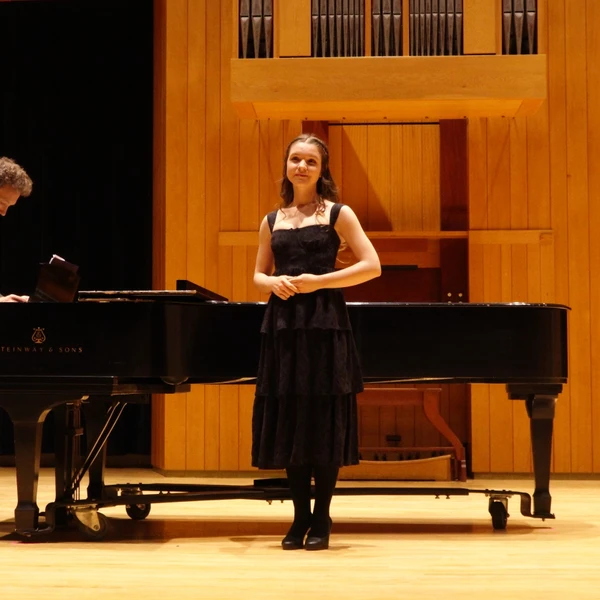
My name is Peyton, and I'm a current Music Education student at the University of Vermont and a member of its Patrick Leahy Honors College. My primary instrument is classical voice, but I am proficient in piano and have taken techniques classes in strings, woodwinds, percussion, and brass.
I am so excited to teach music someday! I'm a member of the National Association for Music Education, and the President-elect for Spring 2027. Through NAfME, I have represented UVM at the Collegiate Leadership Advocacy Summit, Hill Day, and the NAfME Eastern Conference. In addition, I'm the Music Education representative on the College of Education and Social Services' Student Advisory Board. On the board, I helped establish a peer mentoring program for first years, organized community events, and advocated for the needs of students in the college.
I'm extremely passionate about working with children and young adults! I would love to specialize in working with people with intellectual/developmental disabilities (IDD) as a music teacher after I graduate. As someone who grew up in a rural school district, I think it is so essential to ensure underserved communities have access to a quality music education.
Thank you for stopping by my profile! To learn more about what i'm up to at UVM, check out my LinkedIn! https://www.linkedin.com/in/peyton-parent-880688289/
Education
University of Vermont
Bachelor's degree programMajors:
- Education, General
- Music
Minors:
- Human Development, Family Studies, and Related Services
Apponequet Regional High
High SchoolMiscellaneous
Desired degree level:
Bachelor's degree program
Majors of interest:
- Education, General
- Music
- Special Education and Teaching
- Communication Disorders Sciences and Services
Career
Dream career field:
Education
Dream career goals:
Music Teacher, either high school choral or elementary band/general music
Peer Mentor for UVM students with intellectual/developmental disabilities
Think College VT2024 – Present2 yearsCamp Counselor
Camp Yomechas2022 – 2022Lifeguard/Swim Instructor
Old Colony YMCA2022 – Present4 years
Arts
Collegiate National Association for Music Education
Music2024 – PresentUVM Catamount Singers
Music2024 – PresentBlaising Studios, Freetown MA
Music2023 – PresentApponequet Summer Sing
Music2022 – PresentApponequet Regional High School
TheatreShe Kills Monsters, The Little Mermaid, Legally Blonde, Mamma Mia, Clue: School Edition, The Play That Goes Wrong2021 – PresentApponequet Regional High School
MusicSemester Choir Concerts2020 – Present
Public services
Volunteering
Student Accessibility Services — Peer Notetaker2025 – 2026Volunteering
National Association for Music Education — Usher2024 – Present
Future Interests
Advocacy
Volunteering
Philanthropy
Carla M. Champagne Memorial Scholarship
I always knew I wanted to be a teacher. I was inspired by my teachers' empathy and ability to make students feel seen. During challenging points in my life, my music teachers were always there to support me--I want to repay their kindness and do the same for future students.
As a current Music Education student, I try to take advantage of opportunities that allow me to work with people--I leave every interaction feeling uplifted and more certain of my decision to teach. For instance, I lifeguard family swim events for Family Room, an organization that supports families of young children with autism. In a city that is predominantly upper-middle class, Family Room welcomes everyone--regardless of ability, race, or income level. Snacks are provided, each child is paired with a volunteer, and families are greeted with a smile. Programs are low-barrier and available to families at zero cost--there are opportunities for connection, support, and education. Through family swim, I learned the importance of an inclusive, safe environment; the children have the opportunity to socialize with volunteers and other kids and the parents can relax and watch their children have fun. Once, I got to witness my boss teach a mother how to swim for the first time. She was nervous, but with encouragement and floatation aids, she started to kick and move through the water on her own! I noticed how my boss was patient and listened to the mother's concerns, while also sprinkling in humor to lighten the situation. This helped build trust between the two, which made the mother feel safe. I will bring this experience into my own teaching. I want to be the teacher who remembers her students' names, listens non-judgmentally, and treats everyone with compassion.
At my college, I am a Peer Notetaker. In this role, I take notes in class and upload them to the Student Accessibility Services portal. From there, students with a notetaker accommodation can view my notes and use them to supplement their learning. If a student has processing challenges, it may be difficult to process the lecture while taking notes–uploading them ensures that the class's content is accessible. In this role, I execute concepts from the Universal Design for Learning (UDL). UDL calls for multiple means of representation (pictures, graphs, text) to fit the learning needs of all students. I try to make my notes as legible and comprehensive as possible, utilizing text and drawings. Someday, I will develop similar resources for my students; this experience helps me understand why additional visual aids are paramount to an equitable education.
My work with Family Room and Student Accessibility Services showed me the importance of inclusivity. Both work to resolve inequities for people with disabilities; one resolving isolation for autistic children and caregivers, and the other making college-level content accessible. As a disabled person, I looked at my own experiences to try to find how I can make a difference too. With Ehlers-Danlos Syndrome, I struggled to get through my voice lessons and courseload without chronic pain. Someone with EDS has a different voicebox and bodily awareness than able-bodied musicians, and it can be challenging for teachers to understand how to work with it. From there, I decided to write my Honors thesis on inclusive voice pedagogy, focused on singers with EDS. I’m researching how EDS impacts the voice on a clinical level, and what instructional strategies are effective. I still have ways to go in my research, but I am steps away from helping students like me. I wouldn’t have this desire to problem solve and help future students without volunteering.
G.A. Johnston Memorial Scholarship
Believe it or not, the reason I fell in love with watercolor was so I could distract myself from my major!
Since I was sixteen, I knew I wanted to become a music educator. My school choral classroom served as a place where I learned how to regulate my emotions and grow as a person. I would love to help students in the same way.
This passion led me to the University of Vermont, where I am currently studying Music Education. As a dedicated vocalist, it has been amazing to spend everyday so invested in my craft. I have a wonderful job working for a preschool, have visited classrooms throughout Vermont, and spend hours practicing voice/piano/woodwinds/strings/everything you need to know to be a music teacher.
With all of that being said, it is extremely important to have creative hobbies OUTSIDE of music (because life is about so much more than your ability to play every single instrument or understand the rules of counterpoint). That's where watercolor comes into the picture! I picked up a paintbrush for the first time in years as a non-music hobby to avoid burn-out, and I am a better person for it. I love watching the colors bleed together and feeling calm wash over me when I create the perfect shade of green. It helps me have more appreciation for the world around me. For instance, I can admire the sun setting over Lake Champlain in the distance and see the blue gradient of the mountains, hints of yellow and orange, and masses of pink and red clouds.
Watercolor has been beneficial in capturing memories from certain points of my life. I am a sentimental person, and I knew I would never want to forget the view from the Music Building's window at UVM. When I painted this, it was the dead of winter, and everyone was tired of the snow. For that moment, however, I could appreciate the overwhelming beauty of snow on the ground in March.
The second image is of my father's greenhouse. My green thumb, resilience, and love for nature are all thanks to my dad. Growing up, he taught me how to identify flowers, weed a garden, and prune tomato vines. We're both artists in our own ways--I'm a musician and a painter, and he's an amazing farmer. I made this for him as a thank you for that.
Audrey Sherrill & Michael D'Ambrisi Music Scholarship
This piece did not influence me to pursue a career in music–it influenced me to remember why I chose music in the first place (despite the burnout from being a music student).
I knew I wanted to be a music educator since I was sixteen–I always felt accepted in choir, and wanted future students to feel the same. When I started my Music Education degree, I absolutely fell in love. I loved learning about learning. I loved learning every instrument and feeling like a kid. I loved knowing that someday, I will make a difference in my students’ lives. I became UVM NAfME’s president-elect and found a wonderful job working at a preschool–I was fully committed to teaching.
As much as I enjoyed the program, I noticed it was taking a toll on my body. My wrists felt too weak to practice piano and the muscles in my neck burned when I played clarinet. The worst impact? I was in too much pain to talk or sing and grieving my ability to be a musician. After a semester of working with a speech therapist, rheumatologist, and occupational therapist, I was diagnosed with hypermobile Ehlers-Danlos Syndrome. HEDS causes joint/muscle weakness and alters alignment. I realized that although teaching music was my calling, I may never be able to complete a program I loved without pain.
During this period of grief, I came across the first movement of Clairières dans le ciel. Since it hurt to sing, I decided to research it. Clairières is a song cycle composed by Lili Boulanger for soprano and piano. When I first heard this piece, I fell in love with the unconventional chord progressions and melancholic mood–I could tell that the composer was grieving something, and I wanted to feel that loss with her. I found that Boulanger also had a chronic illness, and that this work was composed when she was too sick to leave the house.
I related to Boulanger’s story and thought about how it can connect to the text she chose. The songs explore unrealized dreams and loss, through the loss of a partner. In the first movement, “Elle était descendue…”, the speaker remembers Clairières’ heroine in a meadow with grass and lavender. Through syncopation and chromaticism in the melody, we can see that the speaker is feeling more than contemplative–there is a sense of grief from seeing a young woman exist in such a joyful state: laughing, walking, and simply living. Disabled grief entails the mourning of a past body and uncertainty of the future. I felt seen by Boulanger–there had been so many moments where I looked at my classmates singing for fun with envy.
Before I had discovered this piece, I felt like there was no reason for me to keep singing. Afterwards, I was determined to sing this piece and understand how HEDS impacts the voice. I thought about what I would do if I had a voice student in the same situation, and recalled how my teachers didn’t have many resources on how to help me. From there, I had the idea to write my Honors thesis on how HEDS impacts the voice, and what voice teachers can do to help their students. Suddenly, music felt less like a reminder of my limitations and more like a call to action.
Music has the ability to make people feel a little less alone, and inspire them to create positive change in spite of their challenges. Boulanger reminded me that I am not alone in my grief and love and suffering, and inspired me to keep singing.
Sloane Stephens Doc & Glo Scholarship
Throughout my education, I have always been inspired by my teachers. I was awestruck by their drive to help students and seemingly infinite amount of knowledge. My interest in teaching was sparked when I began reaching out to my teachers to ask questions about the course material or chat about our days. They did not have to take the time to talk to me when I was struggling in class or dealing with personal conflicts, but they did—and that meant the world to me. Through this, I realized that I wanted to become a teacher and do the same for future students, helping them navigate high school by building a positive learning environment.
High school is not easy. On top of managing my difficult course load, I had to navigate friendships and personal problems. During this period in my life, music was my escape. For a while, I could forget about everything and focus on singing. The music classroom was a place where I truly belonged; my classmates and I could bond over our love of singing or hatred of reading minor fifths. At the beginning of my junior year, I became choir president. It became my goal to grow the music department, encouraging my peers to try out for festivals and advocating for performance opportunities. Some of my fondest memories as president were the group bonding activities I planned–such as celebratory ice cream parties or game nights. Through my outreach and efforts, our enrollment almost doubled! I would not be the person I am today without my participation there. I decided to combine my love of music with my love of teaching, studying Music Education at the University of Vermont.
To prepare for my career, I sought out many teaching experiences. I taught swim lessons at the YMCA, implementing trauma-informed and differentiated teaching methods into my classes. I learned how to engage children of all ages and abilities to create fun, accessible lessons. Currently, I work as a “party princess” for children’s birthday parties. While wearing a ball gown and performing in a stranger’s home seems like it would not make a difference, I realized that I could inspire these children to use music as a healthy form of self-expression. I tried my best to serve as a role model for every child present; I taught them about the importance of optimism as Anna, resilience as Cinderella, and bravery as Rapunzel.
I am beyond grateful for my education at UVM. In my first semester, I networked with local teachers and sat in on elementary band rehearsals. In October, I attended a jazz festival with my classmates. Four of them taught a masterclass to a group of sixth grade musicians on improvisation. It started with simple questions like “how do we improvise?” and ended with the students out of their seats, dancing and playing instruments. The joy in that room was electric–displaying the power of music education.
Four years from now, in a colorful classroom with fairy lights on the walls, I will be doing the same thing as my educational mentors. From 7:30am-2:30pm, my students will walk into a room where they can leave their problems at the door and focus on the music. The music we play together may not be perfect, but the memories will be.
Teaching Like Teri Scholarship
From the moment I could identify letters and build sentences, it has been impossible to find me without a book in my hand. Of course, my taste has shifted from Charlotte’s Web to Charlotte Bronte as I’ve gotten older, but my love of literature has followed me to the age of seventeen. My AP Language and Literature classes have given me the opportunity to expand my library and analyze my favorite novels in more detail, but I still want to continue pursuing the subject I love the most – as well as work towards my dream of teaching.
Throughout my high school career, I’ve been lucky enough to get to know my teachers personally. Through conversations about books and by asking about my life, my sophomore year English teacher helped me through a challenging time. She didn’t have to take the time to talk to me on days when I was feeling particularly anxious, but she did – and that meant the world to me. Her kindness made me realize that I wanted to help other students like myself excel at school -- even during difficult times -- by becoming a teacher.
In order to achieve this goal, I’ve started to take on experiences that would help me prepare for my future. This included reading complex novels such as The House of Mirth and Sense and Sensibility, shadowing my sixth-grade English teacher to learn how she manages her classroom, being an art teacher’s assistant for a special needs class, as well as working as a swim instructor for my local YMCA. Through these experiences, I have had the opportunity to improve my leadership skills, get to know some incredible students, and solidify my interest in teaching. One of my proudest moments was when one of my swim students, a partially nonverbal eight-year old, was able to talk to me after her first lesson. Through these small, but effective, interactions, I’ve witnessed just how important being a good role model is.
I need the resources and classes to learn everything I need to receive my teaching license; unfortunately, college is extremely expensive. My family’s dream is for me to graduate with little to no student loan debt. My parents are willing to pay for ⅔ of my tuition and fees, but I am expected to pay ⅓. Although I have maintained a 3.94 unweighted GPA and self-studied and received a 32 on my ACT -- all while working a part-time job and participating in extracurriculars -- the tuition and fees for college make attending challenging. I believe that by allowing me to attend the school of my dreams, this scholarship will be incredibly beneficial in my quest towards teaching English and helping even more people!
Nick Lindblad Memorial Scholarship
For the past three years, Tuesdays have been my favorite day of the week. Instead of going home and doing homework like most people my age, I have spent 2:30-7 pm in my school’s band room. First, I have a music rehearsal for the musical, and Select Choir after that. While it seems like a long time to spend at school, it has been the highlight of my week ever since I was fifteen.
Select Choir and rehearsal have been safe spaces for me to grow my leadership skills, meet new people, and make friendships that will last me a lifetime. Something about the hum of the heater under the windowsill, crackle of the keyboard’s speaker, and warm glow of the overhead lights make these magical Tuesdays the perfect environment to practice sight-reading, prep for auditions, and laugh together. In the time I have been a member of the music department, I have watched myself and my peers grow significantly as people and musicians. We have run for leadership positions, auditioned for and attended district honors choirs, and became closer friends.
Sophomore year was a lonely time for me. My school had just returned to in-person teaching and extracurriculars after a year of hybrid-learning, and I felt disconnected from all of my friends. At rehearsals, I could not muster up the courage to sing out, and it seemed like everyone was not in need of a friend--or so I thought. Karina, a senior I had acted with in middle school, began talking to me after we were both placed in the Soprano II section. It was a quick chat about our time in the middle school productions, but we quickly became friends after that. She gave me advice on personal struggles, like balancing schoolwork with extracurriculars, dealing with anxiety in large groups of people, and how to handle arguments with my sister. Through these “twelve-hour Tuesdays”, I was able to feel valued and understood for the first time in ages.
When Karina graduated, I knew what I needed to do -- pay it forward and be that friend for future students. So, I ran for choir president. Once I was elected, I made sure to constantly check in with the freshmen, schedule a positive affirmation time at the beginning of Select Choir rehearsals, and give my best pep talks before auditions. Soon, people I wasn’t even close with began reaching out to me. Someone sitting in front of me would turn around and ask me to help practice lines for the play, a group of sopranos began gushing to me about songs we were singing, and my school sent over twenty students to an audition-only festival through my campaigning. I noticed the impact I made on the people around me, and that was only able to happen as a result of the positivity from the music department.