Hobbies and interests
Dance
Singing
Piano
Exercise And Fitness
Reading
Education
I read books multiple times per month
Patricia Raj
1x
Finalist1x
WinnerPatricia Raj
1x
Finalist1x
WinnerBio
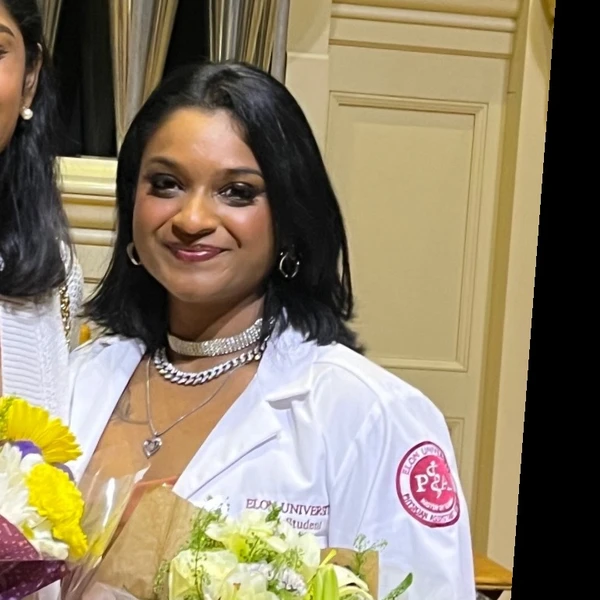
I am a PA-S first generation student passionate about Emergency Medicine, Pediatrics, and Behavioral Health.
Education
Elon University
Master's degree programMajors:
- Health Professions and Related Clinical Sciences, Other
University of the Sciences
Bachelor's degree programMajors:
- Biological and Biomedical Sciences, Other
Minors:
- Psychology, General
Miscellaneous
Desired degree level:
Master's degree program
Graduate schools of interest:
Transfer schools of interest:
Majors of interest:
- Biological and Biomedical Sciences, Other
Career
Dream career field:
Hospital & Health Care
Dream career goals:
Physician Assistant
EMT-B
Ambulunz2019 – 20234 years
Sports
Powerlifting
Club2021 – 20243 years
Awards
- State Records
- National Records
Research
Social Sciences, General
Usciences — Student Researcher2022 – 2022
Arts
USciences Dhadkan
DanceDDN Performances.2018 – 2020
Public services
Advocacy
USciences — VP of Student Life and Diversity2018 – 2022
Future Interests
Advocacy
Politics
Volunteering
Philanthropy
Entrepreneurship
Issa Foundation HealthCare Scholarship
The elderly woman's hand trembled as she reached for mine in the emergency department. Her son had stepped away to take a call, and now it was just us—a sixty-year-old woman with crushing chest pain and me, a student with a textbook full of knowledge but no idea how to bridge the sudden silence between us. In that moment, all my clinical training felt inadequate. I knew how to interpret her ECG and calculate the correct nitro dosage. But what she needed was someone to hold her hand and tell her she wasn't dying alone.
That moment challenged everything I thought I knew about patient care. I had spent years mastering the science—responding to 500+ emergency calls as an EMT in Coatesville, where I learned to stay calm when gunshots rang out and chaos surrounded me. I had perfected my laceration repair technique and managed psych emergencies back-to-back during overnight rotations. But here, faced with a patient whose fear I couldn't simply "fix" with a procedure, I understood that technical competence without human connection is incomplete. The best clinical skills mean nothing if your patient feels alone in their terror.
I didn't let that moment end in silence. I pulled my chair closer, kept holding her hand, and just stayed. "I'm here," I said quietly. "You're not alone." She squeezed back, tears slipping down her temples, and slowly her breathing steadied. Later, after her son returned, I learned she had been avoiding the ER for weeks because she couldn't afford the last hospital bill. That revelation—unlocked not by my clinical skills but by a moment of shared humanity—changed her entire discharge plan. I connected her with financial assistance and made sure she left with a follow-up appointment.
This experience reshaped the physician assistant I am becoming, but it also connected to something deeper I had discovered outside the hospital walls. At a local middle school and elementary school, I volunteered to talk with kids about what it means to be a PA—to show them that someone who looked like them, from a background like theirs, could wear a white coat. In the Start Early in Medicine program, I stood at an anatomy table with wide-eyed elementary students, guiding their gloved hands as they explored a kidney model and explained how blood filters through nephrons. I watched their faces shift from confusion to wonder, and I recognized the same fear I saw in my patient's eyes—the fear of not belonging, of being left out of a world that seems reserved for others.
Those kids taught me something essential: my ability to nurture isn't limited to the bedside. It lives in the patience I offer a child struggling to pronounce "glomerulus," in the encouragement I give a first-generation student who never considered medicine possible. I became a PA student not just to treat patients, but to be proof that the door opens for those willing to walk through it—and to hold it open for the next generation behind me.
This is the physician I am becoming: one who carries the calm of a Coatesville night shift in one pocket and the curiosity of a middle schooler in the other. One who understands that clinical mastery must be paired with the humility to sit with a frightened patient and the commitment to teach the next first-generation student that they belong here too. The trembling hand in that ER bay and the small hands exploring anatomy models taught me the same lesson: healing happens when we refuse to let anyone face their fear alone. I am ready to spend my career doing exactly that.
PAC: Diversity Matters Scholarship
WinnerMy stethoscope rests on the chest of a young man with a gunshot wound in Coatesville, its steady rhythm a counterpoint to the sirens outside. In his eyes, I see not just pain, but the complex tapestry of an underserved community—a tapestry of poverty, trauma, and resilience. This scene is a world away from the ceremonial incense of the Guatemalan highlands, where I advocated for women’s health, yet the core lesson is identical: profound healing requires meeting a person within their own reality. My journey, from the back of an ambulance to the Phi Kappa Phi Honor Society, has been a deliberate cultivation of the three attributes I believe define an impactful PA: clinical mastery under pressure, leadership dedicated to equity, and a resilient, culturally humble compassion.
My clinical training has been a rigorous pursuit of versatility for this very purpose. While my resume details rotations from first-assisting in general surgery procedures like suturing and maintaining sterile fields to managing psychiatric evaluations for mood disorders, the true test came during night shifts in Coatesville. There, clinical agility meant pivoting from a drug overdose to a psych emergency, interpreting a POCUS ultrasound for a DVT, and performing a complex laceration repair—all while maintaining the composure that earns a patient’s trust. Excelling in these environments while achieving a 3.9 GPA and Phi Kappa Phi honors was a discipline in ensuring my practice is as intellectually rigorous as it is practically skilled.
I believe that leadership must actively dismantle the barriers to care that my patients face. My role as VP of Student Life and Diversity was the academic parallel to my work in Coatesville and Guatemala. Having navigated my own challenges as a POC student, I created BIPOC networking events and advocated for inclusive policies, just as I coordinated with community leaders to respectfully integrate health initiatives. This is the same advocacy I bring to the bedside—whether educating a patient on semaglutide in family medicine or using my Spanish to ensure a patient in women’s health truly understands their contraceptive options.
Ultimately, the sleepless nights and emotional weight of this work are sustained by an unwavering purpose: to become a truly compassionate and good PA. The discipline of Indian classical dance taught me to listen to unspoken stories; my mission work taught me the humility to honor them. This is the thread connecting a well-child exam, a suicide risk assessment, and educating a patient in Coatesville about overdose reversal. It is a commitment to the whole person, forged in the most challenging environments.
My whole life has been a preparation for this calling. From responding to 500+ EMT calls to guiding peers as PA Club President, my path has been one of service and leadership. I am not just a future clinician; I am a bridge-builder and a steadfast ally to the underserved BIPOC community. I carry the resilience of the communities I’ve served and the unwavering conviction that equitable, compassionate care is not a privilege, but a right I am dedicated to fighting for as a first generation, Indian orgin, Physician Assistant.