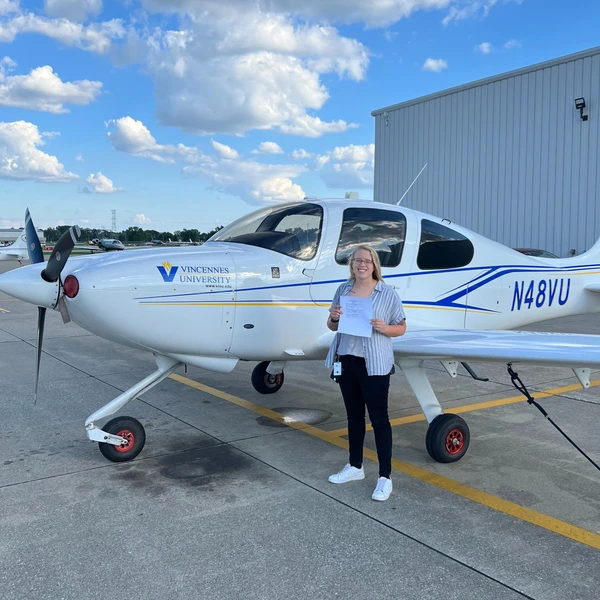
1. As a Deaf woman with a cochlear implant, my parents told me that anything I wanted to become, I could. I'm very thankful to have had unwavering support throughout my life, but I'm not sure it was that big of a shock to them when I told them I wanted to be a pilot. As a little girl, my parents pointed out airplanes in the sky because my eyes were always glancing skyward. I told them at age 6 that I wanted to be pilot Barbie, but kids of course change their minds every day. The event that solidified my love for aviation was the Young Eagles flight that I took around the age of 11 in Elkhart, Indiana. My uncle was an air traffic controller there at the time, and because of the program, the pilot asked me to sit up front. He let me manipulate the controls a little and I was hooked. There was nothing more magical than that feeling and I was determined from that day forth - I was going to be one of the first Deaf lady pilots.
2. I prioritize and maintain safety in aviation by setting firm personal minimums. The minimums include ceilings, winds and temperatures, as well as personal factors such as illnesses or external pressures. They are wrote down so that I never question whether a flight should be made or not. The aircraft is also very important to my safety, so extra measures are taken to verify the aircraft is in a condition for safe flight. Before every flight lesson, I also comb through the Flight Operation Manual and review the maneuvers that I will doing that day or the day after that. In aviation you can never be too safe.
3. My biggest challenge in my pursuit to aviation was the two-year battle I faced with the FAA to clear my medical certificate. Despite using a cochlear implant to hear and communicate, the FAA was reluctant to issue my first class medical. My Aviation Medical Examiner cleared me for a first class medical with no issues. Since it has to go through the FAA for approval, I got it back 3 months later. The medical stated that I was not valid for solo flight. I submitted a lot of paperwork, made many calls and after a year, was able to get a medical flight test done. After 6 months of waiting, I got my medical back. However, upon closer inspection, the examiner cleared me for my vision. I use glasses for my nearsightedness, but that was originally stated in the medical to begin with. Since the examiner retired a couple months after our flight, I had to call and explain the circumstances. He was quick to get ahold of the FAA but it was another 3 months before I got my medical back fully cleared. After two years of back and forth with the FAA, I started my flight training.
4. There are a number of skills and qualities that I possess that I believe contribute greatly to my success in aviation. The first quality I hold is my willingness and ability to learn. There is no room for mistakes in this industry and I find that many students can be hard to teach. They either think they know all the material or they get too cocky and it ends up backfiring on them later. By being willing to learn and train, I acknowledge that I will never have every answer. I enjoy gaining new knowledge and being a lifelong student. The second skill I have is my ability to work with others. I may not be a natural at flying like some individuals are, but I can effectively and maturely communicate and express what I need or what others may need. I am not afraid to speak up, especially when it pertains to the safety of flight.
5. To serve others in my community I participate in a number of aviation related activities. Numerous times I have helped my school, Vincennes University, with events. During these events I have sat as a panel member, operated the flight simulators or talked one on one with individuals interested in aviation. On top of that, I am a member of EAA Chapter 67 and The 99's. My local airport has a community breakfast and airport day in one of the hangars. I have helped them with that event for the last two years. I am also a board member of the Women in Aviation Hoosier Heartland Chapter. Myself and six other women from the aviation industry noticed that there was a lack of representation in Indianapolis, and together we got a chapter running and certified as a non profit in 10 months. To better represent women and underrepresented minorities in aviation, I hope to pursue my Certified Flight Instructor certificate so I can teach other female pilots, especially those who are Deaf or Hard of Hearing. By becoming a CFI, I could also get involved with a non profit called Able Flight, which allows differently abled people to become pilots.
6. I believe that I am a strong candidate for this scholarship because I am not only devoted to what I do, but I'm devoted to helping others get into this field as well. I've seen what aviation has done for me and there's nothing more I want than to spread the joy of flight. I am a hard worker who never gives up. Despite my own family members telling me that becoming a pilot as a Deaf person is impossible, I obtained my Private pilot certificate and my instrument rating. I'm not a stranger to adversities and negative stereotypes. They have only made me a stronger person and a more confident pilot.
I am not an Alaskan native, however, I would love nothing more than to fly in the beautiful state that you all call home. I recognize the profound use of airplanes, especially for those who live in the bush. My plan is to get my Seaplane rating at Alaska Floats & Skis in the future.
9. Aviation in Alaska is especially important for a number of reasons. Since Alaska is not connected to the lower 48 states, airplanes are one of the only ways to receive mail from the other parts of the United States. The sheer size and ruggedness of Alaska means that air travel, especially Seaplane travel, is one of few options for bush residents to access healthcare, supplies, food and other individuals. Since many towns do not have roads connecting them, snow mobiles and aircraft are more or less the only options that villagers have on most occasions. The need for planes in Alaska are exponentially higher than other areas in the world. Aircraft are not simply for pleasure in Alaska, they are a livelihood.