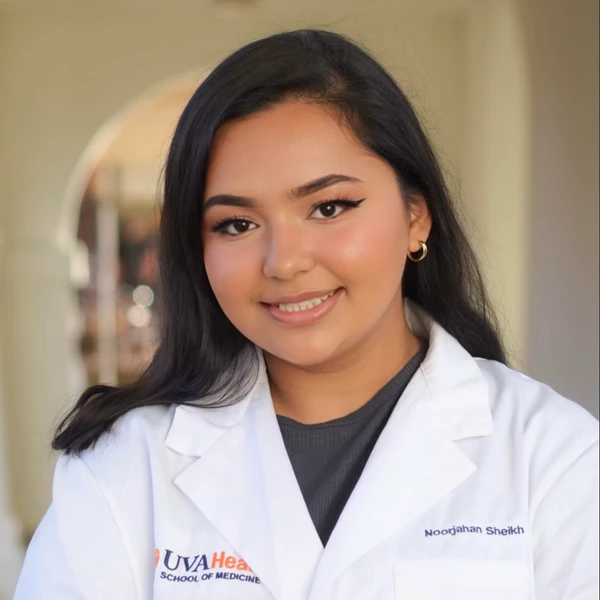
user profile avatar

Noorjahan Sheikh

1x

Finalist

General information

Hobbies & Interests

  • 3D Modeling
  • Advocacy And Activism
  • Social Justice
  • Social Media
  • Social Sciences
  • Social Work
  • Anatomy
  • Anime
  • Anthropology
  • Babysitting And Childcare
  • Badminton
  • Beach
  • Biology

Reading

  • Academic
  • Adventure
  • Biography
  • Book Club
  • Cookbooks
  • Crafts
  • Anthropology
  • Cultural
  • Food and Drink
  • Gardening
  • Health
  • Humanities
  • Psychology
  • Parenting

I read books daily.

Bio

Noorjahan Sheikh is a third-year medical student and Hook Scholar at the University of Virginia School of Medicine. A first-generation, low-income (FGLI) student, she is the first in her family to graduate from high school and college and pursue medicine. Her lifelong passion for medicine first intersected with her interests in culture, ethics, and health equity through her undergraduate studies in medical anthropology and is now being realized through her clinical training. Noorjahan is passionate about research, social justice, mentorship, and advocacy, particularly for communities whose voices and lived experiences have historically been overlooked in medicine. During her clerkship year, she has earned excellent evaluations and recognition for her clinical growth, patient-centered care, and advocacy. Her developing clinical and scholarly interests include medical humanities, adolescent psychiatry, pediatric and adolescent anesthesia, and dermatology. Drawing upon her experiences as an FGLI student and her background in medical anthropology, she hopes to build a career that combines compassionate clinical care with scholarship and advocacy, while centering the social, cultural, and structural contexts that shape her patients’ lives.

Education

University of Virginia-Main Campus

Master's degree program

2026 – 2028

Majors:
  • Public Health

University of Virginia-Main Campus

Doctoral degree program (PhD, MD, JD, etc.)

2024 – 2028

Majors:
  • Medicine

Northern Virginia Community College

Associate's degree program

2018 – 2019

Majors:
  • Biological and Physical Sciences

University of Virginia-Main Campus

Bachelor's degree program

2017 – 2021

Majors:
  • Anthropology

Mount Vernon High

High School

2013 – 2017

Miscellaneous

Desired degree level:
Doctoral degree program (PhD, MD, JD, etc.)
Graduate schools of interest:
University of California-San Francisco, University of California-Los Angeles
Majors of interest:
Medicine, Mental and Social Health Services and Allied Professions, Public Health, Anthropology, Biopsychology
Desired degree modality:
In-Person
Medical school interest:
Yes
English as first language:
No
Homeschooled:
No

Career

  • Medical Assistant

    Medicine · Dermatology office of Dr. Hema Sundaram

    Jan 2021 – Jan 2021

  • Pre-med mentor

    Higher Education · Student Medical Leadership Program (SMLP) at UVA School of Medicine

    Jan 2025 – Present

  • Resident advisor

    Higher Education · Student Medical Leadership Program (SMLP) at UVA School of Medicine

    Jan 2025 – Present

Miscellaneous

Dream career field:
Healthcare Administration, Medicine, Anthropology
Dream career goals:
Child psychiatrist, child anesthesiologist, child dermatologist, or family medicine doc!
Work experience:
5 years
Has nursing license:
No
Leadership experience:
Yes

Future Interests

  • Advocacy
  • Volunteering
  • Philanthropy
  • Entrepreneurship
Michael Rudometkin Memorial Scholarship
As an ambitious, highly motivated medical student, I once thought that one could only make a difference if only achieved large-scale, substantial changes within a community. However, as I have learned more about health advocacy and fighting against disproportionately distributed health disparities through my educational endeavors, and combining it with a myriad of unique lived experiences, that I've come to learn the most meaningful efforts are often individually oriented, filled with patience, empathy, and an ongoing commitment to uphold ones dignity. Throughout my undergraduate studies, I was a full-time, first-generation college student who simultaneously perfected her craft as an extreme couponer. Although this hobby was initially picked up out of necessity to help provide my low-income family with groceries and household essentials, it quickly became an addicting activity. By junior year, I was a seasoned veteran, having transformed my laundry room into a fully stocked “couponing room,” filled to the brim with any essential one could imagine. Realizing that my couponing room was filling far quicker than goods were being used, I wanted to apply my hobby toward uplifting my community. Rising Hope Mission Shelter, where I volunteered, seemed like a wonderful place to start. As the weather grew chillier that sophomore-year Fall, I sought my mother's assistance, and together, we spent days preparing “necessity totes”: durable, reusable bags filled with warm Bengali meals, new winter clothing, and various full-sized necessities. These bags were crafted with great care and variety, hoping to provide residents with something that was often lost amid their circumstances: genuine autonomy. As I passed these bags out, I encountered a young man named Sam. When I handed him his tote, he quickly pulled out his flip phone, snapped a photo of its contents, and excitedly called his mom, reassuring her with tears in his eyes that he would be okay. It felt like witnessing a touching movie scene right before my eyes. Even years later, his ear-to-ear grin brings tears to my eyes as I reflect now for your scholarship. That same commitment to service followed me into my university classrooms. During junior year, I unexpectedly encountered a lethargic peer who struggled to afford groceries and often forwent meals altogether. Although organic chemistry was challenging itself, it was disheartening to learn that she lacked the strength and energy to study. I spent weeks learning Kroger's sales schedule, looking through previous years' weekly advertisements, before returning to her with a plan. Together, we devised a routine of grocery shopping after lectures and sharing meals between classes. Although initially hesitant, she eventually agreed. Watching her return to class with more energy as the semester passed was especially rewarding. Above all, I was proud to have served my classmate while upholding her privacy, dignity, and autonomy through individually attuned efforts. Growing up with housing and food insecurity, scarce financial resources, and the experiences of caring for my chronically ill father, I closely empathized with those whose lives revolved around uncertainty. Yet, through humbling encounters with individuals like Sam and my classmate, I learned that selflessness is not measured by the magnitude of one's contributions, but by the willingness to recognize another person's needs and act with compassion. Now, as I approach the end of my third year of medical school, I carry these lessons into every patient encounter. I am indebted to those I have served for transforming my outlook on privilege, suffering, and the power of genuine interpersonal connections. In the words of medical anthropologist Nancy Scheper-Hughes, I aspire to be a “compañera” to those I serve: an empathetic physician, fierce advocate, and above all, a friend.
Brian J Boley Memorial Scholarship
In my mother tongue–Bangla–there is a word I grew up well-acquainted with long before I’d ever learned about mental health: পাগল–pagol. Growing up, pagol encompassed nearly everything related to mental illness. Depression, anxiety, psychiatric care–these distinctions rarely existed in the conversations I overheard. Instead, there was pagol: a blanket term traditionally wielded as an insult–meaning crazy or abnormal–a mark of shame. It didn’t matter if it was being used toward me or not; hearing pagol stilled me every time–like I was being stabbed–and for so long, I didn’t know what to make of it besides hurt and shame that even thinking about things like depression and anxiety made me inexplicably angry with everyone around me. Yet, during dawats (Bengali invitations and festivities), I sat closely beside my mom in circles with the aunties of my community, and what I witnessed was anything but pagol. Over the years, I saw some of the most hardworking women I’ve ever known endure abusive relationships, receive little respect within their households, and lose authority over their autonomy because they lacked financial independence. I saw women struggling to get out of bed in the morning called lazy. Women who would’ve told you their pride and joy was motherhood becoming emotionally distant from their children. Women who were too exhausted to prepare fresh meals for their husbands being called pathetic. Women suffering profoundly while lacking the vocabulary–and often the permission–to name that suffering. For much of my childhood, I developed an equally complicated relationship with mental health. It was not until my undergraduate studies in Medical Anthropology that it felt like a veil had been lifted from my eyes: I learned about explanatory models for illness, medical justice, and the ways culture shapes how we understand sickness and healing. Suddenly, I had language for experiences I had witnessed my entire life. My undergraduate experience opened my world to mental health, but it also illuminated how desperately women like my mom and aunties needed someone who looked like them, understood them, and could gently dismantle a worldview in which asking for help meant admitting you were a pagol without shaming them even more. I became committed to amplifying the long-silenced, underacknowledged, and frequently undermined perspectives of marginalized immigrant women and vowed to use my future career in medicine to shed light on their suffering. I entered medical school dreaming of becoming an adolescent psychiatrist or a culturally competent psychiatrist focused on women’s mental health. After completing my psychiatry clerkship this year, I could not be more certain. As a future physician, I want to make mental healthcare feel culturally recognizable rather than foreign. I want to sit across from a Desi mother and understand that treating her depression may first require understanding why she fears the word used to describe it. I aspire for adolescent girls growing up between cultures to learn earlier than I did that suffering does not make them weak, ungrateful, lazy, or a pagol. I wish to practice psychiatry that doesn’t ask patients to abandon their culture at the footsteps of my clinic, but rather understands culture and lived experience as integral to how they recognize illness, family, autonomy, and healing. My lived experiences have become a guiding compass for the physician I hope to become. Through my work, perhaps someday, a little anxious girl afraid of the uncertainties of the world–like my mom once was–will no longer only know pagol, but instead have words for trauma, healing, and hope–and, most importantly, know that none of these words are of shame.
Ismat's Scholarship for Empowering Muslim Women
As I start this year as a third-year medical student, I look back and reflect on all that I’ve accomplished. I am the eldest daughter of three to hardworking, first-generation Bengali immigrants, and I am the first person in my entire lineage–marked by poverty and limited access to education–to graduate from high school and college with the highest honors and now be halfway through medical school. Growing up with housing insecurity and food insecurity, people like me typically do not make it into medicine. Although 20% of medical student matriculants come from the top 5% of our country’s wealthiest households, fewer than 5% come from the lowest 25%. Above all, I am thankful to Allah (swt) for blessing me with the wisdom I have gained from my lived experiences. Moreover, I am thankful to my parents: for working several full-time jobs, persevering through countless hardships, and giving me the space to thrive academically while discovering what it meant to dream. Growing up as a child interpreter for my timid parents at every medical appointment, a consistent caregiver for my two much younger siblings, and someone raised in poverty, I have been drawn to medicine from an early age. One of my most cherished childhood memories was attending cardiology appointments with my dad and joyfully helping him type and print a neatly organized list of his medications before every visit. Because he lived with rheumatoid arthritis, aortic stenosis, diabetes, partial blindness, Parkinson disease, and many other chronic illnesses, this became a familiar routine across countless specialties. Although my dad would have supported any career I pursued, he proudly says he planted the "early seed" of medicine simply by taking me to those appointments. Those seeds were further nurtured by my mother, who stood on the opposite end of the spectrum and frequently avoided medicine because she feared being mistreated. As I grew older and better understood her experiences, I learned the significance of medical racism, health inequities, medication nonadherence, and the devastating consequences they can have. Through years of conversations, shared decision-making, and empathy, I slowly helped my mom build trust in a new kind of medicine. I worked with her at her own pace, celebrated every victory alongside her, and became a safe haven during the setbacks. Together, we watched her health improve. While my dad sparked my early interest in medicine, it was helping my mom through her most vulnerable years that affirmed for me that I would rather do nothing else than serve patients like her. As an ambitious dreamer, I wish to pave the way for women from disadvantaged backgrounds by demonstrating that the social determinants which once shaped our lives do not have to define our futures, but can instead become a source of resilience and wisdom. Earning your scholarship would assist me tremendously in achieving my goals of becoming a physician while minimizing the loans required to complete my education. I am proud to have graduated from college debt-free; however, as I pursue both an MD and an MPH, I know the remainder of my educational journey will be costly. By investing in my future, your support would allow me to continue serving others–and, Insha'Allah, one day establish scholarships of my own for students with stories like mine. Thank you so much for your consideration and support. Jazakhallah Khair.
Bick First Generation Scholarship
As the eldest daughter of hard-working, first-generation Bengali immigrants, I am the first person of my entire lineage–marked by poverty and inaccessibility to education–to graduate from high school and college, and now, I am nearing the end of my third year of medical school. I hold close to my heart the wisdom gained from my unique journey as a child-interpreter for my timid immigrant parents, a caretaker for my two younger siblings, and the humbled perspective of coming from a first-generation, low-income background. Being a first-generation student has often felt like navigating academia with a blindfold on, desperately trying to make sense of the spaces I occupied and wondering if everyone else received the secret memo that skipped my inbox and mine alone. The more I progressed in my academic journey, the less I could connect with peers whose backgrounds paralleled mine. Although charting the unknown terrain of academia can be frightening, it has also been exciting and uplifting. For a long time after my undergraduate studies, I did not know if medical school would even happen for me. I couldn't even fathom how it happened for other people! I took care of my father through three intense brain-strokes and remained committed to being by his side throughout his recovery. I packed daily lunches for my baby siblings and, year after year, renewed my family’s applications for SNAP-EBT, SSDI, and Medicaid–while my dreams remained in limbo. Although my journey had a detour, despite the doubt and delays, I finally made it. Now, I walk the halls of the hospital with a shiny stethoscope and a white coat I earned the hard way–and I'm still in utter disbelief. I think of the girl who relied on free lunch at school; the girl who grew up in a basement, in insecure housing; the girl who could not afford business-casual clothes for conferences; and the girl who translated Medicaid letters on behalf of her parents throughout her elementary-school years–I finally made it. I do not take it lightly that I am the first person in my entire family not to have to prioritize work and can instead follow my dreams through higher education, research, and medicine. I am getting an education to serve as an inspiring example for my younger brother and sister–that hard work does pay off. I also wish to assist other first-generation, low-income women in fulfilling their dreams by showing them that it is possible to overcome obstacles like poverty in academia. Education has changed my family’s trajectory in a single generation, and truly, it has been life-changing, and truly, I am living out my most passionate dreams. Receiving the Marcia Bick Herman First Generation Scholarship would help alleviate the financial burden of my medical education and allow me to prioritize becoming the best future physician I can be. I would make the most of your investment in my future, with the hope that one day I can make that same financial investment in first-generation students who come after me.
Sloane Stephens Doc & Glo Scholarship
As I near the end of my third year of medical school, I frequently find myself looking back at how far I've come, but also at the physician I am becoming. I am the eldest daughter of three born to two hard-working, first-generation Bengali immigrants, and the first person from my entire lineage–marked by poverty and inaccessibility of education–to graduate from high school and college with the highest honors, and now, to be approaching my final year of medical school. Above all, I am thankful to my parents: for holding several full-time jobs, for persistent beyond hardships such as food insecurity and homelessness during my nascence, and for trying to shield me from as much of it as they could while giving me the space to thrive academically and discover what it meant to have a dream in education. Their sacrifices shaped not only how I arrived, but what I intend to do with the privilege of being able to have a dream and study. I grew up as a child-interpreter for my timid parents for all things related to English–including medical appointments. Carrying the humbled perspective of coming from a poverty-stricken background, I have been drawn to medicine for as long as I can remember. One of my most cherished childhood memories is attending cardiology visits with my dad and helping him type/print a neatly organized list of his prescriptions beforehand. Because he was chronically ill, this became a frequent endeavor across many specialties. Truly, it felt like a great honor to learn typing skills early and present his attendings with this up-to-date list. Though my dad takes great pride in saying that he planted the “early seed” of medicine by taking me to these visits, these ambitions were further sown through experiences with my mother, who frequently avoided medicine because she feared being mistreated. As I grew older, I learned through her the significance of medical racism, health inequity, medication adherence, and what can happen when patients do not feel safe within the systems meant to care for them. After years of discussions, shared-decision making, arguments, empathy, and patience, I slowly opened my mom's world to a new kind of medicine: I worked with her at her pace, celebrated the wins with her, and served as a haven for the lows. While my dad might've planted the seed, it was my mom who taught me what I wanted to grow from it. Nearly three years into medical school, those childhood lessons have followed me through my journey. When I meet patients who feel too small to speak, and I hold their hands and advocate for their health, I am reminded that I am in the right place. Through my medical education and upcoming public-health training, I hope to build systems where patients like my parents, neighbors, and community members are heard, respected, understood, and empowered within their care. As an ambitious dreamer, I want to pave the way for women from disadvantaged backgrounds–to show that the social determinants that once dominated our lives do not have to hold us back and can instead become a wealth of wisdom to draw from. Education has changed my family’s trajectory in a single generation. Every day, I am living the dream–still in the “pinch me, is this happening?” phase.Receiving the Sloane Stephens Doc & Glo Scholarship would be a dream come true. By investing directly in my future, my promise to you would be two-fold: to make the best use of your scholarship and, one day, to host several of my own. Thank you so much for your consideration and support.
New Beginnings Immigrant Scholarship
​​Tiny, rough bumps sprawled across my palms. As I feel their abrasive texture, I instantly think of my dedicated parents, whose hands–deeply etched with calluses: a testament to their resilience. I define the American Dream with my parents as a shining example: pure grit, a sheer force of will, and an unbendable strength to persist without giving up. During the 1990s, my parents bravely immigrated from Bangladesh to the United States–a wholly foreign country–with limited financial resources, no background in education, and severe language barriers. Nevertheless, they refused to succumb to the challenges that tried to swallow them whole as new immigrants and instead prioritized seeking better opportunities for my siblings and I. Although my parents tirelessly worked throughout their lives, my family remained in constant financial peril. Due to the severe time constraints posed by their tiring work and the fear of being laid off, my parents had no room to pursue education or seek medical attention when ill. Instead, they often suffered in silence, exacerbating their health complaints until they could no longer be ignored–leading to a significant dependence on my assistance from a young age. As the eldest daughter of first-generation immigrants, I am the first person of my entire lineage–marked by poverty and inaccessibility to education–to graduate from high school and college–and continue my journey in medical school. I hold close to my heart the wisdom gained from my lived experiences as a child-interpreter for my timid, immigrant parents, as a caretaker for my two younger siblings, and the humbled perspective of coming from a marginalized, low-income background. Using the lessons learned from these unique experiences as a guiding compass for my future endeavors, I genuinely wish for those frequently shunned by medicine to feel openly welcomed to an accessible healthcare space under my care. When I think of my parents’ grit, I draw on values instilled by them as hardworking immigrants–of hard work, authenticity, and empathy–to aim high in academia to accomplish my dreams. Their journey as immigrants in the United States–as evidenced on their hands–is an endearing allegory to push limits and never accept defeat. With each passing day, their story propels me to embrace challenges with an open heart, just as they did when they immigrated to a new country. The coarse patches on my hands are not merely physical marks but symbolic of strength and resilience–the Dream my parents’ immigrant legacy has instilled in me. I am getting an education in medicine to continue the path laid before me by my parents and to inspire my younger siblings–that hard work does pay off. Because of my upbringing in an immigrant household, I am intimately familiar with the challenges of language barriers and cultural differences of those from foreign lands. On a more personal level, I am also aware of the “funny looks,” hurtful mumbles, and outright blatant disrespect that immigrants continue to face on a daily basis simply for their differences. Coupled with my extensive knowledge of urban poverty, social determinants of health endured by patients of color, and the higher risks of health disparities that immigrants face, I am determined to be a physician who will never give up in her fight against medical racism and injustice Similarly to how I’ve cared for my parents and assisted them with needs unique to immigrants throughout my life–such as translating, advocating, and supporting–I vow to carry on the values instilled by my family to serve my future patients and to amplify their voices, something especially crucial when people with narratives like mine are rarely found in medicine.
Charles B. Brazelton Memorial Scholarship
Teasing me, my friends have bestowed the nickname of "the stress baker," upon me. Yes, when exams are looming or presentations await us, I frequently find myself making my perfect brown butter chocolate chip cookies, pistachio cinnamon rolls, or red velvet beetroot brownies–desserts that absolutely no one asked for. However, contrary to popular belief, cooking is not how I relieve stress. If anything, spending hours making everything from scratch is probably the opposite of relaxing. What keeps me coming back to the kitchen is something entirely different: I love watching what food does to people and the connections it allows me to make. For as long as I can remember, I've loved making people smile through food–a trick I picked up from my mother, who best expressed her love for me in her intricate culinary skills. There is something incredibly rewarding about placing a homemade meal in front of someone, watching them take their first bite, and seeing their expression instantly change. I love hearing, "Wait–you made this from scratch?" Not only do I love introducing peers to 10/10 dishes and combinations they've never tried before, but I especially love how a shared meal can connect two people who otherwise may have had very little in common. Perhaps my strangest quality is how intensely I hyperfixate on learning new cuisines. Once I become interested in a culture's food, I don't just learn one recipe–I learn dozens and commit them to memory. I research and collect ingredients and practice cooking techniques to perfection until I've somehow become the unofficial expert among my friends. My signature phrase has become, "yes, I made it from scratch!" Most recently, my greatest culinary obsession has undoubtedly been Korean cuisine. As an avid foodie, I had never encountered anything quite like Korean banchan: a deliciously diverse collection of miniature side dishes that transform a meal into a flavorful experience. To start out, I bought a five-pound bag of gochugaru, filled my pantry with ingredients whose labels I couldn't read, and began teaching myself recipe after recipe. Soon I was making bulgogi alongside homemade oi muchim, jajangajji, gamja jorim, gyeran jjim, traditional pickled radishes, kimchi, and countless other dishes–all made from scratch with love. My mother, a Bangladeshi-immigrant, initially found my whole endeavor to be ridiculous. Although she regularly cooked with many spices herself, she couldn't understand why I was buying ingredients packaged entirely in Korean. It took quite a bit of convincing before she finally agreed to try one of my homemade banchan; however, "Korean nights" have since one of my family's favorite traditions. Watching my mom go from skeptical and afraid to excited wasn't satisfying because she liked the cuisine. Instead, seeing her soften reminded me that sharing a meal has always been our strongest form of communication. Growing up, she spoke almost exclusively in Bangla while I rebelliously responded in English. Over the years, countless conversations became lost in translation, often leading to misunderstandings and frustration. Yet somehow, despite the language barrier, she never failed to tell me she loved me through the nutritious and complicated meals she cooked every day. I genuinely believe that food is the gateway into someone's soul. Through cuisines, I've connected with my mom in newfound ways that words often couldn't, introduced friends to flavors they'd never experienced, and forged some of my most meaningful conversations around cookies. Yes, my friends can keep calling me a stress baker. Yes, I'll happily wear the title–as long as they know that the real joy was never making the food, but rather, watching people come together.
Noah Jon Markstrom Foundation Scholarship
As the eldest daughter of first-generation immigrants, I've grown to be well-acquainted with what it meant to be a caregiver long before I'd ever stepped into any clinical space. With age gaps of ten and sixteen-years between my sister and brother, respectively, I played a central role in their upbringing. As the first-child, I often managed my responsibilities for them while assisting my family in paying the bills and interpreting for them when it came to all things medical and legal. Growing up, I quickly learned that love often meant quietly assuming responsibility for those around you. While my parents love to claim that they planted the seed of medicine into my dreams, it was caring for my siblings from birth that inspired me to pursue a pediatric subspecialty. Though I was only a teenager myself, I loved telling my friends that my siblings were my first children. During my first year of college, my father–our family's breadwinner at the time–suffered from an unexpected yet debilitating stroke. Though I was originally far from home for college, I quickly transferred schools to return home to care for my father and raise my then-eight-years-old sister and two-year-old brother. Although that decision fundamentally changed the trajectory of my education, I've never regretted choosing my family. Despite being the first of my family to even go to college and the many moments of impostor syndrome I faced, truly, it has been the look of unconditional hope in my siblings' eyes that ultimately gave me the motivation to pave my journey forward. Because of them, caring for children has never felt like work, but rather instinctive. Even now, although I carry the wisdom that comes from navigating adversity, I have never lost the humor, curiosity, and imagination of a child, and as a result, I'm a hit with everyone, including any "difficult teens" I've encountered in clinic. Through the love, pain, and effort that went into raising my siblings, I understand how important it is for pediatric patients to feel heard, protected, and genuinely safe, especially in frightening circumstances within the hospital they cannot fully understand. Recognizing this, long before I started medical school at the University of Virginia School of Medicine in 2024, I knew I would pursue a pediatric subspecialty. As a current third-year well over halfway through her clerkships, I have grown to appreciate a fond appreciation for the operating theatre–from the chairs in anesthesia's corner! Surgery can be frightening for patients of any age, though I especially emphasize with children, as they're required to place complete trust in unfamiliar faces while temporary saying goodbye to the people they love the most before their procedures. In the brief moments before anesthesia, a physician has the opportunity to transform fear into reassurance and peace. Not only do I wish to be the physician who kneels before a frightened child and makes them laugh despite their circumstances, but I strive to serve as a safe, known-advocate for them and their loved ones. As someone who wished for more empathy in raising my siblings while growing up, I can intimately understand how profoundly compassion can shape a patient's experience. With your help, my medical education will enhance my abilities to make a difference for vulnerable pediatric patients and also contribute to my ability to fight for equitable social change and justice. Armed with a retrospective understanding of inequitable health disparities and a strong passion for change, I look forward to fighting for greater health outcomes for under-resourced patients–something especially crucial when people with narratives like mine are rarely found in medicine.
Noorjahan Sheikh Student Profile | Bold.org