Hobbies and interests
Advocacy And Activism
Basketball
Cooking
Gaming
Nimrod Chapel
1x
Finalist
Nimrod Chapel
1x
FinalistBio
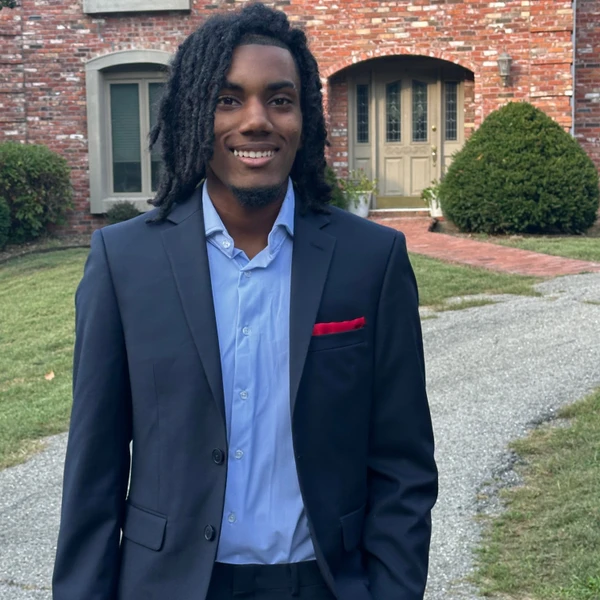
Right now, I’m focusing on classes that will bring me into my freshman year of college. I plan on studying psychology along with law studies focused on corporate issues. My GPA currently stands at 3.594, despite balancing schoolwork and athletic responsibilities. Running the Jack and Jill of America group means organizing events where helping others matters most. Being president entails tasks such as planning projects while remaining responsible and guiding others. On the field, participation in two university-level sports shapes how I handle pressure and stick with challenges long enough. Those experiences transfer directly into studying harder and reaching further than before. Caring for my grandfather when he fought constant back pain changed how I see my role in life. Instead of just helping now, I started thinking ahead about how laws can shape workplaces without leaving people behind. Over time, my aim grew clearer: apply business knowledge not solely to climb high personally, yet also to support open green spaces where neighbors connect easily. These spaces matter just as much as profits ever did.
Education
Capital City High School
High SchoolMiscellaneous
Desired degree level:
Doctoral degree program (PhD, MD, JD, etc.)
Majors of interest:
- Psychology, General
- Business, Management, Marketing, and Related Support Services, Other
- Law
Career
Dream career field:
Law Practice
Dream career goals:
Sports
Track & Field
Varsity2024 – Present2 years
Awards
- Academic honors conference sectional
Basketball
Varsity2023 – Present3 years
Awards
- Academic honors
- lettered for 3 years
Public services
Volunteering
Boy Scouts of America — Life Scout2020 – PresentVolunteering
National Honor Society — Member; mentor and tutor to peers2024 – PresentVolunteering
Kappa alpha psi Kappa League — President of the Jefferson City Chapter2025 – PresentVolunteering
Jack and Jill of America Inc. — Central Missouri Chapter Teen President2023 – Present
Future Interests
Advocacy
Volunteering
Philanthropy
Entrepreneurship
Virginia Douglas Memorial Scholarship for Change
Silence is powerful. It can protect, but it can also imprison. I have learned that many survivors of sexual violence live in that silence — carrying pain they never asked for, often feeling unseen, unheard, and alone. That reality is what draws me to social work.
I plan to study psychology and later pursue a law degree because I want to stand at the intersection of healing and justice. I want to understand trauma deeply — how it rewires the brain, how it impacts self-worth, how it lingers in classrooms and courtrooms long after the moment has passed. But understanding alone is not enough. I want to use that knowledge to advocate for policies, protections, and support systems that make it easier for survivors to come forward and begin rebuilding their lives.
My passion for social work is rooted in empathy and responsibility. I have always believed that leadership is not about being the loudest voice in the room, but about protecting those who struggle to speak at all. Survivors of sexual violence often face doubt, stigma, or fear of retaliation. That compounds the trauma. Social workers are often the first safe place someone encounters — the person who says, “I believe you,” and means it. I want to be that safe place.
Addressing sexual violence requires more than awareness; it requires action. In my future career, I intend to focus on trauma-informed counseling practices and legal advocacy for survivors. I want to work toward expanding access to mental health services in underserved schools and communities, where resources are limited and stigma is high. As an attorney, I hope to strengthen institutional accountability and ensure that survivors are not forced to navigate complex systems alone.
Even now, I practice advocacy through mentorship and leadership in my community. I strive to create environments where respect, accountability, and empathy are the standard. Real change begins in everyday conversations — challenging harmful jokes, supporting peers who confide in you, and choosing courage over comfort.
Sexual violence does not define survivors — but the support systems around them can define their recovery. I want to build systems that protect, uplift, and empower. That is why social work is not simply a career path for me. It is a commitment to justice with compassion.
Receiving the Virginia Douglas Memorial Scholarship for Change would allow me to continue pursuing an education centered on healing and advocacy. More importantly, it would help me carry forward a mission: to ensure that no survivor feels alone in their silence again. I am committed and determined to be part of that change.
Julia Elizabeth Legacy Scholarship
Diverse representation in STEM careers is essential because science and technology shape the systems that define our daily lives. From healthcare innovations to artificial intelligence, engineering, environmental planning, and public health policy, STEM fields influence who benefits from progress. When those developing solutions come from limited backgrounds, the solutions themselves can unintentionally overlook entire communities.
Representation in STEM ensures that innovation reflects the full diversity of society. Individuals from different racial, socioeconomic, and cultural backgrounds bring unique perspectives shaped by lived experience. These perspectives allow scientists, engineers, and researchers to identify problems others may not see. For example, medical research has historically lacked diversity in clinical trials, which has led to disparities in treatment effectiveness across different populations. When more voices are included in research and development, outcomes become more equitable and comprehensive.
Diverse representation also strengthens creativity and innovation. Research consistently shows that diverse teams outperform homogenous ones when solving complex problems. STEM careers require collaborative thinking, adaptability, and breakthrough ideas. When individuals with varied experiences work together, they challenge assumptions, push boundaries, and arrive at solutions that are more thoughtful and forward-thinking. Innovation thrives when it is inclusive.
Beyond improving outcomes, representation also inspires the next generation. Young students are more likely to pursue careers when they see people who look like them succeeding in those fields. Without visible role models, talented students may unconsciously believe certain careers are not meant for them. Increasing diversity in STEM creates a cycle of opportunity where today’s representation becomes tomorrow’s motivation. Access to STEM careers should not be limited by background but expanded by it.
Diverse representation in STEM is also tied to economic and community advancement. Many STEM careers are high-growth, high-impact professions that influence infrastructure, healthcare systems, environmental sustainability, and business innovation. When underrepresented groups gain access to these spaces, entire communities benefit through economic mobility and problem-solving that directly addresses local needs. Inclusion in STEM is not simply about fairness. It is about maximizing societal potential.
Finally, equity in STEM careers is critical to building trust in science itself. Communities are more likely to engage with and support scientific initiatives when they see themselves represented within those fields. Trust fuels collaboration, and collaboration fuels progress.
In a world increasingly shaped by technology and scientific advancement, the question is not whether diversity matters. It is whether we can afford to move forward without it. Diverse representation in STEM ensures that innovation is not only groundbreaking but also inclusive and transformative for everyone.