user profile avatar

Ndeji Omekongo

1x

Finalist

Bio

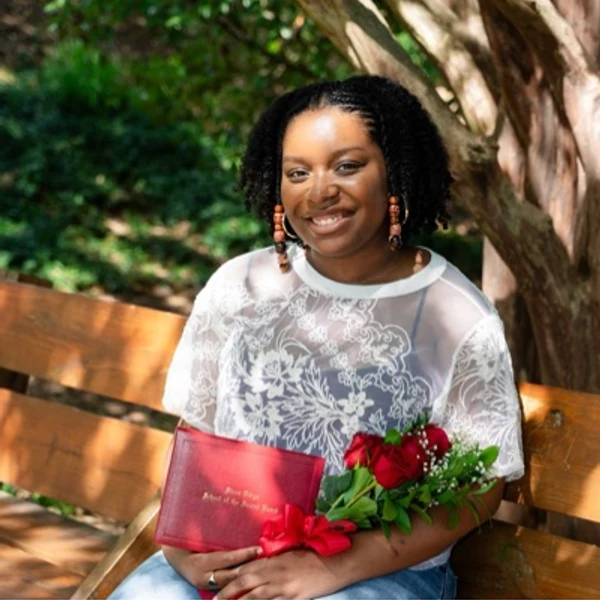
My name is Ndeji Nyla Muadi wa Omekongo, and I am a reader, a musician, a chef, a chemist, a middle child, a writer, an ethicist, and so much more. As a longtime student of a Sacred Heart institution, I strongly believe that a holistic education is the key to not only bettering ourselves, but to bettering our world. For this reason, I seek out as many diverse opportunities to learn as possible and plan to pursue a graduate-level education. I love to play the flute, both as a soloist and in various ensembles—I've played just about everywhere from the National Gallery of Art to community centers in Barbados and Trinidad to the pit in my school’s theater—and I am the chair of our Black Student Alliance, where I organize community events, invite guest speakers to campus, and work with administrators to promote inclusivity throughout our school. I am deeply passionate about natural hair care, and this passion has inspired my intended chemistry major. I want to research cosmetic product formulation to create a world where women of color do not feel obligated to hide their natural hair under chemical relaxers and synthetic extensions and potentially risk their health using affordable products made with known carcinogens just to be “presentable.” I believe everyone deserves the knowledge and the means to learn, love, and be transformed by their hair as I have been, and I plan to use my college education to make this meaningful change possible. Thank you for your consideration.

Education

Stone Ridge School of the Sacred Heart

High School
2022 - 2026
  • GPA:
    4

Miscellaneous

  • Desired degree level:

    Doctoral degree program (PhD, MD, JD, etc.)

  • Majors of interest:

    • Chemistry
  • Not planning to go to medical school
  • Career

    • Dream career field:

      • Cosmetics
    • Dream career goals:

      By specifically researching cosmetic chemistry and social policy, I hope to educate my community on the harmful chemicals commonly used in hair products that they should avoid exposure to, learn how to effectively reduce production costs to make quality hair care a justifiable expense, strengthen legislation to combat hair-based discrimination in the workplace, and ultimately create a world where women of color are not pressured to hide their natural hair and potentially risk their health just to be “presentable.”

    • Administrative Assistant

      OrigiNation Cultural Arts Center
      2024 – 2024
    • Administrative Assistant

      Bikram Yoga Works
      2022 – Present4 years
    • Administrative Assistant

      These Eyes of Mines
      2023 – 20241 year
    • Summer Camp Intern

      DC Youth Orchestra
      2025 – 2025

    Sports

    Volleyball

    Varsity
    2022 – 20242 years

    Research

    • Chemistry

      Independent Research (Stone Ridge School of the Sacred Heart) — Student Researcher
      2025 – 2026

    Arts

    • Stone Ridge Theater Department

      Theatre
      Into the Woods, The Sound of Music
      2025 – 2026
    • DC Youth Orchestra Program

      Music
      2022 – Present

    Public services

    • Volunteering

      Project Linus — Student volunteer (knitting, crocheting, and quilting)
      2024 – Present

    Future Interests

    Advocacy

    Politics

    Volunteering

    Philanthropy

    Entrepreneurship

    Byte into STEM Scholarship
    Earlier this year, my African American Studies teacher shared that to truly learn something is to be transformed by it in every possible way. This reminded me of a similar concept Catholic education has instilled in me: that to love deeply is to be transformed. These philosophies have manifested in my personal life through my relationship with my hair, and they have greatly shaped my vision for the future. My journey of learning to care for my kinky hair first started five years ago, when I made the decision to comb out my sisterlocks. The transition was full of ups and downs; in those early days, I struggled to achieve the results I wanted and often regretted my choice. I dreaded every wash day and quickly fell into a routine of constantly wearing braids to avoid dealing with the damage my hair had undergone. Eventually, my chemistry and biology classes introduced me to things like the function of surfactants in shampoos and the causes behind protein denaturation, and I was inspired to apply what I learned to my own hair routine. I explored the science behind different ways to revitalize my hair, like deep conditioning with heat to restore lost moisture and using products with high amounts of protein to ensure the integrity and longevity of my hair shaft. In the years since, growing more knowledgeable about the chemical components in different products has only made me more passionate about my hair. Even though some days my arms ache and frustration gets the best of me after hours of styling, my hair has become a true labor of love that I can’t describe as anything other than transformative, and it is something for which I am eternally grateful. While hair has become my personal beacon of scientific discovery and self-love, I know that this experience is not universal. To this day, countless Black women continue to hide their natural hair under relaxers and wigs due to decades of messaging that curly hair is too unruly and difficult to maintain. Unfortunately, this isn’t entirely false; hair products and extensions marketed towards Black women have historically been formulated with known carcinogens, and the ones that aren’t are often too expensive to justify repeated purchase. This reality along with the enduring stigma that kinky hair is too unprofessional for the workplace and classroom have discouraged so many women from embracing their hair the way it grows naturally. I have seen this internalized stigmatization in my own life, from watching friends and family constantly opt for synthetic extensions over their curls and flat irons over styling brushes. We cannot allow this internalized stigmatization to continue. Relaxers and wigs should be a personal choice, not a societal mandate, or the sole financially viable option. Everyone should have access to the means and to the knowledge necessary to make an informed decision, because everyone deserves to learn and to love their hair. This is why I intend to study chemistry at the University of Chicago. I specifically hope to research cosmetic product formulation so that I can create a world where women do not feel obligated to hide their natural hair for convenience’s sake, or potentially even risk their long-term health for affordable hair care. Learning to properly maintain my hair turned what was once my heaviest burden into my strongest source of pride and self-confidence, and I want to use my college education to inspire others in my community to undergo similar transformations of knowledge and love.
    Charles B. Brazelton Memorial Scholarship
    There’s a good number of “awkward” things you might notice about me upon first glance: I don’t wear acrylics or press-ons, but I keep my natural nails long (although rarely at a uniform length); my left arm is permanently bent inwards as the result of a birth injury to my brachial plexus system that not even a surgery from 7 years ago could fully correct; and at school you’ll often find me carrying my flute, my piccolo, and multiple binders full of music in addition to my backpack because I get nervous leaving my most prized possessions unattended. All of that said, however, I find that the most “awkward” thing I could tell you about me lies right on my face. Allow me to provide some context: I have been wearing glasses since the first grade (read: for the past eleven years, I’ve been teased for my poor eyesight by friends and family alike). And to make matters worse, my prescription has only intensified over time. I’m almost embarrassed to admit that at just seventeen years old, I already require bifocal lenses. But funnily enough, as my prescription grew more severe, the teasing, less so. I could attribute this to countless things—a loss of interest, or my peers simply “growing up”— and yet somehow I believe it all ties back to the confidence of the wearer. My first pair of glasses were probably the most unfortunate accessory to ever descend upon a six-year-old’s face. The frames were black and narrow rectangles, strikingly reminiscent of something you might see on the “readers” shelf at Walgreens. Looking back, if I have anything to actually be embarrassed to admit, it’s that I thought they made me look cool. My glasses today couldn’t stray further from that first dismal pair; little by little, as I grew in my own self-assuredness, the frames I wore became more expressive and more representative of who I was becoming. My current everyday frames are bright purple and extensively oversized, to the point where my glasses are usually the first accessory anyone will remark about me, and though they may be “awkward,” they are my pride and joy. I believe my glasses have given me my own unique way of seeing the world. Purple is the color of my imagination, my creativity, and most importantly, the untapped possibility all around me of which I am always working to take advantage. I’m proud to say it is the color that contextualizes my outlook on life. Seeing the world in purple means I understand my environment not for what it is, but what it can be. It means instead of becoming overwhelmed by the new academic pressures of high school, I strengthened my relationships with my teachers and created new study systems that allowed me to become the valedictorian of my class. It means instead of accepting that interest in my school’s Black Student Alliance was low, I reached out directly to students with engaging meeting topics that brought our attendance up to 50+ members at all twelve of our lunch meetings this year. It means that when I spent the summer working for the very optician that sold me these frames, instead of leaving her extensive paper files disorganized, I spent days alphabetizing and dating all her invoices and client notes to streamline her office system and maximize the space available. Some may see the world through rose-tinted glasses, but I’m proud to say my purple rimmed lenses empower me to problem-solve, build, and lead, and I have to ask: what’s so awkward about that?
    Julie Adams Memorial Scholarship – Women in STEM
    My journey of learning to care for my kinky hair first started five years ago, when I made the decision to comb out my sisterlocks. The transition was full of ups and downs; in those early days, I struggled to achieve the results I wanted and often regretted my choice. I dreaded every wash day and quickly fell into a routine of constantly wearing braids to avoid dealing with the damage my hair had undergone. Luckily, my chemistry and biology classes eventually introduced me to things like the function of surfactants in shampoos and the causes behind protein denaturation, and I was inspired to apply what I learned to my own hair routine. I explored the science behind different ways to revitalize my hair, like deep conditioning with heat to restore lost moisture and using products with high amounts of protein to ensure the integrity and longevity of my hair shaft. In the years since, growing more knowledgeable has only made me more passionate about my hair. Even though some days my arms ache and frustration gets the best of me after hours of styling, my hair has become a true labor of love that I can’t describe as anything other than transformative, and for that I am eternally grateful. While hair has become my personal beacon of scientific discovery and self-love, I know that this experience is not universal. Allow me to take it back a few decades. The year was 1999: Black women had TLC’s FanMail, Phat Farm streetwear, and Fashion Fair cosmetics, but most of all, they just wanted a decent shampoo. Enter Andre Walker, famed hair stylist to Oprah Winfrey. To promote sales for his new product line, Walker published a fundamental hair typing chart that categorized hair textures on a scale from bone straight to densely coiled. I imagine he thought himself something of a revolutionary; by breaking down textures into simple terms and diagrams, Walker made it so that the average consumer could understand his categorization and easily observe it in their own hair. But at what cost? First and foremost, the chart assigns straight hair, most common among those of European descent, as the base, or “Type 1,” from which every other type strays. By denoting curlier hair as some sort of genetic aberration, Walker contributed, however indirectly, to the veneration of white features at the center of society. Walker’s system included enough detail to supersede the broad Caucasian, Asian, and African racial classifications that had previously persisted among scientists, but racial stigmatization endured nonetheless. Kinkier hair, primarily found amongst people of African descent, had a reputation of being impossible to control; it was irreparably dry, fragile, and was much better appreciated under wigs, relaxers, and protective styles like braids. In attributing these qualities to what he called “Type 4” hair, Walker only gave a name to a hair type already condemned by society at large. Revolutionary? I think not. Because it was already pronounced more difficult to maintain, it’s no surprise that Walker encouraged people with Type 4 hair to buy straightening products on top of his basic line of shampoos and conditioners. They were expected to develop more complex and more expensive routines than those of their straight-haired counterparts. Why should your genes determine whether or not your hair maintenance poses a financial burden? Walker additionally did not consider the fact that most heads are not uniform. Case in point: the hair at the nape of my neck has a much tighter coil than the strands closer to my temple. Where does that leave me on this all-encompassing chart? Where do I fit in? Lastly, and perhaps most importantly, Walker’s system was not based in irrefutable scientific research, but rather formulated as a marketing strategy to sell products. What does it say about our society that perpetuating centuries-old stigmas is an acceptable way to advertise commercial goods? Asking myself these questions and many more has led me to realize that despite the increasing levels of research and awareness surrounding natural hair care in the years since this chart was published, costliness and enduring stigma continue to block the industry from being accessible across the board. Unfortunately, no amount of “Type 4 curly girl” influencers or expensive all-natural salon treatments can singlehandedly undo our society’s flawed approach to textured hair maintenance. So for all these reasons and many more, I believe it is time to free ourselves from this chart and all the stigmas it subtly reinforces. Modern hair care would most definitely unravel. It would be a marketing nightmare for hair care companies to redefine their target audiences and lab technicians would have to formulate a whole new classification system to guide their research, but imagine where this collective rebrand could take us as a society. Imagine what we could do. Imagine a world where hair care is an equitable social enterprise, rooted in science and not sales. In inclusivity and not assimilation. Pretty awesome, no? This is where my passions for cosmetic chemistry and sociology intersect: the vision of a world where Black women are encouraged to flaunt their natural curls and given the tools to do so with ease rather than burden. But alas, once something’s put out into the world, there’s no taking it back. Since I unfortunately cannot uninvent Walker’s system, I’ll settle for appreciating what it got right. For one, it is important to acknowledge that there are different hair types that require uniquely tailored maintenance routines. But instead of manipulating curly hair to mimic a subjectively Eurocentric beauty standard, we can tailor those routines using measurable scientific properties, like hair porosity and elasticity, in a way that allows people of all ethnicities to embrace their hair the way it grows out of their heads. And it’s true that kinkier hair experiences more dryness and brittleness due to the difficulty natural oils have traveling down a coiled hair shaft, but instead of accepting that as an incurable symptom of a genetic disease, we can start teaching people science-backed methods to restore moisture to their strands. Everyone deserves the resources and the means to learn, love, and be transformed by their hair as I once was all those years ago, and I plan to use my college education to make this meaningful change possible.
    Katie's Alcove Scholarship
    My hair is dead. It might look healthy, or thick, or moisturized, but the fact remains: it’s dead. The fact that my hair, dead as it may be, remains chemically active has fascinated me ever since I combed out my sisterlocks five years ago. The reality that my hair is the basis of centuries of discrimination against Black women in professional spaces and that its maintenance can often pose significant health risks deeply unsettles me. This is why I want to research cosmetic chemistry and sociology: to create a world where women are not obligated or expected to hide their natural hair and potentially even risk their health with toxic chemical relaxers all for the sake of being “presentable.” I'm proud to say that, five years into my journey, I've grown into my hair; I know which styles suit me and which products are more likely to leave me with days of dryness and flaking versus the ones that will result in thoroughly moisturized strands, and I've reached a point where my hair is my favorite accessory to any look. However, this is not the case for so many of the Black women in my life. I once asked my best friend Sam why she always chose to wear rope twists, and her response echoed the sentiment I'd heard countless times before: "it's just easier." Sam loved the added length the synthetic extensions provided, but more importantly, she appreciated not having to battle with her knots and tangles every morning or spend hours on a wash day only to end up disappointed with the results right before she had to go out. To me, having my hair "done" for an event looks like a fresh braid out or a wash and go, but to many of my friends and family, it looks like a silk press or knotless braids: essentially any style that is easily manipulated and therefore more manageable and "polished". While they are all beautiful styles, it pains to see so many women deem their natural curls not suitable or for most occasions. What's more, because it has been widely pronounced more difficult to maintain, it’s no surprise that people with textured hair are often encouraged to buy countless products on top of basic shampoos and conditioners, developing more complex and more expensive routines than those of their straight-haired counterparts. Natural hair is not hard. Kinks and coils are not unmanageable. But when the most affordable products are the ones formulated with harmful chemicals and known carcinogens, then of course natural hair care becomes daunting to even consider. No budget, stigma, or circumstance should be the deciding factor between a head of healthy hair and repeated exposure to toxic chemicals or protective styles worn too long that can inadvertently cause damage to the hair. This is the unfortunate reality I plan to use my education, supported by this scholarship, to unravel; whether it be by formulating more affordable products rooted in healthy ingredients and science or by showing those around me how simple yet effective hair routines can change their perception of their natural curls, I hope to inspire my community to embrace their hair the same way I did all those years ago. My hair might be dead, but exploring its properties and observing its social implications has not only allowed my passions for chemistry, social policy, and cosmetology to thrive, but has given me new life, and I wouldn’t trade it for the world. I hope that by investing in my passion, you will help me to leave a meaningful impact on all those around me.
    Love Island Fan Scholarship
    Challenge Name: “The Chemistry Check” Picture this: the Islanders wake up to a text. “Islanders, love is in the hair. Tonight, your chemistry will be tested. Literally. #NoDryEnds #SecureTheBond” Welcome to The Chemistry Check, a Love Island challenge where couples have to prove that attraction is cute, but communication, curiosity, and proper moisture retention are what really keep a relationship alive. The challenge begins with every couple entering the “Villa Lab,” which is decorated with beakers, oversized shampoo bottles, silk bonnets, shower caps, and one suspiciously dramatic fog machine. Each couple is assigned a hair “client” mannequin with a unique set of needs: dry curls, product buildup, heat damage, frizz, breakage, or a mystery scalp crisis. As someone who once combed out her sisterlocks and spent years learning how to love and care for my kinky hair, I can confidently say this is not a game for the weak. Round One is called “Know Your Ingredients.” One partner is blindfolded while the other has to guide them through choosing ingredients for a hair product. The options include shea butter, aloe vera, water, oils, proteins, sulfates, silicones, and surfactants. Pick too many harsh cleansing agents, and your mannequin’s curls become dry and betrayed. Pick no cleansing agents at all, and the buildup wins. Tragic. Round Two is “Routine Roulette.” Couples must create a full wash day routine in under five minutes: cleanse, condition, detangle, moisturize, style. The catch? One partner can only speak in compliments, while the other can only ask clarifying questions. “Your technique is beautiful, but are we using the wide-tooth comb before or after the conditioner?” That is romance. Round Three is “The Recoupling Rebrand.” Each couple presents their finished hair-care product and gives it a name, slogan, and dramatic pitch. My personal winning product would be something like Coil Chemistry: rooted in science, not sales. The judges score each couple on communication, creativity, scientific accuracy, and whether their mannequin looks ready for Casa Amor or a deep-conditioning intervention. The winning couple gets a private spa night with silk pillowcases, mocktails, and absolutely no cheap 3-in-1 shampoo. More importantly, they earn the title of “Best Chemistry in the Villa.” I would create this challenge because Love Island is already obsessed with chemistry, but usually only the romantic kind. I want to see a challenge that proves real chemistry is about listening, adapting, and caring for someone’s needs without forcing them to become easier to handle. Whether in the villa, in a lab, or in my own natural hair journey, love works best when it is informed, intentional, and just a little bit dramatic.
    Sabrina Carpenter Superfan Scholarship
    I am a fan of Sabrina Carpenter because her career has been connected to so many stages of my own growing up. In middle school and early high school, she was a huge part of my life- Girl Meets World was one of my favorite shows, and Maya was my favorite character. I admired Maya for her humor and confidence, but at the end of the day, what struck me most was her undying love for those who mattered to her. At that age, I was also figuring out who I was, and seeing how Sabrina Carpenter portrayed such a nuanced character gave me insight into who I wanted to become. As I got older, I started paying more attention to Sabrina Carpenter beyond acting. Her transition from Disney actress to singer and songwriter showed me what it looks like to grow without being limited by the version of yourself that other people first knew. That has impacted me because I have also had to grow into different parts of myself. As a Black Congolese-Grenadian student, a musician, a chemistry scholar, and someone who has spent years learning to love and care for my natural hair, I understand how important it is to define yourself instead of letting other people decide who you are supposed to be. This understanding became even clearer to me when I saw Sabrina Carpenter on the Emails I Can’t Send tour with my sister and my father years ago. The concert itself was amazing, but the night became unforgettable for a ridiculous reason: while we were inside the venue, my dad’s car was broken into, and someone stole my bag. The funniest part is that there was almost nothing valuable inside, just a library book and a phone charger. It was stressful at the time, but now it is one of those family stories that makes us laugh. That memory represents why I associate Sabrina’s artistry not only with music, but with joy, family, and moments that become part of your personal history. As someone who has played flute since I was eight and has performed with DC Youth Orchestra and OrigiNation Cultural Arts Center for years, I also admire the discipline behind her career. Performing takes confidence, preparation, and the willingness to be vulnerable in front of people. Sabrina’s songwriting, humor, and stage presence remind me that art can be both polished and personal. Her career has shown me that creativity does not have to fit into one category, and that growth can be public, imperfect, and still powerful. Even though I do not listen to her music as regularly today, I still have a lot of fond memories tied to her work. Sabrina Carpenter’s career has impacted me by reminding me that growing up does not mean abandoning earlier versions of yourself. Sometimes, it means carrying those memories with you in order to become more confident in your own voice.
    Hester Richardson Powell Memorial Service Scholarship
    After an unprecedentedly stressful junior year, I had only one goal going into summer break: do something you love. It was with this in mind that I applied to intern at my youth orchestra’s summer camp, where I’d teach beginner flute lessons and supervise some kids in recess and art class. The opportunity to welcome young kids into a community that had changed my life three years prior was everything to me. After I’d gotten the internship, I felt more energized than I had in a long time. I ended my junior year on a high note, excited for what lay ahead. Nothing could have prepared me for the news of my grandmother’s passing, a mere two days into summer. I struggled to form words in my teary confusion. How could she be gone? Too much was still unfinished. That summer, I was supposed to come up to Boston and play my flute for her. We were supposed to watch Dragon Ball Z. She was supposed to teach me Swahili. She was supposed to see me graduate. We were supposed to have more time. In the weeks that followed, I struggled to find much excitement in anything. I now dreaded the internship I had once dreamed of, but before I knew it, the time to go to work had come. The shift from spending most days home with family to every day surrounded by hyper children and unfamiliar colleagues was difficult to manage at first, but by the end of the first week, I fell into a rhythm with my students and coworkers, and I began looking forward to work again. Every day during recess, Ava, one of my eight-year-olds, would sit near me instead of playing with her peers, insisting that we play Uno while she asked incessant questions about the different instruments and pried into personal life. At first, I found it difficult to reciprocate her enthusiasm, but little by little, she yanked me out of my shell and showed me that working with kids meant putting my personal struggles aside to meet them where they are. Watching students like Ava enter the program unsure of why they were there and gradually find confidence as they explored different instruments and learned about themselves assured me: this was where I needed to be. After my grandmother’s service, I wasn't sure if I’d be ready to face everybody at camp so soon. I spent the trip back to DC once again dreading the job I knew I loved, scared I wouldn’t be able to stay positive for the kids I’d been charged with supporting, but my fears were quickly put to bed the next morning, when Ava ran to me and squeezed me in an embrace. She immediately started telling me how much she loved the violin and how excited she was to take formal lessons when the school year started up again. When she thanked me for helping her choose and joked that I wasn’t allowed to miss any more days of camp, I realized that even though I was struggling through a loss, consistently showing up for Ava with encouragement and enthusiasm inspired her to start what was sure to be an incredible journey with a program that meant the world to me. Tears of pride welled in my eyes: I achieved my goal.
    Redefining Victory Scholarship
    Code Breakers & Changemakers Scholarship
    My journey of learning to care for my natural hair first started five years ago, when I combed out my sisterlocks. In the early days of my transition, I often regretted my choice; I thought my new hair texture was ugly and unkempt, and had no clue what to do with myself. Luckily, after my chemistry and biology classes introduced me to things like the function of surfactants in shampoos and the process of protein denaturation in the hair shaft, I grew inspired to research further and apply what I learned to my own routine. As a result, my hair has transformed into a labor of love I wouldn’t trade for the world. While hair is my own beacon of scientific discovery and self-love, I know that this experience is not universal. To this day, countless Black women continue hiding their hair under relaxers and wigs due to decades of messaging that our curly hair is unmanageable. This isn’t entirely false; hair products and extensions marketed towards Black women are commonly formulated with known carcinogens, and the ones that aren’t are often too expensive to justify repeated purchase. This along with the enduring stigma that kinky hair is too unprofessional for school or for the workplace discourage too many women and girls from embracing their hair. We cannot allow this stigmatization to continue. Relaxers and wigs should be a personal choice, not a societal mandate. This is why I plan to study cosmetic chemistry in college: to create a world where Black women do not feel obligated to hide their natural hair and potentially risk their health just to be seen as beautiful. My goal of changing the world through hair was greatly shaped by Toni Morrison’s The Bluest Eye, which I read in AP English Language last year. Throughout the novel, Eurocentric beauty standards—yellow (straight) hair, light skin, blue eyes—are forced onto the children at every turn and ultimately lead to Pecola Breedlove’s devastating demise, exposing the deeply rooted impacts of internalized oppression on young girls of color. I believe we can turn these internalized stigmas around. Last month, a Black middle schooler came up to me asking how I got my hair to look so pretty. I was wearing a twist out. Beyond nearly bringing me to tears, our conversation showed me that I can empower young Black girls to love their hair as much as I do. I know I can make a lasting positive impact through scientific study, and the Code Breakers & Changemakers Scholarship will help me make this goal a reality. To me, my goal means creating the resources to educate our community on the harmful chemicals they should avoid exposure to in products. It means researching ways to effectively reduce production costs to make quality hair care a justifiable expense. And most importantly, it means leading young Black girls by example, so that they never stop to think that the hair that grows out of their head is anything less than beautiful. I believe everyone deserves the resources and the means to learn, to love, and to be transformed by their hair, and I hope to use my college education, supplemented by the Code Breakers & Changemakers Scholarship, to make this meaningful change possible.