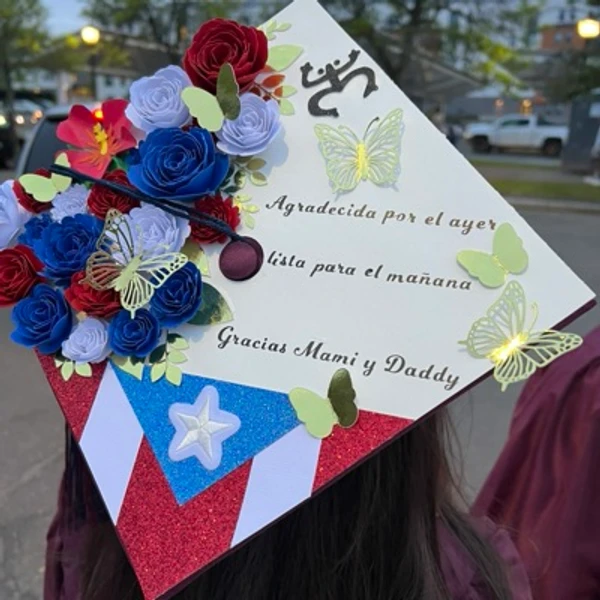
Growing up in Holyoke, Massachusetts, I was surrounded by a reality that often felt designed to keep dreams small. Holyoke is a city rich in culture, but it is also a place heavily impacted by poverty, gang violence, and systemic barriers—a environment where families, including my own, are often forced to put their personal passions on permanent hold just to survive and raise the next generation. As a first-generation Puerto Rican woman, the idea of pursuing a career in high-level science always felt incredibly abstract. I did not grow up seeing people who looked like me dominating research labs or navigating complex scientific fields. For a long time, I didn't even realize I could pursue science as a career because it felt out of reach. Yet, looking back at my life, I realize I was subconsciously laying the brickwork for a biology degree all along, driven by a simple, relentless force: a profound curiosity about how the world works.
That curiosity started with the media I consumed as a child—shows like Wild Kratts, Odd Squad, and the world of Pokémon—which transformed the natural world into a giant puzzle waiting to be solved. As I grew older, that childlike wonder evolved into an academic hunger. When I reached high school, I threw myself into every science elective available. During my cell biology class, I became completely enamored by the microscopic structures of life, spent hours fascinated by cellular systems, and couldn't stop talking about what I was learning. Noticing how deeply captivated I was by the subject, my mom went out and bought me my very own microscope complete with a set of slides. Having that instrument at home allowed me to bring my curiosity into our living room, bridging the gap between a high school classroom and my actual life. It was a tangible reminder that my passion was real, and that my family was fully backing my dreams. I didn't just stick to a single lane; I wanted to understand everything. I loved geology, forensics, zoology, chemistry, and physics. Each subject offered a different lens to view reality, and I found a unique happiness in simply investigating my questions.
This passion for structured investigation truly solidified through the Advanced Placement program at my high school. In AP Seminar and AP Research, I learned that scientific inquiry isn't just about test tubes; it is about analyzing human and environmental systems. For my AP Research thesis, I conducted a deep-dive study on how the romanticized portrayal of fictional vigilantes influences adolescent perceptions of real-world violence. The project was incredibly rigorous, but the hard labor paid off when I earned a medal for Excellence in Presentation, placing me in the top ten students of the entire course. In AP Seminar, I examined the intersections of spirituality and its physical, measurable effects on cancer patients. I tackled complex socioeconomic studies, analyzing the layers of gentrification, colonialism, and diaspora through the lens of modern cultural figures like Bad Bunny. I investigated how PTSD and intense societal pressures influence youth mental health, and explored the ecological devastating effects of climate change on polar bear populations.
These intense courses taught me how to read data, build arguments, and stand confidently behind my work. AP Seminar, quite literally, made me lose hair from the sheer stress of its workload. But it taught me a valuable lesson that I will carry with me to the University of Massachusetts Amherst: what doesn't kill you makes you stronger. I grew exponentially from those challenges, and the academic road ahead became clearer because of it.
I was not alone on this journey. I am forever grateful to the remarkable educators who saw my potential before I fully recognized it myself. My AP Seminar teacher, who also taught me in the ninth grade, provided the exact kind of tough love I needed. She was demanding in the classroom but fiercely supportive outside of it, watching me grow and providing the foundational presentation and analytical skills I will use for the rest of my life. Similarly, my Algebra II teacher noticed my affinity for numbers and constantly questioned why I wasn’t in honors classes. To my surprise, she fast-tracked my name into an accelerated summer pre-calculus program so that I could take AP Calculus as a senior alongside accelerated juniors. My AP Calculus teacher, who had previously taught me geometry, welcomed me with open arms, guiding me through complex mathematical concepts with endless patience and love. These women wrote my recommendation letters, championed my growth, and gave me the academic confidence to pursue a STEM degree.
My passion for biology is also deeply tied to my community. While volunteering as a bilingual kiosk assistant at the Holyoke Medical Center, I got a first-person look into the healthcare system and the vulnerabilities of my community. I spent my shifts helping elderly, Spanish-speaking Puerto Rican residents navigate digital intake screens and complex medical documentation. I saw firsthand how a lack of representation and language barriers leave vulnerable populations isolated. This experience showed me that my love for science cannot exist in a vacuum; it must be used as a tool to bridge these systemic gaps.
By pursuing a biology degree at UMass Amherst, I am choosing to be a cycle breaker. I am entering a STEM field where Puerto Rican women are historically underrepresented to show the next generation that we can dominate in any arena we choose—not just the cannabis shops, music, or arts that society expects us to limit ourselves to. I want to live a life fueled by what makes me happy and curious, while simultaneously honoring the immense sacrifices my family made for me to reach this point. Pioneering my path as a first-generation college student is my way of sticking it to the man and proving that our stories are defined by our brilliance, our ambition, and our capacity to heal the world.