
Hobbies and interests
Athletic Training
Sports
Baking
Writing
Reading
Health
Academic
Literature
I read books multiple times per week
Nathalia Marie Jackson
1x
Finalist
Nathalia Marie Jackson
1x
FinalistBio
My name is Nathalia Marie Jackson. My life hasn’t followed a straight line, but every challenge has shaped who I am and what I stand for. Losing my father to gun violence and living with Crohn’s disease taught me resilience early on. Instead of letting those experiences define my limits, I used them to define my purpose and deepen my empathy for others.
My life goals are centered on advocacy, service, and leadership. I want to work with communities affected by violence, illness, and hardship, creating spaces where people feel seen, supported, and not alone. Through public service or community leadership, I aim to turn personal pain into meaningful impact and be a voice for those who feel overlooked.
I am most passionate about people—especially those quietly carrying burdens others don’t see. Through over 2,000 hours of service with Justice for Homicide Victims, tutoring, and leading initiatives like Relay for Life, I’ve committed myself to showing up for others. I value not only large-scale impact, but also the small, consistent acts of care that build trust and connection.
I am a strong candidate because I don’t just achieve—I persist. Maintaining a 3.86 GPA while taking rigorous courses, serving as ASB President and team captain, and competing as a four-year athlete reflects my discipline and determination. Balancing these responsibilities while managing a chronic illness has strengthened my resilience and time management. More importantly, I lead with empathy—I listen, I notice, and I act.
Education
University of California-Los Angeles
Bachelor's degree programMajors:
- Physiology, Pathology and Related Sciences
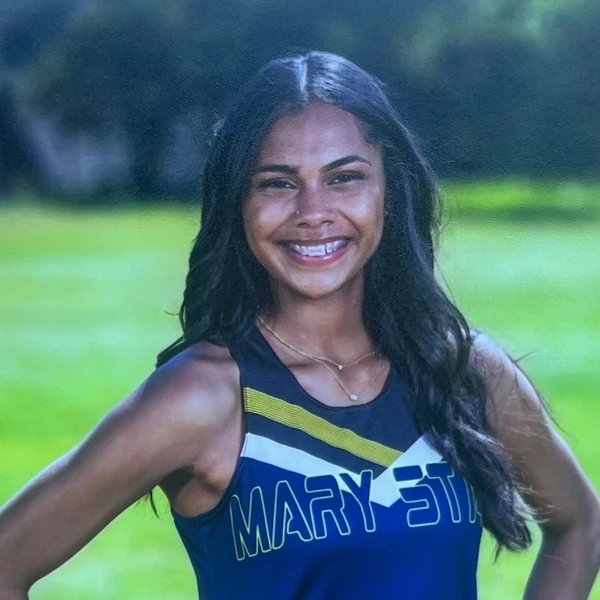
Mary Star of the Sea High School
High SchoolMiscellaneous
Desired degree level:
Bachelor's degree program
Graduate schools of interest:
Transfer schools of interest:
Majors of interest:
- Physiology, Pathology and Related Sciences
- Mental and Social Health Services and Allied Professions
Career
Dream career field:
Medicine
Dream career goals:
Intersection of Physical and Mental Health
Mentor/Tutor
Mu Alpha Theta Tutoring2025 – 20261 year
Sports
Cheerleading
Varsity2023 – 20263 years
Awards
- Best Flyer
- Most Spirited
- Best Technique
- 2025-2026 Captain
Track & Field
Varsity2023 – 20263 years
Awards
- CIF 4x1 Champion
- 2023-2024 Girl's League Champion
- 2023 MVP
Golf
Varsity2025 – 20261 year
Public services
Volunteering
Church Organization — Volunteer2024 – 2026Volunteering
Relay for Life — member2025 – 2026Advocacy
Justice for Homicide Victims — Advocate2015 – 2026
Future Interests
Advocacy
Volunteering
Science and Advocacy Scholarship
Science became personal to me before it became academic. I did not first fall in love with science from a textbook. I began paying attention to it while sitting through infusions for Crohn’s Disease, trying to understand why my body could look fine on the outside while fighting so much on the inside.
Being diagnosed with Crohn’s during my sophomore year changed the way I saw the human body. I became fascinated by inflammation, the immune system, nutrition, stress, and the gut-brain connection. I started to understand that science is not just formulas or vocabulary words. It is the reason doctors can look at a symptom and search for its cause. It is the reason a treatment plan can give someone their life back. It is also the reason I want to study Physiological Science at UCLA and eventually become a Mental Health Nurse Practitioner. I want to understand the body deeply enough to care for the whole person, especially people whose pain is not always visible.
My passion for science grew outside the classroom because I had to live with questions science could help answer. At appointments, I learned to ask what my labs meant, why my symptoms changed, and how treatment affected more than one part of my body. I became especially interested in how physical health and mental health affect each other. When someone is constantly sick, tired, grieving, or scared, the mind and body do not separate neatly. I want to study that connection so I can one day help patients feel understood instead of dismissed.
My advocacy for science comes from believing that information should not only stay in hospitals, classrooms, or research papers. It should reach people in a way they can understand and trust. As Relay for Life President, I helped support cancer awareness, fundraising, and community participation because science is part of hope. Cancer research can sound distant until it is connected to a family, a survivor, or a community walking together. Through Justice for Homicide Victims, I also learned how important it is to communicate difficult truths with compassion. Advocacy taught me that people listen when facts are paired with humanity.
That is the kind of scientific advocate I am becoming. I want to make science less intimidating, especially for underserved communities, young people, and families who may already feel overwhelmed by illness, trauma, or medical language. If science is not championed, misinformation fills the silence. People may delay care, distrust treatment, or believe they are alone in what they are experiencing. I know how dangerous silence can be.
Science gave me language for my own body. Advocacy gave me a voice to use beyond myself. In college and in my future career, I want to bring both together: the discipline to understand science and the heart to explain it in a way that helps people feel seen, safe, and empowered to seek care.
Learner Math Lover Scholarship
The first time I realized I loved math, it did not look like a math class. It looked like a lab result.
Living with Crohn's disease taught me that numbers can tell a story before words can. A test result, a dosage, a pattern of symptoms, or a change in inflammation can help explain what a person's body is trying to say. At first, those numbers felt intimidating because they were connected to pain, uncertainty, and questions I could not always answer. Over time, I began to see math differently. It became a way to turn fear into understanding.
That is what I love most about math. It gives structure to things that feel overwhelming. In school, math has taught me to slow down, look for patterns, and solve problems one step at a time. Those same skills have helped me outside the classroom, whether I was balancing academics with cheer, leadership, health challenges, or community service. Math reminds me that even complex problems become possible when I refuse to panic and focus on the next step.
As I prepare to study Physiological Science at UCLA, I know math will continue to be part of my future. The human body may seem emotional and unpredictable, but science depends on measurement, data, and patterns. I want to become a healthcare professional who uses both compassion and evidence to help people feel seen. Math will help me understand research, read medical information carefully, and make decisions that can affect real lives.
I also love that math is honest. It does not erase hardship, but it gives me tools to respond to it. My experiences with illness, grief, and service have shown me that people often carry struggles that are hard to measure. Still, math can help us identify needs, study health disparities, and create better systems of care.
To me, math is not just equations on a page. It is a language of problem-solving, healing, and possibility. I love math because it helps me make sense of the world and gives me one more way to serve it.
Arthur and Elana Panos Scholarship
Faith has not made every hard thing in my life disappear. It has taught me how to keep showing up when hard things remain.
When I was five years old, my father was taken by gun violence. For a long time, that kind of loss felt too big for me to understand. I only knew that someone I loved was gone, and that my family had to learn how to keep living with an empty space that could not be filled. As I grew older, my faith helped me believe that pain did not have to become the end of my story. It could become part of the reason I serve.
That belief became even more important when I was diagnosed with Crohn's Disease during my sophomore year. Monthly infusions, flare-ups, and the uncertainty of an invisible illness have tested me in ways most people do not see. There were days when my body felt exhausted, but I still had responsibilities: school, leadership, advocacy, and the people depending on me. Faith reminded me that strength is not always loud. Sometimes strength is praying for patience, getting up, and doing the next right thing.
My faith has helped me become someone who does not look away from pain. Through Justice for Homicide Victims, I have advocated for families affected by gun violence since childhood. I have attended community events, spoken publicly, and used my story to help others feel less alone. Through Relay for Life, ASB, cheer, and service, I learned that leadership is not about being perfect. It is about being present, especially when people need hope.
As I prepare to attend UCLA and study Physiological Science, my faith will continue guiding the way I approach my education and career. My goal is to become a Mental Health Nurse Practitioner who supports people carrying trauma, illness, grief, and emotional pain that others may not notice right away. I know what it feels like to live with something invisible. I know what it feels like when loss changes a family. Because of that, I want to care for patients with both knowledge and compassion.
Faith will help me in this career because healthcare requires more than science. It requires integrity when decisions are difficult, humility when I do not have every answer, and compassion when someone needs to be heard before they can begin to heal. I want my patients to feel that they are not just symptoms or statistics. They are people with stories, families, fears, and futures.
I believe God has carried me through moments I could not carry alone. My faith does not erase what happened to my father or make Crohn's Disease easy. Instead, it gives me a reason to keep turning pain into purpose. In my future career, I hope to offer that same kind of steady presence to others: not perfect answers, but care, honesty, and hope.
Learner Calculus Scholarship
Before I was diagnosed with Crohn's Disease, I thought math was mostly about finding the right answer. After diagnosis, I began to understand that the body rarely gives one simple answer. It changes. Inflammation rises and falls. Medication enters the body, works over time, and slowly leaves. Energy can disappear in the middle of a school day. Stress can affect symptoms, and symptoms can affect mental health. To me, calculus is important in STEM because it gives us a way to understand change instead of only looking at a single moment.
Calculus matters because STEM fields are not built around still pictures. They are built around movement, growth, reaction, and patterns. In physiology, a doctor cannot only ask what a patient's number is at one appointment. They have to ask how quickly that number is changing, whether a treatment is helping, and what may happen next. Derivatives help explain rates of change, while integrals help explain accumulation over time. Those ideas may sound like classroom terms, but in healthcare, they can connect to medication levels, heart rhythms, blood flow, disease progression, and recovery.
As I prepare to study Physiological Science at UCLA, I see calculus as a language that helps science become more precise and more useful. My own experience with monthly infusions made me more aware that treatment is not random. There is timing, dosage, concentration, and response. Someone had to study how the body processes medicine and how long relief may last. Even if a patient never sees the equations, those equations can still help protect them.
Calculus is also important to the future I am working toward as a Mental Health Nurse Practitioner. Mental health care is deeply human, but it also depends on careful observation. Symptoms can build gradually before someone reaches a crisis point. Sleep, stress, pain, hormones, inflammation, medication, and environment can all interact. I am especially interested in the gut-brain connection because I know from experience that physical health and mental health are not separate lives inside one body. Calculus teaches STEM students to notice relationships that are changing at the same time, which is exactly the kind of thinking healthcare needs.
For me, calculus is not only about solving difficult problems on paper. It teaches patience, discipline, and the courage to sit with something complicated until it becomes clearer. That matters in STEM because real people are complicated. A patient is not a formula, but STEM professionals need strong tools to understand the systems affecting that patient's life.
Higher education will help me keep building those tools. I want to combine science, compassion, and advocacy so I can serve patients who feel overlooked, especially young people navigating chronic illness, grief, trauma, or mental health struggles. Calculus is important because it reminds me that change can be measured, studied, and responded to. In healthcare, that means we do not have to wait until someone is at their worst. We can learn the patterns earlier, intervene with more care, and help people move toward healing one step at a time.
Henry Respert Alzheimer's and Dementia Awareness Scholarship
When people talk about Alzheimer’s disease or dementia, they often focus on what is lost: memory, independence, recognition, and routine. Through my community involvement, I have learned that those losses do not belong only to the person diagnosed. They move through entire families and communities, changing the way people communicate, care, grieve, and show patience.
My strongest service work has placed me around people carrying pain that is not always visible. With Justice for Homicide Victims, I have stood beside families whose lives were changed by loss and violence. Through Relay for Life, I helped support families affected by cancer. Through Watts to Boston, I have mentored younger students and learned how much stability, encouragement, and understanding can matter in a young person’s life. Although these experiences are not all dementia-specific, they taught me how illness and trauma can reshape families. They also helped me understand why Alzheimer’s and dementia awareness matters so deeply in every community.
Dementia-related illnesses affect more than the brain. They affect identity. They can turn a parent, grandparent, spouse, or neighbor into someone who needs help with tasks they once handled alone. They can force families into roles they were not prepared for: caregiver, advocate, translator, financial planner, and emotional anchor. In underserved communities, where healthcare access, transportation, financial resources, and medical trust can already be limited, these challenges become even heavier. A family may notice warning signs but not know where to go. A caregiver may be exhausted but feel guilty asking for support. An elder may be treated as difficult instead of being understood as someone whose brain and body are changing.
What I have learned from witnessing community needs is that healthcare cannot stop at diagnosis. People need education before a crisis, compassion during confusion, and resources that protect dignity. Families also need support. The person with dementia deserves care, but the caregiver also deserves rest, guidance, and someone willing to listen. That lesson connects directly to the kind of healthcare future I want to build.
I plan to study Physiological Science at UCLA because I am fascinated by how the body works, but my interest is not only academic. Living with Crohn’s disease has shown me what it feels like to manage a condition others cannot always see. Losing my father to gun violence at a young age taught me how trauma can shape emotional and physical health. My service has shown me that many people are trying to survive systems that do not always see the whole person. Alzheimer’s and dementia awareness strengthens that understanding because these illnesses demand whole-person care: science, patience, mental health support, family education, and community advocacy.
I am especially interested in the connection between the brain, body, and lived experience. Dementia research matters because it can lead to earlier detection, better treatment, and more humane care. But awareness also matters because research alone cannot help if families do not recognize symptoms, trust medical providers, or have access to support. I want to be part of a healthcare field that bridges those gaps, especially for communities where people are often overlooked or diagnosed late.
Henry Respert’s story reminds me that a person is never just a condition. He was a husband, father, brother, former police officer, and mentor before dementia became part of his life. That is the lesson I want to carry forward. Every patient has a history, a family, a voice, and a community that deserves to be honored.
This scholarship would help me continue my education with less financial pressure as I prepare for UCLA and a future in healthcare. More importantly, it would support the purpose that has grown through my service: to help people feel seen before they are in crisis, to advocate for families carrying quiet burdens, and to use science with compassion. Alzheimer’s and dementia may take memories, but awareness, research, and care can protect dignity. That is the kind of impact I hope to make.
Olivia Rodrigo Fan Scholarship
Olivia Rodrigo has a way of putting words to feelings people often hide, especially the fear that growing up will not become easier just because everyone says it will. The lyric that connects most deeply to my life is from "Teenage Dream": "It gets better, but what if I don't?" That question feels honest to me because there have been moments when my life did not look like the kind of teenage experience people imagine.
When I was five years old, I lost my father to gun violence. At that age, I could not fully explain what grief was, but I understood absence. I understood that my family had to keep going after something unfair and permanent had happened. As I grew older, I also learned that grief does not stay in one place. It can show up in quiet moments, in milestones, and in the pressure to seem strong even when something still hurts.
Later, being diagnosed with Crohn's disease taught me another kind of uncertainty. It showed me how difficult it can be to live with something invisible, something that affects your body even when other people cannot see it. There were days when I still showed up to school, leadership responsibilities, cheer, track, service events, and family obligations while carrying more than people knew. Olivia's lyric reminds me of those moments when I wondered if healing was really happening, or if I was simply becoming better at hiding the hard parts.
What I have learned, though, is that getting better is not always dramatic. Sometimes it looks like attending one more meeting, speaking at one more community event, mentoring one more younger student, or choosing to rest when my body needs it. Through Justice for Homicide Victims, I learned to turn pain into advocacy. Through Watts to Boston, I learned to encourage younger students who may also be carrying things silently. Through Relay for Life, I learned that service can help families feel less alone during illness.
Olivia Rodrigo's music resonates with me because it does not rush past complicated emotions. It allows insecurity, sadness, anger, and hope to exist together. That matters because my journey has been both challenging and meaningful. I have faced loss and illness, but I have also become ASB President, Cheer Captain, a student-athlete, a volunteer, and an incoming UCLA student preparing to study Physiological Science. My story is not only about what hurt me. It is also about what those experiences taught me to notice in other people.
The lyric connects to my personal journey because I once believed rising above hardship meant always being okay. Now I know it means being honest about what shaped me while continuing to move forward. I may not have grown up untouched by grief or fear, but I have grown into someone more compassionate, determined, and aware. Olivia's words remind me that doubt is not the opposite of strength. Sometimes naming the doubt is the first step toward becoming better in a real way.
Love Island Fan Scholarship
If I created a brand new Love Island challenge, I would call it Pulse Check: The Villa Vital Signs Challenge. It would not just ask which couple has the most chemistry. It would ask which couple can actually read each other, calm each other, and show up when the connection gets real.
The villa would transform into a neon island clinic with pink heart monitors, oversized prescription bottles filled with challenge cards, beach chairs labeled “waiting room,” and a giant screen called The Pulse Board. Each couple would wear matching scrubs over their swimwear, but the vibe would still be fun, flirty, and dramatic.
Round One is called Villa Vitals. Each Islander privately answers questions about their partner: What makes them feel reassured? What is their biggest dating red flag? What is one thing they hide when they are stressed? What is their love language? Then the couples sit back-to-back and guess each other’s answers. Every correct answer earns a “connection capsule.” Every wrong answer triggers a Doctor’s Order, such as giving a genuine compliment, apologizing for a small misunderstanding, or explaining one thing they want their partner to understand better.
Round Two is Bedside Manner. One partner is blindfolded and must walk through an obstacle course filled with inflatable red flags, green flags, and “mixed signal” signs. The other partner can only guide them using calm, specific instructions. If they yell, panic, or give confusing directions, they lose points. This would be hilarious to watch, but it would also reveal who communicates well under pressure and who makes their partner more nervous.
Round Three is the Prescription for the Future. Each couple writes a short “care plan” for their relationship on a giant prescription pad. It must include one boundary, one promise, and one risk they are willing to take. Then they read it out loud in front of the villa. The twist is that the other Islanders secretly vote for three awards: Most Reassuring Couple, Most Fun Couple, and Couple That Needs a Checkup. The results appear on The Pulse Board before the next recoupling, forcing everyone to talk honestly about what the villa is seeing.
The winning couple gets a private wellness-themed date: smoothies, candles, massages, and a chance to watch unseen clips of their best communication moments. But the real prize is clarity.
I love this challenge because Love Island is entertaining when it is funny and messy, but it becomes unforgettable when people have to be honest. As someone interested in physiological science and mental health care, I think relationships are a lot like vital signs. Attraction can be loud, but safety, trust, and communication tell you whether something is healthy. Pulse Check would bring laughter, awkward confessions, cute moments, and real drama to the villa, all while reminding Islanders that the strongest connection is not always the loudest one. Sometimes it is the one that helps you breathe.
Taylor Swift Fan Scholarship
The Taylor Swift performance I find most moving is “Long Live” from The Eras Tour because it feels less like a celebrity moment and more like a graduation speech for anyone who has fought to reach the next chapter of life. When Taylor stands on stage with the crowd singing back to her, the performance is not just about fame. It is about remembering every person, every hard season, and every small victory that helped someone survive long enough to stand there.
That is why it connects with me. As I prepare to begin my next chapter at UCLA, I think about how much of my journey was shaped by people who kept showing up for me. After losing my father to gun violence, I learned early that life can change without warning. I also learned from my mother, my family, and my community that grief does not have to end your story. It can become part of the reason you keep going. Watching “Long Live” feels moving because it honors that kind of survival without making it look easy or perfect.
I also relate to the performance as someone who has spent years leading and serving in spaces bigger than myself. Through Justice for Homicide Victims, Watts to Boston, Relay for Life, school leadership, and mentorship, I have seen how powerful it is when people come together around a shared memory or mission. Taylor’s performance reminds me that a stage is not only a place for one person to shine. It can be a place where a whole community feels seen. That is what I hope to do in my own life, especially as I study Physiological Science and work toward a future in healthcare and mental health advocacy.
What moves me most is that “Long Live” does not feel like an ending. It feels like a promise to carry every lesson forward. For me, that means carrying my father’s memory, my mother’s strength, my community’s support, and my own determination into college. Taylor’s performance reminds me that success means more when it belongs to everyone who helped you get there. That is why, out of all her performances, “Long Live” stays with me. It celebrates the kind of courage that is built together, remembered together, and carried into whatever comes next.
Charles B. Brazelton Memorial Scholarship
My awkward thing is that I never learned how to pretend hard things are not happening.
That sounds heavy, but it is true. Some people are awkward because they are too tall, too quiet, too loud, or left-handed in a right-handed classroom. I was the girl who could sit in a room where everyone wanted to avoid grief and still say what needed to be said. I did not become that way because I was fearless. I became that way because life made silence feel more dangerous than honesty.
I was five years old when my father was taken from us by gun violence. For a long time, I did not have the perfect words for that kind of loss. I just knew there was an empty space in my life that other children did not have to explain. Later, through Justice for Homicide Victims, I learned that telling the truth about pain could become advocacy. I have attended events, fundraisers, meetings, and awareness campaigns since I was young, and at eleven, I shared my story publicly on Fox 11. That was not comfortable. It was awkward to be a child speaking about something most adults struggled to face. But I learned that if my voice could make one family feel less alone, then being uncomfortable was worth it.
My life has also taught me that not every struggle is visible. During my sophomore year, I was diagnosed with Crohn's Disease. Monthly infusions, flare-ups, and the exhaustion of an invisible illness changed the way I saw people. I learned that someone can be smiling in class, leading a meeting, or cheering on a sideline while fighting a battle no one sees. That made me more patient, more aware, and more committed to showing up for others, not perfectly, just presently.
The thing that makes me stand out is not that I have been through hard things. It is that I try to turn those experiences into a reason to care more deeply. As ASB President, Cheer Captain, Relay for Life President, and a youth advocate, I have learned that leadership is not always about being the loudest person in the room. Sometimes it is noticing who has gone quiet.
This fall, I will attend UCLA to study Physiological Science. My long-term goal is to become a Mental Health Nurse Practitioner, combining healthcare, mental health support, and community healing. I want to work with young people and families carrying trauma, grief, illness, or fear, especially in underserved communities where pain is often normalized instead of treated. I want to help create spaces where people can speak before their pain becomes silence.
So yes, my awkward thing is that I talk about the uncomfortable things. I talk about grief, illness, violence, and healing because I know what can happen when people feel alone with them. I may never be the person who makes every room feel easy, but I hope to be the person who makes it safer. Charles's story reminds me that every life is precious, and I want to honor that truth by helping others feel seen, heard, and still worth saving.
Jake Thomas Williams Memorial Scholarship
I was five years old when my father was killed by gun violence, but grief did not wait until I was old enough to understand it. It entered my life quietly, in missing moments, unanswered questions, and the way my family had to keep moving even when something inside us had changed forever.
My loss was not from suicide, but it taught me something that connects deeply to suicide prevention: pain can be invisible. People can sit in class, smile in pictures, lead clubs, compete in sports, and still carry hurt that others do not see. Through Justice for Homicide Victims, I have stood with families affected by violence since childhood and have spoken publicly, including on Fox 11 News when I was eleven, to raise awareness about gun violence. I saw how grief does not end after the funeral. It affects how people trust, sleep, learn, communicate, and heal.
During my sophomore year, I was diagnosed with Crohn's Disease, and I learned another kind of invisible struggle. I had flare-ups, pain, fatigue, appointments, and monthly infusions while still trying to show up as a student, athlete, and leader. Some days, I looked fine, but my body and mind felt exhausted. Crohn's helped me understand that healthcare cannot separate the physical from the emotional. A patient is not only a diagnosis. A person is also their fears, family, stress, trauma, and hope.
These experiences shaped my goal of becoming a Mental Health Nurse Practitioner. I plan to attend UCLA and major in Physiological Science as the foundation for understanding the body while continuing to build toward a career focused on mental health, trauma, and whole-person care. I want to serve young people and families who feel overlooked, especially in underserved communities where mental health care can feel difficult to access or talk about.
I believe suicide prevention begins before a crisis becomes an emergency. It begins when someone feels noticed. It begins when schools, clinics, and communities create spaces where people can say they are not okay without feeling ashamed. As a future Mental Health Nurse Practitioner, I want to provide compassionate screenings, education, and ongoing support for patients dealing with grief, chronic illness, anxiety, depression, trauma, or thoughts of self-harm. I also want to work with families, because support systems need guidance too.
I have already tried to practice this kind of care in the spaces I am in now. Through Watts to Boston, I mentor younger students and encourage them to believe their circumstances do not define their futures. As Relay for Life President, I helped organize support for individuals and families affected by cancer. As ASB President, Cheer Captain, Baking Club President, NHS Treasurer, and a four-year track and cheer athlete, I have learned that leadership is not about looking perfect. It is about being present and paying attention.
My experiences with loss have not made me want to save people from a distance. They have made me want to sit close enough to listen. I cannot change what happened to my father, and I cannot erase every silent battle someone is fighting. But through higher education and a career in mental health care, I can help people feel seen before they feel hopeless. I can help create the kind of support that reminds someone their life still matters.
Sola Family Scholarship
Growing up with a single mother taught me that strength does not always look loud. Sometimes it looks like getting up the next morning after your whole world has changed, making sure your children are fed, loved, and reminded that their future still matters.
When I was five years old, my father was killed by gun violence. I was too young to understand everything my mother was carrying, but I was old enough to feel the absence he left behind. From that moment, my mother had to become the steady place in our family. She could not remove the grief, but she made sure it did not become the only thing that defined us. She showed me that love can be both gentle and determined.
As I grew older, I began to notice the things I could not fully see as a child. I saw how much planning, sacrifice, and emotional strength it took for my mother to raise me in a single-parent household. She had to think about bills, safety, school, transportation, and our emotional well-being, often all at the same time. Even when life felt heavy, she made our home feel like a place where I could breathe, learn, and keep becoming myself.
Her example shaped the way I handle responsibility. I learned early that showing up matters. I carried that lesson into school, athletics, and service. I became ASB President, Cheer Captain, a track athlete, and a youth advocate because my mother taught me not to wait for perfect circumstances before leading. She taught me that if something matters, you find a way to be present for it.
Growing up with my mother also shaped my compassion. Because I watched her carry so much quietly, I learned that people often have struggles others cannot see. That lesson became even more personal when I was diagnosed with Crohn’s disease. Living with an invisible illness while continuing school and leadership taught me patience with myself and deeper empathy for others. My mother’s strength reminded me that I could be honest about pain without letting it stop me.
Her resilience is also part of why I serve through Justice for Homicide Victims, Watts to Boston, and Relay for Life. I know what it means for a family to be changed by violence, illness, or loss. I also know the difference it makes when someone chooses to stand beside you. My mother stood beside me, and now I try to do the same for others.
As I prepare to attend UCLA and study Physiological Science, I carry my mother’s lessons with me. She taught me that healing is not only medical; it is emotional, practical, and deeply human. I want to enter healthcare with that same understanding, treating people as whole individuals, not just symptoms.
Being raised by a single mother shaped me into someone responsible, empathetic, determined, and service-minded. My mother’s strength did not just help me survive hardship. It taught me how to turn hardship into purpose, and how to keep showing up with love even when life is not easy.
SigaLa Education Scholarship
My interest in Physiological Science began with a question I have had to live with personally: how can something happening inside the body change the way a person learns, leads, heals, and sees herself? Living with Crohn's disease has taught me that health is not just a diagnosis or a chart. It affects energy, confidence, emotions, family routines, and the ability to show up even when no one can see what you are carrying.
That is why I have chosen to study Physiological Science at UCLA. I want to understand how the body's systems communicate with one another, especially the connections between inflammation, chronic illness, stress, trauma, and mental health. In the short term, my goal is to build a strong foundation in biology, chemistry, anatomy, and research while joining student organizations, service programs, and mentorship spaces that connect science to community health. I also want to continue developing as a leader through service, because I believe STEM should be used to solve real problems for real people.
My long-term goal is to work in healthcare with a focus on whole-person care, especially for patients from underserved communities who may feel overlooked, dismissed, or misunderstood. Losing my father to gun violence when I was five shaped the way I understand trauma. Through Justice for Homicide Victims, Watts to Boston, and Relay for Life, I have seen how families carry pain physically, emotionally, and financially. These experiences made me interested not only in treating illness, but also in helping people feel heard while they are healing.
Being a Black and Latina woman entering STEM affects my goals because I know representation changes the way people experience care. When patients do not see people who understand their background, culture, or circumstances, trust can be harder to build. I want to become part of the solution by bringing both scientific training and lived compassion into healthcare. I also want younger students from underrepresented communities to see that they belong in laboratories, clinics, universities, and leadership spaces.
This scholarship would help me financially as I begin my undergraduate journey at UCLA by reducing the pressure of college expenses such as books, supplies, transportation, and other costs that come with transitioning into higher education. More importantly, it would allow me to focus more fully on learning, serving, and preparing for the career I am working toward. I have chosen STEM because I want to understand the body deeply enough to help people heal more completely. My goal is not only to enter this field but to help make it more compassionate, accessible, and representative of the communities it serves.
WCEJ Thornton Foundation Low-Income Scholarship
I have learned that people can look fine on the outside and still be fighting something no one else can see.
I first understood that after my dad was killed by gun violence. I was five years old, but I understood that something had been taken from my family that we were never getting back. Later, when I became involved with Justice for Homicide Victims, I saw that my family's pain was not the only pain like that. I stood with families who had lost someone, too. I spoke publicly about gun violence, even appearing on Fox 11 News when I was eleven. I did not feel brave then. I just felt like someone had to say something.
During my sophomore year, I learned another kind of invisible struggle when I was diagnosed with Crohn's Disease. Some mornings, I woke up already tired or in pain, then still had to go to school, catch up on missed work, lead, practice, and pretend I was okay enough to keep moving. Crohn's taught me that healthcare is not only about treating symptoms. It is about listening to the whole person, especially when their struggle is not obvious.
That is why attending UCLA and studying Physiological Science matters so much to me. Higher education will give me the foundation to understand the body, illness, stress, and the connection between physical and mental health. I want to learn the science behind what patients experience, but I also want to carry the compassion I learned from living it. My goal is to pursue a future in healthcare where I can support people who feel overlooked, especially patients and families in underserved communities who are dealing with chronic illness, trauma, grief, or barriers to care.
I have already tried to create that kind of impact in the spaces I am in now. Through Justice for Homicide Victims, I help raise awareness and support families affected by violence. Through Watts to Boston, I mentor younger students and learned that consistency can change how a child sees themselves. As Relay for Life President, I helped organize fundraising, outreach, and event planning for families affected by cancer. As ASB President, Cheer Captain, Baking Club President, NHS Treasurer, and a four-year track and cheer athlete, I learned that leadership is not about looking perfect. It is about being present, paying attention, and making sure people feel seen.
College will help me take that same purpose further. At UCLA, I want to grow academically, continue serving, and prepare for a healthcare career rooted in both science and empathy. My transcript shows a 4.1944 weighted GPA and years of AP, dual enrollment, leadership, athletics, and service, but what matters most to me is what I do with those opportunities. I want to become the kind of person patients can trust, not because I have every answer, but because I remember what it feels like to need someone to listen.
Financial support would make that path more possible. College brings costs beyond tuition, including books, transportation, supplies, and the pressure of trying to focus on school while helping my family manage what we can. This scholarship would give me more room to focus on learning, service, and the future I am working toward.
I cannot erase what my family has lost, and I cannot make Crohn's disappear. But I can keep showing up. Higher education is how I plan to turn everything I have survived into something useful for others. My impact will not come from being perfect. It will come from using my story, my education, and my care for people to help others feel less alone.
Finestida Scholarship for Women
The part of natural sciences that excites me most is that the body is never as simple as it looks from the outside. A symptom can appear in one place, but the reason can involve the immune system, the nervous system, hormones, stress, nutrition, environment, and even a person’s history. Physiological Science interests me because it studies the body as a connected system, and that is exactly how I have learned to understand people.
Living with Crohn’s disease changed the way I see science. Before my diagnosis, I knew illness could be painful, but I did not fully understand what it meant to live with something invisible. Crohn’s taught me that the body can be fighting a battle other people cannot see. Monthly treatments, flare-ups, fatigue, and self-advocacy became part of my life, but they also made me more curious. I wanted to understand why inflammation happens, why the immune system can misread the body, and why two people with the same condition can have completely different experiences.
That curiosity is what draws me to Physiological Science at UCLA. I am excited by the way this field connects biology to real human lives. Studying organs, cells, and systems is not only about memorizing facts. It is about learning how the body communicates, adapts, protects itself, and sometimes turns against itself. I am especially interested in the gut-brain connection because it shows how physical health and mental health are not separate. Stress can affect digestion. Chronic illness can affect confidence, sleep, mood, and identity. The more I learn, the more I believe healthcare should treat the whole person, not just the most visible symptom.
My interest in science is also connected to the communities I care about. After losing my father to gun violence, I became involved with Justice for Homicide Victims and learned how deeply trauma affects families. Through Watts to Boston and Relay for Life, I have seen how young people and families need support that is compassionate, patient, and informed. These experiences taught me that science matters most when it helps people feel seen, understood, and cared for.
What excites me about natural sciences is the possibility of asking better questions. Why do some patients feel dismissed before they are diagnosed? How can healthcare providers recognize invisible pain earlier? How can research on inflammation, stress, and the nervous system lead to better treatment for people with chronic illness or trauma? I want to use my education to explore questions like these and eventually contribute to healthcare that is more accessible and human.
As a woman pursuing science, I am motivated by the chance to become both a learner and a role model. I want younger girls, especially those from underserved communities or those managing invisible struggles, to see that science belongs to them too. Natural sciences excite me because they give me a way to turn curiosity into service. Through Physiological Science, I hope to understand the body more deeply so I can help people heal with both knowledge and compassion.
Charlene K. Howard Chogo Scholarship
I used to think women’s empowerment had to be loud, but the first woman who empowered me did it quietly. My mom cooked, worked, listened, and still made room for other people in our home, even after my father was killed by gun violence and our family had to rebuild around a loss we never asked for. Watching her taught me that strength is not pretending pain does not exist. Strength is continuing to care, lead, and make space for others while carrying your own hurt. That lesson became the foundation for the way I try to empower other girls and women.
My effect on women’s empowerment begins in the spaces where I lead. At Mary Star of the Sea High School, I have served as ASB President, Cheer Captain, Relay for Life President, Baking Club President, and NHS Treasurer. Those titles matter less to me than what they allow me to do: help people feel included, heard, and capable. As a cheer captain, I have learned that leadership is not about being the loudest person on the team. It is about noticing who is discouraged, who is doubting herself, and who needs someone to remind her that she belongs. As ASB President, I have worked to create school activities and an environment where students feel connected, not overlooked.
My service has also shaped how I understand empowerment. Through Justice for Homicide Victims, I have stood beside families affected by violence, including mothers, daughters, sisters, and grandmothers who are carrying grief while still fighting for awareness and change. I know what it feels like to lose someone to gun violence, so when I show up for other families, I am not just volunteering. I am helping turn silence into voice. Through Watts to Boston and other service opportunities, I have mentored and encouraged younger students, reminding them that their circumstances do not define their future. Through Relay for Life, I have helped support people affected by cancer and the families who love them. These experiences taught me that empowering women often starts with helping someone feel seen before asking her to be strong.
As a Black and Latina young woman preparing to study Physiological Science at UCLA, I want my future to continue that work. Living with Crohn’s Disease has taught me how isolating invisible pain can feel, especially when people only see what you accomplish and not what it costs you. In the future, I hope to work in healthcare and mental health advocacy, helping women and girls understand their bodies, speak up for their needs, and receive care that treats them as whole people. My effect on women’s empowerment is still growing, but it is rooted in everything I have lived: grief, illness, leadership, service, and the example of my mother. I want every girl I reach to know that she does not have to be perfect to be powerful, and she does not have to carry her story alone.
Sabrina Carpenter Superfan Scholarship
What I admire most about Sabrina Carpenter is that her career feels like proof that a young woman can keep becoming herself without apologizing for outgrowing old versions of who people expected her to be. She started as someone many people knew from Disney Channel, especially as Maya Hart on Girl Meets World, but she did not stay locked into one image. She kept working, writing, performing, acting, and finding a voice that feels confident, funny, honest, and completely her own.
That impacts me because I am also stepping into a season where I am learning how to be more than one thing. I am a student preparing to attend UCLA, a young woman who has lived through grief, a daughter raised by a strong mother, a community advocate, and someone who wants to build a future in healthcare. Sometimes people expect young women, especially young women of color, to choose one version of themselves: serious or joyful, ambitious or kind, strong or vulnerable. Sabrina's career reminds me that I do not have to shrink myself into one category to be taken seriously.
I became a fan because her music carries confidence without losing playfulness. Songs like Espresso and Please Please Please are fun, but they also show how powerful it can be when a woman owns her personality instead of hiding it. That matters to me because I have learned that strength does not always look heavy. Sometimes strength looks like showing up with humor, style, and confidence after difficult seasons. As someone who has used my voice through community service, youth advocacy, and leadership, I connect with the way Sabrina uses her platform to be expressive, creative, and visible.
Her career has impacted me by reminding me that growth can be public, messy, joyful, and still meaningful. I am entering college with goals that are bigger than just earning a degree. I want to study Physiological Science, pursue healthcare, and eventually help people who are carrying pain, illness, grief, or trauma feel seen and cared for. Sabrina's journey encourages me to bring my full self into that future, not just the polished parts. To me, being a fan is not only about enjoying her songs. It is about admiring the way she keeps evolving, and using that as a reminder that I can keep becoming, too.
Future Nonprofit Leaders Award
I did not learn about nonprofit work from a textbook. I learned it in rooms where people were grieving, sick, tired, or unsure of what came next, and someone still chose to show up for them.
After my father was killed by gun violence, my family became part of a community no one ever wants to need. Through Justice for Homicide Victims, I saw families carry pain that did not end after a funeral or a news story. I also saw what nonprofit work can do when it is rooted in real people. It can give a grieving mother a place to be heard. It can help a young person understand that their loss does not have to become silence. It can turn pain into advocacy, and advocacy into change.
That is why I want my future career to include the nonprofit sector. This fall, I plan to attend UCLA and major in Physiological Science. My long-term goal is to work in healthcare, mental health, and public health spaces where I can support people whose struggles are often invisible. During my sophomore year, I was diagnosed with Crohn's Disease, and I learned how exhausting it can be to look fine on the outside while managing pain, appointments, flare-ups, and fear on the inside. Living with Crohn's made me more aware of how deeply physical health, mental health, stress, and support systems are connected.
Nonprofit work matters to me because it reaches people in the spaces where traditional systems often fall short. I have seen this through my service with Justice for Homicide Victims, Watts to Boston and Operation Progress LA, Relay for Life, and other community programs. Whether I was advocating against gun violence, mentoring younger students, supporting cancer awareness, or helping families feel less alone, I learned that service is not just about hours. It is about presence. It is about noticing when someone feels invisible and choosing not to look away.
In the future, I hope to help build or work with nonprofit programs that connect healthcare, mental health support, and community advocacy. I want to serve communities affected by violence, chronic illness, grief, and limited access to care. My dream is to help create spaces where young people can talk about trauma without shame, where families can find resources after tragedy, and where patients with invisible illnesses are treated as whole people instead of a list of symptoms. I also want to continue mentoring students from communities like mine, reminding them that their circumstances may shape them, but they do not have to limit them.
This scholarship would help me move closer to that future by easing the financial pressure of starting college at UCLA. It would help with books, supplies, transportation, and the everyday costs that come with pursuing a demanding science major while continuing to serve. More than that, it would remind me that my goals are worth investing in.
I want to pursue nonprofit work because nonprofits helped teach me how to turn loss into purpose. I have been carried by people who showed up when life was heavy. Now, I want to spend my career doing the same for others, with compassion, knowledge, and a commitment to communities that deserve to be seen, heard, and supported.
Larry Darnell Green Scholarship
My educational journey started in my mother's kitchen.
My mom was always cooking, always making space for people. Our home in Wilmington was never just ours. Family, friends, and people going through hard things came in and out, and I grew up watching my mother care for them without expecting anything back. At the time, I did not realize she was teaching me what service looked like. I just knew that when people needed somewhere to feel safe, she made room.
Then my dad was killed by gun violence. I was five years old, young enough to not understand everything, but old enough to know that something had been taken from us that was not coming back. My mother became both parents overnight. She carried grief, bills, responsibility, and still somehow made sure I believed my future could be bigger than what happened to our family.
Being raised by a single mother shaped my education because I understood early that school was not just about grades. It was about building a life my father would not get to see, but my mother sacrificed for every day. When I wanted to give up, I thought about her. When I was diagnosed with Crohn's Disease during my sophomore year and had to balance pain, appointments, infusions, and missed schoolwork, I thought about how she kept going even when life was unfair. I kept showing up too.
At Mary Star of the Sea High School, I maintained a 3.86 GPA while taking AP and dual enrollment courses. I served as ASB President, Cheer Captain, Relay for Life President, Baking Club President, and NHS Treasurer. I also competed in track and field and cheer, even on days when my body did not feel strong. Those accomplishments matter to me, but they matter more because they represent the quiet lessons my mother gave me: be responsible, keep your word, and do not let pain make you stop caring about people.
My single-parent household also pushed me toward community service. After losing my dad, I became involved with Justice for Homicide Victims, standing with families who knew the same kind of loss. I have also served through Watts to Boston, Relay for Life, Mu Alpha Theta tutoring, and my church. Service became personal because I know what it feels like to need support while everyone assumes you are okay.
In the future, I plan to give back by studying Physiological Science at UCLA and pursuing a career in healthcare and mental health care. I want to support people whose struggles are not always visible, including families affected by grief, trauma, chronic illness, and underserved healthcare systems. I want to become the kind of advocate my mother has always been for me and for others.
Coming from a single-parent household did not make my education easy. It made it meaningful. It taught me that resilience is not pretending that nothing hurts. It is continuing to learn, lead, and serve while carrying what shaped you. My mother made room for people in our home. I want to spend my life making room for people in systems where they often feel forgotten.
Bright Lights Scholarship
My future has never felt like something I could plan without thinking about the people who helped me survive my past.
I grew up watching my mom turn our home into a place where people could breathe. She was always cooking, always making space, always showing me that care is not only what you say, but what you do when someone is hurting. After my dad was killed by gun violence, that lesson became even more real. I learned early that loss does not disappear just because life keeps moving. It follows you into classrooms, practices, birthdays, and quiet moments. But I also learned that pain can become purpose when it pushes you to show up for other people.
That is the future I am building. This fall, I plan to attend UCLA and major in Physiological Science. My long-term goal is to work in healthcare, especially in mental health and patient-centered care, so I can support people whose struggles are not always visible. I know what it feels like to carry something quietly. During my sophomore year, I was diagnosed with Crohn's Disease, and suddenly, my body became something I had to learn how to manage every day. There were mornings when I woke up already exhausted, days when appointments or flare-ups interrupted school, and moments when I felt frustrated because I looked fine on the outside while fighting pain on the inside.
Living with Crohn's made science personal to me. It made me curious about how the body works, how stress affects health, and how important it is for providers to listen to the whole person, not just the symptoms in front of them. At UCLA, I want to build a strong foundation in physiology while continuing to explore how physical health, trauma, and mental health connect. One day, I hope to serve patients and families who feel overlooked by medical systems, especially in underserved communities like the ones I grew up around.
I have already started giving back in the ways I can. Through Justice for Homicide Victims, I have stood beside families affected by violence because I know what that grief feels like. Through Watts to Boston and Operation Progress LA, I have mentored younger students and learned that sometimes the most important thing you can offer is consistency. As ASB President, cheer captain, Relay for Life President, and a student balancing academics, athletics, and service, I have learned that leadership is not about looking perfect. It is about being present enough for people to trust you.
The Bright Lights Scholarship would help me take the next step toward that future. College costs are not just tuition. They are books, transportation, supplies, lab materials, and the pressure of trying to afford opportunity while still managing medical needs and family responsibilities. This scholarship would ease that pressure and allow me to focus more fully on my classes, service, and preparation for a healthcare career.
As a Black and Mexican student, I understand how powerful it is to see someone from your community enter spaces that once felt far away. I want my education to become more than a personal accomplishment. I want it to become a light I can carry back to others, so they know their pain, background, or circumstances do not have to be the end of their story.
Marcia Bick Scholarship
I know what it feels like to carry adult-sized worries while still trying to show up as a student, athlete, leader, and daughter. After my father was taken by gun violence, my family had to learn how to keep moving with grief, financial pressure, and unanswered questions. Later, when I was diagnosed with Crohn's disease during my sophomore year, I faced another kind of uncertainty. I had to learn how to manage pain, appointments, fatigue, and the fear of not knowing how my body would feel from one day to the next.
Those experiences are why I believe motivated and high-achieving students from disadvantaged backgrounds deserve scholarships and grants. Opportunity should not depend only on income, zip code, family stability, or access to resources. Many students who grow up with hardship are already proving their strength every day by staying focused while carrying responsibilities and pain that are not always visible. A scholarship is not just financial help. It is a reminder that our effort is seen, our potential is real, and our dreams are worth investing in.
I have worked to overcome my obstacles by refusing to let them shrink my future. At Mary Star of the Sea High School, I maintained a 3.8611 unweighted GPA and a 4.1944 weighted GPA while taking challenging classes, serving as ASB President and Junior Class President, competing in track and cheer, and completing more than 420 service hours. Through organizations such as Justice for Homicide Victims, Operation Progress LA, and Special Needs Network, I have served families affected by violence, disability, and limited access to support. These experiences helped me understand that healing is not only personal. It is also communal.
My goal is to attend UCLA and major in Physiological Science, then continue toward becoming a Mental Health Nurse Practitioner and eventually earn a Doctor of Nursing Practice. Losing my father showed me how trauma can shape a family. Living with Crohn's disease showed me how physical health and mental health are connected. Serving my community showed me how many families need advocates who understand both science and compassion.
This scholarship would help reduce the financial weight my family carries as I begin college. It would allow me to focus more fully on my education, health, and service instead of worrying about how each expense will be covered. More importantly, it would help me continue building a future where I can return to communities like mine as a healthcare provider who listens, understands, and helps others feel less alone.
I am not defined by hardship, but I have been shaped by it. With support, I will keep turning grief into purpose, illness into empathy, and opportunity into impact.
Julie Adams Memorial Scholarship – Women in STEM
Before I learned the language of physiology, I learned what it felt like to need answers from my own body.
During high school, I was diagnosed with Crohn’s disease, a chronic illness that affects more than just the digestive system. It affects energy, confidence, routines, school days, athletic goals, and the quiet emotional space a person carries when they are trying to seem fine. I remember realizing that science was not something that only existed in textbooks or labs. It was happening inside of me. Every appointment, treatment plan, symptom, and question made me more curious about how the human body works and why healing is never only physical.
That is why I am passionate about pursuing Physiological Science at UCLA. I want to study the body not as a collection of separate systems, but as an interconnected story. The immune system, nervous system, digestive system, and brain all communicate in ways that can shape a person’s daily life. Living with Crohn’s disease made me especially interested in how chronic illness affects both physical and mental health. I know what it is like to push through responsibilities while managing pain, fatigue, and uncertainty. I also know how much difference it makes when healthcare professionals listen carefully, explain clearly, and treat a patient as a whole person instead of only a diagnosis.
My passion for this degree also comes from experiences outside of my own health. When I was five years old, my father was killed by gun violence. That loss shaped how I understand trauma, grief, and community. Through my volunteer work with Justice for Homicide Victims, I have seen families carry pain that is not always visible. Through Operation Progress LA and Special Needs Network, I have learned how important support, patience, and advocacy are for young people and families facing different challenges. These experiences strengthened my interest in healthcare and mental health because they showed me that well-being depends on more than medicine alone. People need science, but they also need compassion, access, trust, and someone willing to see the full picture.
Physiological Science gives me a foundation for the kind of future I want to build. I am interested in the relationship between the body, brain, chronic illness, stress, and trauma. I want to better understand why some patients feel dismissed, why certain communities face barriers to care, and how science can be used to improve the way people experience healthcare. My long-term goal is to work in healthcare and mental health care, especially with patients from underserved communities who may be carrying both physical symptoms and emotional pain.
I am also passionate about this degree because I know representation matters in STEM. As a Black and Mexican young woman from Los Angeles, I have not always seen people who look like me centered in science, healthcare, or research. Pursuing STEM is not only about my individual ambition. It is also about helping expand what future scientists, healthcare professionals, and advocates can look like. I want younger girls, especially girls of color, to know that curiosity belongs to them too. They can ask hard questions, enter labs, study the body, lead teams, and use knowledge to serve their communities.
At Mary Star of the Sea High School, I have tried to show that passion through discipline. I maintained a strong GPA while balancing leadership, athletics, service, and health challenges. As ASB President, cheer captain, and a four-year varsity track and field athlete, I learned how to keep showing up even when life was demanding. Breaking my school’s 100-meter record and becoming a CIF Champion taught me that progress is built through consistency, not perfection. Those same lessons apply to STEM. Science requires patience, focus, resilience, and the willingness to keep searching for answers even when they do not come easily.
What draws me most to Physiological Science is that it combines curiosity with purpose. I do not want to study the body simply to memorize its systems. I want to understand how those systems affect real people: the student trying to manage a chronic illness, the family grieving after violence, the patient who feels unheard, or the community that has learned not to trust healthcare because access has not always been equal. I want my education to help me become someone who can listen deeply, think scientifically, and advocate for care that is more human.
Julie Adams dedicated her life to teaching and encouraging students, especially young women in STEM. That mission speaks to me because one teacher, one mentor, or one act of encouragement can help a student believe she belongs in a field that once felt out of reach. I am pursuing Physiological Science because I believe knowledge can become service. My passion comes from my own body, my family’s story, my community, and the future patients I hope to help. Through STEM, I want to turn what I have lived through into understanding and turn that understanding into healing for others.
RonranGlee Literary Scholarship
"Men are disturbed, not by things, but by the principles and notions which they form concerning things. Death, for instance, is not terrible, else it would have appeared so to Socrates. But the terror consists in our notion of death, that it is terrible. When therefore we are hindered, or disturbed, or grieved, let us never impute it to others, but to ourselves, that is, to our own principles."
- Epictetus, The Enchiridion, Chapter 5, translated by Elizabeth Carter
In this passage from The Enchiridion, Epictetus argues that human suffering is shaped not only by external events but by the meanings we attach to them; his underlying message is not that pain is imaginary, but that the mind has a responsibility to examine its own interpretations so grief, fear, and hardship do not become the final authors of a life.
The first words, "Men are disturbed," immediately place the focus on the human interior. Epictetus does not begin with war, illness, loss, poverty, or any specific crisis. Instead, he begins with the condition that follows crisis: disturbance. That choice matters because it shifts the passage away from a list of problems and toward the way human beings process them. The verb "disturbed" suggests that the mind has been shaken from order. It does not mean the world is harmless. It means the world enters us through judgment, memory, fear, and expectation. Epictetus is asking the reader to look at the moment between an event and a response, because that is where a person still has agency.
The next phrase, "not by things," can sound harsh if it is read quickly. A surface reading might make Epictetus seem as if he is minimizing suffering. But the structure of the sentence shows something more precise. He does not say that things do not happen, or that they do not hurt. He says they are not the complete source of disturbance. The word "things" is intentionally broad. It includes everything outside the self: loss, illness, other people's actions, public opinion, even death. By using such a general word, Epictetus turns the reader's attention away from the endless variety of circumstances and toward the common human habit of giving those circumstances power over the inner life.
The real center of the passage is the contrast between "things" and "the principles and notions which they form concerning things." Epictetus places interpretation at the center of experience. "Principles" suggests deeply held beliefs, the rules by which a person decides what is good, shameful, unbearable, or meaningful. "Notions" suggests the mental stories that can grow around an event. Together, these words show that the mind is not a passive container for pain. It is an active maker of meaning. The underlying claim is that a person cannot always choose what happens, but can learn to question the story built around what happens.
Epictetus then uses death as his test case: "Death, for instance, is not terrible, else it would have appeared so to Socrates." This example is powerful because death is one of the few experiences that seems beyond argument. If anything should be automatically terrifying, it is death. Yet Epictetus invokes Socrates, who faced execution with philosophical calm, to prove that terror is not inherent in death itself. The point is not that death is easy or unimportant. The point is that even the most feared reality is interpreted through values. Socrates could face death differently because he valued truth and virtue more than survival. For Epictetus, this makes Socrates evidence that fear is shaped by what the mind believes it is losing.
The sentence "But the terror consists in our notion of death, that it is terrible" repeats the idea with sharper force. The word "consists" is important. Epictetus is not saying terror merely accompanies our notion. He says terror is made of it. Fear, then, is not just a reaction. It is a construction. That does not make fear fake. A building is constructed and still real. Instead, Epictetus suggests that because fear is partly constructed, it can also be examined, challenged, and rebuilt. This is where the passage becomes hopeful. If terror were located entirely in the event, the human being would be powerless. But if terror also lives in interpretation, then reflection becomes a form of freedom.
The final sentence turns philosophy into practice: "When therefore we are hindered, or disturbed, or grieved, let us never impute it to others, but to ourselves, that is, to our own principles." The list of emotional states is significant. To be "hindered" is to be blocked from action. To be "disturbed" is to be mentally unsettled. To be "grieved" is to suffer loss. Epictetus recognizes different forms of pain, but he gives the same instruction for all of them: return to the principles. The word "impute" means to assign responsibility. He is warning against handing total authorship of the inner life to outside forces. This is not a command to blame ourselves for suffering. It is a command to reclaim the part of suffering that can still be shaped by thought, discipline, and purpose.
This distinction matters to me because my life has not always made sense in a straight line. My father was killed by gun violence when I was young, and later I was diagnosed with Crohn's disease. I could not control either reality. Grief changed my family. Illness changed the way I understood my body. But Epictetus helps name something I have had to learn slowly: I am not responsible for every hardship that enters my life, but I am responsible for what I let it teach me. That is why I kept showing up in school, leadership, athletics, and service. It is why my work with Justice for Homicide Victims became more than an activity. It became a way to turn pain into advocacy instead of silence.
A careless reading of Epictetus could produce emotional coldness, as if strength means refusing to feel. A closer reading reveals the opposite. The passage only matters because people do feel. If grief and fear were not powerful, Epictetus would not need to teach discipline over interpretation. His philosophy does not erase emotion. It asks emotion to be guided by principles strong enough to keep a person from becoming trapped inside one moment of pain.
That is why this passage connects not only to philosophy, but to the way I want to live and serve. As I prepare to attend UCLA and pursue a future connected to healthcare and mental health, I think often about people who are carrying invisible pain. A patient is more than a diagnosis, and a person is more than the worst event that happened to them. Epictetus reminds me that care must address both reality and meaning. Healing is not only about changing circumstances. Sometimes it is also about helping people recover their voice, their agency, and their belief that they can keep moving forward.
The underlying meaning of this passage is that freedom begins in interpretation. Epictetus does not promise a life without loss, illness, or grief. He offers something more honest: a way to examine the meanings that hardship tries to impose. Read closely, his words teach that the mind is not a place where suffering simply lands. It is a place where suffering can be questioned, reshaped, and directed toward a life of purpose.
Sloane Stephens Doc & Glo Scholarship
Every time I sit with a family affected by violence, illness, or lack of support, I see a version of my own story and the future I am working toward. I lost my father to gun violence, and that loss changed the way I understood safety, grief, and community. Later, during my sophomore year of high school, I was diagnosed with Crohn's disease and learned what it feels like to live inside uncertainty, managing pain, fatigue, appointments, and the fear of not knowing how my body would feel from one day to the next.
Those experiences did not make me smaller. They made my purpose clearer. I want to use my education to become a Mental Health Nurse Practitioner and eventually earn a Doctor of Nursing Practice so I can serve communities that carry trauma, medical challenges, and emotional pain without always having access to compassionate care.
At UCLA, I plan to major in Physiological Science because I want to understand the body deeply before helping patients heal. For me, healthcare is not only about symptoms or diagnoses. It is about the whole person. Living with Crohn's disease taught me how closely physical health and mental health are connected. Losing my father taught me that trauma can live in a family long after the moment of violence has passed. These lessons shaped the kind of provider I want to become: someone who listens carefully, treats patients with dignity, and helps them feel less alone.
The people who inspire me most are the ones who keep serving even after hardship. Through Justice for Homicide Victims, I have seen families turn pain into advocacy. Through Operation Progress LA and Special Needs Network, I have seen how mentorship, patience, and community support can give young people confidence when life feels heavy. Their resilience reminds me that giving back is not something I should wait to do after I become successful. It is something I can practice now.
That is why I have tried to lead with service throughout high school. At Mary Star of the Sea High School, I served as ASB President and Junior Class President, participated in track and cheer, maintained strong academics, and completed more than 420 service hours. These commitments taught me that leadership is not about having the loudest voice. It is about noticing needs, showing up consistently, and helping people believe they matter.
The impact I want to make is rooted in access. I want to help build a future where students from underserved communities, families affected by violence, and patients facing chronic illness can receive care that sees both their pain and their potential. I want young people who have experienced grief or illness to know that their circumstances do not disqualify them from dreaming boldly.
This scholarship would help reduce the financial pressure of beginning college and allow me to focus more fully on my education, health, and service. More importantly, it would invest in the future I am determined to create: a future where I turn grief into purpose, illness into empathy, and education into healing for my community.
Women in STEM Scholarship
As a Black and Mexican young woman pursuing a future in STEM and healthcare, I understand how powerful knowledge can be when it is used with purpose. To me, STEM is not just about science, research, or innovation. It is about asking questions, understanding people more deeply, and using what we learn to improve lives. My curiosity about the human body and my commitment to serving others have been shaped by both the challenges I have faced and the community that raised me.
Growing up in an underserved community in Los Angeles, I saw how limited access to healthcare, mental health resources, and educational opportunities can affect families. I also learned this personally. At a young age, I lost my father to gun violence, an experience that introduced me early to grief, trauma, and the lasting impact violence can have on a family. Later, living with Crohn’s disease taught me how much strength it takes to manage a chronic illness while still trying to be a student, athlete, leader, and friend. There were times when I had to rely on doctors, treatments, and medical knowledge just to continue with my daily life. Those experiences made science feel personal to me because I saw how research, care, and understanding could directly affect someone’s ability to heal.
My interest in Physiological Science comes from wanting to better understand how the body works, how illness affects people physically and emotionally, and how healthcare can become more compassionate. I plan to attend the University of California, Los Angeles, where I will major in Physiological Science as a foundation for becoming a mental health nurse practitioner and eventually earning my Doctor of Nursing Practice. I want to support people who are carrying pain that others may not immediately see, whether it comes from trauma, chronic illness, or personal hardship.
At Mary Star of the Sea High School, I have maintained a 3.8611 unweighted GPA and a 4.1944 weighted GPA while balancing rigorous classes, leadership, athletics, and service. As ASB President, former Junior Class President, cheer captain, and a four-year varsity track and field athlete, I have learned how to lead with discipline, empathy, and accountability. Breaking my school’s 100-meter record, becoming a CIF Champion, and earning CIF First Team All-League honors taught me that growth takes consistency, focus, and resilience.
Service has also shaped the kind of woman I want to become in STEM. I have completed over 420 hours of community service through organizations such as Justice for Homicide Victims, Operation Progress LA, and Special Needs Network. Through these experiences, I have supported families affected by violence, mentored younger students, and served diverse communities with compassion.
This scholarship represents more than financial support. It represents a community of women who are empowered by knowledge, driven by curiosity, and ready to contribute to STEM with purpose. I hope to be part of that community by using my education to advocate for underserved patients, encourage more young women of color to enter STEM, and help create healthcare that is more understanding, accessible, and human-centered.
Our Destiny Our Future Scholarship
I plan to make a positive impact on the world by becoming a healthcare provider who helps people feel seen, heard, and supported, especially those in underserved communities who are carrying pain that is not always visible. My goal is to turn my experiences with grief, Crohn’s disease, leadership, and service into a career focused on compassionate physical and mental healthcare.
At a young age, I lost my father to gun violence. That loss introduced me to grief and trauma before I fully understood either one. I saw how violence affects not only one person, but entire families and communities. I also learned that many people are expected to keep going while silently carrying emotional pain. Growing up in Los Angeles, I witnessed how mental health struggles are often ignored or misunderstood, especially in communities where survival, finances, and daily responsibilities come first.
Later, living with Crohn’s disease taught me how deeply connected physical and mental health are. Managing a chronic illness while balancing school, athletics, leadership, service, and medical responsibilities has required discipline and resilience. There were moments when I felt overwhelmed, but those experiences helped me understand how isolating invisible struggles can be. They also showed me the importance of healthcare providers who treat patients as whole people, not just as conditions or symptoms.
Because of these experiences, I plan to attend the University of California, Los Angeles, where I will major in Physiological Science. This will give me a strong foundation for my future career as a mental health nurse practitioner, with the long-term goal of earning a Doctor of Nursing Practice degree. Through this path, I hope to help bridge the gap between physical healthcare and mental healthcare, especially for people affected by trauma, chronic illness, poverty, and limited access to resources.
My desire to make an impact has already shaped the way I serve my community. I have completed over 420 hours of community service through organizations such as Justice for Homicide Victims, Operation Progress LA, and Special Needs Network. As a youth advocate with Justice for Homicide Victims, I supported families affected by violence and grief. Through Operation Progress LA, I mentored younger students facing adversity and encouraged them to believe in their potential. As a program coordinator with Special Needs Network, I served individuals with diverse needs and learned the value of patience, compassion, and understanding.
Leadership has also prepared me to create change. As ASB President, former Junior Class President, cheer captain, and a four-year varsity track and field athlete, I have learned how to listen, communicate, and uplift others. Maintaining a 3.86 GPA while managing Crohn’s disease, athletics, leadership, and service has taught me that impact requires consistency, not perfection.
In the future, I hope to work directly with underserved communities by providing trauma-informed care, increasing mental health awareness, and helping reduce the stigma around asking for support. I also want to create or contribute to programs that connect medical care with counseling, mentorship, education, and community outreach.
My impact will not come only from a title or degree. It will come from the way I use my story to serve others. I want to become someone who helps people feel less alone, more understood, and more empowered to heal.
Stevie Kirton Memorial Scholarship
Losing my father, Kenny, at a young age changed my life in ways I am still learning to understand. His death from gun violence left an emptiness in my family that could never be replaced. As a child, I did not fully understand grief, but I understood the missed moments, the unanswered questions, and the reality that life could change instantly. Growing up without my father forced me to mature earlier than many of my peers. I watched my mother carry her own grief while still working hard to provide stability, love, and support for our family. Her strength taught me resilience, but my father’s absence also taught me empathy.
Personally, losing my father shaped the way I see people and their pain. I learned that grief is not always visible, and that many people carry trauma quietly while still trying to move forward. For a long time, I did the same. I continued going to school, competing in athletics, and showing up for my responsibilities, even when I was still processing loss. Over time, I realized that I did not want my pain to only be something I survived. I wanted it to become part of my purpose. That is why serving others has become such an important part of who I am. Through Justice for Homicide Victims, I have supported families affected by violence and loss similar to my own. As a youth mentor with Operation Progress LA, I encourage younger students facing adversity to believe that their circumstances do not have to define their future.
Academically, my father’s loss motivated me to work harder and create opportunities for myself. At Mary Star of the Sea High School, I have maintained a 3.8611 unweighted GPA and a 4.1944 weighted GPA while balancing leadership, athletics, and over 420 hours of community service. I currently serve as ASB President and cheer captain, and I am also a four-year varsity track and field athlete. These roles have taught me discipline, accountability, and how to lead with compassion. Even while living with Crohn’s disease, which has challenged me physically and emotionally, I have stayed committed to my goals. My experiences with grief, trauma, and chronic illness inspired me to pursue Physiological Science at the University of California, Los Angeles. In the future, I hope to become a mental health nurse practitioner and earn a Doctor of Nursing Practice so I can care for people who are carrying both physical and emotional burdens.
Financially, losing my father has also affected my family. Being raised by a single mother means I understand the sacrifices behind every opportunity I receive. Preparing to attend UCLA is exciting, but it also brings financial pressure, especially while managing the ongoing costs of Crohn’s disease, including biologics, regular infusions, and specialized care. The cost of living with a chronic illness is higher than it is for many of my peers. Without scholarship support, I may have to take on more work and reduce my involvement in leadership, service, and advocacy.
This scholarship would be more than financial assistance. It would give me stability and allow me to focus on my education, my health, and my commitment to serving others. I have already applied for more than 15 scholarships because I am determined to make my education a reality. While I cannot change what happened to my father, I can choose how I honor his memory. I choose to build a future centered on resilience, purpose, and impact.
Jason Choi Memorial Scholarship
Fitness has become one of my greatest passions because it has taught me how to trust my body again, even after my health made me feel like I could not. As a four-year varsity track and field athlete and varsity cheerleader at Mary Star of the Sea High School, athletics have shaped my discipline, confidence, and resilience. But fitness became even more meaningful to me after I was diagnosed with Crohn’s disease during my sophomore year of high school.
Before my diagnosis, I was used to pushing myself in the classroom, on the track, and during cheer practice. I loved competing, improving, and setting goals for myself. Then, after months of chronic and unexplained pain, I was told I had Crohn’s disease. Hearing that there was “no cure” at fourteen years old was devastating. I went through denial because I did not want to accept that this illness would always be part of my life. Suddenly, simple tasks became difficult. Pain and physical discomfort followed me into classrooms where I had once thrived, and practices that used to excite me became exhausting. Sports were no longer just about beating my opponents. They became about battling my own body.
There was a time when I wanted to give up. The flare-ups, fatigue, and discomfort felt too heavy to carry while trying to keep up with school, leadership, community service, track, and cheer. My turning point came at a track meet when my coach replaced me in the 4x1 relay. I sat on the bleachers and watched my team compete without me. In that moment, I realized I was not willing to let Crohn’s take away the things I loved. I did not want my illness to decide my limits for me.
Fitness helped me rebuild my mindset. Training through pain was not easy, but it gave me a sense of control when my body felt unpredictable. With monthly infusions, support from my doctors, and encouragement from my mom, I slowly found my passion again. My natural competitiveness pushed me to return stronger, but this time, my confidence came from something deeper than winning. I was proving to myself that I could rise above pain and still pursue the life I wanted.
Through track, I learned that growth takes patience. Breaking my school’s 100-meter record and becoming a CIF Champion did not happen overnight. Those accomplishments came from years of showing up, even when I felt tired, discouraged, or unsure of myself. Cheerleading also strengthened me in a different way. As cheer captain, I learned that fitness is not only physical. It is also about teamwork, trust, leadership, and encouraging others when they are struggling.
Fitness has bettered my life because it has given me mental strength, not just physical strength. It helped me understand that my body may have challenges, but it is still capable. It taught me discipline that carries into my academics, where I have maintained a 3.86 GPA, and into my service work, where I have completed over 420 hours helping others. It has also influenced my future goal of attending UCLA to study Physiological Science and eventually becoming a mental health nurse practitioner.
For me, fitness is more than exercise. It is healing, confidence, purpose, and resilience. Crohn’s disease changed my life, but athletics helped me take back what it tried to steal from me. Fitness taught me that I am not defined by my illness, but by my strength to keep moving forward.
Electric Cycle Studio Student Athlete Scholarship
Sports have shaped nearly every part of who I am as a student, athlete, and leader. As a four-year varsity track and field athlete and varsity cheerleader at Mary Star of the Sea High School, athletics have taught me dedication, teamwork, and resilience in ways that continue to influence my life in and out of the classroom.
My background as a student-athlete has not always been easy. Growing up in Los Angeles, I faced challenges that forced me to mature early, including losing my father to gun violence at a young age. Later, during my sophomore year of high school, I was diagnosed with Crohn’s disease after months of chronic and unexplained pain. Hearing that there was “no cure” when I was only fourteen was devastating. I went through denial and struggled to accept that this disease would always be part of my life.
Crohn’s disease affected everything. It became harder to focus in class, harder to succeed in sports, and harder to feel like myself. Practices that once felt exciting became exhausting. At times, it was no longer about beating my opponents, but about beating my own body. There was a period when I wanted to give up because the flare-ups felt too difficult to face.
One moment that changed my mindset happened at a track meet when my coach replaced me in the 4x1 relay. I sat on the bleachers and watched my team compete without me. At that moment, I realized I was not willing to let Crohn’s take away the things I loved. My natural competitiveness helped me find the mental strength to keep going, but I also needed support. My doctors started monthly infusions to help minimize flare-ups, and my mom reminded me to stay positive. Slowly, my passion was reignited.
That experience taught me the true meaning of dedication. Dedication is not just showing up when everything is easy. It is continuing to show up when your body hurts, when you are tired, and when progress feels slow. Through track, I learned discipline, consistency, and patience. Breaking my school’s 100-meter record, becoming a CIF Champion, and earning CIF First Team All-League honors did not happen overnight. Those accomplishments came from years of practice, setbacks, and refusing to quit.
Cheerleading has taught me just as much about teamwork. As cheer captain, I learned that success depends on trust, communication, and encouragement. Every routine requires each person to do their part, and if one teammate loses focus, the whole team is affected. Leadership is not about being the loudest person in the room. It is about creating an environment where others feel supported, included, and motivated to do their best.
I carry these same lessons into the classroom. While balancing athletics, leadership, service, and my health, I have maintained a 3.86 GPA and earned recognition through the Principal’s Honor Roll, National Honor Society, California Scholarship Federation, and Mu Alpha Theta. As ASB President, I work to help students feel heard and connected. Through over 420 hours of community service with organizations such as Justice for Homicide Victims, Operation Progress LA, and Special Needs Network, I have learned that resilience is also about using your experiences to support others.
I plan to attend UCLA and major in Physiological Science as a foundation for becoming a mental health nurse practitioner. Being a student-athlete has shown me the connection between physical health, mental strength, and emotional support. My experiences with loss, chronic illness, athletics, leadership, and service have taught me that resilience is not about never struggling. It is about rising again with purpose.
Deanna Ellis Memorial Scholarship
My experience with substance abuse has not come from a single personal story, but from learning how deeply addiction can affect individuals, families, and communities. Through stories, service, and my own understanding of trauma and mental health, I have come to see substance abuse not as a weakness or a character flaw, but as a painful struggle that often connects to grief, isolation, and emotional wounds people may not know how to express.
One story that helped shape my understanding was the film Beautiful Boy. What stayed with me most was not just the addiction itself, but the way it affected an entire family. The movie showed how substance abuse can create fear, confusion, frustration, and heartbreak, while still leaving room for love and hope. Watching the father continue to love his son through his relapses reminded me that people should not be reduced to their hardest moments. Addiction is complicated, and recovery is not always simple or immediate. That lesson has influenced the way I view people who are struggling. Instead of asking, “Why can’t they just stop?” I have learned to ask, “What pain are they carrying, and what support do they need?”
This belief connects deeply to my own life. At a young age, I lost my father to gun violence, which introduced me to grief and trauma before I fully understood either one. Living with Crohn’s disease has also taught me what it feels like to carry a struggle that others cannot always see. These experiences have made me more aware that pain is often hidden beneath the surface. Substance abuse can be one of those hidden struggles. A person may seem distant, angry, or self-destructive, but underneath that behavior, there may be untreated trauma, mental health challenges, or a need for compassion.
My service experiences have also shaped my beliefs. Through Justice for Homicide Victims, I have supported families affected by violence. Through Operation Progress LA, I have mentored younger students who are navigating difficult circumstances. As a program coordinator with Special Needs Network, I have learned how important patience and understanding are when serving different communities. These experiences have taught me that healing takes more than judgment or advice. It takes consistency, dignity, and people who are willing to listen.
Substance abuse has also influenced my relationships by making me more patient and compassionate. Whether I am serving as ASB President, cheer captain, a teammate, or a mentor, I try to remember that everyone carries something. I have learned not to assume I know the full story behind someone’s behavior. Instead, I want to be someone who makes others feel seen, heard, and supported.
These beliefs have strongly shaped my career aspirations. I plan to attend UCLA and major in Physiological Science as the foundation for a future in healthcare. My long-term goal is to become a mental health nurse practitioner and earn a Doctor of Nursing Practice. I want to support people who are facing trauma, chronic illness, mental health challenges, or addiction with care that treats the whole person, not just the symptoms.
Substance abuse has taught me that healing requires empathy, education, and support. In my future career, I hope to create spaces where people are not judged by their pain but supported through it.
Richard Neumann Scholarship
I have not yet had the money or resources to build a full technology platform, but I have already tried to solve a problem I know personally: the feeling of carrying pain that other people cannot always see. Through my own life, I learned that physical illness, grief, and trauma are often treated separately, even though they affect the same person at the same time. If I had the resources to create a larger solution, I would build MindLink, a wearable and app-based healthcare platform that connects physical health data with mental health support in real time.
The idea for MindLink comes from my own experiences. I live with Crohn’s disease, which has taught me discipline, adaptability, and the reality of managing a chronic illness while still trying to show up as a student, athlete, and leader. I also lost my father to gun violence at a young age, which introduced me to grief and trauma before I fully had the words to explain them. These experiences helped me understand that many people struggle silently. A person may look strong on the outside while dealing with pain, anxiety, exhaustion, or fear on the inside.
MindLink would be designed to notice those hidden struggles earlier. The platform would include a wearable device, similar to a smartwatch, that tracks heart rate, sleep patterns, stress levels, inflammation indicators, and medication schedules. A connected mobile app would allow users to record symptoms, moods, pain levels, triggers, and daily stress. Over time, the system would use artificial intelligence to identify patterns that may signal a Crohn’s flare-up, emotional distress, anxiety, depression, or burnout.
The most important part of MindLink would be what happens after a warning sign appears. Instead of only collecting data, the app would respond with support. It could suggest breathing exercises, journaling prompts, hydration reminders, medication alerts, grounding techniques, or questions that help the user decide whether they need rest, medical care, or emotional support. If the data showed serious concern, the app could alert a trusted caregiver, healthcare provider, counselor, or support person chosen by the user.
I would also make MindLink accessible to underserved communities, where mental health care and specialized medical support are often harder to reach. With enough funding, I would partner with schools, clinics, hospitals, and community organizations. My service experiences with Justice for Homicide Victims, Operation Progress LA, and Special Needs Network have shown me how powerful support can be when people feel seen and cared for. Those experiences would shape MindLink’s design so it would not feel cold or judgmental, but personal, safe, and compassionate.
As I prepare to attend UCLA and major in Physiological Science, my long-term goal is to become a mental health nurse practitioner and earn a Doctor of Nursing Practice. MindLink connects directly to the kind of provider I hope to become: someone who treats the whole person, not just isolated symptoms. This platform would not replace doctors, therapists, or family support. Instead, it would help bring them together before someone reaches a breaking point.
The problem I want to solve is silence. Too many people live with invisible pain and do not receive help until their struggles become severe. MindLink would give people a way to be noticed earlier, supported more fully, and reminded that they are not alone.
Maxwell Tuan Nguyen Memorial Scholarship
My inspiration to pursue a career in the medical field comes from experiences that taught me how deeply physical health, mental health, and personal hardship are connected. My name is Nathalia Marie Jackson, and my path has not been defined by ease, but by resilience, purpose, and a desire to help others feel seen during difficult moments.
At a young age, I lost my father to gun violence. That loss introduced me to grief before I fully understood how to carry it. It also showed me that trauma does not end when the event is over. It stays with families, affects emotions, changes how people move through the world, and often remains invisible to others. Later, living with Crohn’s disease gave me another perspective on suffering that many people do not immediately see. There are mornings when I wake up already exhausted, and days when pain, fatigue, or flare-ups interrupt even simple plans. Managing a chronic illness while balancing school, leadership, athletics, and service has required discipline, patience, and constant adjustment.
These experiences inspired me to see healthcare as more than a profession. I see it as a calling rooted in empathy. Being a patient has taught me lessons that no textbook could fully explain. I know what it feels like to be vulnerable, to need care, to advocate for myself, and to hope that someone is truly listening. Because of that, I want to become the kind of healthcare provider who treats the whole person, not just the symptoms in front of them.
I plan to attend the University of California, Los Angeles and major in Physiological Science as the foundation for becoming a mental health nurse practitioner and eventually earning a Doctor of Nursing Practice degree. My goal is to bridge the gap between physical and mental healthcare, especially for patients living with chronic illness, trauma, or hardship in underserved communities. I want to study how stress, grief, and chronic illness affect both the body and mind, and use that knowledge to provide care that is compassionate, informed, and complete.
Throughout high school at Mary Star of the Sea High School, I have worked to prepare myself for this path. I maintained a 3.8611 unweighted GPA and a 4.1944 weighted GPA while serving as ASB President, cheer captain, and a four-year varsity track and field athlete. Athletics taught me discipline and resilience, especially as a CIF Champion and school 100-meter record holder. Leadership taught me how to listen, communicate, and create spaces where people feel included.
Service has also shaped the difference I hope to make. Through over 420 hours of community service with organizations such as Justice for Homicide Victims, Operation Progress LA, and Special Needs Network, I have supported families affected by violence, mentored younger students, and served individuals with diverse needs. These experiences reminded me that care is not only found in hospitals or clinics. It is also found in advocacy, mentorship, patience, and showing up consistently for others.
Through my career, I hope to make a difference by helping patients feel understood, supported, and empowered. I want to provide healthcare that recognizes both visible and invisible struggles. My challenges have not weakened my purpose. They have strengthened it, and they continue to guide me toward a future where I can turn my own resilience into meaningful care for others.
Peter and Nan Liubenov Student Scholarship
I perceive myself as a positive force in society because I try to use what I have experienced to help other people feel seen, heard, and supported. I do not believe being a positive force always means doing something loud or receiving recognition. Sometimes, it means showing up consistently, speaking for people who feel ignored, and creating spaces where others feel like their struggles matter.
Growing up in Los Angeles, especially in an underserved community, I saw how many people carry pain silently. I learned this personally after losing my father to gun violence when I was young. That loss changed my life and forced me to understand grief, trauma, and injustice earlier than most children should have to. It also introduced me to the pain that affects not only one family, but entire communities. Through my work with Justice for Homicide Victims, I have been able to support families affected by violence and help bring awareness to an issue that is often overlooked until it happens close to home. Even when I was younger, I understood that staying silent was not enough.
I also live with Crohn’s disease, which has taught me that not every struggle is visible. There are days when I am tired, in pain, or overwhelmed, but I still have to balance school, leadership, athletics, and service. Managing a chronic illness while maintaining a 3.86 GPA, serving as ASB President, being cheer captain, and competing as a four-year varsity track and field athlete has taught me resilience. More importantly, it has helped me understand that many people are fighting battles that others cannot see. Because of that, I try to lead with empathy instead of judgment.
The current social norms around mental health, race, gender, illness, and success shape how I think about my role in society. In many communities, especially low-income communities, people are taught to keep going no matter how much they are hurting. Mental health is sometimes treated as a weakness, and asking for help can feel shameful. As a Black and Latina young woman from Wilmington, California, I also know that people do not always expect someone like me to be in leadership spaces, STEM spaces, or healthcare spaces. Those expectations motivate me instead of limiting me. I want other young girls who look like me to see that they belong in those spaces too.
Right now, I try to be a positive force through leadership and service. At Mary Star of the Sea High School, I lead by including others, listening to student voices, and encouraging people around me. Through over 420 hours of community service with Justice for Homicide Victims, Operation Progress LA, and Special Needs Network, I have supported families affected by violence, mentored younger students, and served individuals with special needs. These experiences taught me that impact is built through compassion and consistency.
In the future, I hope to continue that impact through healthcare. I plan to attend UCLA and major in Physiological Science as a foundation for becoming a mental health nurse practitioner and eventually earning a Doctor of Nursing Practice degree. My goal is to help bridge the gap between physical healthcare and mental healthcare, especially for people dealing with trauma, chronic illness, grief, or limited access to resources.
To me, being a positive force means turning pain into purpose. It means challenging the norm that people should suffer quietly. It means using my voice, education, and compassion to help build a society where people feel cared for physically, emotionally, and mentally.
YOU GOT IT GIRL SCHOLARSHIP
My name is Nathalia Marie Jackson, and I believe I am a “You Got It Girl” because I keep showing up, even when life gives me every reason not to. On paper, my life may look put together: a 3.86 GPA, ASB President, Cheer Captain, Principal’s Honor Roll, National Honor Society, California Scholarship Federation, Mu Alpha Theta, varsity sports, and over 420 hours of community service. But living it has not always felt that simple.
I lost my father to gun violence when I was young. That kind of loss changes you. It follows you into school, quiet moments, and milestones where someone important is missing. Later, during my sophomore year, I was diagnosed with Crohn’s Disease after months of chronic pain. Hearing that there was “no cure” at fourteen was devastating. It was frustrating to feel like my body was slowing me down while everything around me kept moving.
But I still showed up.
That is what makes me a You Got It Girl. Not perfection. Not pretending everything is easy. It is continuing through grief, chronic illness, leadership pressure, competition, and uncertainty, while still choosing to uplift others.
Sports have been one of the biggest foundations of my life. I have competed in track and field for four years and have also been a varsity cheerleader for four years at Mary Star of the Sea High School. In track, I became a CIF Champion, earned CIF First Team All-League honors, helped my 4x1 relay team succeed, became a Girls League Champion, earned MVP in 2023, and broke my school’s 100-meter record. In cheer, I now serve as captain, which has taught me that leadership is not about being the loudest person in the room. It is about being present, encouraging others, and helping people believe they can do more than they think.
One of my biggest setbacks happened after my Crohn’s diagnosis. There was a track meet where my coach replaced me in the 4x1 relay. I sat on the bleachers watching my team compete without me, and it hurt in a way I cannot fully explain. It was not just about missing a race. It felt like Crohn’s was taking something I loved from me. But that moment changed my mindset. I realized I was not willing to let my illness decide who I could become. With monthly infusions, support from my doctors, encouragement from my mom, and my own competitiveness, I fought my way back. I learned that empowerment does not always feel loud. Sometimes it is quiet. Sometimes it is just choosing to try again.
Someone I admire most is my mom. Growing up, I watched her make space for everyone. Our home was never just ours. Family, friends, and people going through hard times came in and out, and she always found a way to care for them. After losing my dad and helping me manage Crohn’s, she stayed strong in ways I know were not easy. She inspires me because she taught me that strength and love can exist together.
This scholarship would support more than my education. It would support the life I am working hard to build. I plan to attend the University of California, Los Angeles and major in Physiological Science as a foundation for becoming a mental health nurse practitioner and eventually earning a Doctor of Nursing Practice. Living with Crohn’s is expensive, with biologics, infusions, appointments, and specialized care. College also brings costs for school, transportation, athletic gear, training, and basic needs. This scholarship would help relieve that pressure so I can focus on my health, academics, service, and future career without feeling like I have to sacrifice one part of myself to protect another.
At UCLA, I am not attending on an athletic scholarship, but I plan to continue athletics in whatever capacity is available to me, whether through training, club opportunities, intramurals, or possibly walking on if the opportunity is there. Being a student-athlete has never only been about titles for me. It has been about discipline, confidence, teamwork, and proving to myself that I am stronger than the things I have survived.
I want YGIG to know that my story is not just about what I have overcome. It is about what I plan to do with it. Through Justice for Homicide Victims, Operation Progress LA, Special Needs Network, Relay for Life, and school leadership, I have learned that people carry more than we realize. My goal is to become a healthcare provider who sees the whole person, not just their symptoms.
I am a You Got It Girl because I keep showing up, and I use every challenge as a reason to become stronger, kinder, and more determined to help others feel seen, heard, and supported.
Let Your Light Shine Scholarship
My legacy will not be built only on titles, degrees, or accomplishments. I want my legacy to be the lives I helped strengthen, the people I helped feel less alone, and the spaces I helped create where healing feels possible. My journey has taught me that some of the heaviest burdens are carried quietly. After losing my father to gun violence at a young age and later learning to manage Crohn’s disease, I understood early that pain can be both visible and invisible. Those experiences shaped my purpose and inspired me to use my future to serve others with compassion.
As a senior at Mary Star of the Sea High School in Los Angeles, I have tried to begin creating that legacy through leadership, service, and everyday kindness. As ASB President, cheer captain, and a four-year varsity track and field athlete, I have learned that shining my light means using my position to uplift people around me. It means encouraging a teammate after a hard practice, helping create school events where students feel included, or leading with positivity even when I am facing my own challenges. Breaking my school’s 100-meter record and becoming a CIF Champion taught me discipline, but serving others taught me purpose.
That purpose has also grown through my community service. I have completed over 420 hours of service with organizations such as Justice for Homicide Victims, Operation Progress LA, and Special Needs Network. Through Justice for Homicide Victims, I have supported families affected by violence, a cause that is deeply personal to me. Through Operation Progress LA, I have mentored younger students who are facing adversity. Through Special Needs Network, I have learned how important patience, understanding, and consistency are when serving diverse communities. These experiences showed me that shining my light does not always have to be loud. Sometimes it is simply showing up, listening, and helping someone feel seen.
In the future, I plan to attend the University of California, Los Angeles and major in Physiological Science as a foundation for becoming a mental health nurse practitioner and eventually earning a Doctor of Nursing Practice. One day, I hope to create a healthcare business called MindLink, a wearable device and mobile platform that connects physical health data with mental health support in real time. MindLink would track indicators such as heart rate, sleep, stress levels, inflammation markers, and medication schedules. With artificial intelligence, it could identify patterns that may signal emotional distress, anxiety, depression, or a physical health flare-up. It could then recommend coping strategies, connect users to resources, or alert healthcare providers and trusted support systems when needed.
This business idea is personal to me because I know what it feels like to manage physical illness while also carrying grief and trauma. Too often, healthcare treats the body and mind separately, especially in underserved communities where mental health resources are limited. MindLink would help bridge that gap by offering more complete, preventative, and compassionate care.
The legacy I hope to create is one of healing, advocacy, and hope. I want people who are carrying trauma, chronic illness, grief, or hardship to know that they are not invisible. I shine my light by leading with empathy, serving consistently, and turning my own challenges into a reason to help others. Through healthcare, innovation, and compassion, I hope to leave behind a legacy that reminds people they are seen, heard, supported, and never alone.
Forever90 Scholarship
Service has become one of the most meaningful parts of my life because I know what it feels like to need support during moments no one else can fully see. On paper, my life may look put together: a 3.86 GPA, leadership roles, athletics, and years of community service. But living it has taught me that people often carry pain quietly, and that service means noticing them anyway.
I first learned service at home. My mom was always in the kitchen, cooking and making space for people. Our house was never just ours. Family, friends, and people going through hard times came in and out, and my mom cared for them without expecting anything back. At the time, I did not realize that I was learning what compassion looked like. Now I understand that it was one of my first examples of service.
Then my dad was killed. He was a victim of gun violence. I was young, but not too young to understand that something had been taken from us that we were never getting back. That loss changed how I saw the world. Because of my dad, I became involved with Justice for Homicide Victims. At first, I was just showing up. Over time, it became something deeply personal. I stood with families who had lost someone the same way I had. I also spoke out about gun violence, even appearing on Fox 11 News when I was 11 years old. I did not feel brave. I just felt like someone had to say something.
During my sophomore year, I was diagnosed with Crohn’s disease. That was a different kind of struggle because it was not always visible. Some days I looked fine, even when I was tired, in pain, or trying to catch up after missing school. Living with Crohn’s taught me that many people are fighting battles others cannot see. That lesson has shaped the way I serve. I try to pay attention. I notice when someone is quieter than usual or looks like they are carrying something. I try to be present.
At Mary Star of the Sea High School, I have served through leadership, athletics, and community work. As ASB President, Cheer Captain, Relay for Life President, Baking Club President, and NHS Treasurer, I have learned that leadership is not just about titles. It is about creating spaces where people feel included, encouraged, and supported. As a four-year varsity track and field athlete and cheerleader, I have also learned discipline, teamwork, and the importance of showing up even when things are hard.
My service has extended beyond school through Justice for Homicide Victims, Operation Progress LA, Special Needs Network, tutoring through Mu Alpha Theta, church volunteering, and Relay for Life. These experiences have allowed me to support families affected by violence, mentor younger students, work with individuals with special needs, and serve people facing hardship. To me, service is not about hours or recognition. It is about people.
I plan to attend the University of California, Los Angeles and major in Physiological Science. My goal is to become a mental health nurse practitioner and eventually earn a Doctor of Nursing Practice degree. Through my education, I want to better understand the connection between physical and emotional health, especially for people dealing with trauma, chronic illness, grief, or limited access to care. I hope to become the kind of healthcare provider who listens closely, treats patients with compassion, and helps people feel less alone.
Williams Foundation Trailblazer Scholarship
Many of the activities and service projects I have pursued throughout high school have been driven by one goal: creating support systems for people who often feel overlooked, unheard, or underserved. Growing up in Los Angeles in an underserved community, I experienced firsthand how trauma, financial hardship, violence, and limited access to resources can affect families and young people. Those experiences motivated me to become involved in service work that not only addresses immediate needs, but also creates connection, encouragement, and long-term support for vulnerable communities.
One of the most meaningful areas of my involvement has been my work with Justice for Homicide Victims, where I have served as a youth advocate for several years. After losing my own father to gun violence at a young age, I understood the emotional impact that violence leaves on families and communities. Through this organization, I have supported events, outreach efforts, and advocacy initiatives designed to provide resources, awareness, and emotional support for families affected by homicide and trauma. My involvement allowed me to connect with individuals who were experiencing grief similar to my own and helped me realize the importance of creating spaces where people feel understood and supported during difficult times.
In addition to advocacy work, I became involved in mentorship through Operation Progress LA, where I worked with younger students facing adversity and limited opportunities. Many of the students I mentored struggled with confidence, instability, or the feeling that their circumstances would define their future. I wanted to change that mindset by showing them that success is possible despite hardship. I helped guide students academically, encouraged goal setting, and most importantly, served as someone they could trust and relate to. Because I grew up facing challenges of my own, including living in a single-parent household and managing Crohn’s disease, I understood the importance of having supportive role models who genuinely listen and care.
Another impactful experience was serving as a Program Coordinator with Special Needs Network, where I supported programs for individuals with special needs and their families. In this role, I helped coordinate activities and provide assistance to ensure participants felt included, supported, and valued. This experience deepened my understanding of accessibility, equity, and the importance of advocating for populations that are often underserved within healthcare and community systems.
Beyond formal organizations, I have also worked to create positive and inclusive environments within my school community as ASB President and a student leader at Mary Star of the Sea High School. Through school events and leadership initiatives, I focused on increasing student engagement and creating spaces where students from different backgrounds felt connected and represented. I learned that even small efforts to include others can have a meaningful impact on someone’s sense of belonging.
These experiences shaped both my personal values and future goals. I plan to attend University of California, Los Angeles and major in Physiological Science as a pathway toward becoming a mental health nurse practitioner. My long-term goal is to help bridge gaps in healthcare and mental health support for underserved communities, especially individuals facing trauma, chronic illness, or emotional hardship.
What motivates me most is knowing that meaningful change often begins with compassion, consistency, and the willingness to show up for others. Through advocacy, mentorship, leadership, and service, I hope to continue creating opportunities and support systems that empower marginalized communities and help individuals feel seen, valued, and supported.
Curtis Holloway Memorial Scholarship
One of the greatest sources of support in my educational journey has been my mother, Connie Chavarria. After losing my father to gun violence at a young age, my mother became the person who carried our family through grief, hardship, and uncertainty while still encouraging me to believe in my future. Growing up in a single-parent household was not always easy, but her strength, sacrifice, and constant support shaped the person I am today.
My mother worked tirelessly to provide stability and opportunity for me while balancing the emotional weight of losing my father herself. Even during difficult times, she consistently reminded me of the importance of education, perseverance, and character. She taught me that success is not only about achievement, but also about resilience and the way you treat others. Watching her continue to show compassion and dedication through adversity inspired me to approach my own challenges with determination instead of defeat.
Her support became especially important as I learned to manage Crohn’s disease while balancing academics, athletics, leadership, and community service. There were moments when the physical and emotional demands felt overwhelming, but my mother never allowed me to lose sight of my goals. She encouraged me to prioritize my health while continuing to work hard and believe in my potential. Knowing that she believed in me gave me the confidence to push forward even during difficult moments.
I honor my mother through the way I approach my education, leadership, and service to others. At Mary Star of the Sea High School, I have maintained a 3.8611 unweighted GPA and a 4.1944 weighted GPA while serving as ASB President, cheer captain, and a four-year varsity track and field athlete. I strive to reflect the same resilience, discipline, and compassion that she demonstrated for me growing up.
Her example also inspired my commitment to community service. Through over 420 hours of service with organizations such as Justice for Homicide Victims, Operation Progress LA, and Special Needs Network, I have worked to support youth, families affected by violence, and individuals with special needs. These experiences taught me the importance of creating support systems for people who may feel unseen or alone, just as my mother created one for me.
The support I received as a child growing up without my father was instrumental because it showed me that adversity does not have to define a person’s future. My mother’s encouragement gave me stability during moments when life felt uncertain and reminded me that I was capable of achieving more than my circumstances suggested. Her sacrifices motivated me to take my education seriously and pursue goals that once felt out of reach.
I plan to attend the University of California, Los Angeles, and major in Physiological Science as a pathway toward becoming a mental health nurse practitioner. As I continue pursuing my dreams, I want to build on my mother’s support by creating a future where I can help others facing trauma, hardship, and emotional struggles. My success will never be mine alone—it will always reflect the sacrifices, strength, and belief my mother poured into me throughout my life.
Brent Gordon Foundation Scholarship
Losing my father at a young age changed the course of my life in ways I am still learning to understand. My father, Kenny, was someone whose presence continues to shape me even in his absence. Although I did not get the chance to grow up with him the way I once imagined, the impact of losing him to gun violence affected my family, my perspective, and the person I have become today.
As a child, I did not fully understand grief. What I understood was the emptiness that followed—the missed moments, unanswered questions, and the realization that life could change instantly. Growing up without my father forced me to mature earlier than many of my peers. I watched my mother work hard to provide stability and support for our family while carrying her own grief. Seeing her strength taught me resilience, responsibility, and perseverance even during difficult times.
The loss of my father also exposed me to the emotional effects of trauma within underserved communities. I saw how violence impacts not just one individual, but entire families and generations. For a long time, I carried those emotions quietly while trying to continue with school, athletics, and everyday life. Over time, however, I realized that pain could either hold me back or motivate me to create purpose from my experiences. I chose the second path.
That decision influenced many areas of my life. Academically, I became determined to create opportunities for myself despite the obstacles I faced. At Mary Star of the Sea High School, I maintained a 3.8611 unweighted GPA and a 4.1944 weighted GPA while balancing leadership, athletics, and service. I currently serve as ASB President, cheer captain, and have participated as a four-year varsity track and field athlete. Through these roles, I learned discipline, accountability, and the importance of leading with empathy.
My father’s loss also shaped my passion for community service and advocacy. Through over 420 hours of service with organizations like Justice for Homicide Victims, I have worked with families affected by violence and loss similar to my own. Supporting others through grief helped me realize how important compassion and understanding are during difficult moments. I also became a youth mentor with Operation Progress LA, where I encourage younger students facing adversity to believe in their future despite their circumstances.
In addition to losing my father, living with Crohn’s disease challenged me physically and emotionally, further strengthening my resilience and empathy. These experiences inspired my goal of pursuing Physiological Science at University of California, Los Angeles and eventually becoming a mental health nurse practitioner. I want to support individuals who are silently carrying emotional and physical burdens, especially within underserved communities.
Although losing my father created pain that will always stay with me, it also shaped my determination to build a meaningful future. His absence motivated me to become stronger, more compassionate, and more committed to helping others. While I cannot change what happened, I can choose how I respond to it. I choose to honor my father’s memory by pursuing education, serving my community, and creating a life centered on resilience, purpose, and impact.
Byte into STEM Scholarship
At five years old, I learned that the human body is fragile. Losing my father to gun violence did not just take a parent away from me; it fundamentally altered how I viewed life, survival, and the systems meant to protect us. Growing up in a single-parent household, I watched my mother transform her grief into advocacy, bringing me alongside her as we joined Justice for Homicide Victims. By eleven, I was speaking on the Fox 11 Evening News, advocating for families shattered by violence. I learned early that pain demands a response, and that advocacy is how we heal communities. But I did not yet understand how I would translate that advocacy into a career until my own body turned against me.
During my sophomore year of high school, after months of debilitating pain, I was diagnosed with Crohn's disease. Hearing there was "no cure" was devastating. My focus shifted from leading my varsity cheer team and maintaining my high GPA to simply surviving the day. However, this diagnosis became my introduction to the life-altering power of STEM. Relying on complex biologic infusions and scientific research to return to my daily life taught me that STEM is the tangible force that gave me my life back. My doctors did not just treat my physical symptoms; they gave me the capability to return to the track and win a CIF Championship, serve as ASB President, and graduate on the Principal’s Honor Roll with a 3.86 GPA.
Yet, as a young Hispanic woman navigating the healthcare system, I saw significant gaps. I realized how often the psychological toll of a physical diagnosis is overlooked, especially in underserved communities like mine in Wilmington, California. This realization cemented my path toward pursuing a degree in Physiological Science at UCLA, with the ultimate goal of becoming a neuropsychologist. I want to understand the undeniable connection between the brain and the body—how chronic illness and trauma physically alter our neurological pathways. My education will allow me to develop holistic treatment approaches that prioritize restoring the mind as much as repairing tissue.
This scholarship aligns perfectly with my vision for the future. It supports the idea that scientific inquiry must be used to uplift the human condition. Through my leadership as ASB President and my volunteer work mentoring youth in low-income areas, I have seen how crucial it is for young people of color to see themselves represented in professional fields. I want to be that representation in healthcare, bridging the gap between complex medical science and the communities that need it most.
My journey has taught me that we cannot control the tragedies or diagnoses that happen to us, but we can control how we use them. My father's death gave me my voice as an advocate; my Crohn's diagnosis gave me my purpose in STEM. With the support of this scholarship, I will turn that purpose into a career, using science not just to treat illness, but to advocate for equity, heal trauma, and ensure that the next generation of patients feels seen, supported, and understood. This degree is my vehicle for creating a lasting impact, allowing me to transform my personal adversity into a professional mission to uplift my community and diversify the industry.
Dr. Michal Lomask Memorial Scholarship
At five years old, I learned that the human body is fragile. Losing my father to gun violence did not just take a parent away from me; it fundamentally altered how I viewed life, survival, and the systems meant to protect us. Growing up in a single-parent household, I watched my mother transform her grief into advocacy, bringing me alongside her as we joined Justice for Homicide Victims.
During my sophomore year of high school, after months of debilitating and unexplained pain, I was diagnosed with Crohn's disease. Hearing a doctor tell a fourteen-year-old that there is "no cure" for her condition is a devastating experience. Suddenly, my focus shifted from maintaining my high GPA and leading my varsity cheer team to simply surviving the day. My passion for academic success and athletic accomplishment was dimming. Pain consumed my mind in classrooms where I had previously thrived.
However, my diagnosis also became my introduction to the profound, life-altering power of STEM. I had to rely on doctors, complex biologic infusions, and decades of scientific research just to manage my condition and return to my daily life. I learned firsthand that STEM is not a collection of abstract theories in a textbook; it is the tangible force that gave me my life back. My doctors did not just treat my intestines. They gave me the physical capability to return to the track and win a CIF Championship, to serve as ASB President, and to graduate with honors with a 3.86 GPA.
Yet, as I navigated the healthcare system as a young Hispanic woman, I also saw its gaps. I realized how many individuals struggle not only physically, but mentally and emotionally when dealing with chronic illness, and how often the psychological toll of a physical diagnosis is overlooked. This is especially true in underserved communities like mine in Wilmington, California, where access to comprehensive, empathetic healthcare is often a privilege rather than a right.
This realization cemented my path. I am pursuing a degree in Physiological Science at UCLA, with the ultimate goal of becoming a neuropsychologist. I want to understand the intricate, undeniable connection between the brain and the body. I am fascinated by how chronic illness, trauma, and stress physically alter our neurological pathways, and how we can develop holistic treatment approaches that address both. Healing is not just about repairing tissue; it is about restoring the mind.
The Dr. Michal Lomask Memorial Scholarship aligns perfectly with my vision for the future. This scholarship champions the idea that academic excellence and scientific inquiry must be used to uplift and understand the human condition, which is exactly what I intend to do. Through my continued volunteer work mentoring kids in low-income areas devastated by violence, I have seen how crucial it is for young people of color to see themselves represented in professional fields.
I want to be that representation in healthcare. I want to bridge the gap between complex medical science and the communities that need it most, making health information accessible, culturally competent, and human-centered. My journey has taught me that we cannot control the tragedies or diagnoses that happen to us, but we can control how we use them. My father's death gave me my voice as an advocate; my Crohn's diagnosis gave me my purpose in STEM. With the support of this scholarship, I will turn that purpose into a career, using science not just to treat illness, but to advocate for equity, heal trauma, and ensure that the next generation of patients feels seen, supported, and understood.
PrimePutt Putting Mat Scholarship for Women Golfers
For most of my life, I have been defined by speed and high-energy performance. If you look at my athletic record, it reads like a series of explosive wins: a CIF Champion in track and field, a Girl’s League Champion, and the captain of the cheer team. I am used to the roar of the crowd and the surge of adrenaline that comes with pushing my body to its absolute limit. However, as a member of the Golf Development Team, I discovered that the most profound lessons do not come from the sprints or the cheers. They come from the quiet, frustrating, and incredibly precise game of golf. My favorite part of the sport is the mandatory stillness it requires, which is a sharp contrast to the rest of my fast-paced life, and it has fundamentally reshaped my character by teaching me the art of the internal reset.
This stillness presented a unique challenge because I was conditioned to use adrenaline to bypass physical limits. In golf, however, the body must remain steady even when it is in pain. This became a defining part of my journey after I was diagnosed with Crohn’s Disease during my sophomore year. Crohn’s is a constant, invisible fight. There are mornings I wake up already tired and in pain, feeling as though my body is slowing me down while the world keeps moving forward. In golf, if you carry that physical tension or emotional frustration into your swing, the ball "tells on you" every single time. It taught me that while I cannot always control my physical circumstances, I have absolute authority over my composure.
As a female golfer, one of the primary challenges I’ve faced is overcoming the external and internal noise that accompanies the game. Golf is often a space where women have to work twice as hard to prove their discipline and technical prowess. Overcoming the quiet skepticism of others required me to lean into the resilience I developed through personal tragedy. The loss of my father to gun violence when I was only five years old left a silence in my life that, for a long time, felt heavy and overwhelming. Grief, much like a chronic illness, shows up uninvited during quiet moments. Golf changed my relationship with that silence. It turned the "quiet" from a source of heaviness into a tool for focus. It taught me that a bad hole, a bad health day, or a painful memory does not have to dictate the entire round. You acknowledge the pain, let it go, and focus entirely on the ball right in front of you.
I maintained a 3.86 GPA and took on significant leadership roles as ASB President and NHS Treasurer because golf taught me the discipline to keep going even when I am tired. I have learned to be a leader who is present and observant, noticing when my peers are carrying their own silent weights.
Looking forward, I plan to carry these lessons to UCLA as I pursue a career as a Neuropsychologist. The patience and mental fortitude I found on the green will be essential as I study the complexities of the human brain and advocate for patients navigating their own cognitive and emotional traumas. Golf has shown me that my story is not about achieving a perfect score or having everything together. It is about the strength found in the reset. It is about showing up, over and over again, and being the steady presence in the room. Through golf, I found the quiet strength to turn my obstacles into my greatest advantages.
Scorenavigator Financial Literacy Scholarship
My name is Nathalia Jackson, and my understanding of finance was not formed in a classroom or through a trust fund; it was forged in the quiet, often stressful realities of a single-parent household. When I was only five years old, my father was murdered due to gun violence. In an instant, my family’s world was upended, leaving my mother to navigate the complexities of life and labor alone. Growing up, "financial education" wasn't a formal curriculum for me. Instead, it was a daily masterclass in prioritization, watching my mother stretch a single income to cover the essentials while ensuring my brother and I felt secure. These early experiences taught me that money is not just a medium of exchange; it is a tool for stability that, when absent, leaves a family vulnerable to the whims of tragedy.
As I matured, my personal experience with finances became more hands-on and, out of necessity, more disciplined. I realized early on that if I wanted to pursue higher education, the financial burden would rest entirely on my shoulders. Without familial or federal support, I had to become my own accountant, strategist, and benefactor. This sense of responsibility was put to the ultimate test during my sophomore year when I was diagnosed with Crohn’s disease. Managing a chronic illness is, in itself, an expensive and grueling endeavor. Navigating the costs of medical care while maintaining a 3.86 GPA and serving as ASB President required a level of financial and personal management that most teenagers never have to encounter. I learned to balance the ledger of my health against the ledger of my academic goals, ensuring that neither went bankrupt.
Through these challenges, I have developed a philosophy of "active financial stewardship." I do not view my lack of traditional support as a deficit, but as a catalyst for a superior kind of financial literacy. Being an active athlete while managing Crohn’s taught me the value of investing in one's own physical and mental capital. My financial education has been one of trial by fire, teaching me that independence is built on a foundation of meticulous planning and the courage to advocate for oneself.
I plan to use the lessons from my past to build a future defined by the stability that was taken from my father. My primary goal is to achieve financial self-sufficiency through a career that rewards the resilience and leadership skills I have honed. I intend to pursue an education that allows me to bridge the gap for others who, like me, find themselves in the "middle ground"—too "wealthy" for federal aid but too "poor" to afford tuition without sacrifice. I want to use my voice and my experience to advocate for systemic changes that provide clearer pathways for students with chronic illnesses and those from single-parent homes.
Ultimately, my financial education has taught me that wealth is not just about the balance in a bank account, but about the ability to navigate crises without losing one's path. I move forward with a 3.86 GPA, a history of leadership, and a bone-deep understanding of the value of a dollar. I am not just planning for a job; I am planning for a legacy of security. I will use my future platform to ensure that the next girl who loses her father at five, or receives a life-altering diagnosis at sixteen, has the financial knowledge and the societal support to keep her dreams on the Honor Roll. My future is not just a personal victory; it is a calculated, well-earned investment in a life of purpose.
Resiliency Award
The path toward higher education is often described as a collective effort, but for me, it has been a solitary climb fueled by a personal mandate. My name is Nathalia Jackson, and my journey is defined by a refusal to let the tragedies or physical limitations of my past dictate the height of my future. Pursuing a degree without familial or federal financial support isn't just a logistical challenge; it is the ultimate expression of my independence and my resolve to build a future on my own terms.
My circumstances were shaped by a sudden, violent shift when I was just five years old. The murder of my father due to gun violence did not just leave a hole in our hearts; it fundamentally altered our financial stability forever. I was raised by a hardworking single mother who did everything in her power to provide, but the reality of a single-income household meant there was never a surplus for a college fund. Faced with the reality that neither my family nor federal assistance would be able to cover the costs of my education, I accepted that the responsibility for my academic and professional success rested entirely on my shoulders.
The weight of that responsibility intensified during my sophomore year when I was diagnosed with Crohn’s disease. Suddenly, I was not just fighting for my education; I was fighting my own body. There were days when the pain was a physical barrier to the classroom, but I refused to let my health become an excuse for mediocrity. I learned to manage my medical needs with the same precision I applied to my studies. Despite the flare-ups, the medical appointments, and the exhaustion, I maintained a 3.86 GPA and kept my place on the Principal’s Honor Roll. This battle with my health did not weaken my resolve; it gave me a survivalist perspective on time management, grit, and self-discipline.
This sense of responsibility naturally flowed into my leadership within the school community. Serving as the ASB President, I learned how to advocate for a student body while navigating my own personal hurdles. Leading meetings and organizing events taught me that true leadership is about showing up and delivering results even when things are difficult behind the scenes. My role as an active athlete further reinforced this; sports required a physical resilience that Crohn's tried to steal from me, yet competing became my way of proving that I was still the one in control of my own narrative.
My independence is not a rejection of my mother. Her strength as a single parent is the foundation I stand on, but it is a recognition that my financial path is mine alone to pave. I have balanced academic rigor with the necessity of planning for my own future, learning the stewardship of my own potential. Every step I take toward my degree is a conscious investment in the woman I am becoming, funded by my own determination and hard work.
Looking forward, my goals are sharpened by these experiences. I do not just want a degree for a paycheck; I want it to build a life of stability that was taken from my father and was financially out of reach for my family. I am driven toward a career where I can use my resilience to advocate for others facing systemic or health-related barriers. I move forward not in spite of the trauma or the illness, but because those fires tempered me into a leader who knows exactly what it takes to succeed when the odds are stacked against her.
Chris Ford Scholarship
I have always believed that my life does not move in a straight line. If you were to look at my journey on paper, it might look perfectly put together with a 4.19 weighted GPA and a wall of leadership titles. But beneath those milestones lies a constant balancing act between ambition and the unpredictability of managing Crohn’s Disease and the long term grief of losing my father to gun violence. These challenges have not defined my limits; they have defined my purpose.
Currently, I am a student at Mary Star of the Sea High School, where I serve as the ASB President, Cheer Captain, and Relay for Life President. My life has been deeply shaped by the quiet side of struggle, which is the emotional weight people hold when they feel they have to keep everything together. Because of this, I am heading to UCLA to major in Nursing with a concentration in Psychiatric Mental Health, with the ultimate goal of becoming a Neuropsychologist.
I plan to make a positive impact on the world through my career by focusing on several key areas. First, I want to bridge the gap between medicine and mental health. My journey with chronic illness exposed me to how frustrating it is when your body slows you down but the world keeps moving. As a Neuropsychologist, I want to provide the specialized support necessary to help patients navigate the intersection of neurological health and emotional trauma. I want to be that beacon of hope for others, providing not just medical care, but the emotional support necessary to navigate chronic illness and trauma.
Second, I am committed to advocating for the overlooked. I have spent over 2,000 hours in community service, much of it with Justice for Homicide Victims. My mother and I joined this organization to support families navigating the unthinkable pain of losing a loved one to murder. I want to use my professional platform to ensure that people facing similar traumas feel supported, heard, and not alone.
Furthermore, I aim to create inclusive spaces within the healthcare field. Through my leadership roles, I have learned to notice when someone is quieter than usual or carrying a heavy weight. In my future practice, I plan to create environments where patients are seen as whole individuals, not just for their productivity but for their humanity. I want to be part of spaces where people are seen for who they are.
Finally, my career is about turning pain into purpose. I want to prove that our hardest days do not decide what we are capable of. My goal is to turn my history of loss and illness into a relentless drive to achieve, serve, and uplift those in need. I am not just a survivor of gun violence or a patient with a chronic illness; I am a leader and an advocate.
My story is not about perfection; it is about the strength found in showing up over and over again. I intend to use my education and career to be the kind of professional I needed when things were hard, helping others find their own path to healing and resilience. I am ready to carry the torch and make my community proud.
Aserina Hill Memorial Scholarship
I have often felt that my life does not move in a straight line. If you were to look at my journey on paper, it might look perfectly put together with a 3.86 GPA, AP classes, and a wall of leadership titles. But beneath those milestones lies a constant balancing act between ambition and the unpredictability of managing Crohn’s Disease and the long-term grief of losing my father to gun violence. These challenges have not defined my limits; they have defined my purpose.
Currently, I am a student at Mary Star of the Sea High School, where I have poured my energy into academics and a wide range of interests. Athletics has been a major part of my life, as I have been a member of CIF championship track and field teams for four years and serve as the Varsity Cheer Captain. My interests also extend to leadership and community building; I currently serve as the ASB President, Relay for Life President, and Baking Club President. These roles allow me to be the kind of leader who is present for those carrying heavy, invisible burdens.
My community involvement is rooted in my personal history. I have spent over 2,000 hours in service, much of it with Justice for Homicide Victims, standing with families who have endured the same loss I have. Following high school, I am heading to UCLA to major in Nursing with the goal of becoming a Neuropsychologist. My journey with chronic illness exposed me to the profound impact of dedicated healthcare professionals, and I want to provide the emotional and medical support necessary for others to navigate trauma.
If I could start my own charity, the mission would be to bridge the gap between physical health and emotional recovery for children facing chronic illness or traumatic loss. I would call it The Seen Project. This organization would serve youth in overlooked communities who are quietly carrying the weight of medical diagnoses or the sudden loss of a parent to violence. My goal would be to ensure that no child feels like they have to keep everything together alone.
Volunteers for The Seen Project would perform a variety of services centered on holistic support. They would act as academic mentors for students who miss school due to health flare-ups, helping them catch up so they do not feel like they are falling behind. They would also serve as companions who provide "low stress" spaces for creative expression through art and music, or simply sit with children during quiet moments when grief feels the heaviest. Most importantly, volunteers would facilitate peer support groups where young people can share their stories without fear of judgment.
My story is not about perfection; it is about the strength found in showing up over and over again. Through my education and my future charity work, I intend to be the person I needed when things were hard. I want to prove that our jagged lines can eventually form a map that leads others toward healing and hope.
Julius Quentin Jackson Scholarship
The mirror does not always reflect the person the world sees. While my transcript reflects a 4.19 weighted GPA and a wall of leadership titles, my reflection tells a story of survival, of a girl who had to learn to mend a shattered world before she was old enough to tie her own shoes. My life is not a straight line of success; it is a map of scars that have become my greatest strengths.
The first major shift in my world occurred at age five when my father was killed by gun violence. I was too young to understand the statistics of loss, but I was old enough to feel the sudden, cold silence in a home that used to be full of my father’s existence. Grief became a permanent resident in our house, showing up in the quiet moments and the milestones where he was missing. This loss followed me into every classroom and onto every track, forcing me to grow up with a weight that most children never have to carry.
Just as I began to navigate the trauma of my past, a new challenge emerged from within. At fourteen, I was diagnosed with Crohn’s Disease. It felt like a second betrayal, this time by my own body. There were mornings I woke up in debilitating pain, unable to sit in a chair or run a lap, yet knowing I had to somehow keep up with a world that does not pause for illness. These dual burdens of grief and chronic disease could have broken me, but instead, they forged a perspective of deep empathy.
These challenges have been compounded by a constant, underlying financial struggle. Since my father’s death, my mother has navigated life as a single, widowed provider. I have watched her work tirelessly, making immense sacrifices to ensure I could attend a school like Mary Star of the Sea and pursue my athletic dreams. However, the reality of a single income household is a delicate balancing act. The added costs of managing a chronic illness, including medications and specialist visits, place a heavy strain on our limited resources.
As I prepare to enter UCLA to major in Nursing, the financial mountain ahead feels steeper than ever. This scholarship is more than a line on a financial aid package; it is the bridge that allows me to focus on my rigorous studies without the haunting fear that my education will come at the cost of my mother’s stability. It would alleviate the burden of tuition and medical expenses, allowing me to fully commit to becoming a Neuropsychologist.
My history of loss and illness has not made me a victim; it has made me a relentless advocate. I have spent over 2,000 hours serving others because I know what it feels like to need a hand and find none. I am ready to turn my survival into a professional legacy of service, proving that the most difficult paths can lead to the most meaningful destinations.
Abigail O. Adewunmi Memorial Scholarship
I have often felt that my life does not move in a straight line. My journey is marked by the jagged edges of losing my father to gun violence and my own ongoing battle with Crohn’s disease. In these moments of uncertainty, I find a deep connection to the legacy of Abigail O. Adewunmi. Like Abby, I have had to navigate life with a quiet strength and a perseverance that can only be forged through trial. While I continue to pursue the dreams that were cut short for her, I carry her spirit of "Miss No Stress" by approaching my challenges with grace and an unwavering commitment to serving others.
My background in community service is not just a list of hours; it is a reflection of my identity. Growing up, I watched my mother transform our kitchen into a sanctuary for anyone in need, teaching me to care for people without asking for anything in return. When my father was killed, that lessons of service became my survival mechanism. I have invested over 2,000 hours in community service, much of it with Justice for Homicide Victims. Standing with families who have endured the same "forever" loss that I have has taught me that education and influence are responsibilities to be used for the collective good.
My future goals, both during and after college, are rooted in this history of advocacy. As I transition to UCLA to major in Nursing, my primary collegiate goal is to bridge the gap between medical care and emotional support. Living with Crohn’s has shown me how frustrating it is when your body slows you down while the world keeps moving. I plan to use my time at UCLA to not only excel academically—maintaining the discipline that earned me a 4.19 weighted GPA—but to actively serve the campus community. I intend to join student health advocacy groups and continue mentoring youth in low-income areas through programs like Operation Progress LA, ensuring that those who feel invisible know they are seen.
Post-graduation, my goal is to become a Psychiatric-Mental Health Nurse Practitioner. I want to work in spaces where I can support individuals navigating the intersection of chronic illness and traumatic loss. I believe, as Abby did, that learning is a gift meant to be shared. I plan to continue my service by advocating for policy changes regarding gun violence and healthcare accessibility. I want to create the kind of inclusive, supportive spaces I have strove to build as ASB President—environments where people are valued for their humanity rather than just their productivity.
Abby’s legacy of walking forward with faith and peace resonates deeply with me as I face my own "hard days". There are moments when my health or my grief feels like an insurmountable hurdle, but I choose to "show up" anyway. By pursuing my degree and my career in nursing, I am not just fulfilling my own dreams; I am honoring the values of achievement and community that my father cherished and that Abby embodied.
My story is not one of perfection, but of persistent grace. Through this scholarship, I hope to carry the torch for those who were taken too soon, turning my history of pain into a professional life dedicated to healing, advocacy, and a deep, genuine care for every person I encounter.
Scott A. Ross Memorial Golf Scholarship
I have often felt that my life does not move in a straight line. If you look at my athletic record, it looks like a series of wins: a CIF Champion in track and field, a Girl’s League Champion, and the captain of the cheer team. But as a member of the Golf Development Team, I have learned that the most important lessons do not come from the high-energy sprints or the loud cheers of a crowd. They come from the quiet, frustrating, and incredibly precise game of golf. My favorite part of playing golf is the mandatory stillness it requires, a sharp contrast to the rest of my fast-paced life, and it has impacted my character by teaching me the art of the internal reset.
This stillness was a unique challenge for me because I am used to sports where I can use adrenaline to push through physical limits. However, in golf, your body must be steady even when it is in pain. This became a defining part of my character after I was diagnosed with Crohn’s Disease during my sophomore year. Crohn’s is a constant, invisible fight. There are mornings I wake up already tired and in pain, feeling like my body is slowing me down while the world keeps moving. In golf, if you carry that frustration or physical tension into your swing, the ball will tell on you every single time. The game has taught me that I cannot always control my physical circumstances, but I can control my composure.
The impact on my character is most evident in how I handle adversity. One of the biggest challenges I have overcome is the loss of my father, who was a victim of gun violence when I was very young. Grief, much like a chronic illness, just sits with you and shows up randomly when things are quiet. In the past, that quietness felt heavy and overwhelming. Golf changed that. It turned the "quiet" into a tool for focus. It taught me that one bad hole, or one bad health day, does not have to dictate the entire round. You have to learn to acknowledge the mistake or the pain, let it go, and focus entirely on the ball right in front of you.
This resilience has translated into every other area of my life. Even when I had to miss school due to illness, I refused to let my situation decide what I was capable of. I maintained a 3.86 GPA and took on leadership roles as ASB President and NHS Treasurer because golf taught me the discipline to keep going even when I am tired. I have learned to be a leader who is present and observant, noticing when others are carrying their own silent weights.
Looking forward, I plan to carry these lessons into my studies at UCLA as I pursue a career in Nursing. The patience and mental fortitude I found on the green will be essential as I advocate for patients navigating their own traumas and illnesses. Golf has shown me that my story is not about perfection or having everything together. It is about the strength found in the reset. It is about showing up, over and over again, and trying to be the kind of person I needed when things were hard. Through golf, I found the quiet strength to turn my obstacles into my greatest advantages.
Hulede Collegiate Golf Scholarship
I have always believed that my life does not move in a straight line. On paper, my journey as a student-athlete looks steady: a 4.19 weighted GPA, a member of the Golf Development Team, and a CIF Champion in track and field. But beneath those milestones lies a constant balancing act between ambition and the unpredictability of managing Crohn’s disease and the long-term grief of losing my father to gun violence. These challenges have not defined my limits; they have defined my purpose.
Outside of golf and academics, I invest my time in the "quiet side" of leadership and service. I have dedicated over 2,000 hours to my community, much of it through Justice for Homicide Victims. As a youth advocate, I have shared my father’s story on Fox 11 News and at community rallies to demand change and offer hope to other children facing similar tragedies. Whether I am leading as ASB President, serving as Cheer Captain, or mentoring youth in low-income communities with Operation Progress LA, I invest my time in creating spaces where people feel seen and supported.
This commitment to others has led me to UCLA, where I will major in Nursing with the goal of becoming a Psychiatric-Mental Health Nurse Practitioner. My journey with Crohn’s disease exposed me to the profound impact of compassionate healthcare professionals. I want to provide more than just medical care; I want to offer the emotional support necessary for patients to navigate the intersection of chronic illness and trauma. I plan to give back during college by continuing my advocacy work and eventually using my professional platform to serve overlooked communities.
Receiving the HCGS scholarship would meaningfully impact my collegiate experience by alleviating the financial burden on my single, widowed mother. Academically, it allows me to focus entirely on the rigorous nursing curriculum at UCLA. Athletically, it provides the resources to continue pursuing my passion for golf, a sport that requires the kind of mental discipline I rely on daily. Personally, the intentional mentorship would be a bridge to the professional world, guiding me as I transition from a student-athlete to a healthcare advocate.
A significant moment of adversity occurred during my sophomore year when I was diagnosed with Crohn’s disease. I remember a day on the golf course when the physical pain made it nearly impossible to focus. I was frustrated that my body was slowing me down while everything else kept moving. In that moment of uncertainty, I had to learn the art of the "internal reset." I realized I could not control the flare-up, but I could control how I responded to the next shot. This experience taught me that resilience is not about perfection; it is about showing up over and over again, even when the path is jagged.
I am not just a survivor of violence or a patient with a chronic illness; I am a leader and an athlete ready to carry my father’s legacy of achievement forward. With the support of HCGS, I will continue to turn my pain into purpose, proving that the most difficult courses in life often lead to the most meaningful destinations.
Linda Kay Monroe Whelan Memorial Education Scholarship
I have often felt that my life does not move in a straight line. On paper, my journey might look like a steady climb: a 4.19 weighted GPA, leadership roles, and athletic success. But beneath that surface lies a constant balancing act between ambition and limitation, determination and unpredictability. My life has been shaped by two defining forces: the quiet, internal battle with Crohn’s Disease and the loud, world-shattering loss of my father to gun violence. These experiences did not just test my resilience; they built the foundation of my compassion and defined my life’s work.
Giving back to my community has been the primary way I have processed my own pain. Because my father was a victim of gun violence, I got involved early with Justice for Homicide Victims. At first, I was just showing up, but over time, it became the space where I found my voice. I have spent over 2,000 hours in community service, much of it standing with families who have lost someone the same way I did. Speaking out about gun violence on Fox 11 News at age eleven taught me that someone has to say something, even when it is hard.
This service shaped my life by teaching me that leadership is not about being the loudest person in the room; it is about being present for those who are carrying heavy, invisible burdens. Through roles like ASB President and Relay for Life President, I have learned to notice when someone is quieter than usual or looks like they are carrying something heavy. Giving back taught me that success is not just about personal achievement, but about creating spaces where people feel supported, heard, and not alone.
My battle with Crohn’s Disease further refined this perspective. Diagnosed in my sophomore year, I faced a fight that no one could see. There were mornings I woke up in pain, knowing I would have to miss school and later struggle to catch up. Managing this unpredictability required a partnership built on trust and precision. It taught me to value resilience over perfection and progress over speed. This invisible barrier became a bridge to others; it sparked a deep interest in helping those who face similar struggles with chronic illness and trauma.
These life lessons have directly informed my college educational goals. As an incoming freshman at UCLA, I plan to major in Nursing with a future concentration in Psychiatric-Mental Health. My goal is to become a Nurse Practitioner. My journey with Crohn’s exposed me to the profound impact that compassionate healthcare professionals can have, and I want to be that beacon of hope for others. I want to work in spaces where I can provide not just medical care, but the emotional support necessary to navigate life’s most difficult "jagged lines."
Ultimately, my educational pursuit is about turning my experiences into meaningful action. I want to advocate for communities that feel overlooked and ensure that kids who feel invisible know they are seen and capable of greatness. My path has not been a straight line, but every barrier I have faced has become the very thing that propels me forward. I am ready to use my education to continue showing up for others, just as my community and mentors showed up for me.
Tom LoCasale Developing Character Through Golf Scholarship
I have always believed that my life does not move in a straight line. If you look at my athletic record, it looks like a series of wins: a CIF Champion in track and field, an MVP, and the captain of the cheer team. But as a member of the Golf Development Team, I have learned that the most important lessons do not come from the sprints or the routines where energy is high and the crowd is loud. They come from the quiet, frustrating, and incredibly precise game of golf. The biggest life lesson I have learned through golf is the art of the internal reset, and it is a lesson that has saved my life both on and off the green.
Golf is a unique challenge for me because it is a sport of stillness, which is the exact opposite of track or cheer. In those sports, I can often use adrenaline to mask the physical toll of my Crohn’s disease. But in golf, my body has to be steady, even when it is in pain. I was diagnosed with Crohn’s in my sophomore year, a disease that is constant and often invisible. There were mornings I woke up already tired and already in pain, feeling like my body was slowing me down while the world kept moving. In golf, if you carry that frustration or that physical tension into your swing, the ball will tell on you every single time.
I remember a day on the course when my health was making it difficult to focus. I was frustrated that I could not control my own body, and that frustration led to a terrible first few holes. In track, I would have tried to run through the anger. In golf, I had to stop. I realized that I could not control the flare up, just like I cannot control a sudden gust of wind, but I could control how I responded to the next shot. Golf taught me that one bad hole or one bad health day does not have to dictate the entire round. You have to learn to reset your mind, acknowledge the pain or the mistake, and then let it go so you can focus on the ball right in front of you.
This lesson of the internal reset is something I plan to utilize throughout my entire future. As I head to UCLA to major in Nursing, I know the road will be rigorous. I will take a breath, reset my focus, and show up for the person in front of me, regardless of the score from the hour before.
In my future career as a Psychiatric-Mental Health Nurse Practitioner, I want to teach my patients this same lesson. Many people I hope to serve are carrying heavy burdens like grief, chronic illness, or the trauma of violence like the kind that took my father. I want to show them that while we cannot always control the course we are playing on, we can control our swing. I plan to use the patience and resilience I found in golf to advocate for those who feel like giving up when they hit a rough patch.
Golf taught me that showing up matters more than being perfect. Whether I am dealing with a flare up or a difficult academic challenge, I will continue to utilize the internal reset. I will keep showing up, over and over again, focusing on the next shot and the next person I can help.
Jeanne Murphy Scholarship: Compassion in Action
I have often felt that my life does not move in a straight line. If you were to look at my life on paper, it might look perfectly put together with a 4.19 weighted GPA, leadership titles, and athletic championships. But that is not how it feels to live it. My compassion was not something I studied in a textbook; it was forged in the kitchen of my childhood home, tempered by the fire of a gunshot that took my father, and tested by a body that often feels like it is at war with itself.
The source of my compassionate ways begins with my mother. Growing up in Los Angeles, our house was never just ours. My mother was always in the kitchen, making space for family, friends, and people going through hard times. She worked tirelessly as a single, widowed mother to provide for us, yet she never stopped taking care of others without asking for anything in return. From her, I learned that compassion is not a grand gesture; it is a way of existing that ensures no one around you feels alone.
That lesson became my lifeline when my father was murdered. I was only five years old when he was taken by gun violence. He was a man who believed in achievement and community, and his absence left a hole that could never be filled. As I grew, that grief sat with me, showing up in the quiet moments when I realized he would not be there for the milestones that mattered. But instead of letting that pain turn inward, I chose to follow my mother’s lead. I joined Justice for Homicide Victims, spending over 2,000 hours standing with families who lost someone the same way I did. Compassion, for me, became the act of using my voice to speak for those who were still silenced by their trauma.
In my sophomore year, compassion took on a new, more personal meaning when I was diagnosed with Crohn’s disease. This was a different kind of fight—an invisible one. There were mornings I woke up in debilitating pain, forced to miss school and then push myself to catch up academically while my body slowed me down. It was frustrating and lonely. Yet, this struggle made me even more aware of how many people are hurting in ways you cannot see.
I exemplify compassion in action today through my leadership as ASB President and Cheer Captain. I did not step into these roles because I thought I was perfect. I stepped into them because I know what it feels like to struggle and not be noticed. I try to be the kind of leader who notices when someone is quieter than usual or looks like they are carrying a heavy weight. Whether it is checking in on a teammate during a flare-up or mentoring youth in low-income communities with Operation Progress LA, I strive to be the person I needed when things were hardest.
As I head to UCLA to major in Nursing, I intend to continue exemplifying compassion on a larger scale. My journey with chronic illness exposed me to the profound impact of dedicated healthcare professionals. I want to become a Psychiatric-Mental Health Nurse Practitioner to provide the emotional and medical support necessary for those navigating trauma and illness. My life may not be a straight line, but every jagged turn has led me toward a future where I can turn my history of loss into a legacy of healing.
Mark L. Williams Scholarship
I have always believed that my life does not make sense in a straight line. On paper, the line looks steady with a 3.86 GPA, leadership positions, sports, and over 2,000 service hours. But beneath those milestones, the line is jagged, marked by the trauma of losing my father to gun violence and a constant, invisible battle with Crohn’s Disease. For a long time, I felt like I was carrying these weights in total silence. I was showing up, but I felt like I was falling behind everyone else. That changed in my sophomore year when I met my English teacher, Ms. Brittany Radine.
That year, my body and my spirit felt the most broken. I had just been diagnosed with Crohn’s, which was a fight you could not see from the outside. There were mornings I woke up already in pain, knowing I would have to miss school and spend the night desperately trying to reteach myself lessons just to keep up. I was exhausted from the quiet side of struggle, which is the emotional weight of trying to look like I had everything together while my body was failing me.
Ms. Brittany Radine was the first person in an academic setting who noticed the person behind the grades. I remember sitting in her class, trying to focus through the pain, feeling that familiar frustration of my body slowing me down while everything else kept moving. After class, she did not ask about my missing assignments or my test scores. She simply noticed I was off and made space for me. She told me that it was okay if I was not the loudest person in the room and that just being present was enough.
It was a small moment, but it shifted my entire perspective on education and leadership. Before Ms. Radine, I viewed school as a series of hurdles I had to jump despite my grief and illness. She taught me that education is not just about academic perfection. It is about resilience and the community we build for those who feel unnoticed. She mirrored the kind of leader I wanted to become, which is the kind who is not necessarily the loudest, but the most present.
Her empathy motivated me to pursue my education with a new purpose. I realized that by bettering my life through college and advocacy, I could create the same inclusive spaces she created for me. She saw the girl who spoke on the news at age eleven and the girl who stands with families of homicide victims, and she validated that my lived experience was a strength, not a distraction.
Today, as ASB President and a student leader, I carry her lesson with me. I pay attention to the students who are quieter than usual because I know what it is like to carry something heavy. Because of Ms. Radine, I no longer see my Crohn’s or my grief as things that decide what I am capable of. I want to continue showing up, not just for myself, but for the communities that feel overlooked, proving that we can be the people we needed when things were hard.
Jules Ehlers-Danlos Syndrome Resilience Scholarship
My name is Nathalia Jackson, and living with Crohn’s disease has shaped not only my daily life, but also the way I see the world and my future within it. My journey is not defined by a single challenge, but by the intersection of many, managing a chronic illness, growing up in a single-parent household, and carrying the loss of my father, who was a victim of gun violence. These experiences have tested me beyond the classroom, but they have also given me a strong sense of purpose, resilience, and clarity about my future in the medical field.
Living with Crohn’s disease is unpredictable. There are mornings when I wake up already exhausted, and days when flare-ups interrupt even simple routines. Pain and fatigue are not occasional, they are realities I have learned to live with. Balancing school while managing my health requires constant adjustment. I have learned to be intentional with my time, planning around my energy, doctor’s appointments, and moments when my body needs rest. While others may rely on consistency, I have had to create it for myself in small, meaningful ways.
Beyond the physical challenges, there is also an emotional side to living with an invisible illness. Many people do not fully understand what I am going through, which has required me to advocate for myself. Whether asking for support or explaining my condition, I have had to find my voice. At first, this was difficult because I did not want to feel different. Over time, I realized that speaking up is a strength. It has taught me confidence, self-respect, and the importance of making sure my needs are recognized.
At the same time, my life outside of my illness has shaped me just as much. Being raised by a single mother taught me responsibility early on. My mom has always been my source of strength, and watching her persevere has influenced how I approach challenges. Losing my father added another layer of hardship. It brought grief and a deeper understanding of how fragile life can be. There were moments when everything felt overwhelming, especially while managing my health, but those experiences reshaped my understanding of strength and perseverance.
These challenges have influenced my decision to pursue a career in healthcare. I do not see it as just a profession, but as a purpose. Being a patient has given me a perspective that goes beyond textbooks. I understand what it feels like to be vulnerable and to depend on others for care. Because of this, I want to become a medical professional who not only treats symptoms but also understands the person behind them.
The most important lesson I have learned is that strength is not always about pushing through. Sometimes, it means adapting, being patient with yourself, and continuing forward even when things are uncertain. My experiences have taught me resilience, gratitude, and the value of compassion.
Living with Crohn’s disease, while navigating personal loss and responsibility, has shaped who I am. It has strengthened my desire to make a difference and to use my experiences to help others. As I move forward, I carry these lessons with me, knowing they will guide me in both my education and my future in healthcare.
Resilient Scholar Award
I was raised in a single-parent household after my father passed away due to gun violence. From a young age, it was just my mom and me, and everything in our lives shifted after that loss. My mom became my entire support system. She worked hard to provide for us while still making our home a place where people felt welcome. Our house was never just ours. Family, friends, and people going through difficult times were always coming in and out. Watching her care for others, even while carrying her own pain, shaped the way I understand strength and compassion.
Growing up in a single-parent household came with challenges, especially financially and emotionally. There were moments when things felt uncertain, and I could see how much responsibility my mom carried on her own. At the same time, it taught me independence at an early age. I learned how to manage my time, take responsibility for my goals, and push myself even when things felt difficult. Losing my father also gave me a deeper awareness of how quickly life can change, and how important it is to value the people around you.
One experience that led to a new understanding of myself was becoming involved in Justice for Homicide Victims. I initially joined because of my dad, without fully understanding what it would mean to be part of that community. Over time, I began to meet other families who had gone through similar losses. I listened to their stories, stood with them at events, and supported them in moments that were incredibly difficult. Through this, I realized that my pain was not something that separated me from others, but something that connected me to them.
That realization changed how I saw myself. For a long time, I viewed my experiences as something I just had to get through. But through my involvement and service, I began to see that my story could also be a source of strength and purpose. I learned that I didn’t have to have all the answers to make a difference. Sometimes, just showing up, listening, and being present is enough.
It also changed how I understand others. I became more aware that people carry struggles that aren’t always visible. That awareness made me more empathetic and intentional in my relationships. Whether it’s through leadership roles, volunteering, or everyday interactions, I try to be someone who notices when others might need support.
Being raised by a single parent has shaped me into someone who values resilience, responsibility, and compassion. It has taught me how to adapt, how to lead with empathy, and how to keep going even when things are uncertain. Most importantly, it has shown me that strength is not just about overcoming challenges alone, but about using those experiences to support and uplift others.
My upbringing has not only influenced who I am, but also who I am becoming. It has given me a deeper understanding of people, a stronger sense of purpose, and a commitment to continue growing through every challenge I face.
Strength in Adversity Scholarship
One moment that made me proud of my resilience didn’t feel important at the time, but looking back, it changed how I face everything now. It was during a period in my life when everything felt unstable. I was dealing with the loss of my dad, ongoing financial stress, and my diagnosis with Crohn’s disease. There wasn’t one single event that made things hard. It was the constant feeling of having to adjust, adapt, and keep going even when I didn’t feel ready.
I remember a time when my health was at its worst. I had missed multiple days of school because of pain and exhaustion, and when I returned, everything felt overwhelming. I was behind on assignments, struggling to focus, and trying to act like I was okay when I wasn’t. On top of that, I still had responsibilities as a student leader and commitments to my team and community. It felt like everything was piling up at once.
That day, I had a choice. I could either let everything catch up to me, or I could take it one step at a time. I chose to stay. I went to my classes, even when it was hard to concentrate. I talked to my teachers, asked for help, and slowly started catching up on what I had missed. After school, I still showed up to practice, even though I wasn’t at my best. I wasn’t perfect that day, and I didn’t suddenly fix everything. But I didn’t give up either.
At the time, it didn’t feel like resilience. It just felt like survival. But looking back, that moment showed me something important about myself. It showed me that I am capable of continuing forward, even when things feel overwhelming. It taught me that resilience isn’t about being unaffected by challenges. It’s about showing up despite them.
That experience changed how I approach future challenges. Now, when I face something difficult, I don’t immediately feel defeated. I remind myself that I’ve handled hard situations before, and I can do it again. Instead of focusing on everything at once, I break things down into smaller, manageable steps. I’ve also learned to ask for help when I need it, instead of trying to carry everything on my own.
It also changed how I see other people. I became more aware that everyone is dealing with something, even if you can’t see it. That perspective has shaped the way I lead and support others. I try to be more understanding, more patient, and more present, because I know how much it can mean when someone simply shows up for you.
Most importantly, that moment helped me realize that resilience is not about being perfect or having everything together. It’s about continuing to move forward, even when things are uncertain. It’s about choosing to try, even when it’s hard.
That mindset has stayed with me. Whether I’m facing challenges in school, my health, or my personal life, I carry that same lesson with me. I show up, I take things one step at a time, and I keep going.
Women in Healthcare Scholarship
Hi, my name is Nathalia Marie Jackson, and I plan to use my healthcare education to help others by improving the way people understand, experience, and access care. To me, science and health are deeply connected because science gives us the knowledge to understand how the body works and how to care for it. Through fields like biology, chemistry, and physiology, we are able to study how systems in the body function, identify what goes wrong, and develop treatments that save lives. This connection is what drives my passion for pursuing a future in healthcare.
My interest in this field is personal. Living with Crohn’s disease has given me firsthand experience with how important medical knowledge, research, and innovation are. There were times when I had to rely on doctors, treatments, and scientific advancements just to manage my condition and continue with my daily life. That experience showed me that healthcare is not just about treating symptoms, it directly impacts people’s quality of life. It also made me realize how many individuals struggle not only physically, but also mentally and emotionally when dealing with illness.
Because of this, I plan to pursue Physiological Science and eventually become a neuropsychologist. I want to understand how the brain and body are affected by chronic illness, trauma, and stress. More importantly, I want to use that knowledge to help people who feel overwhelmed, unseen, or unsupported. I hope to contribute to better treatment approaches that consider both physical and mental health, because healing is not just about the body, but also about the mind.
Beyond my future career, I also plan to use my healthcare education to serve my community. Through my volunteer work with Justice for Homicide Victims, tutoring, and leading initiatives like Relay for Life, I have already seen how education and support can make a difference. I want to continue raising awareness about health issues, promoting early intervention, and making information more accessible to underserved communities. Many people do not have access to proper healthcare or knowledge about their conditions, and I want to help bridge that gap.
Healthcare also gives me the opportunity to advocate for change. Whether it is supporting research, improving healthcare systems, or educating others, I want to be part of solutions that make care more equitable and effective. My goal is not only to succeed in this field, but to use what I learn to uplift others and create meaningful impact.
To me, healthcare is more than a career path. It is a way to turn knowledge into action and compassion into change. Through my education, I hope to improve lives, support those facing challenges like mine, and contribute to a future where care is more understanding, accessible, and centered around people.
Elijah's Helping Hand Scholarship Award
Living through everything I have, including Crohn’s disease, losing my dad to gun violence, and financial instability, has deeply affected my mental health in ways that aren’t always visible. There have been times when I felt overwhelmed, anxious, and emotionally drained, especially trying to balance school, leadership responsibilities, athletics, and everything I was carrying internally. Grief is not something that simply fades; it stays with you and shows up in unexpected moments. Living with Crohn’s disease added another layer of difficulty because it’s unpredictable. There were days I woke up already exhausted or in pain and still had to find the strength to go to school, lead, compete, and keep up academically. Mentally, that can be draining, feeling like you always have to push through even when you don’t feel okay.
At times, I felt like I had to be strong for everyone else, even when I was struggling myself. That pressure made it hard to fully process everything I was going through. But over time, I began to understand that strength doesn’t always mean holding everything in. It can also mean continuing to show up, even in small ways, and learning how to navigate those emotions instead of ignoring them.
Because of this, my career goal is to become a neuropsychologist. I want to study how the brain and mental health are impacted by trauma, grief, and chronic illness because I’ve experienced all three in different ways. I’m interested in understanding not just what people go through, but how it affects the way they think, feel, and function. I want to be able to support individuals who are struggling mentally, help them make sense of what they’re experiencing, and give them tools to cope, heal, and move forward. I know what it feels like to carry things internally, and I want to be someone who can help others process those experiences in a healthy and supported way.
My experiences have also shaped the way I build relationships. I’ve become more observant and more intentional with people. I notice when someone seems off, when they’re quieter than usual, or when something doesn’t feel right. I don’t assume everything is okay just because it looks that way on the outside. I value genuine connection, and I try to be someone people can rely on, not just in big moments, but in small, everyday ways. Whether it’s checking in, listening, or just being present, I’ve learned that those things matter more than people realize.
Overall, these challenges have changed my understanding of the world. I’ve learned that many people are carrying struggles you can’t see, whether it’s grief, illness, or personal hardships. It’s made me more empathetic, more patient, and more aware of the importance of kindness and support. I don’t see strength as being perfect or having everything together. To me, strength is continuing to show up, even when things are difficult.
I still have hard days. There are moments when I miss my dad more than usual, or when my health makes things harder. But through it all, I keep showing up. That’s what my experiences have taught me, to keep going, to care deeply, and to use what I’ve been through to help others. And that’s the kind of person I strive to be moving forward.
Ethel Hayes Destigmatization of Mental Health Scholarship
Living through everything I have, including Crohn’s disease, losing my dad to gun violence, and financial instability, has deeply affected my mental health in ways that aren’t always visible. There have been times when I felt overwhelmed, anxious, and emotionally drained, especially trying to balance school, leadership responsibilities, athletics, and everything I was carrying internally. Grief is not something that simply fades; it stays with you and shows up in unexpected moments. Living with Crohn’s disease added another layer of difficulty because it’s unpredictable. There were days I woke up already exhausted or in pain and still had to find the strength to go to school, lead, compete, and keep up academically. Mentally, that can be draining, feeling like you always have to push through even when you don’t feel okay.
At times, I felt like I had to be strong for everyone else, even when I was struggling myself. That pressure made it hard to fully process everything I was going through. But over time, I began to understand that strength doesn’t always mean holding everything in. It can also mean continuing to show up, even in small ways, and learning how to navigate those emotions instead of ignoring them.
These experiences have shaped my goals in a very intentional way. They’ve given me a sense of direction rooted in both personal understanding and purpose. Through my involvement with Justice for Homicide Victims, where I’ve dedicated over 2,000 hours of service, I’ve stood alongside families who are going through the same kind of loss I experienced. I didn’t always have the right words, but I showed up. I listened. I supported. That experience taught me that sometimes the most powerful thing you can do for someone is to let them know they’re not alone.
In addition to that work, I’ve been involved in tutoring through Mu Alpha Theta, volunteering at church, and leading Relay for Life. Each of these experiences has allowed me to connect with different people in meaningful ways, whether it’s helping a student understand something they’re struggling with, supporting cancer awareness efforts, or simply being present in my community. Through all of it, I realized that I am most fulfilled when I am helping others navigate challenges, especially ones that affect them mentally and emotionally.
Because of this, my career goal is to become a neuropsychologist. I want to study how the brain and mental health are impacted by trauma, grief, and chronic illness because I’ve experienced all three in different ways. I’m interested in understanding not just what people go through, but how it affects the way they think, feel, and function. I want to be able to support individuals who are struggling mentally, help them make sense of what they’re experiencing, and give them tools to cope, heal, and move forward. I know what it feels like to carry things internally, and I want to be someone who can help others process those experiences in a healthy and supported way.
My experiences have also shaped the way I build relationships. I’ve become more observant and more intentional with people. I notice when someone seems off, when they’re quieter than usual, or when something doesn’t feel right. I don’t assume everything is okay just because it looks that way on the outside. I value genuine connection, and I try to be someone people can rely on, not just in big moments, but in small, everyday ways. Whether it’s checking in, listening, or just being present, I’ve learned that those things matter more than people realize.
Overall, these challenges have changed my understanding of the world. I’ve learned that many people are carrying struggles you can’t see, whether it’s grief, illness, or personal hardships. It’s made me more empathetic, more patient, and more aware of the importance of kindness and support. I don’t see strength as being perfect or having everything together. To me, strength is continuing to show up, even when things are difficult.
I still have hard days. There are moments when I miss my dad more than usual, or when my health makes things harder. But through it all, I keep showing up. That’s what my experiences have taught me, to keep going, to care deeply, and to use what I’ve been through to help others. And that’s the kind of person I strive to be moving forward.
Emerging Leaders in STEM Scholarship
My name is Nathalia Jackson. On the surface, my journey may look like anyone else’s. But beneath that surface lies a constant balancing act between ambition and limitation, determination and unpredictability.
One of the biggest unseen responsibilities I carry is managing my health while trying to meet the same expectations as everyone else. I am living with Crohn’s Disease and it quietly shaped the direction of my education and career in ways that many people never see. There are days when fatigue, pain, or sudden flare-ups make even simple tasks feel overwhelming. Yet, I’ve learned to adapt. I’ve become highly organized, planning my schedule around my energy levels and medical needs. This has taught me discipline and time management in a way that no classroom ever could.
Managing the unpredictability of Crohn’s Disease while maintaining a high-performance lifestyle requires a partnership built on trust and precision. It shapes how I define success and purpose. It has taught me to value resilience over perfection, compassion over comparison, and progress over speed. While the challenges remain unseen to many, they have built a foundation of strength that guides me forward every single day of my life journey.
Another barrier I’ve faced is my dad was killed. He was a victim of gun violence. I was young, but not too young to understand that something was taken from us that we weren’t getting back. After that, everything shifted. Not all at once, but slowly. The house didn’t feel the same. I didn’t feel the same. Grief just kind of sits with you. It shows up randomly—when things are quiet, when something reminds you of them, when you realize they’re not going to be there for moments that matter. That loss didn’t leave me. It followed me into school, into everything I did. I got involved early with Justice for Homicide Victims because of my dad.
I am interested in pursuing a field centered on advocacy, medicine, public service, and community impact because my life experiences have shown me how deeply people are affected by challenges that often go unseen. Losing my father to gun violence, facing financial hardships, and being diagnosed with Crohn’s disease have all shaped my perspective and strengthened my resilience. These experiences didn’t stop me—they pushed me to grow, adapt, and find purpose in helping others.
Because of this, I want to pursue a path where I can advocate for individuals and communities facing similar hardships. I hope to make an impact by creating spaces where people feel supported, heard, and not alone. Whether through my career path, community work, policy, or leadership, my goal is to turn my experiences into meaningful action and help others overcome the challenges they face.
These experiences have deeply influenced my career path. I’ve been drawn toward environments that value empathy, flexibility, and resilience. I want to be part of spaces where people are seen as whole individuals, not just for their productivity but for their humanity. Living with a chronic illness has also sparked my interest in helping others who face similar struggles, whether through awareness, support, or meaningful change.
In many ways, the barriers I’ve faced have become the very things that propel me forward. It has taught me patience, perseverance, and gratitude for the good days. It has shown me that success doesn’t always follow a straight line—and that’s okay. My path may look different, but it is no less valuable.