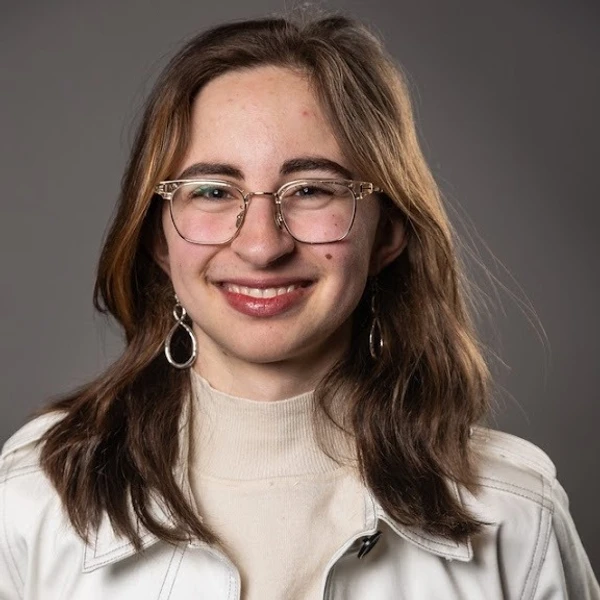
Natalie A
1x
Nominee1x
Finalist
Natalie A
1x
Nominee1x
FinalistBio
Biochemistry and Spanish double major. Natalie has been a driving force across campus life — serving as President of Alpha Phi Omega, Assistant Managing Editor of The Pleiad, an Interfaith Ambassador, and a teaching assistant in four departments, while pursuing dual student research projects in Spanish and Biology through the Honors Program and Wilson Institute of Medicine. Natalie will speak about community as something we build together through small, consistent acts of care — weaving their own story as a first-generation student and campus leader with scholarship and research to challenge graduates to carry that commitment forward into every space they enter after Albion.
Natalie plans to continue working in both a toxicology and public health lab while applying for MD/PhD programs. Natalie is particularly interested in addressing healthcare disparities and using both science and storytelling to advocate for more equitable systems of care.
Education
Albion College
Bachelor's degree programMajors:
- Biochemistry, Biophysics and Molecular Biology
Miscellaneous
Desired degree level:
Doctoral degree program (PhD, MD, JD, etc.)
Graduate schools of interest:
Transfer schools of interest:
Majors of interest:
Career
Dream career field:
Hospital & Health Care
Dream career goals:
Certified Nursing Assistant
Corewell Health2023 – Present3 years
Research
Classics and Classical Languages, Literatures, and Linguistics, General
Albion College — Researcher2024 – PresentBiological and Biomedical Sciences, Other
Albion College — Researcher2024 – Present
Arts
Albion Pleiad
Visual Arts2023 – Present
Mikey Taylor Memorial Scholarship
My experiences with mental health have shaped the way I understand people, relationships and the kind of work I want to pursue. They have made it clear that health is not only physical or measurable, but also deeply tied to emotional, social and environmental factors. This perspective has influenced how I approach both my personal life and my long term goals in healthcare.
On a personal level, mental health has taught me to pay closer attention to what is often unspoken. I have seen how stress, trauma and uncertainty can affect decision making, communication and overall well being. Because of this, I tend to approach situations with more patience and awareness. I have learned that people are often carrying experiences that are not immediately visible, and that responding with empathy can change the outcome of an interaction. This has shaped my relationships by making me more intentional about listening and creating space for others to feel understood, rather than rushing to offer solutions.
At the same time, these experiences have not always been easy. There have been moments where balancing academic pressure, work responsibilities and personal expectations felt overwhelming. Learning how to manage that has required developing coping strategies, setting boundaries and recognizing when to ask for support. These are skills that I continue to build, and they have changed how I define success. It is no longer only about achievement, but also about sustainability and maintaining a sense of stability over time.
In my relationships, mental health has influenced the way I communicate and show up for others. I have become more aware of the importance of consistency, trust and emotional safety. Whether in friendships, leadership roles or team settings, I try to create environments where people feel comfortable expressing concerns or asking for help. This has been especially important in roles where others rely on me, such as in academic or organizational settings. I have learned that being dependable is not just about completing tasks, but also about being present and supportive.
These experiences have also played a significant role in shaping my career aspirations. As someone pursuing a path toward medicine and research, I recognize that mental health is often underrepresented or separated from other areas of care. I want to be part of a system that treats patients more holistically, where mental and physical health are considered together rather than as separate issues. My background has made me more aware of the barriers people face when seeking support, including stigma, lack of access and cultural perceptions around mental health.
Because of this, I hope to incorporate mental health awareness into my future work, regardless of the specific field I focus on. Whether I am conducting research or working directly with patients, I want to approach care in a way that acknowledges the full context of a person’s experience. This includes being mindful of how stress, environment and social factors influence health outcomes, and advocating for systems that address these connections.
Overall, my experiences with mental health have given me a clearer sense of what it means to support others and to take care of myself. They have shaped my beliefs about empathy, resilience and the importance of understanding people beyond what is immediately visible. Moving forward, I intend to carry these lessons into my career, using them to guide how I interact with patients, collaborate with colleagues and contribute to a more thoughtful and inclusive approach to healthcare.
Julie Holloway Bryant Memorial Scholarship
I am a biochemistry and Spanish double major with a strong interest in how science, communication and lived experience intersect in healthcare. Throughout my time in college, I have focused on developing both technical research skills and the ability to think critically about the broader systems that shape health outcomes. My academic path has been shaped by laboratory research in microbiology and environmental health, as well as by work in journalism and community engagement. Together, these experiences have pushed me to approach problems from multiple perspectives and to stay grounded in both data and human experience.
After graduation, I plan to pursue an MD/PhD. My goal is to build a career that combines clinical practice with research, particularly in environmental health and toxicology. I am interested in studying how chemical exposures, such as PFAS, affect human health and how these impacts are often distributed unequally across communities. In the long term, I hope to contribute to research that informs policy and improves access to care, especially for populations that have been historically overlooked or underserved.
My first language is Polish, which has played an important role in shaping how I understand communication and identity. Being bilingual has come with both challenges and benefits. One of the main challenges has been navigating spaces where language creates barriers, especially in academic or institutional settings that are not designed with multilingual individuals in mind. Early on, I often had to translate not only words but also meaning for my family, whether in healthcare settings, school systems or official documents. This required a level of responsibility and precision that could feel overwhelming at times, particularly when I was younger.
At the same time, being bilingual has been one of my greatest strengths. It has given me a deeper awareness of how language shapes understanding and access. I have learned that communication is not just about direct translation, but about context, tone and cultural nuance. This has made me more attentive in both academic and professional settings, especially when working with diverse populations. It has also strengthened my ability to listen carefully and adapt my communication depending on the audience.
In addition, being bilingual has influenced my academic interests. It is one of the reasons I chose to study Spanish alongside biochemistry, as I value the ability to connect with people across different linguistic and cultural backgrounds. In healthcare, this skill is particularly important. Patients’ experiences, concerns and decisions are often shaped by language, and being able to communicate effectively can directly impact the quality of care they receive.
Overall, my background has shaped both my goals and how I plan to achieve them. I see my education and language skills as tools that allow me to bridge gaps between science and community, research and application. Moving forward, I hope to use these tools to contribute to a more equitable and accessible healthcare system.
Dream BIG, Rise HIGHER Scholarship
Education, for me, has never been a passive process of absorbing information. It has been a way of learning how to navigate systems, ask better questions and understand the structures that shape people’s lives. Over time, it has given me not only direction, but also a sense of responsibility to myself and to the communities I come from and hope to serve.
As a biochemistry and Spanish double major, my education has developed at the intersection of science and lived experience. In my science courses, I have learned how to analyze biological systems at a molecular level, interpret data, design experiments and think critically about evidence. In my Spanish courses, I have learned how language carries culture, identity and history. Together, these disciplines have reshaped how I see problems. Health is no longer just a biological outcome. It is influenced by communication, access, policy and social context. That realization has shaped my long term goal of pursuing an MD/PhD and building a career that combines medicine, research and advocacy.
My path to this point has not been straightforward. As a child of immigrants, I grew up taking on roles that extended beyond what is typically expected of a student. I translated documents, navigated complex systems and helped my family make decisions in spaces where language and institutional knowledge were barriers. Those experiences exposed me early to inequities in healthcare, education and public systems. They also showed me that knowledge, especially the ability to understand and communicate it, can be a form of power.
Balancing those responsibilities with academics required constant adjustment. I often felt as though I was learning how to succeed in two different worlds at once, one rooted in my family’s needs and another shaped by academic expectations. There were moments when the pressure of both felt overwhelming. Working multiple jobs while pursuing a demanding course load added another layer of challenge. Time, energy and financial stability were never guaranteed, and I had to develop discipline and adaptability quickly.
Rather than discouraging me, these challenges clarified my goals. They pushed me to become more intentional about my education. Instead of approaching coursework as a checklist, I began to focus on understanding why what I was learning mattered. This shift became especially evident in my research experiences. In the laboratory, I have worked on projects ranging from studying bacterial effects on the gut microbiome of Drosophila melanogaster to examining environmental contaminants like PFAS and their impact on health. These experiences taught me how to move from theory to application and how to ask questions that connect molecular mechanisms to real world consequences.
What has stayed with me most is not just the technical skills, but the realization that scientific knowledge does not exist in isolation. Studying environmental toxins like PFAS has made it clear that exposure is not evenly distributed. Communities with fewer resources often bear a disproportionate burden, as seen in places like Flint, Michigan. Understanding the chemistry behind contamination is only one part of the issue. Addressing it requires attention to policy, communication and trust between institutions and the public.
My education has also been shaped by my work outside the classroom. As an assistant managing editor for my college newspaper, I learned how to listen to people’s stories and represent them accurately and ethically. Writing about campus issues, interviewing individuals and navigating sensitive topics strengthened my ability to communicate complex ideas clearly. This skill is just as important in science and medicine as technical knowledge. Being able to explain findings, advocate for patients and build trust depends on clear and thoughtful communication.
Looking forward, I hope to use my education to build a career that integrates clinical practice with research focused on environmental health. I am particularly interested in addressing the long term effects of chemical exposures in vulnerable communities. My goal is not only to contribute to scientific understanding, but also to ensure that this knowledge reaches the people who are most affected. Whether through patient care, community engagement or policy work, I want to be part of efforts that reduce health disparities and improve access to care.
Education has given me more than a set of skills. It has given me a framework for understanding the world and a direction for how I want to move within it. It has taught me that knowledge carries responsibility. The challenges I have faced have shaped how I approach that responsibility, with persistence, adaptability and a focus on impact. Moving forward, I intend to continue using my education not only to advance my own goals, but also to contribute to a future where access to health and opportunity is more equitable.
Lippey Family Scholarship
One of the most significant hardships I have faced has been learning how to navigate responsibility far earlier than I was prepared for, particularly as a child of immigrants. From a young age, I became a translator, advocate, and decision-maker for my family in situations that carried real consequences, especially in healthcare settings. While this role shaped my sense of purpose, it also created a quiet but constant pressure. I was often expected to understand complex systems, communicate critical information, and help guide decisions, even when I was still learning how to do those things for myself.
The challenge was not only external, but internal. I struggled with the feeling that I had to be constantly capable, composed, and correct. There was little room to hesitate or ask for help, because I was often the person others relied on. Over time, that expectation began to affect how I approached my own life. I became hesitant to pursue opportunities unless I felt fully prepared, and I often questioned whether I truly belonged in spaces that required confidence and expertise.
This became especially clear when I entered college. Surrounded by peers who seemed more certain of their paths, I found myself holding back, particularly in academic and professional opportunities. I was interested in research and science, but I hesitated to act on those interests because I felt I lacked the experience or background to justify taking that step. The same sense of responsibility that had once pushed me forward began to limit me.
Recognizing this pattern was the first step in overcoming it. I began to challenge the assumption that I needed to feel ready before taking action. Instead of waiting for confidence, I focused on building it through experience. I started applying for opportunities that I would have previously dismissed, including research positions. I sought out mentors, asked questions more openly, and allowed myself to learn in visible ways rather than trying to appear fully prepared from the start.
One concrete step I took was becoming involved in laboratory research, where I had to confront uncertainty directly. Learning new techniques, troubleshooting experiments, and working through failure required me to shift my mindset. I could no longer rely on perfection or control. Instead, I had to accept that growth often comes from not knowing. At the same time, I continued taking on leadership roles, including positions where I supported others, which helped me redefine responsibility as something that could be shared rather than carried alone.
Through these experiences, I also learned the importance of boundaries. I began to understand that being dependable does not mean being everything for everyone at all times. I worked to separate my sense of worth from my ability to meet every expectation, and instead focused on sustainability, balance, and intentional growth. This was not a single moment of change, but an ongoing process that required reflection and adjustment.
Looking ahead, I will carry these lessons into my future in healthcare. My experiences have given me a deep understanding of what it feels like to navigate systems that are unfamiliar or inaccessible, and how critical it is to have someone who can advocate clearly and compassionately!
First Generation College, First Generation Immigrant Scholarship
Growing up as a child of immigrants shaped my sense of purpose in ways I did not fully understand at the time. I often served as a translator and advocate for my family in medical and bureaucratic settings, navigating systems that were unfamiliar to them. In those moments, I saw how much depended on clear communication and how easily misunderstandings could affect care. I learned that access is not just about being present in a system, but about truly understanding it.
These experiences also came with responsibility. I was expected to interpret complex information and help guide decisions, even when I was still learning myself. While challenging, this role gave me early insight into how systems function and who they often exclude. I began to recognize patterns in who felt comfortable asking questions and who did not, and how language and cultural barriers could shape outcomes.
Over time, these experiences became central to my sense of purpose. They showed me that knowledge alone is not enough if it is not accessible, and that trust is a critical part of effective care. As a result, I am committed to pursuing a career in healthcare where I can combine scientific understanding with clear, compassionate communication.
Ultimately, being a child of immigrants has taught me to approach my work with both awareness and responsibility. It has motivated me to help create systems where patients feel informed, respected, and supported in their care.
Jeune-Mondestin Scholarship
I am a biochemistry and Spanish student whose path into healthcare has been shaped as much by lived experience as by academic curiosity. I did not enter college with a fully formed plan, but I knew I was drawn to understanding how the body works and, just as importantly, how people experience care within complex systems. Over time, those interests came together into a clear direction.
Growing up as a child of immigrants, I often served as a translator and advocate for my family in medical settings. I saw how much depended on clear communication, and how quickly confusion or hesitation could affect the quality of care. Those experiences showed me that healthcare is not only about scientific knowledge, but also about trust, access, and the ability to navigate systems that are not always intuitive or equitable. I began to understand that being effective in healthcare requires both technical expertise and a strong sense of responsibility to others.
At the same time, my studies in biochemistry introduced me to the scientific side of health in a more rigorous way. Through coursework and research, including work with bacterial infection and the gut microbiome, I developed an appreciation for how molecular-level processes connect to broader questions of disease and resilience. I became interested in how careful, methodical research can lead to insights that directly improve human health. This combination of personal experience and scientific training is what led me to pursue healthcare as a field of study.
Looking forward, I want to become a physician who integrates clinical care with research and advocacy. I am particularly interested in environmental health and how exposure to contaminants can shape long-term outcomes, especially in communities that have historically been overlooked. Growing up in Michigan, where water quality issues have had lasting consequences, has influenced my desire to better understand and address these challenges.
The difference I hope to make is both individual and systemic. On an individual level, I want to provide care that is clear, respectful, and accessible, especially for patients who may feel uncertain or unheard in medical settings. On a broader level, I want to contribute to research and policy efforts that address the underlying causes of health disparities, whether they stem from environmental exposure, language barriers, or gaps in access to care.
Ultimately, I chose healthcare because it allows me to bring together my interest in science with my commitment to advocacy and service. I want to use my education to not only treat illness, but also to improve how care is experienced and delivered.
Dorothy Walker Dearon Scholarship
My academic goal is to complete my degree in biochemistry while continuing to strengthen my understanding of how molecular, environmental, and social factors shape human health. I want to move beyond memorization and develop a deeper ability to think critically about biological systems, interpret complex datasets, and design meaningful research questions. Through my coursework and continued lab experience, I aim to refine my technical skills in areas such as molecular biology and microbiome analysis while also learning how to connect scientific findings to real-world problems. I am especially interested in how experimental results can be translated into interventions that improve health outcomes beyond the lab.
Following graduation, I plan to apply for MD/PhD programs. I am drawn to this path because it allows me to integrate scientific research with clinical practice in a sustained and intentional way. My goal is to become a physician who is not only grounded in science, but also attentive to the broader context in which patients experience health and illness. My background has shown me that effective healthcare requires more than clinical knowledge. It requires strong communication, cultural awareness, and an understanding of the systemic barriers that patients may face. I want my training to reflect that balance so that I can move fluidly between patient care and research that informs it.
In the long term, I hope to build a career that combines clinical practice with research and advocacy. I am particularly interested in environmental health and the ways in which exposure to contaminants, such as PFAS, can affect long-term outcomes. Growing up in Michigan, where water quality issues have had lasting impacts on communities, has shaped my interest in this area. I want to contribute to research that identifies health risks, clarifies mechanisms of toxicity, and informs public health policy. At the same time, I want to work directly with patients who are affected by these exposures, helping them understand and navigate the health consequences.
I also hope to address healthcare disparities, particularly those related to language barriers, access to care, and trust in medical systems. My experiences serving as a translator and advocate for my family have given me insight into how easily patients can feel overlooked or misunderstood. As a physician, I want to create spaces where patients feel informed, respected, and supported in their care, and where communication is treated as a central component of treatment.
Ultimately, my goal is to use my education to bridge science and service. I want to contribute to a healthcare system that not only treats illness, but also works to prevent it and address the conditions that allow inequities to persist.
Janice Louise Olach Scholarship
One of the most significant hardships I have faced has been learning how to navigate responsibility far earlier than I was prepared for, particularly as a child of immigrants. From a young age, I became a translator, advocate, and decision-maker for my family in situations that carried real consequences, especially in healthcare settings. While this role shaped my sense of purpose, it also created a quiet but constant pressure. I was often expected to understand complex systems, communicate critical information, and help guide decisions, even when I was still learning how to do those things for myself.
The challenge was not only external, but internal. I struggled with the feeling that I had to be constantly capable, composed, and correct. There was little room to hesitate or ask for help, because I was often the person others relied on. Over time, that expectation began to affect how I approached my own life. I became hesitant to pursue opportunities unless I felt fully prepared, and I often questioned whether I truly belonged in spaces that required confidence and expertise.
This became especially clear when I entered college. Surrounded by peers who seemed more certain of their paths, I found myself holding back, particularly in academic and professional opportunities. I was interested in research and science, but I hesitated to act on those interests because I felt I lacked the experience or background to justify taking that step. The same sense of responsibility that had once pushed me forward began to limit me.
Recognizing this pattern was the first step in overcoming it. I began to challenge the assumption that I needed to feel ready before taking action. Instead of waiting for confidence, I focused on building it through experience. I started applying for opportunities that I would have previously dismissed, including research positions. I sought out mentors, asked questions more openly, and allowed myself to learn in visible ways rather than trying to appear fully prepared from the start.
One concrete step I took was becoming involved in laboratory research, where I had to confront uncertainty directly. Learning new techniques, troubleshooting experiments, and working through failure required me to shift my mindset. I could no longer rely on perfection or control. Instead, I had to accept that growth often comes from not knowing. At the same time, I continued taking on leadership roles, including positions where I supported others, which helped me redefine responsibility as something that could be shared rather than carried alone.
Through these experiences, I also learned the importance of boundaries. I began to understand that being dependable does not mean being everything for everyone at all times. I worked to separate my sense of worth from my ability to meet every expectation, and instead focused on sustainability, balance, and intentional growth. This was not a single moment of change, but an ongoing process that required reflection and adjustment.
Looking ahead, I will carry these lessons into my future in healthcare. My experiences have given me a deep understanding of what it feels like to navigate systems that are unfamiliar or inaccessible, and how critical it is to have someone who can advocate clearly and compassionately.
Pay It Forward Scholarship
I chose to pursue healthcare not because I always had a clear, singular vision of becoming a provider, but because my life has consistently placed me in positions where care, advocacy, and responsibility were necessary. Over time, those experiences shaped how I understand both science and service, and ultimately led me toward a career in healthcare.
Growing up as a child of immigrants, I often served as a translator, advocate, and intermediary for my family in medical and bureaucratic settings. I learned early how much power language, knowledge, and confidence carry in healthcare spaces, and how much harm can occur when those are absent. I watched my parents navigate systems that were not built with them in mind, and I stepped in where I could, even when I was still learning myself. These experiences taught me that healthcare is not just about diagnosing and treating illness. It is also about communication, trust, and equity.
At the same time, my academic path in biochemistry gave me a deep appreciation for the scientific foundation of medicine. Through research, particularly my work studying bacterial infection and the gut microbiome in Drosophila melanogaster, I began to see how molecular processes connect to larger questions of health, disease, and resilience. I was drawn to the problem-solving aspect of science and the idea that careful observation and experimentation can lead to meaningful impact. Research taught me how to ask better questions, but my lived experiences pushed me to consider why those questions matter and who they serve.
These two parts of my life eventually came together. I realized that I did not want to pursue science in isolation from people. I wanted to work in a field where I could both understand the biology of disease and actively support those experiencing it. Healthcare became the space where those goals could exist together.
In the future, I plan to use my degree to become a physician who provides not only clinical care but also strong patient advocacy. I am especially interested in addressing healthcare disparities that arise from language barriers, socioeconomic inequities, and systemic gaps in care. My goal is to help create environments where patients feel seen, heard, and understood, not just treated.
Beyond clinical practice, I hope to remain involved in research and public health efforts that address broader contributors to disease. I am particularly interested in environmental health and how factors such as water quality, exposure to contaminants, and access to resources shape long-term outcomes. By combining clinical work with research and advocacy, I want to contribute to solutions that support both individuals and communities.
Ultimately, I chose healthcare because it allows me to bring together my background, my education, and my commitment to others into one purpose. I want to use my degree not only to treat illness, but also to address the conditions that allow inequities in health to persist.
Dynamic Edge Women in STEM Scholarship
When I think about what brought me into STEM, I don’t think of a single class, grade or achievement. I think of Barbara, the first woman in STEM I ever met who made me feel like I belonged there before I had any real reason to believe it myself.
I met Barbara during my first year of college, at a time when everything still felt uncertain. I had declared an interest in science, but it felt tentative, almost like something I was trying on rather than something I fully owned. STEM, to me, was a space filled with people who had always known they belonged: people who were confident, experienced and sure of their direction. I didn’t feel like that person. I felt like I was constantly trying to catch up, quietly measuring myself against others and finding reasons why I didn’t quite fit.
One conversation in particular has stayed with me. I remember sitting with her and talking about my interests in biology. Even in that moment, I framed everything cautiously. I downplayed my curiosity, describing it as something small, something I wasn’t sure would lead anywhere. I told her I thought research sounded interesting, but I quickly followed it with reasons why it probably wasn’t realistic for me. I didn’t have experience. I didn’t know enough. I assumed those opportunities were meant for students who were already ahead.
Instead of agreeing or offering reassurance in a vague way, Barbara responded very practically. She asked me, “Why aren’t you applying for research positions?” I remember laughing it off, almost instinctively, because the idea felt so far outside of what I thought I was qualified for. But she didn’t let the conversation move on.
She opened her laptop and began walking me through actual opportunities: how to find them, how to email professors, how to write an application. There was no hesitation in her tone, no sense that this was something I might work toward someday. In her mind, it was something I could do now.
That moment was subtle, but it fundamentally shifted how I saw myself. It was the first time someone positioned me not as someone preparing to enter STEM, but as someone already within it. Her confidence in me wasn’t abstract, it was actionable. She gave me the tools and expectation that I should take the next step.
With her encouragement, I applied for research opportunities that I would have otherwise dismissed. Eventually, I began working in a lab, gaining hands-on experience and developing skills that became central to my academic path. That experience didn’t just build my résumé, it reshaped my confidence. I began to see myself as a scientist, not just a student hoping to become one.
Looking back now, it’s difficult to believe how much time has passed since that first conversation. What felt like a small interaction at the time became a turning point in my life. Barbara’s influence wasn’t loud or dramatic, but it was deeply transformative. She changed the way I understood belonging: not as something you wait to earn, but as something you can step into, even before you feel ready.
More than anything, Barbara showed me the power of being seen. She recognized potential in me at a moment when I was still questioning it, and she acted on that belief in a way that made it real. Because of her, I didn’t just pursue STEM, I stayed, grew and built a future within it!