user profile avatar

Nadia Nijjer

1x

Finalist

Bio

Graduating from the University of South Florida with BAs in History (Cold War concentration) and Philosophy (epistemology and aesthetics) with a minor in Anthropology (with a lot of experience working with environmental concerns).

Education

New England Law-Boston

Doctoral degree program (PhD, MD, JD, etc.)
2026 - 2029
  • Majors:
    • Law

University of South Florida-Main Campus

Bachelor's degree program
2023 - 2026
  • Majors:
    • Philosophy
    • History
  • Minors:
    • Anthropology

Miscellaneous

  • Desired degree level:

    Doctoral degree program (PhD, MD, JD, etc.)

  • Graduate schools of interest:

  • Transfer schools of interest:

  • Majors of interest:

    • Law
    • International Relations and National Security Studies
  • Not planning to go to medical school
  • Career

    • Dream career field:

      Law Practice

    • Dream career goals:

    • Brownfield Ambassador

      USF Brownfrield Organization
      2025 – 2025
    • Skip Gandy Intern

      USF Library
      2024 – 2024
    • Sales Associate

      Old Navy
      2025 – Present1 year
    • Policy Intern

      CAIR
      2025 – Present1 year
    • Research Assistant

      USF Civil Engineering
      2025 – Present1 year
    • Hollister

      Key Holder
      2023 – 20252 years

    Sports

    Soccer

    Club
    2007 – 202013 years

    Research

    • Anthropology

      USF Civil Engineering — Research Assistant
      2025 – Present

    Arts

    • USF Thread

      Visual Arts
      Living At Home In Your Early Twenties, Papa-Ji Hates My New Tattoo
      2025 – 2026

    Public services

    • Volunteering

      Cimino Elementary — Cotton Candy Machine Operator
      2025 – 2025
    Women of Impact Education Scholarship
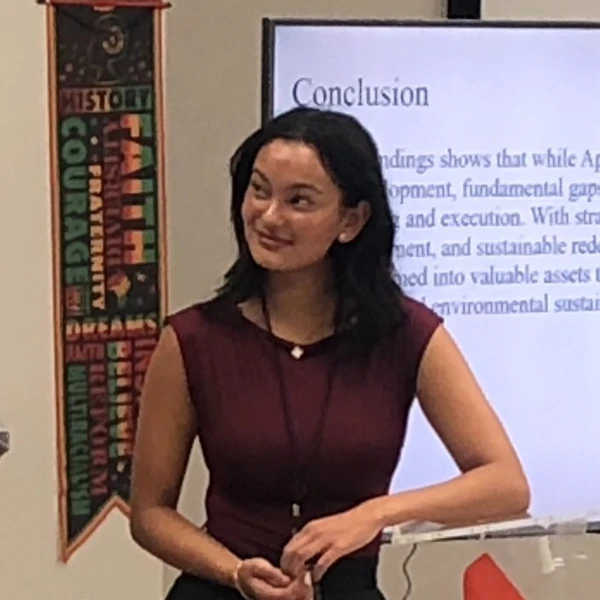
    My professional work has been grounded on the basis of hope. A hope that fueled the idea that there would always be something worth fighting for, and even the smallest victory was worth sweat and tears. Becoming a Brownfield Ambassador was further proof of my belief. There, I led a team of other Ambassadors where we used GSI and other environmental mapping systems in order to understand the state of Apopka’s environment and people, revealing that this was a community that had a history of environmental decline. We had the opportunity to meet and directly work with the local government where we drafted a Federal report of the area, recommending that Apopka be awarded Federal aid in order to improve the lives of their people. Later, I would have the privilege of presenting our findings to the One Florida Environmental Conference, contributing to the academic field, and bringing a full awareness to many of the local citizens where it was the first time they learned of how neglected their home really was. It was a beautiful experience where I got to work with real people who were, and still are, affected by corporate irresponsibility. I have always maintained that the most important part of any movement is the work done in the grassroots. Without first serving the community, you cannot say that you are doing work for the people. Part of what made the Brownfield so fundamental to me was the fact that when filing the Federal Report, we got to sit down and ask the community what they needed and wanted to make their lives better. CAIR Florida is what has shaped my legal aspirations the most. I first became their intern in the fall of 2025 where I joined the fight to bring Mohammed Ibrahim, an American boy held in foreign prison, home to Florida. With CAIR I did outreach, made phone calls, organized peaceful protests and rallies, raised awareness to my community about what was happening. I was driven by passion and inspired by the strong, hardworking women that let me see behind the curtain. This semester I am working directly with CAIR on HB1471, where we are fighting to preserve First Amendment rights in Florida. Working with CAIR has only added fuel to the fire that the Brownfield had ignited, this is real work being done for an underrepresented community, this is a civil rights battle that I cannot look away from. Becoming an attorney would mean that I could do so much more for communities like CAIR and those suffering in the Brownfield. It would mean I could give back to my community and create opportunities. If awarded the Women of Impact Education Scholarship, I aspire to become an attorney who will always stand for civil rights, to stand guard on those who cannot stand up for themselves, and assist in the ongoing fight for equality that so many face. It is my purpose and passion.
    Margot Pickering Aspiring Attorney Scholarship
    The dining table in my parents’ house is older than me. It commands attention with its dark oak legs, elegantly bowed towards each other, topped with a thick, well-loved sheet of glass beneath a handmade tablecloth flown directly from India; a small and homely reminder of where half my blood remains. It seats six people comfortably, ten uncomfortably. My family is large enough that elbows bumping and chairs fitting chaotically together was never a worry. Thanksgiving, Christmas, even a stray Dungeons and Dragons game—room for more would always be made. The table was a beacon for conversation, never about the table itself, but as a gathering place—a stoa for the discussions that took place over it. Economics, politics, religious beliefs, strong opinions on the recent action movie. It is an endless list that keeps the table and its guests entertained. A table serves many purposes, but for me, it was Ground Zero. With my father and grandfather at each head of the table, it was never just small talk, instead we picked up last night’s quarrel. It was here, caught between minds more brilliant than mine, I learned the art of argumentation. It was also here, twelve years old and a fawn to the opinionated world, that my father called me a terrorist. The word felt large and heavy coming from his mouth, and even heavier when echoed by my grandfather. If you keep saying stuff like that, you’re gonna sound like a real terrorist Post 9/11, with a family like mine—immigrants, brown, dark haired, and frowned upon; the kind that got stopped by airport security because of my father’s thick beard and my mother’s efficiently packed luggage—the word carried an unimaginable weight. In the era of clickbait headlines and unrestricted internet access, I knew what he was doing. The taboo was meant to scare me back onto the much clearer path my family had laid out for me. And yet, I distinctly remember thinking: How could feminism be seen as terrorism? Sometimes, I wonder if the table had soaked in enough knowledge over the years to offer an opinion. To tell me whether it agreed with the giants whose shoulders I stand on or if I should continue to toe the line. I pushed harder. The dining room became my training ground, sharpening my ferocity and my ethics, learning to bridge the gaps between our cogent communication. Teeth sharper than the night before, I continued to feel the primal need to hunt, to carve opportunities from the white towers of academia and set myself into action. Internships, jobs, clubs, organizing protests, attending rallies—I devoured information, fed myself like an oroborus. My path led me into environmental work, where I learned of the Brownfields that Florida let fester, leaving entire communities to suffer. Then I moved toward surveying, completing water quality research in Tampa’s largest minority communities, hopeful that the ongoing investigation would bring relief to our neighborhoods. Every time I rose to advocate, anytime I met someone new and pulled them under my wing, I thought about what my father said and asked, Am I a real terrorist yet? Nearly a decade later, it's a quiet morning at the dining table when the news finds me: Twenty-two and declared a terrorist by the Sunshine State. CAIR FL, a nonprofit organization dedicated to the civil liberties and rights of Muslims, fell under fire after we successfully brought home Mohammed Ibrahim, an American boy who had been wrongfully imprisoned for nine months by a foreign nation. My entire internship was dedicated to getting Mohmmed home. I made calls, organized student protests, did community outreach, drafted open letter responses to state representatives. What should have been the cherry on top of an entire career of hard, foundational work turned into one of the few times my father’s bitter jokes had aged like wine. A slew of headlines, emails, and texts further confirmed that I was officially an enemy of the state that raised me; becoming exactly what my family had feared. And yet, I welcomed it with open arms. I was once afraid of the implication the title terrorist held, but now, in the thick of it, I can do nothing but sit at the dining room table and remember that the trajectory of my life has led me here, ready to act.
    Dream BIG, Rise HIGHER Scholarship
    The dining table in my parents’ house is older than me. It commands attention with its dark oak legs, elegantly bowed towards each other, topped with a thick, well-loved sheet of glass beneath a handmade tablecloth flown directly from India; a small and homely reminder of where half my blood remains. It seats six people comfortably, ten uncomfortably. My family is large enough that elbows bumping and chairs fitting chaotically together was never a worry. Thanksgiving, Christmas, even a stray Dungeons and Dragons game—room for more would always be made. The table was a beacon for conversation, never about the table itself, but as a gathering place—a stoa for the discussions that took place over it. Economics, politics, religious beliefs, strong opinions on the recent action movie. It is an endless list that keeps the table and its guests entertained. A table serves many purposes, but for me, it was Ground Zero. With my father and grandfather at each head of the table, it was never just small talk, instead we picked up last night’s quarrel. It was here, caught between minds more brilliant than mine, I learned the art of argumentation. It was also here, twelve years old and a fawn to the opinionated world, that my father called me a terrorist. The word felt large and heavy coming from his mouth, and even heavier when echoed by my grandfather. If you keep saying stuff like that, you’re gonna sound like a real terrorist Post 9/11, with a family like mine—immigrants, brown, dark haired, and frowned upon; the kind that got stopped by airport security because of my father’s thick beard and my mother’s efficiently packed luggage—the word carried an unimaginable weight. In the era of clickbait headlines and unrestricted internet access, I knew what he was doing. The taboo was meant to scare me back onto the much clearer path my family had laid out for me. And yet, I distinctly remember thinking: How could feminism be seen as terrorism? Sometimes, I wonder if the table had soaked in enough knowledge over the years to offer an opinion. To tell me whether it agreed with the giants whose shoulders I stand on or if I should continue to toe the line. I pushed harder. The dining room became my training ground, sharpening my ferocity and my ethics, learning to bridge the gaps between our cogent communication. Teeth sharper than the night before, I continued to feel the primal need to hunt, to carve opportunities from the white towers of academia and set myself into action. Internships, jobs, clubs, organizing protests, attending rallies—I devoured information, fed myself like an oroborus. My path led me into environmental work, where I learned of the Brownfields that Florida let fester, leaving entire communities to suffer. We fought to get them the federal funding they needed in order to serve their community better. Then I moved toward surveying, completing water quality research in Tampa’s largest minority communities, hopeful that the ongoing investigation would bring relief to our neighborhoods. Every time I rose to advocate, anytime I met someone new and pulled them under my wing, I thought about what my father said and asked, "Am I a real terrorist yet?" Nearly a decade later, it's a quiet morning at the dining table when the news finds me: Twenty-two and declared a terrorist by the Sunshine State. CAIR FL, a nonprofit organization dedicated to the civil liberties and rights of Muslims, fell under fire after we successfully brought home Mohammed Ibrahim, an American boy who had been wrongfully imprisoned for nine months by a foreign nation. My entire internship was dedicated to getting Mohammed home. I made calls, organized student protests, did community outreach, drafted open letter responses to state representatives. The community came together in support, walking the streets, phoning their representatives. It was beautiful to see people working in tandem like that. What should have been the cherry on top of an entire career of hard, foundational work turned into one of the few times my father’s bitter jokes had aged like wine. A slew of headlines, emails, and texts further confirmed that I was officially an enemy of the state that raised me; becoming exactly what my family had feared. And yet, I welcomed it with open arms. I was once afraid of the implication the title terrorist held, but now, in the thick of it, I can do nothing but sit at the dining room table and remember that the trajectory of my life has led me here, ready to act.
    Tandy Law Firm Scholarship
    CAIR Florida is what has shaped my legal aspirations the most. I first became their intern in the fall of 2025 where I joined the fight to bring Mohammed Ibrahim, an American boy held in foreign prison, home to Florida. With CAIR I did outreach, made phone calls, organized peaceful protests and rallies on campus and in the Tampa area. Working with other organizations and clubs, we raised awareness in the community about the injustice happening and made sure they were educated on not only the next steps they could do to help, but how to spread the word. I was driven by passion and inspired by the strong, hardworking women that let me see behind the curtain on how grueling and how much thought and hard work goes into every part of a movement. From hour long brain storming sessions, card writing, weekly events in order to raise spirits and get motivated. CAIR FL was relentless, and in turn has made me so. Our goal was to advocate for an American citizen, to bring a boy home to his family. On Thanksgiving we actually got the news that Mohammed would be coming home. That feeling of victory, of the success of months of work will never compare to how beautiful it was to see a family reunited. This semester I am working directly with CAIR on HB1471, where we are fighting to preserve First Amendment rights in Florida. Working with CAIR has only added fuel to the fire that has long since burned within me. This is real work being done for an underrepresented community by their people, this is a civil rights battle that I cannot look away from. The first amendment is the pillar to what the United States is and stands for. The right to religious freedoms, to freedom of speech, and freedom of expression is what should always be preserved at the end of the day. It is the difference between a free state and oppression. My involvement with CAIR has shown that to me in more ways than once, especially as more and more censoring and restricting bills are passed when it comes to education and a student's right to protest. If awarded the Tandy Law Firm Scholarship, I hope to continue this fight through law school, to become more educated and strong enough to be of service to organizations like CAIR. Becoming an attorney would mean I could protect underrepresented and targeted communities from having their first amendment rights violated.
    Jeffrey J. Douglas First Amendment Scholarship
    CAIR Florida is what has shaped my legal aspirations the most. I first became their intern in the fall of 2025 where I joined the fight to bring Mohammed Ibrahim, an American boy held in foreign prison, home to Florida. With CAIR I did outreach, made phone calls, organized peaceful protests and rallies on campus and in the Tampa area. Working with other organizations and clubs, we raised awareness in the community about the injustice happening and made sure they were educated on not only the next steps they could do to help, but how to spread the word. I was driven by passion and inspired by the strong, hardworking women that let me see behind the curtain on how grueling and how much thought and hard work goes into every part of a movement. From hour long brain storming sessions, card writing, weekly events in order to raise spirits and get motivated. CAIR FL was relentless, and in turn has made me so. Our goal was to advocate for an American citizen, to bring a boy home to his family. On Thanksgiving we actually got the news that Mohammed would be coming home. That feeling of victory, of the success of months of work will never compare to how beautiful it was to see a family reunited. This semester I am working directly with CAIR on HB1471, where we are fighting to preserve First Amendment rights in Florida. Working with CAIR has only added fuel to the fire that has long since burned within me. This is real work being done for an underrepresented community by their people, this is a civil rights battle that I cannot look away from. The first amendment is the pillar to what the United States is and stands for. The right to religious freedoms, to freedom of speech, and freedom of expression is what should always be preserved at the end of the day. It is the difference between a free state and oppression. My involvement with CAIR has shown that to me in more ways than once, especially as more and more censoring and restricting bills are passed when it comes to education and a student's right to protest. If awarded the Jeffrey J. Douglas First Amendment Scholarship, I hope to continue this fight through law school, to become more educated and strong enough to be of service to organizations like CAIR. Becoming an attorney would mean I could protect underrepresented and targeted communities from having their first amendment rights violated.