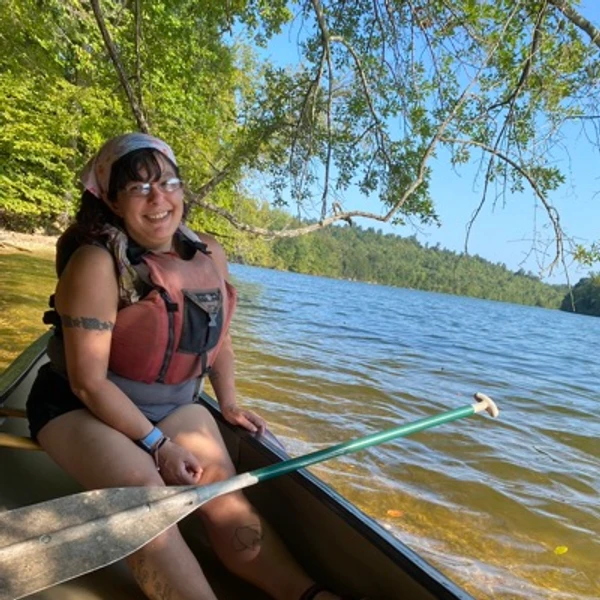
user profile avatar

Nada Znebaka

1x

Finalist

General information

Hobbies & Interests

  • Drawing And Illustration
  • Music Production
  • Japanese
  • Epidemiology
  • Astronomy

Reading

  • Novels

I read books multiple times a week.

Bio

As a single mother of four and an adult student, my academic journey is fueled by resilience and a lifelong passion for science. I began my studies at Chattanooga State in 2019, earning my biology degree in 2024 despite a near-fatal battle with COVID-19 and Graves' hyperthyroid toxicosis in 2022. Though this health crisis delayed my timeline, my fight against this chronic disease only strengthened my resolve. Now a double major in Biology and Geology at the University of Tennessee at Chattanooga (UTC), I am merging my childhood fascination with Earth's mechanics into actionable career goals. Upon graduation, I will research the removal of waste metals from local waterways, provide freelance biological illustrations, and lead science outreach for youth. With my federal aid exhausted for my final semesters, this scholarship will directly support the completion of my dual degree and my mission to protect our environment.

Education

The University of Tennessee-Chattanooga

Bachelor's degree program

2024 – 2027

Majors:
  • Geological and Earth Sciences/Geosciences
  • Biological and Physical Sciences

Chattanooga State Community College

Associate's degree program

2001 – 2024

Majors:
  • Biological and Physical Sciences

Miscellaneous

Desired degree level:
Doctoral degree program (PhD, MD, JD, etc.)
Graduate schools of interest:
Western Kentucky University
Majors of interest:
Biological and Physical Sciences, Geological/Geophysical Engineering
Desired degree modality:
Online
Medical school interest:
No
English as first language:
Yes
Homeschooled:
No

Career

  • Tech support and billing

    Telecommunications · T-mobile

    Jan 2014 – Jan 2016

  • Luxury Lifestyle Consultant

    Leisure, Travel, & Tourism · Aspire Lifestyles Inc.

    Jan 2016 – Jan 2020

  • Covid-19 Contact tracer and vaccine specialist

    Hospital & Health Care · Navient

    Jan 2020 – Jan 2021

  • Dispatcher

    Transportation/Trucking/Railroad · Eagle Tele-Services

    Jan 2021 – Jan 2022

  • Techsupport and Tax software assistant

    Consumer Services · Concentrix

    Jan 2023 – Jan 2023

  • chemistry tutor

    Education · Gear Up UTC

    Jan 2025 – Jan 2025

Miscellaneous

Dream career field:
Environmental Services, Biology
Dream career goals:
Removal of waste metals in water ways
Work experience:
10+ years
Has nursing license:
No
Leadership experience:
Yes

Future Interests

  • Advocacy
  • Politics
  • Philanthropy
Poynter Scholarship
I have already been committed to college for the last 7 years while raising my kids. I try to balance my kids with school, but there are times where an exam might have to come first, but I have also had situations where it is an emergency and I have had to skip exams to be there for my children.  Initially, I was working from home full-time while pursuing my A.S. in biology from the local community college. It was pretty easy to do classwork in between work calls with those types of jobs, then when I was off work, hang out with my kids. Things became much more complicated once I had COVID. Due to having COVID, I not only got long COVID, that I am still suffering from 4 years later, it also caused me to have Graves' disease. I developed thyrotoxicosis during the first 8 months, lost 100 pounds, and almost died. This impacted not only being able to finish my associates, but also my ability to work and parent my children.  Due to that infection and subsequent disease, I had to leave school for a year, I could not work, and we lost our home, having to move in with my mother. Since moving in with my mother, I was able to get on life saving medications, graduate, and transfer to then four-year university, and be there more consistently for my children. However, the balancing act still remains. Not only do I have to balance my time between school and my children, I also must balance my own energy due to chronic illness. I have had a lot of subsequent issues due to my chronic illness.  My children are ages 16 to 23, and I went back to school in 2019. When I started, all my kids were still minors. I do occasionally get complaints that I am not present enough, I will admit that is difficult when you are majoring in both biology and geology, but I always am there for as many conversations and events as possible. My children have started to exhibit resentment, but it is more about me being chronically ill than me being in school. If I was healthy, doing everything and being everywhere would not hard and was not hard before.  Having this disease can be unpredictable. In late 2024, I was removed from medications only to become thyrotoxic again during 2025 while on a waiting list for a new endocrinologist because the other one in our city had shut down. I was still at every family function, every event I could physically handle being at, turned in every assignment, was there for every conversation when a child, adult or not, needed me; yet even after all that and being bed ridden for 7 weeks, I still had comments from my children that it was not enough. I think it is important to be there for your kids as much as possible, obviously. Ideally, people would go to college before having kids, but life doesn't always work that way. I need these degrees, because how else can I help pay for things for my children? How else will I be able to provide when they stumble as adults as I have. How will I be happy in my life and sustain my health without the income these degrees will provide? Recently, my car broke down, this scholarship will go towards vehicle repairs for me and my children to be able to get to and from our schools.
Women in STEM Scholarship
To me, being a woman empowered by knowledge means recognizing that science is not just a collection of facts in a textbook; it is a tool to actively heal and understand our world. My journey into STEM began in childhood, driven by pure curiosity. From a very young age, I was an avid collector of rocks, shells, and minerals. By age five, I devoutly watched Star Trek, expanding my imagination about what was possible. By eight, I was spending my free time peering through telescopes and microscopes, obsessed with seeing the hidden mechanics of how our planet functions. Between the ages of nine and fifteen, my world expanded into a deep love for books and learning, and I spent my free time volunteering at our small-town library. At fifteen, I fought for top grades in biology just to secure a week-long trip to the Marine Biology Institute on Big Pine Key in Florida. That lifelong curiosity and passion for learning naturally evolved into my current academic pursuit as a non-traditional student at UTC, where I made the ambitious decision to double major in Biology and Geology. Navigating this intense dual STEM track requires absolute dedication, heavy laboratory hours, and demanding fieldwork. My specific undergraduate research bridges both of my majors perfectly. I am currently investigating local river shells to analyze whether they accumulate toxic waste metals from industrial and urban runoff, and if that pollution causes them to exhibit lower levels of calcium carbonate. This localized freshwater project serves as an accessible indicator to measure the precise structural damage heavy metal runoff causes to shell-building organisms before those pollutants ever reach marine environments, where they dangerously amplify ocean acidification and inhibit coral mating cycles. I am fully prepared to contribute significantly to the STEM field, not just through raw research, but through community engagement. For the past thirteen years, I have independently trained in realism and hyper-realism art, focusing specifically on biological illustration and nature photography. I have been creating digital content online to synthesize my artistic skills with my scientific education. Upon graduation, alongside my bio-geochemical waterway research, I plan to work as a freelance biological illustrator and launch science outreach programs aimed at younger generations. Science can often feel intimidating or gatekept, especially for non-traditional students or young girls who do not see themselves represented in labs. By combining my dual-lens science background with visual storytelling, I want to prove to youth that science belongs to everyone. Pushing through severe chronic illness, a major medical delay, and raising four children as a single mother has proven my resilience. I am at the absolute finish line of my degrees, and scholarships like this one provide the vital structural support I need to cross the graduation stage. I am ready to use my education to pioneer environmental remediation, protect our precious aquatic ecosystems, and inspire the next generation of women in STEM.
Organic Formula Shop Single Parent Scholarship
The single greatest challenge of balancing motherhood with a double major in Biology and Geology is the absolute scarcity of time and energy. When you are a single parent of four children, your time is never entirely your own. My household relies completely on my ability to maintain structure when everything is in chaos, provide emotional support even when we all have deadlines as a household of students, and handle the daily logistics of survival while still trying to have fun and foster togetherness. Layering an intense dual STEM track at UTC on top of those responsibilities means I am constantly operating on the edge of exhaustion. High-level science degrees require grueling laboratory hours, complex research assignments, and physically demanding field trips, including overnight camping for data collection. There are no off-hours; every single minute must be fiercely managed between lab reports, making dinner, grading systems, and parenting. This daily balancing act became a battle for survival in 2022. A near-fatal COVID-19 infection left me with Graves' hyperthyroid toxicosis, a chronic autoimmune disease I fight every day. Managing a severe health crisis while refusing to let my kids or my grades slip tested my limits. I had to delay my timeline, but I persevered to graduate from Chattanooga State in 2024 before transferring to UTC. The mental and physical strain of pushing through intense coursework while my body fights a chronic illness is an invisible hurdle I face every semester, but giving up is never an option. Securing grants and scholarships like this one is the vital strategy I need to pave a secure path forward. Right now, I am facing an immediate financial cliff because my lifetime undergraduate FAFSA allocation has hit its limit. Next semester, my Pell Grant drops to just 37% before expiring completely. Supporting five people on a shrinking semester refund check is a terrifying reality. Furthermore, my commuter car desperately needs up to $3,000 in mechanical repairs. My vehicle is the single thread holding my family together. Without it, I cannot transport my children or travel to my mandatory UTC labs and field research sites. Winning support through programs like this allows me to chip away at these costs and focus on the trajectory of our future. Financially, stacking these awards helps bridge my mid-year federal funding deficit and keeps my commuter car operational, ensuring I can finish my senior research investigating how toxic waste metals accumulate in river shells. Professionally, it unlocks my career goals in environmental remediation, waterway conservation, and biological illustration. Culturally, it sets an unforgettable example for my four children. By watching me fight through financial cliffs, domestic survival, and severe illness to earn a double major in science, my children are learning that education is a weapon to wage war for independence and in the long run helps me provide financial support for my kids. This support will empower me to cross the graduation stage, break dead-end career cycles, and build a stable, meaningful future as a scientist for my family.
Barbara Cain Literary Scholarship
Growing up, my relationship with literature did not start out easy. Because I have Autism and ADHD, learning how to read was a massive challenge, and as a young child, I actively disliked books. My saving grace was my grandmother, an avid reader who is still going strong today at 94 years old. She used to take me with her to our small-town library, both to check out books and to tag along while she volunteered. Even though I struggled with reading, that library became a familiar, safe space. Everything changed for me in the summer of 1989. The library launched a summer reading program, offering a free t-shirt to whoever read the most books. Driven by pure determination to win, I pushed through my reading barriers and devoured every book I could get my hands on. I won that Coca-Cola summer reading shirt, and it gave me a massive boost of confidence. I still own that shirt today at the age of 42 because it marks the exact moment books transformed from an obstacle into a sanctuary. By the time I hit middle school, my life grew more complicated. Being mixed-race and neurodivergent made me an easy target for bullying at school. To escape the isolation, I retreated entirely into fiction novels and began volunteering at the library myself. Fiction taught me empathy, showed me how different people navigate adversity, and proved that being different often meant you were the protagonist of your own complex story. Years later, the library transformed from a childhood sanctuary into a literal lifeline. Before I managed to escape my abusive marriage in 2013, the local library was the only safe place I could take my four children to flee the chaos of our home. Books became my quiet resistance. My ex-husband would get intensely angry whenever I checked out textbooks, furious that I was seeking knowledge outside of his control. He actively tried to prevent us from reading by hiding my materials, returning items late, and intentionally forcing me to accrue library fines so my card would be blocked. In those terrifying years, reading wasn't just a pastime. I used books to independently research history, study Japanese, and dive deeply into world religions, philosophy, physics, cosmology, astronomy, and astrology. Devouring everything from hard sciences to fiction escapes taught me that we can always grow, evolve, and become better, stronger individuals. Through that experience, I realized that education through books isn't just a standard tool. It is a weapon to wage war for my independence, as it is for so many others. Literature has completely shaped my long-term aspirations. While I am currently pursuing an intense undergraduate double major in Biology and Geology at UTC, my ultimate goals are deeply tied back to the quiet rows of bookshelves that protected me. Once I graduate, I want to bridge my love for science with my passion for community storytelling. I plan to write my own novels, combining my scientific background in earth mechanics with the deep empathy I learned from fiction. I have also often considered returning to a small-town library to work as an assistant or head librarian, ensuring it remains a safe, inclusive haven for single mothers, non-traditional students, and neurodivergent kids who need a safe place to heal. Books saved my life more than once, and my goal is to give that same sanctuary back to the next generation
Rosie Walks Human–Wildlife Coexistence Scholarship
When we talk about human-wildlife coexistence, people usually think about land animals losing territory to highways or neighborhoods. But to me, an urgent and dangerous problem is completely invisible, the heavy metal and chemical pollution destroying our water systems. Every day, industrial waste, urban runoff, and heavy metals drain straight into our waterways. This breaks down coexistence because wildlife cannot simply move away from a chemical shift in their environment. Instead, they are forced to live in a contaminated habitat, which triggers a quiet collapse of aquatic life cycles. This issue connects directly to my double major in Biology and Geology at UTC. Through my studies, I have learned that heavy metal pollution actually amplifies the devastating effects of ocean acidification. Acidification prevents young coral larvae from successfully attaching to a substrate because it directly destroys their ability to generate calcium carbonate. Furthermore, certain waste metals severely inhibit mating cycles in corals, disrupting their entire life history. This specific breakdown is exactly why I am conducting my own undergraduate research. I am currently investigating local river shells to analyze whether they accumulate waste metals and consequently show significantly lower levels of calcium carbonate. By using freshwater shells as an accessible indicator, I can measure how heavy metal runoff damages shell-building organisms right here in our regional streams before it ever reaches the sea.This crisis hits home for me. Ever since I was a child collecting rocks and minerals, I have been heartbroken by the damage humans cause to the environment. My long-term career goal is to actively fix this breakdown in coexistence. After I graduate, I plan to expand this research, using geochemical methods to pull toxic waste metals right out of our waterways to rehabilitate these habitats. To achieve this goal and finish my senior research, I must overcome an immediate financial hurdle. My lifetime undergraduate FAFSA allocation has hit its limit, meaning my Pell Grant drops to a tight 37% next semester before expiring completely. Balancing intensive lab hours and fieldwork while raising four children as a single mother is an immense challenge. Compounding this, my commuter car desperately needs up to $3,000 in mechanical repairs. Without a working vehicle, I cannot physically get to my mandatory UTC labs or out into the field to collect my shell samples. This scholarship is the exact bridge I need to keep my car on the road and finish my degree.
Learner Calculus Scholarship
In the STEM fields, calculus is far more than an abstract sequence of algebraic procedures; it is the fundamental mathematical language used to describe change, motion, and structural systems across our natural world. As a double major in Biology and Geology at the University of Tennessee at Chattanooga, I routinely see how calculus serves as an essential framework for quantifying complex earth systems and biological processes. Without the predictive power of derivatives and integrals, advanced tracking in fields like oceanography, structural geology, and ecology would be entirely impossible. In geology and oceanography, calculus is indispensable for mapping complex terrains and sub-surface formations. When oceanographers map ocean basins, they rely on advanced sonar and geophysical data that must be modeled mathematically. Because ocean basins are highly irregular, calculus allows scientists to calculate the exact rates of slope change, determine the volume of underwater trenches, and model tectonic shifts over geological time scales. Similarly, in structural geology, calculus is utilized to analyze stress, strain, and deformation within rock formations. By applying differential equations, geologists can accurately predict how subterranean pressures will cause rock layers to fold or fault, which is critical for natural hazard mitigation, groundwater tracking, and structural engineering. Beyond the physical earth, calculus is the primary driver behind modern ecological modeling. In biology, populations of organisms do not exist in a static vacuum; they expand, collapse, and interact dynamically based on resource availability, predation, and environmental stressors. Simple arithmetic cannot model these relationships. Ecological population equations, such as the Lotka-Volterra predator-prey models, rely entirely on differential calculus to track instantaneous rates of change within a species' population size over time. This mathematical precision allows ecologists to predict population thresholds, manage endangered wildlife systems, and understand the carrying capacity of changing habitats. Furthermore, as a student aspiring to conduct environmental research on removing toxic waste metals from regional waterways, I recognize that calculus underpins fluid dynamics and chemical kinetics. Tracking how a pollutant diffuses through a moving river system requires integrating variables like flow rate, volume, and chemical decay over time.Ultimately, calculus is vital to STEM because it bridges raw observational data with actionable, predictive science. It allows us to decode the mechanics of our planet, from the microscopic growth of a cellular population to the massive scale of an ocean basin. This scholarship will provide the critical financial support I need to complete my dual-degree STEM track, allowing me to apply these advanced quantitative tools directly to solving urgent environmental and ecological crises.
Jerrye Chesnes Memorial Scholarship
Returning to school as an adult student has been the most challenging yet transformative journey of my life. My path to higher education has not been linear; it is a story of personal reclamation, overcoming systemic trauma, surviving a near-fatal medical crisis, and proving to my four children that adversity does not define our future. My initial attempt at a degree began in 2001 at Chattanooga State, but my education was abruptly halted by an early marriage and pregnancy. For years, domestic challenges and family crises forced me to put my dreams on hold. In 2013, I made the life-altering decision to escape a severely abusive marriage, striking out on my own as a single mother to protect and provide for my four children. For years, I survived by working dead-end customer service roles. By 2018, at the age of 35, I knew I wanted more for my family. I realized I was meant for scientific pursuit all along. In 2019, I bravely stepped back into the classroom at Chattanooga State as a Biology major. Just as I built academic momentum, my progress was violently derailed in 2022. I contracted a severe COVID-19 infection that triggered an aggressive attack of Graves' hyperthyroid toxicosis. I nearly lost my life and was forced to make the devastating choice to delay my graduation timeline. Yet, I refused to let this chronic illness break my spirit. I fought my way back, adapted to my new physical limitations, and successfully completed my Associate degree in 2024. Determined to reach the finish line, I immediately transferred to the University of Tennessee at Chattanooga (UTC) to pursue my Bachelor of Science. Driven by a lifelong fascination with Earth’s mechanics, I chose to double major in Biology and Geology. Navigating this intense dual STEM track requires immense physical and mental grit. My semesters are packed with extensive laboratory hours, rigorous coursework, and physically demanding field research, including overnight camping trips for bio-geological data collection, all while continuously managing my health and a household of four, as one of my kids has left the nest. Now, at the absolute tail end of my undergraduate education, I am facing my final, most daunting hurdle: an immediate financial cliff. My lifetime undergraduate FAFSA allocation will run out at the end of this semester. Next semester, my Pell Grant funding drops to a mere 37% before expiring completely. Having already accumulated $30,000 in student loan debt over the last two years alone, I cannot take on further debt without destabilizing my household. Compounding this stress, my commuter vehicle requires critical, major mechanical repairs costing up to $3,000. Without a functional car, I cannot physically transport my children or travel to my mandatory UTC laboratories and field sites. Overcoming these challenges has proven my resilience. This scholarship is the vital bridge I need to overcome this mid-year funding cliff, repair my vehicle, and cross the graduation stage to launch my career in environmental science
Emerging Leaders in STEM Scholarship
My fascination with the natural world began in childhood, spent collecting rocks, shells, and minerals. However, it was a profound concern for human impact on our planet and its wildlife that ultimately transformed this passion into a lifelong academic pursuit. After dedicating over a decade to mastering realism art with a focus on hyper-realism for biological illustration, I made a pivotal decision to return to college at age 35 to study the hard sciences. Now, as a non-traditional undergraduate student double-majoring in Biology and Geology at the University of Tennessee at Chattanooga, I find myself uniquely positioned at the intersection of observation, research, and communication. This multidisciplinary field of study allows me to understand the Earth’s complex, interconnected systems from both a foundational cellular level and a deep-time geological perspective. Upon graduation, my primary career goal is to conduct vital environmental research focused on removing toxic waste metals from regional waterways. Ultimately, I want to expand this work to figure out how to mitigate heavy metal pollution in our oceans, directly combating ocean acidification and protecting fragile aquatic wildlife. Beyond laboratory and field research, I plan to freelance in science outreach programs and performing contract biological illustration. By combining my artistic skills with my scientific education. As an emerging leader in STEM, I hope to bridging the gap between rigorous scientific discovery and public understanding, inspiring communities to actively engage in conservation efforts. The path to pursuing this dual-degree has required immense perseverance over significant life adversities. As an adult student and a single mother of four children, balancing intense laboratory coursework, field studies, and family responsibilities demands rigorous time management and emotional resilience. Navigating higher education with zero outside cash and limited support systems meant building my academic foundation from the ground up, starting at Chattanooga State Community College before transferring to UTC. Along this journey, I have had to overcome unexpected financial strains and critical vehicle repairs necessary just to commute to school. Managing these compounding financial pressures while maintaining an uncompromising commitment to my academic performance has been my greatest hurdle. Rather than viewing these challenges as roadblocks, they have forged my leadership capabilities and deepened my empathy. Overcoming these hardships has given me the grit required to tackle demanding scientific research and the resourcefulness to navigate complex systemic problems. Receiving this $500 scholarship will provide critical financial relief, helping to bridge immediate funding gaps so I can focus on my studies, graduate with minimal debt, and dedicate my skills to protecting our ecosystems.
Nada Znebaka Student Profile | Bold.org