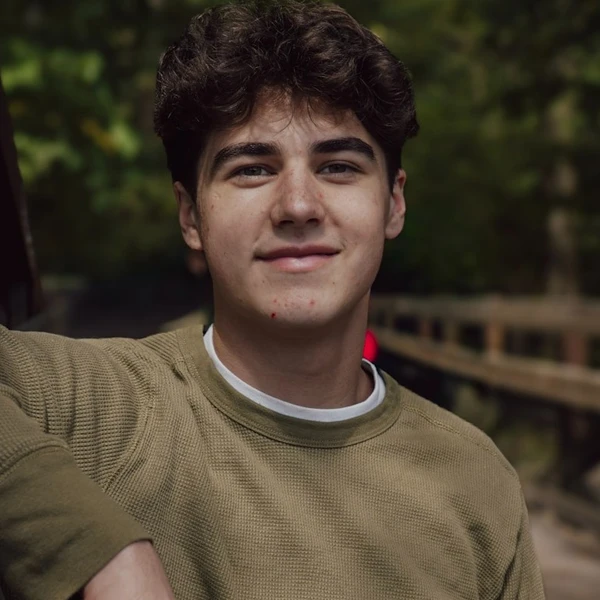
Ohiopyle, PA
Age
17
Gender
Male
Ethnicity
Caucasian
Hobbies and interests
Aerospace
Physics
Advocacy And Activism
Government
Anthropology
History
Research
Jiu Jitsu
Flying And Aviation
Reading
Cooking
Running
Birdwatching
Blacksmithing
Weightlifting
Travel And Tourism
Spending Time With Friends and Family
Environmental Science and Sustainability
Reading
Historical
Academic
Classics
Literary Fiction
Realistic Fiction
Retellings
Social Issues
Fantasy
I read books daily
US CITIZENSHIP
US Citizen
Mylo Moel
1x
Finalist
Mylo Moel
1x
FinalistBio
Hi! I’m Mylo. I’m a rising senior, student pilot, athlete, and youth advocate who is passionate about civic issues and STEM. I am the youngest commissioner in Pennsylvania, on the Governor’s Advisory Commission on Next Generation Engagement, where I advise on issues affecting young Pennsylvanians, including education, civic engagement, workforce development, and mental health. I’m also a Research Assistant with Glisten (formerly GLSEN) and the Youth Voice Fellow with World Affairs Council Pittsburgh. I love reading, traveling, and all things history. I believe that learning about different cultures, perspectives, and moments in time helps us better understand both where we come from and where we’re going. The past is one of our best teachers- and we should never stop learning from the lessons history has to offer.
Education
Pennsylvania Cyber Charter Sch
High SchoolGPA:
3.8
Miscellaneous
Desired degree level:
Bachelor's degree program
Majors of interest:
- Physics
- International Relations and National Security Studies
- Aerospace, Aeronautical, and Astronautical/Space Engineering
- Biochemistry, Biophysics and Molecular Biology
- Anthropology
Career
Dream career field:
Government Relations
Dream career goals:
National Student Council
Glisten2025 – 20261 yearLine Cook
Bittersweet Cafe2025 – Present1 year
Sports
Mixed Martial Arts
Intramural2024 – Present2 years
Awards
- BJJ Blue Belt
Weightlifting
Intramural2023 – Present3 years
Research
Social Sciences, General
Glisten — Research Assistant2026 – Present
Arts
Digital & Traditional art
Illustration2014 – Present
Public services
Advocacy
GSA Club — Vice President2025 – 2026Advocacy
Work2BeWell — National Student Advisory Council2026 – PresentAdvocacy
World Affairs Council of Pittsburgh — Youth Voice Fellow2026 – PresentPublic Service (Politics)
Office of Governor Josh Shapiro — Commissioner, Advisory Commission on Next Generation Engagement2026 – PresentPublic Service (Politics)
New Voters — PA State Lead, 250 Fellowship2025 – 2026Public Service (Politics)
PASC Region C — Board Member2025 – PresentPublic Service (Politics)
Student Council — President2023 – PresentVolunteering
Team Junqueira Brazilian Jiu Jitsu. Marcelo Garcia Association Morgantown — Kids' class coach2024 – Present
Future Interests
Advocacy
Politics
Volunteering
Philanthropy
Science and Advocacy Scholarship
There is a moment in flight training when the textbook stops being a textbook. You're scanning the sky, reading the cloud layers, calculating crosswind corrections while simultaneously managing the throttle and rudder, and it hits you that this is not academics. This is Mother Nature, this is Zhukovsky, this is Euler, this is Bernoulli- this is physics- deciding whether you live or die. That moment, more than any classroom lesson, is when I understood what STEM really is: a single, unified way of making sense of the world.
Most people move through engineered reality without ever stopping to wonder at it. The power grid humming behind a light switch. The load-bearing geometry of a highway overpass. The algorithmic choreography of air traffic control managing hundreds of aircraft through the shared sky. These are easy to write off as background noise, but they are the accumulated answers to questions someone, at some point, was brave enough to ask. My curiosity is drawn exactly there- to the invisible architecture of the everyday.
Aerospace was my entry point. The Space Shuttle, the ISS, airshows, and space museums, these were my earliest obsessions, and they gave STEM a face. When I eventually began flight training and ground school, I discovered that getting an aircraft off the ground is essentially a miracle of collaboration: aerodynamics, meteorology, engineering, and mathematics operating not in separate chapters but simultaneously, in real time, with very real consequences. Aviation does not permit shallow knowledge. You don't memorize; you internalize, or you don't fly.
But the deeper I went into aviation, the more I noticed something STEM education rarely talks about: every engineered system is marked with the fingerprints of the people who built it. The transition from leaded to unleaded aviation fuel- something seemingly only relating to chemistry- was actually a negotiation between economic interest and environmental ethics. Air traffic communication protocols reflect human cognitive limits as much as signal theory. When I was studying the impacts of over a century of heavy metal exposure on the Pittsburgh rivers, I realized that, in real time, we are watching communities reckon with the consequences of decisions made by engineers and policymakers who have never had to live downstream. The science was never just science. It was political, it was geographic. A question of “who gets protected?” and “who absorbs the cost?”
Technology, I started to realize, is never neutral. It encodes the priorities, fears, and blind spots of its era, and understanding that changes how you approach building anything new. It is always a conversation between human intention and physical reality, and the quality of that conversation determines whether the world gets better or worse. However, this realization didn't make me cynical about STEM, just more serious about it. If the systems we inherit carry the values of the people who designed them, then the people who design the next ones have an enormous responsibility to ask harder questions from the start.
I believe in STEM as a method, the transformation of a question into something you can hold, test, prove, or build. “How does this work?” “Why does this happen?” “What if we tried this instead?” Those questions, iterated relentlessly, are how cleaner jet fuels get developed, how new cancer treatments are discovered, how radar imaging improves, and how a community reclaims a river. The cockpit taught me that understanding and accountability are inseparable, that you cannot truly know how a system works without also asking what it owes the world around it, because the questions are never really finished, and neither is the world they're slowly, imperfectly remaking.
JobTest Career Coach Scholarship for Law Students
I’ve always been drawn to systems, how they function, who they serve, and especially who they fail. Growing up in a place like Fayette County, which is a small and conservative corner of Pennsylvania, while navigating both gender transition and mental health problems, I learned very early that the law is not some distant institution that young people “don’t have to worry about until they can vote”, it affects who gets access to help they need, who gets heard, and who falls through the cracks. My experiences have made it clear that I want to pursue a career in law focused on public policy, civil rights, and institutional reform. I want to work right at the crossroad of government and advocacy, to build systems that are more fair and grounded in evidence rather than fear or personal bias.
The first steps in my path began long before I recognized them. As mentioned, I grew up inherently understanding what it feels like to navigate policies that weren’t designed with people like me in mind. I've had to deal with a lack of healthcare support, unfair educational policies, and even local government decisions that diminished opportunities. I became used to advocating for myself. Over time, this self-advocacy turned into a desire to advocate for others. I leaned into, found self-confidence, and grew to love leadership roles that enabled me to practice this, like running as Student Council Vice President and GSA Vice President, and being elected as both.
I find so much joy and fulfillment in these roles, and they have taught me foundational skills that I'm excited to bring to my future legal career. I’ve also spent the last several years developing strong analytical, communication, and research skills through my coursework. As an AP student, I learned the precision and logic needed to build an argument that stands on evidence. In my favorite class, AP U.S. History, I loved learning about how law and government evolve, and how people directly shape that evolution.
My next steps are very intentional, but I need more support than I'm offered to pursue them. I plan to major in political science at Georgetown University while continuing my leadership, public service work, and flight training. I also want to join the ROTC and serve as an Air Force officer, which will give me more experience with federal systems, leadership under high responsibility, and exposure to national-level policy environments. After completing my undergraduate degree, I will attend law school with a focus on administrative law and civil rights. My main goal is to use legal training to work on issues like LGBTQ+ rights and protections in STEM fields, more education access, military policy, and more government accountability.
This scholarship would help me take the next steps toward that future. My goals are ambitious, yes, but not abstract. I’ve already built discipline, leadership, and a sense of purpose in myself needed to follow them. Everybody who knows me knows how ambitious I am, and with continued education and legal training, I am confident in my abilities to become an attorney and advocate who helps create fairer systems for the next generation of kids like me. I appreciate your consideration, and I hope my passion and intent are clear.
Annika Clarisse Memorial Scholarship
Ever since I can remember, two forces have shaped my life: a deep fascination with flight and an unshakable sense that the body I was living in did not match the person I truly was.
Growing up in a small, conservative community meant that being transgender was both unfamiliar to many people, and often outright rejected. From an early age, I tried to hide who I was, burying my real self beneath layers of fear and expectation. But no matter how I tried, the call to be authentic never went away.
By the time I turned twelve, I was already dealing with more than most kids my age could imagine. My family home burned to the ground, and in an instant, we lost not only our belongings but the tangible pieces of a lifetime of memories.
In many ways, the ashes left behind mirrored the sense of loss I felt each day by not living as the real me. A year after that fire, I finally found the courage to come out as transgender, hoping for a fresh start in a life that had already been stripped down to its foundation.
Yet starting over didn’t bring the acceptance I longed for. Instead, I faced hurtful misunderstandings, bullying, and the devastating realization that many of the adults I looked to for protection simply did not and perhaps could not accept me.
Even so, I had dreams that refused to fade. I fell even more in love with the idea of aviation, not just because I wanted to fly, but because I yearned for the discipline, structure, and greater purpose that came with a career as a pilot in the Air Force. I longed for a strong culture of camaraderie, a place where everyone looked out for each other—an ideal that mirrored what my younger self needed so desperately.
That dream was, and still is, fraught with obstacles. Beyond the usual rigors of high school, I found myself fighting with constant reminders that living authentically set me apart from my peers. My challenges are especially apparent in sports. I train in MMA, a sport that prides itself on unity and toughness, but I often hear my teammates or even coaches casually toss out negative remarks about “those transgender people.”
It burns, especially when those same people have cheered me on during practice, calling me a friend, completely unaware of who I am. It’s a constant reminder that, for my safety, I sometimes have to hide my truth. And yet, paradoxically, that heartbreak also fuels me: every bloodied nose, grueling hour of training, and bruised rib is a way to prove that I'm not weak and that I belong.
What hurts the most, though, is confronting how eager I am to serve my country while a large number of people in that very country would rather pretend I don’t exist. My desire to serve in the Air Force stems from genuine patriotism, an urge to protect and uplift others—but it’s disheartening to realize that many who share my flag see me as someone unworthy of basic respect.
Still, I refuse to let that kill my hope. If I have to wait for policies to change, I will. If I must speak up to fight for my and other transgender folks' right to serve, I’ll raise my voice as loud as necessary. I’m convinced that the Air Force’s ideals of discipline, teamwork, and integrity are fully compatible with my identity, and I’m ready to work twice as hard to prove it.
In walking this path, I’ve also learned how closely discrimination can affect mental health. Like Cesar, I’ve felt isolated at times, dealing not just with external bias but with the internal toll of feeling constantly on guard.
The knowledge that someone as imaginative and kind as Cesar lost his battle shows the urgency of building supportive communities and resources for young transgender people. Whenever I feel my own mental health is poor, I remind myself that I’m not alone and that there are people and organizations out there who are working to uplift trans youth.
At the heart of this journey is a desire to show my younger self, and every other trans kid in a small town, that our dreams are not out of reach. My role models in aviation, from pioneering engineers to trailblazing military pilots, never let barriers stand in their way.
Their achievements remind me that my barrier, while unique, can be broken with the same dedication and perseverance they displayed. My next steps include applying to a university with a robust ROTC program or seeking admission to the Air Force Academy, and I plan to pursue a degree that complements a future in flight—possibly aeronautical engineering or aerospace engineering.
Of course, training to become a pilot requires substantial resources, everything from educational costs to flight hours. That’s why scholarships like this are so crucial. Working hard in school while juggling part-time jobs and sports can only cover so much.
This scholarship would help lift part of that burden, allowing me to focus on excelling in my program and logging the flight hours necessary for an aviation career. It would also represent a vote of confidence, not just in my abilities as a student, but in who I am as a person.
In every obstacle I overcome, I hope to prove that living authentically does not have to mean giving up on our greatest ambitions. If I become an Air Force pilot, I want to stand as living proof that transgender people can too serve at the highest levels—ready to protect, lead, and uplift others just like anyone else in uniform.
My deepest hope is that resilience, hard work, and the support of those who believe in me will see me through to the skies, where I can proudly serve my country as my authentic self. Thank you for reading my story and for considering me for this scholarship.