Hobbies and interests
Art
Violin
Speech and Debate
Biology
Drawing And Illustration
Public Speaking
Business And Entrepreneurship
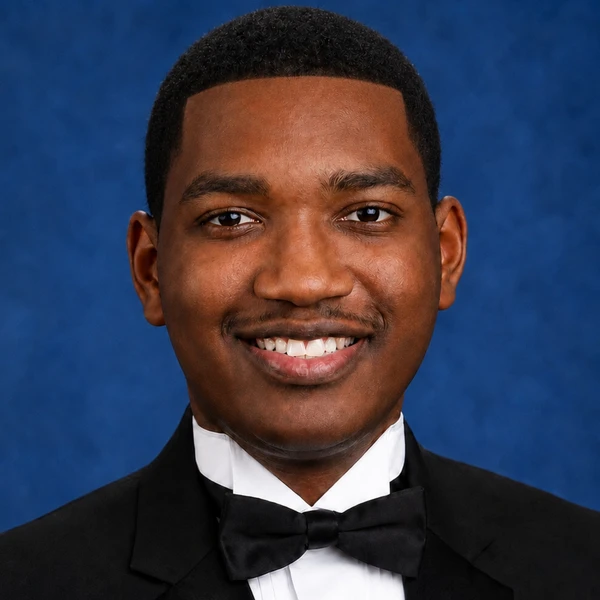
Myles Bracey-Hairston
2x
Finalist
Myles Bracey-Hairston
2x
FinalistBio
I am a college student with a strong passion for science, medicine, and serving my community. My goal is to build a successful career in neuroscience and medicine, using research and compassionate patient care to improve lives and make a lasting impact. I value education because it allows me to grow as a person while giving me the opportunity to contribute to the world around me.
Throughout high school, I built a strong foundation in leadership, research, and service. I served as President of the Alexandria-Fairfax Kappa League, was a two-time National Debate Champion, participated in biomedical research through the Future Kings Program, and was selected to attend the Disney Dreamers Academy. These experiences strengthened my leadership, communication, and problem-solving skills while reinforcing my commitment to serving others. Today, I remain active through the George Washington University Upward Bound Alumni Program, the Future Kings Alumni Program, and the Youth NAACP.
I am motivated, goal-oriented, and committed to completing my college education. Scholarships play a vital role in helping me reduce financial barriers so I can focus on my studies, research opportunities, and professional development. I am grateful for every opportunity to continue my education and work toward a future where I can advance medical research, provide compassionate care, and make a meaningful difference in the lives of others.
Education
Morehouse College
Bachelor's degree programMajors:
- Biology, General
South County High
High SchoolMiscellaneous
Desired degree level:
Doctoral degree program (PhD, MD, JD, etc.)
Graduate schools of interest:
Transfer schools of interest:
Majors of interest:
- Biological and Biomedical Sciences, Other
- Neurobiology and Neurosciences
Career
Dream career field:
- Neuroscience
Dream career goals:
Fry Cook
Kentwood Chicken2018 – 20224 years
Sports
Taekwondo
2012 – 20208 years
Research
Biological and Biomedical Sciences, Other
Future Kings — Future Kings Biomedical Sciences participant with hands-on experience in PCR, gel electrophoresis, and foundational molecular biology techniques.2023 – Present
Arts
South County Theatre
ActingWill the Real Martian Please Stand Up?, Principal Dancer2026 – 2026Alfred Street Baptist Church
Acting2015 – 2026Jacqueline Henry-Green Orchestra
Music2023 – 2026South County Theatre
ActingThe One Act Play Disaster2026 – 2026
Public services
Volunteering
Kappa Alpha Psi Fraternity Inc. — Event Organizer,2022 – 2026Volunteering
Leukemia and Lymphoma Society — Participated in a youth fundraising competition2025 – 2025
Future Interests
Advocacy
Volunteering
Philanthropy
Entrepreneurship
Arthur and Elana Panos Scholarship
Faith has been present in my life for as long as I can remember. I was baptized just a few days after my seventh birthday, a decision that marked the beginning of a relationship with God that has continued to shape who I am. Around that same time, I began participating in productions at my church; what started as a childhood activity grew into something much deeper over time. Church became a place where I learned discipline, humility, and the importance of showing up for a community larger than myself. Through plays, pageants, orchestra, and service opportunities, I was taught that talent means little without character, and that character is built through consistency, not convenience.
My mother has modeled this for me directly. She has worked multiple jobs, including government contracting positions in education and instructional design, to support our household as a single parent. There have been periods of real uncertainty, especially when government contracts shifted unpredictably and income became inconsistent. I watched her continue to show up, continue to provide, and continue to trust that hard work paired with faith would carry us through. That example shaped how I understand perseverance. Faith, for me, has never been about expecting hardship to disappear; it has been about finding the steadiness to keep moving through it.
That steadiness carried into my academic life as well. Balancing AP Calculus BC, AP Biology, and other rigorous coursework with leadership responsibilities and church commitments required me to rely on more than discipline alone. There were moments when I felt stretched thin, particularly while serving as President of the Alexandria-Fairfax Kappa League and competing in debate at the same time. Prayer and reflection gave me the patience to keep working through those moments rather than becoming overwhelmed by them. I have learned that faith does not remove pressure; it gives you the ability to sit with pressure without losing sight of who you are or what you value.
My involvement with the Jackie Henry Green Orchestra through my church and my continued participation in church productions have also taught me the value of collaboration guided by purpose rather than personal recognition. Whether I was playing violin or contributing to a production, I understood that the work was never solely about me; it was about contributing something meaningful to a larger effort. I expect that same understanding to guide me in medicine.
As I move toward a career in neuroscience and neurosurgery, I recognize that this field will demand more than technical skill. It will require integrity in moments when no one is watching, humility when treating patients who are vulnerable, and the discipline to make difficult decisions carefully rather than quickly. My faith has already taught me to approach challenges with patience and to treat people, especially those in difficult circumstances, with compassion rather than judgment. I intend to carry that same posture into patient care, where trust and moral responsibility matter as much as clinical knowledge.
I do not view faith and ambition as separate parts of my life; they are connected. My faith has shaped how I lead, how I serve, and how I respond to setbacks, and I believe it will continue to guide me as I pursue a demanding career in medicine. Success, to me, means little if it is not built on honesty and service to others; faith is what keeps that understanding at the center of everything I work toward.
Learner Calculus Scholarship
When I sat down for AP Calculus BC during my senior year, I understood I was taking on one of the most demanding courses my high school offered; I did not fully understand yet how much that decision would shape the way I think about science and medicine. Calculus is often treated as an obstacle, a class students survive rather than value. I have come to see it differently. Calculus is not just a math course; it is a way of understanding change, and change is at the center of nearly every problem in STEM.
My interest in STEM developed through years of exposure to biomedical research, first through the Future Kings Program's Bio-Medical Concentration and later through the Lift-VA Summer Program. In those spaces, I worked with laboratory techniques like pipetting, PCR, gel electrophoresis, and bacterial transformation, and I saw firsthand how research depends on precision and pattern recognition. Calculus trains that same precision. It teaches students to track how one variable changes in relation to another, whether that variable is population growth, drug concentration in the bloodstream, or the rate at which a tumor progresses. As someone planning to pursue neuroscience and neurosurgery, I recognize that the brain itself is a system defined by rates of change: electrical signals firing, neurotransmitters releasing and clearing, blood flow adjusting to demand. Understanding calculus gives me a framework for understanding those processes at a deeper level than memorization ever could.
Calculus also teaches something less obvious but equally important: patience with difficulty. Concepts like limits, derivatives, and integrals do not come easily to most students, myself included. Working through that difficulty builds a discipline that carries directly into scientific research and medicine, fields where the answer is rarely immediate and where progress often depends on persistence through complex, unresolved problems. My participation in Kappa League Debate strengthened my ability to reason through complicated arguments step by step, and I found that calculus demands a similar kind of structured thinking; each step must follow logically from the one before it, and there is little room for shortcuts.
Placing into Calculus I at Morehouse College, the highest math placement available to incoming freshmen, confirmed for me that the effort I put into AP Calculus BC was not wasted. It also reminded me that calculus is not a subject I am finished with; it is a foundation I will continue building on as I move through pre-med coursework and eventually into medical research. Fields like biostatistics, pharmacokinetics, and medical imaging all rely on calculus-based models to interpret how the body responds to treatment over time.
STEM careers are expanding rapidly, and much of that growth depends on people who are willing to engage with quantitative reasoning rather than avoid it. Calculus gives students the tools to model uncertainty, measure change, and make sense of systems that are constantly in motion, which is exactly what medicine requires. I do not think of calculus as a subject I completed in high school. I think of it as a skill I will keep returning to throughout my career in medicine, one calculation, one pattern, one rate of change at a time.
Grand Oaks Enterprises LLC Scholarship
I was not supposed to feel like I belonged. Growing up as an only child on my mother's side, raised by a single mother in an area with no nearby family, I spent a lot of my early years figuring out who I was without a clear roadmap. But somewhere along the way, through loss, leadership, and a lot of hard work, I found my direction.
My name is Myles L. Bracey-Hairston, and I am a seventeen year old student with a passion for medicine, leadership, and community. My journey has not been a straight line. I lost my brother Keith when I was young, and that loss reshaped everything; the way I see the world, the way I treat people, and the reason I want to pursue medicine. Watching my family grieve and carrying questions I could not answer pushed me toward a field where I could one day provide answers and prevent others from experiencing that same pain.
Along the way I have worked to become more than just a student. I am the President of the Alexandria-Fairfax Kappa League, a first place winner of the Virginia State Association IBPOEW Oratorical Contest, a member of the Alexandria-Fairfax Kappa League debate team, and an alumnus of the Disney Dreamers Academy class of 2022, where I was selected as the youngest participant at thirteen years old. Each of these experiences has added something to who I am; confidence, discipline, the ability to speak up and stand firm, and the understanding that leadership is about service before it is about recognition.
Attending Morehouse College is not just a goal; it is a calling. Morehouse represents something that very few institutions in this country can offer a young Black man; a space where excellence is the expectation, where the people around you look like you and believe in you, and where the legacy of those who came before you is not a distant history but a living standard. I want to be surrounded by young men who are just as driven, just as intentional, and just as committed to making a difference as I am. That environment does not just produce graduates; it produces leaders, thinkers, and changemakers. I want to be shaped by that.
The academic programs at Morehouse also align directly with my goals. I intend to pursue a pre-medicine track as I work toward becoming a surgeon. Morehouse has a strong record of producing Black physicians, and that legacy matters to me. Representation in medicine is not just symbolic; it is life-saving. Black patients receive better care when they are treated by physicians who understand their experiences, and I want to be part of closing that gap.
My plan to make a difference begins at home. My mother sacrificed everything to raise me; she moved us away from family, worked without a support system, and never let me feel like I was missing anything even when resources were scarce. Everything I accomplish is for her first. I want to give her a life that reflects how hard she worked, and I want her to see that none of it was wasted.
Beyond my family, I want to make a difference in my community and in the broader Black community that has poured into me. Through Kappa League, church, and volunteering, I have already begun building relationships and showing up for others. But my long term vision is larger; I want to practice medicine in underserved communities, mentor young Black students who are considering careers in healthcare, and build something that outlasts me. Whether that is a practice, a program, or simply a reputation for showing up when it matters, I want my presence to mean something.
Dr. King once said that life's most persistent and urgent question is what are you doing for others. I have been asking myself that question for years, and every answer I have arrived at points in the same direction; toward medicine, toward leadership, and toward a life lived in service to the people who need it most. Morehouse is the next step in that journey, and this scholarship would bring me closer to making it a reality.
Brooks Martin Memorial Scholarship
My name is Myles Bracey-Hairston, and I am an only child, according to my mother's side of the family. But in reality I'm the youngest of four: me, my sister Victoria, and my brothers Keith and Justin. None of us grew up in the same household, and my siblings were all at least eight years older than me. I live with my mother; it was us against the world. I grew up without knowing much much of my father's side of the family, and the age gap made it hard to feel like I really belonged with my siblings.
One day, when I was five, we suddenly started hanging out more. I guess my parents didn't want me to feel so lonely and cut-off from half of my family. It was a new experience for me. We went to the movies and relaxed at one another's house every couple weeks. We played games and wrestled. I came to holiday parties and graduations. Suddenly I had siblings, and they wouldn't let me forget it. Keith quickly became my best friend and my greatest foe; he'd cover for me when I got in trouble but we'd irritate each other whenever possible. On top of all of that I could never out wrestle him. We spent so much time bonding and staying together over breaks that I'd forgotten I was ever an only child altogether.
In the summer, when I wasn't out of town visiting family in other states, I was with my siblings. On August 16, 2016, my mother received a phone call. Keith had passed away from natural causes. When she told me I thought she was joking, that she was just trying to scare me or something before I went to bed. She was serious. I prayed it was a dream, and that in the morning none of it would have been real, but I knew it was. I cried all night in my room, and I began acting different at school and at home; I became much more irritable and angry, and I just wanted to be left alone. It took me a long time to get my act together; I had to sit down and think of the life my brother didn't get to have and the life he would have wanted for me. Over time, I've tried to live up to the standards that he set and the expectations my family had for me. I got good grades and I didn't get into fights, and before I knew it I was in middle school. My mother encouraged me to decide a general path for my life so I'd be prepared before the end of high school. There were a lot of factors that encouraged me to pursue medicine; the ability to help others, the chance to learn something extraordinary and new, and, of course, the money. But, more than anything else I was encouraged by what happened to Keith. What actually led to his passing? What could the doctors have done to save him and what could have prevented it in the first place? How can I help people going through similar experiences to me?
In my eyes medicine is the best route to making a difference. I want to help people whose lives are at risk so they can return to the things they love and the people who love them. I want to prevent lives from being cut short, especially if they're just beginning like Keith's was. And more than anything I want to give kids the opportunity to grow up with their siblings.
Kalia D. Davis Memorial Scholarship
I am a senior at South County High School in Lorton, Virginia, and I have spent the last four years trying to be the kind of person others can count on; not just in the big moments, but in the quiet ones too. That intention has shaped every commitment I've made and every community I've chosen to be part of.
I carry a 3.7 GPA while playing violin in my school orchestra, serving as President of the Alexandria-Fairfax Kappa League for the second consecutive year, competing on my school's debate team as a four-year secretary and national champion, and participating in George Washington University's Upward Bound program; where I've attended professional symposiums, conducted community research, and produced a 50-minute documentary. I am in three plays this year across my school and church, I volunteer regularly through community organizations, and I have spent four years in laboratory settings through Future Kings' Bio-Med Concentration studying health disparities in African-American men. I also represented my school's district as the only eighth grader selected for the Disney Dreamer's Academy, and participated in a Student Visionary of the Year campaign for the Leukemia and Lymphoma Society. Excellence, for me, is a habit; not an event.
I come from a single-parent household where my mother works multiple jobs, holds a doctorate, and has never once let me believe that my circumstances were a ceiling. I've tried to honor that by showing up fully; for my teammates, my community, and myself. The most meaningful parts of that showing up aren't the achievements; they're the people. The younger Kappa League members who needed a steady president. The debate teammates who needed someone reliable in the room. The kids in my church watching to see what's possible.
I am planning to study Pre-Medicine and Business in college, driven by years of research into cancer disparities and a belief that my community deserves better healthcare and better economic opportunity. I also have a graphic design and apparel business in development; because I believe the same drive that builds a career can build something that employs and uplifts people too.
What draws me to this scholarship is what it stands for. Kalia Davis was a student-athlete, a campus leader, a hard worker, and someone her peers genuinely loved; not because she was perfect, but because she was present. She didn't wait to matter. That is the standard I try to hold myself to every day; and this scholarship, beyond the financial support it would provide my family, would mean that her legacy is part of the story I carry into whatever comes next.
Raise Me Up to DO GOOD Scholarship
My mother doesn't sleep much. Between her work as a government contractor, an online course creator, a teacher, and a holder of a doctoral degree, she has always carried more than most people could imagine; and she has carried it alone. Growing up in a single-parent household, I watched her pour herself into every role without complaint, and in doing so, she taught me the most important lesson of my life: purpose doesn't wait for perfect conditions.
That lesson became the foundation of everything I do. I couldn't afford to sit on the sidelines while my mother worked tirelessly to build a life for us. So I didn't. I threw myself into violin, which I've played since third grade, into debate; where I've served as secretary for four years and earned a national championship; into the Technology Student Association, Quiz Bowl, theater, and my church orchestra. Each commitment wasn't just an activity; it was a way of honoring the work ethic my mother modeled every single day.
But it was the communities that shaped me most. As President of the Alexandria-Fairfax Kappa League for two consecutive years, I've had the privilege of leading young men who, like me, understand what it means to grow up navigating the world with something to prove and someone at home sacrificing for their future. Through Future Kings' Bio-Med Concentration, I've spent four years in laboratory settings, studying patterns in prostate cancer among African-American men; a population that includes my community, my uncles, my neighbors. That work is not abstract to me; it is personal. And through George Washington University's Upward Bound program, I participated in the Xfinity Symposium, the American Society for Metabolic and Bariatric Surgery conference, and produced a 50-minute documentary; all experiences that opened doors I hadn't even known to knock on.
My mother never told me what to become; she showed me how to become. And what I've learned from watching her is that the question isn't which career I'll choose; it's what kind of person I'll be within it. Whether I enter medicine, public policy, communications, or something I haven't encountered yet, I know what drives me: closing gaps. Health gaps. Opportunity gaps. Information gaps. The same gaps I grew up watching my community navigate.
I've seen what happens when young Black men lack mentorship; I joined the Youth NAACP and the Kappa League to be part of the answer. I've seen what happens when communities lack access to health information; I chose the Bio-Med track and studied cancer disparities. I've seen what happens when stories go untold; so I made a documentary. Every path I've taken has been a response to a need I witnessed firsthand.
I don't yet know the title of the role I'll hold someday. But I know the shape of the life I'm building: one defined by service, grounded in my community, and made possible by a woman who worked multiple jobs so I could have every opportunity she didn't. The best thing I can do with those opportunities is make sure I'm not the last one to have them.
Zedikiah Randolph Memorial Scholarship
My name is Myles Logan Bracey-Hairston. I am a senior at South County High School in Lorton, Virginia, and I will pursue a career in Neuroscience once I graduate from high school. I want to pursue a career in medicine because I have always been interested in the field, even as a little kid; I knew I wanted to pursue a STEM career after my STEM-themed birthday party. In middle school, after splitting my patella in half, I recognized the amazing impact that those in the medical field have on the people you see every day; without them, I wouldn't be able to walk, my grandparents wouldn't be here today, and the world as a whole would be a much more terrifying place.
Finally, I chose to pursue Neurosurgery specifically because, along with my interest in medicine and science, I've always been intrigued by how things work, and I've grown to love learning. The brain is, even now, a somewhat mysterious thing, yet neurosurgeons and neuroscientists, despite the odds, through hard work and dedication, have learned how to help or even fix issues with our brains and minds, and they are still learning. Of course, scientists in every field learn and discover new things all the time, but, in my eyes, no other field has such a profound impact on our lives. And I truly don't believe I would be as passionate in any other field.
I aspire to use my knowledge as a Neuroscientist to help in the research and development of safe, effective, and affordable treatments and drugs for those in need; if I cannot help those who need it most, then I have no right to call myself a scientist. Affordability for proper treatment and care is a major societal issue that we've yet to solve, and I don't believe my involvement in the field will solve it overnight. However, as a member of the field, it would be my duty and obligation to help where I can, when I can.
While about 4% of neuroscience graduates are black, they only make up approximately 1% of in-field faculty. We make up more than 14% of the population, and we've still only managed 1%. Over time, there's been a significant growth in people in the field, and, especially in recent years, there has been a sort of wave of programs and organizations that aim to encourage more of us to enter the field and the field of medicine in general. While these programs and organizations are doing essential work outside of schools, they are missing a lot of potential participants by not extending these programs or invitations to them to the schools themselves. Take, for example, the Future Kings program that I am a part of; they do a lot of work to introduce their participant to important figures in the community and give us opportunities to get more involved in STEM fields. However, most of the work done on the "promotional" side is done by the already active members and participants: students, parents, and advisors. As a Neuroscientist, I will actively and persistently encourage and discover resources that will potentially pave the way for future members in the field. I want to create a resource that will be accessible to youth who are interested in or may have never heard of neuroscience. I would also encourage community members and educators to promote not just what I've made but other resources as well.
Thank you for your consideration.