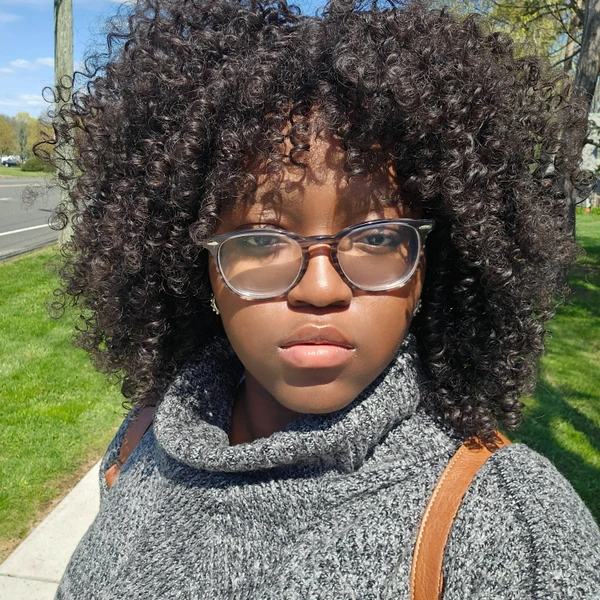
user profile avatar

Moyosoreoluwa Akinsulere

1x

Finalist

General information

Location
Waterbury, CT
Age
22
Gender
Female
US Citizenship
Permanent Resident (Green Card)
Ethnicity
Black/African, Asian
Religion
Christian

Hobbies & Interests

  • Foreign Languages
  • Singing
  • Gaming
  • Social Media
  • Fashion
  • Yearbook
  • Coding And Computer Science
  • Public Speaking

Reading

  • Action
  • Art
  • Adventure
  • Fantasy
  • Mystery
  • Novels
  • Thriller
  • Biography
  • Religion

I read books multiple times a month.

Bio

My name is Moyosoreoluwa (English meaning: I rejoice to the glory of God). I am an aspiring full stack developer who wants to later transition into Software Engineering. I'm currently Computer Science student with minors in Data Science & Cybersecurity who is deeply passionate about leveraging technology to solve deep & complex real-world problems. Growing up with limited financial resources in Nigeria, I learned early on that perseverance and adaptability are essential to achieving my goals. My academic journey has recently thrown me some difficult financial and structural hurdles, but my commitment to my education remains unshaken. I am actively working through these challenges by taking proactive steps, such as self-advocating for enrollment solutions and managing my degree progression independently. My long-term goal is to utilize my background in technology and mathematics to develop impactful software interfaces & systems while opening doors for other underrepresented students in STEM such as myself. Any scholarship I receive represents more than just financial relief; it is the vital bridge that will allow me to overcome my immediate obstacles, stay enrolled in school, complete my degree, and succeed in my desired career path. Thank you for considering me among all options, and God bless you. Stay safe!

Education

University of Hartford

Bachelor's degree program

2022 – 2027

Majors:
  • Computer Science
Minors:
  • Data Science
GPA3.2 GPA

Brewster High School

High School

2018 – 2022

GPA3.3 GPA

Miscellaneous

Desired degree level:
Master's degree program
Graduate schools of interest:
University of Phoenix, University of Connecticut-Hartford Campus, DeVry University, Brandeis University, Central Georgia Technical College, Pennsylvania State University-World Campus, University of Maryland Global Campus
Majors of interest:
Computer and Information Sciences and Support Services, Other, Computer Science, Data Science, Computer Systems Analysis, Data Analytics
Desired degree modality:
Full-Time, Online, In-Person, Hybrid
Medical school interest:
No

Career

  • Member

    Asian Student Association (ASA)

    Jan 2022 – Present

  • Member

    UHART Computing Club

    Jan 2022 – Present

  • Volunteer Library Assisstant

    Libraries · Brewster High School Library

    Jan 2020 – Jan 2021

Miscellaneous

Dream career field:
Technology
Dream career goals:
Full-Stack Developer, Software Engineer, or Systems Analyst
Has nursing license:
No

Future Interests

  • Advocacy
  • Volunteering
Cyrilla Olapeju Sanni Scholarship Fund
When I was five years old, my world broke. My father passed away from severe bacterial pneumonia induced by late-stage, undetected pulmonary tuberculosis. This preventable loss left my mother and me to endure an increasingly unfriendly environment in Nigeria, where deep systemic failures in public health infrastructure transformed medical care into a privilege rather than a human right. As local security rapidly deteriorated due to the threat of Boko Haram, survival involved constantly running. I uprooted my life, moving homes and schools multiple times to escape community violence and child kidnappings. Every five-kilometer walk to school was an active battlefield where tomorrow was never promised. Then arrived the battle for my own life, exposing me further to the harsh disparities of healthcare. At age seven, just two years after losing my father, and shortly after losing my one-year-old baby brother, I was diagnosed with a grade 4 abnormal heart murmur. My mother, already enduring clinical depression from profound grief and a subsequent stillbirth, was shattered at the prospect of losing her first daughter to a treatable cardiovascular defect. In a fractured medical ecosystem driven entirely by immediate, out-of-pocket costs, advanced pediatric care was out of reach. We leapt from hospital to hospital, begging for help, only to be repeatedly turned away because we lacked upfront financial means. The systemic delays took an immediate toll; without medical management, I became entirely bedridden, losing my ability to walk or talk. In our darkest moment, a compassionate hospital physician took pity on us, personally funding the complex, life-saving cardiac surgery I required to survive. Then, against all odds, an opportunity arose for us to relocate to the United States in 2017. Arriving here felt like a medical and humanitarian miracle, but likewise, it instilled a profound sense of responsibility. Even after finding safety, our medical battles followed us. In 2020, my mother was diagnosed with Type 2 diabetes and severe kidney stones, requiring the surgical removal of one of her kidneys. Because she continues to severely struggle with these chronic conditions today, she became completely unable to work for a year. This sudden loss of livelihood created a massive socioeconomic barrier, forcing me to halt my own education because we could no longer afford the costs associated with attending school. Now, having finally overcome those hardships to return to school, my perspective has evolved entirely. Witnessing my mother navigate an intricate, fragmented healthcare system as a chronic patient, while experiencing firsthand how medical crises disrupt a student's academic development, made me realize that I cannot just passively survive; I have to thrive. This deep history of family medical trauma inspired me to unite the critical divide between software technology and global health equity by pursuing a degree in Computer Science. Although technology is often viewed as a luxury, my childhood and my family's ongoing health battles taught me that digital connectivity, health informatics, and data management are literal tools for survival. I will use my software engineering training to build secure, open-access medical software, patient-centric chronic disease tracking tools, and community health alert systems. By engineering reliable digital health infrastructure, I endeavor to protect vulnerable families, enable patients coping with complex conditions such as diabetes, kidney disease, and heart disease to coordinate care seamlessly, and provide community health workers with access to vital clinical data. This degree is my pledge to ensure that no other family is neglected in the healthcare system and to uplift the world's most vulnerable communities.
GD Sandeford Memorial Scholarship
When I was five years old, my world fractured. My father passed away from severe bacterial pneumonia induced by late-stage, undetected pulmonary tuberculosis. This preventable loss left my mother and me to navigate an increasingly hostile environment in Northern Nigeria, where deep systemic failures in public health infrastructure transformed medical care into a privilege rather than a human right. As local security rapidly deteriorated due to the threat of Boko Haram, survival meant constantly running. I uprooted my life, moving homes and schools multiple times to escape community violence and child kidnappings. Every five-kilometer walk to school felt like an active battlefield where tomorrow was never promised. Then came the battle for my own life, exposing me further to the harsh disparities of healthcare. At age seven, just two years after losing my father, and shortly after losing my one-year-old baby brother, I was diagnosed with a grade 4 abnormal heart murmur. My mother, already enduring clinical depression from profound grief and a subsequent stillbirth, was shattered at the prospect of losing her first daughter to a treatable cardiovascular defect. In a fractured medical ecosystem driven entirely by immediate, out-of-pocket costs, advanced pediatric care was out of reach. We leapt from hospital to hospital, begging for help, only to be repeatedly turned away because we lacked upfront financial means. The systemic delays took an immediate toll; without medical management, I became entirely bedridden, losing my ability to walk or talk. In our darkest moment, a compassionate hospital physician took pity on us, personally funding the complex, life-saving cardiac surgery I required to survive. Then, against all odds, an opportunity arose for us to relocate to the United States in 2017. Arriving here felt like a medical and humanitarian miracle, but it also instilled a profound sense of responsibility. Even after finding safety, our medical battles followed us. In 2020, my mother was diagnosed with Type 2 diabetes and severe kidney stones, necessitating the surgical removal of one of her kidneys. Because she continues to severely struggle with these chronic conditions today, she became completely unable to work for 2 years. This sudden loss of livelihood created a massive socioeconomic barrier, forcing me to halt my own education because we could no longer afford the costs associated with attending school. Now, having finally overcome those hardships to return to school, my perspective has evolved entirely. Witnessing my mother navigate a complex, fragmented healthcare system as a chronic patient, while experiencing firsthand how medical crises disrupt a student's academic trajectory made me realize that I cannot just passively survive; I need to thrive. This deep history of family medical trauma inspired me to bridge the critical divide between software technology and global health equity by pursuing a degree in Computer Science. While technology is often viewed as a luxury, my childhood and my family's ongoing health battles taught me that digital connectivity, health informatics, and data management are literal tools for survival. I will use my software engineering training to build secure, open-access medical software, patient-centric chronic disease tracking tools, and community health alert systems. By engineering resilient digital health infrastructure, I aim to protect vulnerable families, allow patients managing complex conditions like diabetes, kidney disease, and heart conditions to coordinate care seamlessly, and give community health workers access to vital clinical data. This degree will allow me to turn my family’s past and present medical traumas into purposeful, health-centric action, equipping me to build the modern digital lifelines that will protect and uplift the world's most vulnerable communities. God bless and stay safe!
Moyosoreoluwa Akinsulere Student Profile | Bold.org