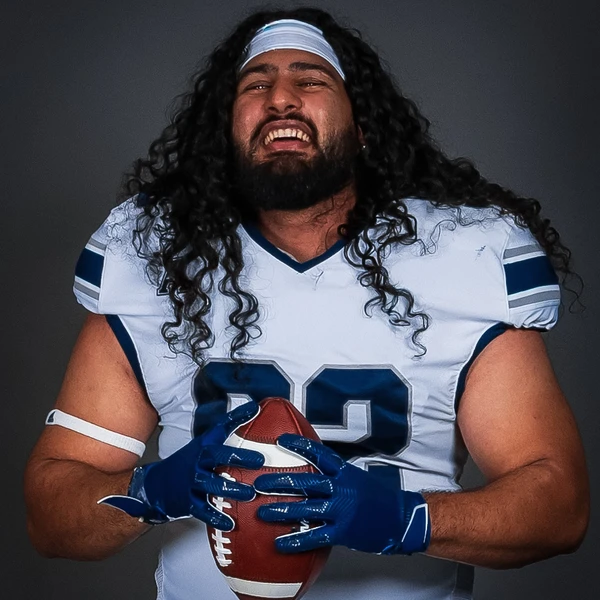
Momen means “believer” (مؤمن), yet belief has not always come easily.
I have never been the kind of student success was built for. I was a first-generation, low-income Pakistani Muslim kid trying to find my footing in a world where everything, from FAFSA forms to football scholarships, felt written in another language. My parents had never been to college. I filled out my own financial aid paperwork, took the bus to and from campus, and worked through nights while trying to keep my dreams alive on the football field.
When I walked on to the Division I football team at William & Mary, I thought hard work would be enough. I was told I would earn a scholarship after my first season, that I would be taken care of. Instead, that promise never came. When I got injured twice, no one covered the cost of my surgeries or physical therapy, even though both injuries happened on the field. I played through torn ligaments and pain that did not end after the whistle. I was on food stamps, sneaking into dining halls for meals, and rehabbing myself between classes. My teammates arrived in nice cars while I limped from the bus stop, hoping no one noticed the swelling in my ankle.
There were times I questioned why I kept going. The injuries hurt, but the isolation hurt more. I had worked my whole life to belong, yet every day reminded me how different I was. My name, faith, and skin color entered the room before I did. I was racially profiled more times than I can count, followed in stores, searched on the street, and treated like I did not belong in spaces I had earned my way into.
Then, when I thought I had survived the worst of it, I was falsely accused of sexual assault. It was the lowest point of my life. Overnight, I went from being a respected student-athlete to a headline of whispers. I thought I would lose everything, from my degree to my reputation and community. But I refused to disappear. I met with the people who spread the rumors. I kept showing up to class, to practice, and to the Board of Visitors meetings where I represented the entire student body. I did not let hate harden me. I chose to forgive, not because it was easy, but because bitterness would have destroyed me long before injustice did.
In time, the truth came out. I was completely cleared. But what mattered most was not vindication, it was how I carried myself through it. I kept advocating for due-process protections so no other student would go through what I did. I kept mentoring first-generation and low-income students who felt invisible. I helped secure halal dining and organized Ramadan meals so Muslim students could eat with dignity. And I stood on stage as my university’s 2025 Valedictory Speaker, representing every underdog who had ever been overlooked.
Through all of it, I learned that tenacity is not loud. It is quiet, stubborn faith. The kind that keeps showing up when the world expects you to quit. Grace is not about staying untouched by pain; it is about refusing to let pain make you cruel.
My background in biology and data science grew from that same spirit. I have studied cancer histology, sports medicine, and public health systems because I want to fix the inequities I have lived through. Working at Proton International, I modeled how access to cancer treatment changes survival rates depending on where you live. At HTI Sports Diagnostics, I analyzed MRI data from athletes around the world to understand injury patterns that often go ignored. For me, science is not abstract. It is personal. Every number represents a story like mine, where someone is just trying to be seen, healed, or believed.
Andrea Worden believed in the power of people who do not fit the mold. That is why this scholarship means so much to me. I was not supposed to make it here. I was the kid taking the bus while my teammates drove Teslas, the player paying out of pocket for surgeries the program should have covered, the student who had to fight for his education and name. And yet, I flourished.
I became a Board of Visitors representative, shaping policy on equity and student wellness. I earned a 3.8 GPA and graduated Summa Cum Laude in Biology and Data Science. I spoke at commencement, not as the most decorated student, but as one who had walked through fire and still found kindness intact. That same year, I received the Cypher Award for leadership, service, and flourishing, along with a letter from the Seven Society recognizing my impact on the university community. Even in my hardest seasons, I was named to the CSC Academic All-District Team for academic and athletic excellence. Those honors remind me that success is not about perfection, but perseverance with integrity.
There is a line from the Qur’an that my father taught me: “Indeed, with hardship comes ease.” It does not mean life will get easier. It means that within hardship itself lies the opportunity to grow softer, wiser, and more compassionate. Every obstacle I have faced has deepened my empathy. It is why I want to build a career using data to close gaps in health and opportunity, to make systems work for those who have always had to work around them.
I am not a traditional success story. I didn't have perfect support, perfect health, or perfect circumstances. But I have learned that imperfection is where empathy lives. The adversity that could have broken me became the reason I believe in others so fiercely.
If Andrea Worden were here, I think she would understand that the real measure of grace is how you treat people when no one is watching, and the real test of tenacity is continuing to believe when you have every reason not to.
I am still that believer. I always will be.