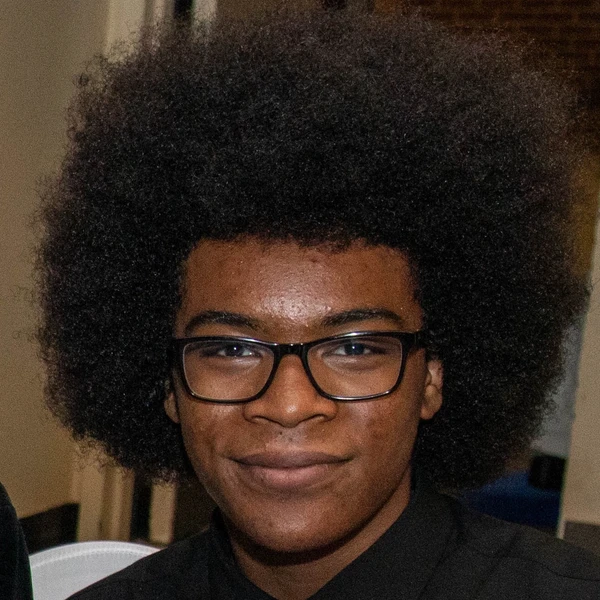
Hyattsville, MD
Age
17
Ethnicity
Black/African
Hobbies and interests
Advocacy And Activism
Anatomy
Botany
Cooking
Education
Environmental Science and Sustainability
Gaming
Food And Eating
Gardening
Foreign Languages
Geography
Government
Health Sciences
Journalism
Learning
Math
Movies And Film
Music
Marketing
Mental Health
Medicine
Mock Trial
Meditation and Mindfulness
Mentoring
Human Rights
Nutrition and Health
National Honor Society (NHS)
Photography and Photo Editing
Politics and Political Science
Psychology
Public Health
Public Speaking
Research
Self Care
Sewing
Social Justice
Social Sciences
Sociology
Spending Time With Friends and Family
Speech and Debate
Physiology
Student Council or Student Government
Sustainability
Teaching
Television
Tutoring
Volunteering
Video Editing and Production
Videography
Reading
Action
Adult Fiction
Adventure
Young Adult
True Story
Tragedy
Suspense
Sports and Games
Speculative Fiction
Drama
How-To
Social Issues
Short Stories
Childrens
Folk Tales
Folklore
Romance
Crafts
Fantasy
Psychology
Music
Literary Fiction
Realistic Fiction
Humor
Magical Realism
Mystery
Retellings
Health
Sociology
Self-Help
Art
Biography
Historical
History
I read books multiple times per month
Mikal Witherspoon
1x
FinalistMikal Witherspoon
1x
FinalistBio
My name is Mikal Witherspoon, and my goal is to help people. The method that I have chosen to get there is medicine. Specifically, I want to focus on medicine that takes care of the whole person and also using plants for medicine. I am currently a high school student graduating with an associate's degree in health sciences. In undergrad I want to study biochemistry and plant sciences and work in emergency medicine. I then want to connect my knowledge of plants with medicine in graduate school and eventually get a Doctor of Osteopathic Medicine degree.
Education
Academy Of Health Sciences At Pgcc
High SchoolGPA:
3.9
Prince George's Community College
Associate's degree programMajors:
- Health Professions and Related Clinical Sciences, Other
GPA:
4
Miscellaneous
Desired degree level:
Doctoral degree program (PhD, MD, JD, etc.)
Majors of interest:
- Botany/Plant Biology
- Plant Sciences
- Biochemistry, Biophysics and Molecular Biology
Test scores:
1400
SAT
Career
Dream career field:
Medicine
Dream career goals:
Student Governance Association - Chief of Staff
Prince George's Community College2025 – Present1 yearSummer Paid Intern
National Energy Education Development Project2023 – 2023
Research
History
Greenbelt Middle School / National History Day — Researcher / Presenter2019 – 2020
Arts
Broadway Bears
TheatreChoose Your Own Oz2021 – 2022
Public services
Volunteering
Greenbelt Middle School — Food Sorter and Transporter2021 – 2021Volunteering
Greenbelt Middle School — Greeter2022 – 2022
Future Interests
Advocacy
Politics
Volunteering
Philanthropy
Entrepreneurship
Stewart Family Legacy Scholarship
I want to study plants because I believe they hold answers that modern medicine has only begun to uncover. Throughout history, plants have served as the foundation of healing, yet their full potential remains largely untapped. As I graduate high school with an Associate’s degree in Health Sciences, I carry both a clinical foundation and a deep curiosity about how the natural world can shape the future of healthcare. By majoring in Plant Sciences, I hope to understand how plants function at the molecular and biochemical level so I can apply that knowledge to medicine and improve the way we treat disease.
Science shapes our future through discovery. Scientific breakthroughs have transformed healthcare and improved quality of life across the globe. Many widely used medications originated from plant compounds, which reveals an important truth: innovation does not always require creating something entirely new. Sometimes it requires looking deeper into what already exists and asking better questions.
Through Plant Sciences, I want to study how plants produce complex chemical compounds and defend themselves against disease. Understanding these systems could lead to treatments that are more affordable and accessible. Plant-based medicines often have lower production costs, which is critical in communities where healthcare remains financially out of reach. In areas with limited medical infrastructure, plant-derived therapies may offer sustainable options for care. Expanding research in this field could make medicine not only more innovative, but more equitable and complete.
While science fuels discovery, leadership determines how those discoveries shape society. Pioneering research requires individuals willing to challenge assumptions and pursue solutions others may overlook. Leadership in science means ensuring that breakthroughs benefit the widest possible population rather than remaining confined to laboratories.
As I pursue graduate study and medical school, I aim to combine research with compassionate practice. I want to become a physician who understands both the science behind treatments and the lived experiences of patients. By integrating plant research into evidence-based care, I hope to contribute to a future where innovation is accessible, sustainable, and centered on improving lives.
Get Up and Go Scholarship
Ethel Hayes Destigmatization of Mental Health Scholarship
My experience with mental health has shaped my goals, relationships, and understanding of the world by helping me understand myself, those around me, and the world as a whole. Understanding my mental health and how to handle it has helped me with my goals in the present and future. Having knowledge of and experience dealing with mental health conditions has helped me maintain relationships. And this understanding, knowledge of, and experience with mental health have also contributed to the lens through which I view the world.
I am a high school student. As students, we are expected to balance and maintain our physical, mental, and social health. Even with help, it is difficult to stay healthy in all three areas. Especially when you have to keep your grades up, and you may have to work or do chores. Personally, I have decided to neglect my physical health in the past. When I get off the school bus, I relax and talk to friends for social and mental health. Afterward, or during that time, I do chores and things like that. Then, I hit all of my school deadlines before midnight and sometimes after. And after all of that, I put sleep last.
Something that I realized is that all areas of health are interconnected. I didn't just realize this through middle school health class and the triangle of wellness, but instead through my experiences. I have noticed that when my physical health declines, so does my mental health. When social health improves, so does mental health. Since it's all connected and I want to strive to be my best self, the goals I have made since this revelation have focused on all three of those aspects of wellness. I have been trying to avoid neglecting my health, and because of that, I have been getting better.
Mental health has had a big impact on my relationships throughout the years. I have had several friends who have harmed or considered harming themselves. This affected how my relationships with others function because I am very conscious and weary of possible mental health issues. Since then, I have processed what happened in those situations and internalized it. In my relationships, I make sure that other people know that I am there for them. I also try to make sure the people I care about or even random strangers on the street know that someone cares, and I urge people to use good mental health practices. Sometimes, I feel that I can be overbearing or that I am giving where nobody asked, but sometimes hearing "it's ok to cry" or that "your feelings are valid" can make someone feel okay. Or set them in a good direction where they might have been going in a bad one.
Whenever I hear someone with opinions drastically different from mine, I try to understand where they are coming from. This mental investigation may be through the lens of race, geographic location, culture, upbringing, or gender. I also like to think through a mental health lens. I know about mental health not just because of my psychology and sociology high school classes but also because of personal research. The brain, how it works, and why people do the things they do interest me, and it has affected me, so I occasionally try to learn about it. Knowing about mental health, mental health conditions, and how mental health can affect others, and then using that lens, can help me understand the world. I can use this lens of mental health for people I don't relate to or for people I do relate to. All in all, mental health has impacted my life in various ways, including my goals, relationships, and perspective.
Learner Math Lover Scholarship
If I was given a whiteboard and had to fill that whiteboard, math would be on there. Right now I am a high school geometry student and every time we learn a new concept I am stunned by the beauty of math. Patterns create geometric rhythmic sequences of shapes, numbers, and letters through equations and graphing. The Fibonacci sequence, pi, prime numbers, squares, cubes, exponential graphs. Math makes sense to me. At first, I may not understand a concept, but once it clicks, I am able to teach it. Back in quarantine, I would learn concepts, and teach them to my classmates within the same class period. Math is fun to teach and fun to learn. Math also makes sense to me, and that's why math is my favorite class. The problem have answers, and even if there is a constructed response, there is a correct answer. 2+2 equals 4, period. No, what ifs or but ifs. Math makes sense, and there are right and wrong answers. Something else I love about math is how it builds on itself.
Math is my favorite class, and one of the reasons is because you feel like you are progressing. You learn numbers, then how to count, then scale, then addition, subtraction, multiplication, and division. Negative numbers, fractions, decimals, and order of operations. Squares, square roots, coordinate planes, graphing, exponential, and quadratics. The formula of a circle, square, rhombus, rectangle, triangle, prism, sphere, cone, and pyramid. Parallel, perpendicular, acute, obtuse, verticals, supplementary, complementary, reciprocal, opposite, circumference, diameter, and translations. And as I sit here in math class learning about proofs, and how to find slopes in a rhombus, I think. I love this.
Lieba’s Legacy Scholarship
In the future, I plan to go into education, specifically becoming a teacher. Originally, I would have liked to get a General Education degree and become a middle school teacher. But after learning about Special Education, what it meant, and the difference between the two degrees. I decided that if I were going into education, Special Education would be the choice.
Special education is education in which lessons are given at the rate of a child's understanding. General education is education in which lessons are given for the stage of development expected for the entire class. When you hear this comparison, the issues may become evident. If a child falls behind in General Education, they will be left behind, because the curriculum doesn't account for that. If a child is ahead in general education, school may be easy for them, but they won't be challenged or excel because of it. These issues could lead to students not building proper skills in school, and not reaching their full potential.
As someone who used to be in the Talented and Gifted Program, which is a type of Special Education, I understand the importance of special education. Being a special education teacher is important for gifted children, I personally have been impacted by many of my special education teachers. They took an effort to understand me, and make sure I understood the material. Special education teachers may be in the classroom helping gifted children, but general education teachers are also important to gifted children as well.
Before I was recommended for the Talented and Gifted program, I was in general education classes. My teacher noticed that I was ahead and always bored with work. I was not being challenged. She recommended me to the TAG program and I got into the program where I was then challenged and got a better education for me. I do not know whether she had a general education degree, or if she had a special education degree. But I do know that regardless, my teacher helped me, a gifted student.
Teachers are vital to the education, and overall well-being of gifted children. And they are required for the intellectual needs of gifted children to be met. How does the proper education of children contribute to social-emotional well-being? Well, to be frank, education is the key to everything in life. To know how to take care of yourself, how to read, how to write, how to speak, how to take care of others, and how to do math. These things are vital to social-emotional health because, without education, you wouldn't know how to human.
While the education system doesn't prepare you for everything, and a big part of education is at home. Being a teacher of gifted children, in the classroom or in life, is crucial to their development. Me being a teacher will help gifted children fulfill their intellectual needs and foster their emotional well-being. Having a good education at home and at school is crucial to gifted children becoming functioning members of our society and allowing them to thrive.
Paige's Promise Scholarship
Hello, I am Mikal Witherspoon and I want to make a difference. I plan to work with something psychology and/or education related in the future because it interests me. Something that has specifically caught my attention when it comes to Psychology and partially in Education too is Substance Use Disorder. There is a massive stigma around it and usually, when I hear people talking about it, they aren't informed on the issue. Substance Use Disorder (SUD) is not a choice in many circumstances. Some people may try a substance, or use it to forget about their problems, but getting addicted isn't necessarily a choice. While I don't know all the chemistry, and hormones, that go into addiction, I know that it is hard to stop once you get started. I also know that it can be harmful to people and those around them.
When I hear people talking about Substance Use Disorder, 9 out of 10 times it is in a negative connotation. With words like crackheads, alcoholics, druggies, and other demeaning terms. People often talk about them and say that they are self-destructive, or stupid, but they may just be a victim of this disorder. To educate myself more about this disorder, I will make sure to do research pertaining to this topic, and ask questions and make sure that it is really right. This is an important topic with a lot of misinformation and misunderstanding around it, so it is crucial to get the facts right. I will not only question basic online sources like Google, but also my textbooks.
After doing some digging, I came to the conclusion that textbooks may not be telling the whole story. History and reading textbooks paint SUD as an issue and the people it affects as deviants. The most recent instance that I have noticed discrepancies is in the psychology textbooks. While I am a high school student, and knowing all the brain science behind SUD would be a bit much for a basic high school psychology class. The small piece that they do give us should be entirely correct, and acknowledge that there is more to it than what it gives us.
When I think about educating people about SUD, first I think of teaching or displaying it in a classroom. But then I think about my own life, and I realize that a large part of removing the stigma is talking to friends, families, and peers about it. Making sure that everyone has all the facts straight. In my own life, I have already found an example as my younger sibling just thinks drugs are bad and that is that. Alcohol is bad and that is that. People who do these things are just 'stupid'. While these substances can be harmful in abundance, he does not have the full story. Explaining and talking to him about substances like drugs and alcohol will help break the stigma and educate him about conditions like SUD.
Perspective is very important when discussing these issues, as a person who does not have a Substance Use Disorder, may reason that the solution to the problem is simply stopping. But it is much more than that. Making sure that there is proper education about conditions like Substance Use Disorder is vital, especially in the youth. Doing this will ensure that future generations will be well-informed on all issues and be able to make informed decisions. It will also make sure that harmful stigmas, like the one around SUD, will not form in the future, which will positively impact the world of tomorrow.