Hobbies and interests
Student Council or Student Government
Soccer
Lacrosse
Baking
Football
Coaching
Cognitive Science
Biomedical Sciences
Engineering
Cello
Piano
African American Studies
Anatomy
Food And Eating
Mikaela Nowinski
1x
FinalistMikaela Nowinski
1x
FinalistBio
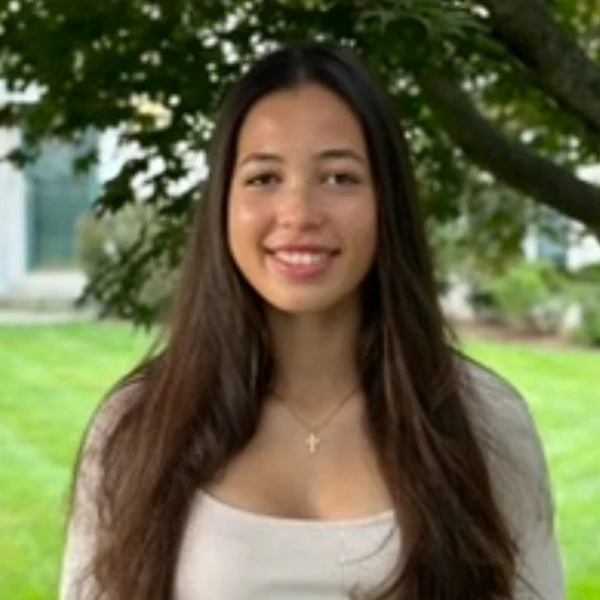
Hi, my name is Mikaela Nowinski. As the oldest sister to two energetic siblings, a self-proclaimed extreme foodie, and a proud military kid, I’ve grown up adapting to change and finding curiosity in unexpected places, especially in science and research.
When my younger siblings used to cover their eyes whenever we watched Captain Hook stalk across the TV screen, 7-year-old me remained fixated on the metal hook. My curiosity and desire to help overwhelmed any fear I had at the time. What if his prosthetic wasn’t as threatening and was more functional? Those images triggered a lasting desire to reimagine prosthetics through a humanitarian lens.
Technology has advanced since pirates’ hooks and wooden legs, but innovations in the prosthetics field have not kept pace. By rethinking current methods, I will use mainstream 3D printing to create widely accessible prosthetics that are seamless extensions of one’s self. A bionic leg that adapts to various terrains and a prosthetic hand that can feel the warmth of a loved one's touch are all within reach. I am determined to transform the lives of those impacted by limb loss by advancing neural integration, intuitive control, and affordability in prosthetics.
I am confident with my passion and dedication that I will turn that 7-year-old girl's dream into a reality, transorfming lives - one person at a time!
Education
Thomas Jefferson High for Science and Technology
High SchoolMiscellaneous
Desired degree level:
Bachelor's degree program
Majors of interest:
- Biomedical/Medical Engineering
- Mechanical Engineering
- Biological and Biomedical Sciences, Other
Career
Dream career field:
Biomedical Engineer
Dream career goals:
Sports
Football
Varsity2025 – 20261 year
Awards
- Apart of high school's first ever girl's flag footbal team
- Captain
Lacrosse
Varsity2022 – Present4 years
Awards
- 3 Year Team Captain
- Led Team to Playoffs x2
- All-Conference x3
- Offensive Player of the Year
Soccer
Club2016 – Present10 years
Awards
- 4 Year Peer Selected Captain
- US National Team ID Camp Selectee
- Elite Conference Cup Player (Top 120 Players in the Nation)
- Mid-Atlantic All Conference x2
Public services
Advocacy
Black Girls Do STEM (BGDS) — Advocate and Volunteer Candidate. Empowering Black Girls nationwide to pursue STEM by sharing STEM passion, leading by example & instilling confidence in underrepresented community.2024 – PresentAdvocacy
America’s VetDogs (AVD)- Provides Service Dogs to Disabled War Veterans — Advocate and Spokesperson. Raised awareness & funds w/community leaders by sharing my experiences with AVD’s life-changing impact on 100% disabled war veterans & their families.2024 – PresentVolunteering
Columbia Buddy - TJHSST Partnership — Team Lead and 3 Year Mentor. Addressed educational inequity for students w/access disparity. Fostered STEM curiosity through interactive and fun science projects.2023 – 2025Volunteering
Mobile Hope Charity – Support and Shelter for At-Risk Youth — Team Lead and Local Area Coordinator. Supported local efforts through food & toy drives. Partnered w/SGA & government organization to distribute food/toys to at-risk youth experiencing hardship.2024 – PresentVolunteering
Leukemia & Lymphoma Society (LLS) – Blood Cancer United — Led team of 19 volunteers raising $20K+ to advance cancer research, awareness, and policy changes. LLS Hall of Fame inductee. Senior mentor selectee.2024 – 2025
Future Interests
Advocacy
Volunteering
Philanthropy
Entrepreneurship
Stephan L. Daniels Lift As We Climb Scholarship
I am a multiracial woman, an engineer, and a dreamer. If anyone asked me to describe myself in three words, that's exactly what I would say.
My dream is to create affordable prosthetics because I want to restore people's lives and confidence. I believe no one should have to choose between basic needs and a prosthetic limb, and I intend to change that by researching lower-cost materials and neural input technology to make prosthetics more affordable and life-like.
Technology has advanced since the first prosthetics, but I want to push it one step farther: a two-way pathway. What I mean is that the most advanced prosthetics today use only a one-way pathway: our brain signals via brain-machine interfaces, and muscle signals measured by electromyography sensors, are decoded and sent to the prosthetic, predicting movement and converting it into mechanical movement. But I want to explore a second pathway: what if sensory input from the world could be sent back to the user via the prosthetic? What if a prosthetic could feel the warmth of a loved one's touch or the roughness of asphalt? The sensory input we receive from the world is a crucial part of our everyday lives and a vital thing I want to restore in patients with limb loss.
This past summer, I gained invaluable exposure to cutting-edge research as one of three high schoolers nationwide selected to contribute to Georgetown University's Center for Neuroengineering workshops. I worked with Dr. Paranjape on nanotechnology and Dr. Burns on transcranial stimulation to push the boundaries of human restorative function. These experiences, alongside rigorous STEM coursework in robotics and neuroplasticity, have equipped me to experiment with neural input enhancement for prosthetics in my senior research project.
The journey to engineering wasn't easy. I'll never forget being made to feel like I didn't belong in STEM — that my skin color or my gender somehow disqualified me. But I kept pushing because I know my curiosity will lead me to help amputees, and I can't let them down. That same drive is why I participate in Black Girls Do STEM, where I design experiments hoping to see that same spark STEM once gave me light up in another little girl's eyes.
I want to combine my passion for prosthetics with my love for community to create a charity that designs affordable prosthetics for underinsured and uninsured amputees — especially in underrepresented communities where access is limited or nonexistent. I would work with Engineering students and professionals to design devices tailored to each user, pushing the boundaries of innovation. Biomedical students, neurologists, and chemists would research lower-cost materials and test neural input technology. And critically, we would recruit women and underrepresented minorities in STEM, because the people designing these devices should reflect the people using them.
By pursuing a higher education, I can delve deeper into my interests in bioelectronics, biosensors, and neuroscience. Through this, I can deepen my curiosity, make more connections, and truly kick-start my dream — a dream that would do more than restore limbs. It would restore lives and prove that a multiracial woman, an engineer, and a dreamer can change the world.
Women in STEM Scholarship
I am a multiracial woman, an engineer, and a dreamer. If anyone asked me to describe myself in three words, that's exactly what I would say.
My dream is to create affordable prosthetics because I want to restore people's lives and confidence. I believe no one should have to choose between basic needs and a prosthetic limb, and I intend to change that by researching lower-cost materials and neural input technology to make prosthetics more affordable and life-like.
Technology has advanced since the first prosthetics, but I want to push it one step farther: a two-way pathway. What I mean is that the most advanced prosthetics today use only a one-way pathway: our brain signals via brain-machine interfaces, and muscle signals measured by electromyography sensors, are decoded and sent to the prosthetic, predicting movement and converting it into mechanical movement. But I want to explore a second pathway: what if sensory input from the world could be sent back to the user via the prosthetic? What if a prosthetic could feel the warmth of a loved one's touch or the roughness of asphalt? The sensory input we receive from the world is a crucial part of our everyday lives and a vital thing I want to restore in patients with limb loss.
This past summer, I gained invaluable exposure to cutting-edge research as one of three high schoolers nationwide selected to contribute to Georgetown University's Center for Neuroengineering workshops. I worked with Dr. Paranjape on nanotechnology and Dr. Burns on transcranial stimulation to push the boundaries of human restorative function. These experiences, alongside rigorous STEM coursework in robotics and neuroplasticity, have equipped me to experiment with neural input enhancement for prosthetics in my senior research project.
The journey to engineering wasn't easy. I'll never forget being made to feel like I didn't belong in STEM — that my skin color or my gender somehow disqualified me. But I kept pushing because I know my curiosity will lead me to help amputees, and I can't let them down. That same drive is why I participate in Black Girls Do STEM, where I design experiments hoping to see that same spark STEM once gave me light up in another little girl's eyes.
I want to combine my passion for prosthetics with my love for community to create a charity that designs affordable prosthetics for underinsured and uninsured amputees — especially in underrepresented communities where access is limited or nonexistent. I would work with Engineering students and professionals to design devices tailored to each user, pushing the boundaries of innovation. Biomedical students, neurologists, and chemists would research lower-cost materials and test neural input technology. And critically, we would recruit women and underrepresented minorities in STEM, because the people designing these devices should reflect the people using them.
This charity would do more than restore limbs — it would restore lives, and prove that a multiracial woman, an engineer, and a dreamer can change the world.
Aserina Hill Memorial Scholarship
My name is Mikaela Nowinski, and I’m a senior at Thomas Jefferson High School for Science and Technology-the #5 best high schools in the country. I enjoy my many classes, including robotics, prototyping, and organic chemistry. These rigorous STEM courses have equipped me to experiment with neural input enhancement for prosthetics in my senior research project.
That is my passion: to create affordable prosthetics because I want to restore people’s lives and confidence. I believe people shouldn’t have to choose between basic needs and their prosthetics. By researching lower-cost materials and neuronal inputs, I would make prosthetics more affordable and life-like.
Besides school and academics, I love being a part of my community. I captain my travel soccer and high school varsity lacrosse team. I work hard to not only push myself to be the best in my sport, but also push my teammates to continue succeeding and reaching new heights. I’m also the activities director of my school’s student government association, planning schoolwide events that bring students and staff closer together. Through this, I’ve learned to manage a team, set agendas, and delegate tasks so we can more quickly and effectively accomplish our goals.
I also love supporting those in need by bringing together my community for a worthy cause. I spearheaded my school’s first-ever Mobile Hope toy drive, gathering toys for at-risk youth. I set an ambitious goal for toy collection and delegated responsibilities based on individual strengths. We were able to raise 50 for toys for children in need, and the following year, I pushed myself to break that number. I partnered with 4 other organizations and expanded the number of parents, students, and staff I reached. We were able to double our total of 50 toys and create gift bags for children’s birthdays. I learned l have a responsibility to be more than a bystander and when I see injustice, act upon it.
However, I’m most proud of my participation in programs like Black Girls Do STEM (BGDS) that allow me to expose more little girls like me to STEM, helping break down barriers. In BGDS, I love designing experiments so I can see the same spark STEM brought me in another little girl’s eyes.
I want to combine my passion for prosthetics and my love for community service to create a charity organization that designs affordable prosthetics for amputees. Our mission would be simple: no one should have to choose between basic needs and a prosthetic limb. We would serve underinsured and uninsured amputees, particularly in underrepresented communities where access to advanced prosthetics is limited or nonexistent.
Volunteers would play a critical role in every step of the process. I would gather both engineering students and professionals to design prosthetics tailored to each user’s specific needs. In addition, I would gather biomedical students, neurologists, and chemists to research lower-cost materials and test neural input technology to make prosthetics more life-like. Community volunteers would handle outreach, connecting amputees with our services and fundraising to keep costs low. Most importantly, we would recruit women and underrepresented minorities in STEM to diversify the field of prosthetics and ensure the people designing these devices reflect the people using them. This charity would do more than restore limbs; it would bring together a community to restore lives and confidence.
Chi Changemaker Scholarship
I still remember the quiet disappointment in that little boy's eyes while volunteering with Mobile Hope. We were distributing food and necessities to homeless and at-risk youth — everything disappeared, but the toys were the first to go. He was left empty-handed, and that look followed me home. I didn't just want to feel bad. I wanted to do something about it.
The following week, I spearheaded my school's first-ever Mobile Hope toy drive. I set an ambitious goal, delegated responsibilities based on individual strengths, and fostered a collaborative environment through social media campaigns, school administration partnerships, and weekly team meetings. We didn't quite reach our goal, but 50 children felt seen and cared for — and I know we changed the quiet disappointment in at least one child's eyes.
That was just the beginning. The following year, I partnered with three other organizations — National Honor Society, Keyettes, and Rotary Interact — expanding our reach across the community. We almost doubled our prior total and assembled gift baskets for children in need. Most importantly, the toy drive is now an annual tradition at my school, meaning future students will carry this work forward long after I graduate.
But I'm not done. My next step is to take this beyond my school — partnering with other schools to multiply our impact and bringing members of my community directly to Mobile Hope's facility to volunteer firsthand. I want people to see the change they're creating with their own eyes, because that experience is what turns a one-time donor into a lifelong changemaker. I want to build something that doesn't just collect toys once a year but creates a generation of people who feel personally responsible for the well-being of those around them.
That little boy's disappointment became my motivation. Real change starts when someone decides not to look away — and as a Chi Changemaker, I have no intention of looking away anytime soon.
Alexander de Guia Memorial Scholarship
The smell hits you first—chicken adobo, sweet and savory, with the sharp crackling of lumpia in hot oil underneath. Then the noise: my Lola teasing my uncles, my dad launching my cousins onto the couch one by one, and laughter bouncing off every wall. This is the wonderful chaos of my Filipino family, and it is home.
But that chaos, that warmth, that home—none of it came easy. My Lola first immigrated from sunny Ilagan, province of Isabela, to snowy Michigan in 1969. Everything was different: the people, the language, and the culture—and she deeply missed her family back home. In 1972, she moved back to the Philippines. Despite the closeness with her family, they didn't earn enough money to reside in the Philippines. The average salary for a farm worker in the province was a dollar a day, so despite knowing the community she was leaving, she headed back to the United States, this time to southern Virginia, in 1978. She cleaned houses, scrubbed hospital floors, and never complained—because she was building up her family in America and helping her family back home. She pushed herself to get a beautician certification, and with the money she earned from cutting hair, she was able to put two kids through college: my uncle and my dad.
My dad carried that same work ethic. He cleaned houses alongside my Lola and faced racist slurs in Southern Virginia—but he persevered, and because of him and my Lola, I get to dream bigger.
Growing up Filipino, I often felt alone. Though I was proud of the amazing dinners and the love my culture brings to everyone around me, I never had someone to share it with or relate to. Korean students bonded over kimbap, and Chinese classmates exchanged red envelopes during Lunar New Year—but I never had that "me too" moment. No one in my elementary school was Filipino, let alone knew where the Philippines was or what we were.
Though that feeling of invisibility was strong, my pride in my culture was stronger. My Lola built the foundation, and my dad built upon it. Now I intend to carry that legacy further in STEM. This past summer, I gained invaluable exposure to cutting-edge research as one of three high schoolers nationwide selected to contribute to Georgetown University's Center for Neuroengineering workshops. I worked with Dr. Paranjape on nanotechnology and Dr. Burns on transcranial stimulation to push the boundaries of human restorative function. These experiences and rigorous STEM coursework in robotics and neuroplasticity have equipped me to pursue what I care about most: creating affordable, accessible prosthetics for those who need them most.
This scholarship would allow me to focus fully on that mission. By removing the financial barriers that once stood in Lola's way, I can become the Filipino engineer she never dreamed possible. When I go back to that gathering, when she pinches my cheek and calls me "maganda", I am reminded that no matter the financial situation, there was always room for love and laughter. That is the Filipino spirit she carried across oceans and passed down to me. I carry it into every lab, every classroom, every boundary I push—because I want to make her proud.
Ava Wood Stupendous Love Scholarship
“Kindness in Action” - Describe a meaningful act of kindness or support you offered someone. Why was that moment important?
Ten-year-old me on Halloween had only one goal: collect as much candy as possible. I wanted more king-size Hersheys, Reeses, and Dum-Dums than any of my siblings, so my best friend and I trekked to as many houses as we could, but we stopped at one house I still think about today.
Up the driveway stood a lady behind a white table sparsely covered in candy. "Sorry, I don't have a lot," she said, apologizing profusely and insisting we each take at least one piece. I felt bad taking anything as she fiddled with her hands, anxiously scanning the street. I knew the candy wouldn't last the next hour. She knew that too, asking in a quiet, nervous voice if more kids were coming.
This sweet lady just wanted enough candy for every kid. I felt powerless. But halfway down the driveway, I realized I wasn't.
I turned back, reached into my Halloween bag, and started dumping candy onto her nearly empty table. Her polite nos didn't stop me, and my best friend soon followed. For the first time that night, she smiled—really smiled. Her relief was better than any king-size Hershey bar.
A week later, a thank-you letter arrived in the mail. To this day, I don't know how she found my address, but the fact that she did told me everything about how much that moment meant to her. It taught me the power each of us holds through acts of kindness, whether big or small, to a stranger or a close friend. It is often the moments no one asks for that matter the most.
“Boldly, Unapologetically Me” - Tell us about a time you resisted pressure to conform and instead chose to be your true self.
Fairies, pirates, and princesses—that was my entire Halloween personality for years. Sophomore year I decided to retire that era and show up to school in a bright orange jumpsuit, thick glasses, and a wig. Yes, I was Vector from Despicable Me.
I got so many stares that day, and, admittedly, there were times I wished I had dressed up like a cowgirl or black cat so I could seem a little more normal. I was so nervous about what others thought of me—that they would think I was the crazy girl who dressed up as Vector. However, I knew I was being authentically me: a little weird, very bold, likes to make others laugh, and doesn't take herself too seriously. Vector to me was more than a bright orange jumpsuit: he was my courage to be myself despite what others might think.
Throughout that day, I got to talk with so many people I hadn't before. It always started with shared laughter over my wonky costume but always turned into learning something more about them—whether that be about their big soccer tournament last weekend or how they wished they could eat a bucketload of hot Cheetos without getting sick. I got tidbits of information that made them who they are.
I realized that being authentically me allows others the opportunity to be authentically themselves.
Sunshine Legall Scholarship
Academic and Professional Goals:
Fueled by my desire to serve humanity, I am eager to study engineering to pursue my passion for developing integrated prosthetics. My passion for artificial limbs was sparked by childhood images of Captain Hook and deepened during visits to military hospitals, where I saw wounded service members adapting after injury.
This past summer, I gained exposure to cutting-edge research as one of three students nationwide selected for Georgetown University's Center for Neuroengineering workshops. I worked with Dr. Paranjape on nanotechnology and Dr. Burns on transcranial stimulation to advance restorative human function. Combined with rigorous STEM coursework in robotics and neuroplasticity, these experiences have prepared me to investigate neural input enhancement for prosthetics in my senior research project. Through engineering, I hope to design prosthetics that restore not only movement, but independence and connection for those living with limb loss.
Community:
I still remember the quiet disappointment in that empty-handed little boy’s eyes while volunteering with Mobile Hope. We were distributing food and necessities to homeless and at-risk youth; everything disappeared, but the toys were the first to go. He was left empty-handed, and his look of quiet disappointment followed me home. I didn’t just want to feel bad; I wanted to do something about it.
The quiet boy’s disappointed look sparked a resolve in me. I was going to act. The following week, I spearheaded my school’s first-ever Mobile Hope toy drive. I set an ambitious goal for toy collection and delegated responsibilities based on individual strengths. Throughout our brainstorming sessions and last-minute logistical changes, I fostered a collaborative environment that empowered my team to tackle challenges by utilizing several social media platforms, collaborating with school administrative staff, and managing weekly meetings. We didn’t quite reach our goal, but now 50 children can feel seen and cared for, confident that we changed the quiet disappointment in at least one child’s eyes.
While certainly fulfilling, I'm most proud that the toy drive has become an annual event at my school. This year, I was determined to beat our fundraising amount from the previous year. I partnered with 3 other organizations at our school to expand our impact by reaching a larger community. I worked harder than the year before: printing multiple flyers, advertising in the morning announcements, and coordinating meetings among 4 different clubs and officers. This year, we almost doubled our prior year's total and put together gift baskets for children in need.
This experience taught me that I have a responsibility to be more than a bystander. It’s to act and provide support where needed. I carry this proactive spirit into everything that I do. It is exemplified when I stay up late with my shin guards still on from soccer practice, headlamp and trash bag in hand, picking up every tin can and milk jug scattered across my neighborhood after a windstorm. Or when my brother taps me on the shoulder with his pencil in hand, asking me to teach him algebra before his exam the next day. I don’t hesitate to help others because I enjoy seeing my neighbors' smiling faces when they walk through a trash-free neighborhood or when my brother comes home with an A on his paper.
What started with that little boy's disappointment and a desire to help quickly became a mindset. A mindset to love those around you, regardless of whether they’re my family, neighbors, or even strangers, and know when to lend a hand. I can’t wait to continue making a change, whether big or small, because real change starts when someone decides not to look away!
InnovateHER Engineering Scholarship
How have you made an impact on your community through leadership experience?
Being a woman of color in STEM has meant walking into rooms where people doubt my abilities before I even speak. I’ve been underestimated in group projects, had my ideas questioned more than others’, and felt the pressure to prove I belong in spaces where few people look like me. But those moments didn’t push me out of STEM. Instead, they clarified why I need to stay. I’ve learned that my identity isn’t an obstacle; it’s perspective, resilience, and representation all at once.
Because of my experiences, I understand how powerful it is for young girls to see someone who looks like them in scientific spaces. That’s why programs like Black Girls Do STEM (BGDS) mean so much to me. Through BGDS, I use my leadership skills to help design hands-on experiments that make science exciting and approachable. I led members through brainstorming sessions and last-minute logistical changes. More than that, I listened, providing guidance and encouragement, and fostered a collaborative environment that empowered my team to work together to come up with cool and engaging science experiments. My team and I brainstormed fun science experiments from wind-powered cars to magic milk with soap and food coloring. My favorite moments are watching a girl’s face light up when her project works. It reminds me of the same spark I felt when STEM first captured my curiosity. In those moments, I see so many possibilities for these young women to continue breaking down barriers in STEM. I can't wait to collaborate with peers and continue making STEM accessible to everyone.
How do you want to impact your community further through engineering?
The novel image of a pirate’s wooden leg sparked my imagination as a young child and eventually evolved into a fervent desire to reimagine artificial limbs. Despite the current use of new materials in modern prosthetics, technological advancement has not progressed much since the Roman era. The stark contrast between that rudimentary peg and the potential of modern biomedical engineering fuels my ambition.
I want to transform the lives of individuals impacted by limb loss by applying advances in neural integration, intuitive control, and affordability into the prosthetics field. My preparation to contribute and desire to innovate stem from several crucial aspects of my life. First, I gained incredible exposure to cutting-edge research as 1 of 3 high school students selected nationwide to contribute to Georgetown University’s Center for NeuroEngineering Restoration of Function workshops. I worked with leaders in nanotechnology and transcranial electrical stimulation to discover novel applications of new technologies. Second, my professors at TJHSST have equipped me through rigorous coursework for my senior research project, where I will explore the use of neural inputs to enhance prosthetic control. Lastly, seeing the toll of my father’s three decades of Army service and the sacrifices endured by his fellow Soldiers convinced me that we must do better, for veterans and civilians alike.
I intend to turn this dream into a reality and let no boundary stop me from achieving that because I know innovations like this will help transform lives!
STLF Memorial Pay It Forward Scholarship
I still remember the quiet disappointment in that empty-handed little boy’s eyes while volunteering with Mobile Hope. We were distributing food and necessities to homeless and at-risk youth; everything disappeared, but the toys were the first to go. He was left empty-handed, and his look of quiet disappointment followed me home. I didn’t just want to feel bad; I wanted to do something about it.
The quiet boy’s disappointed look sparked a resolve in me. I was going to act. The following week, I spearheaded my school’s first-ever Mobile Hope toy drive. I set an ambitious goal for toy collection and delegated responsibilities based on individual strengths. Throughout our brainstorming sessions and last-minute logistical changes, I fostered a collaborative environment that empowered my team to tackle challenges by utilizing several social media platforms, collaborating with school administrative staff, and managing weekly meetings. We didn’t quite reach our goal, but now 50 children can feel seen and cared for, confident that we changed the quiet disappointment in at least one child’s eyes.
While certainly fulfilling, I'm most proud that the toy drive has become an annual event at my school. This year, I was determined to beat our fundraising amount from the previous year. I partnered with 3 other organizations at our school - National Honor Society, Keyettes, and Rotary Interact - to expand our impact by reaching a larger community. I worked even harder than the year before: printing multiple flyers, advertising in the morning announcements, and coordinating meetings among 4 different clubs and officers. This year, we almost doubled our prior year's total and put together gift baskets for children in need. I was proud of what my team and I had accomplished, and my lasting impact will allow future generations of students to continue this worthy cause.
This experience taught me that I have a responsibility to be more than a bystander. It’s to act and provide support where needed. I carry this proactive spirit through my leadership in everything that I do. It is exemplified when I stay up late with my shin guards still on from soccer practice, headlamp and trash bag in hand, picking up every tin can and milk jug scattered across my neighborhood after a windstorm. Or when my brother taps me on the shoulder with his pencil in hand, asking me to teach him algebra before his exam the next day. I don’t hesitate to help others because I enjoy seeing my neighbors' smiling faces when they walk through a trash-free neighborhood or when my brother comes home with an A on his paper.
What started with that little boy's disappointment and a desire to help quickly became a mindset. A mindset that being a leader means loving those around you, regardless of whether they’re my family, neighbors, or even strangers, and know when to lend a hand. I can’t wait to continue making a change, whether big or small, because real change starts when someone decides not to look away!