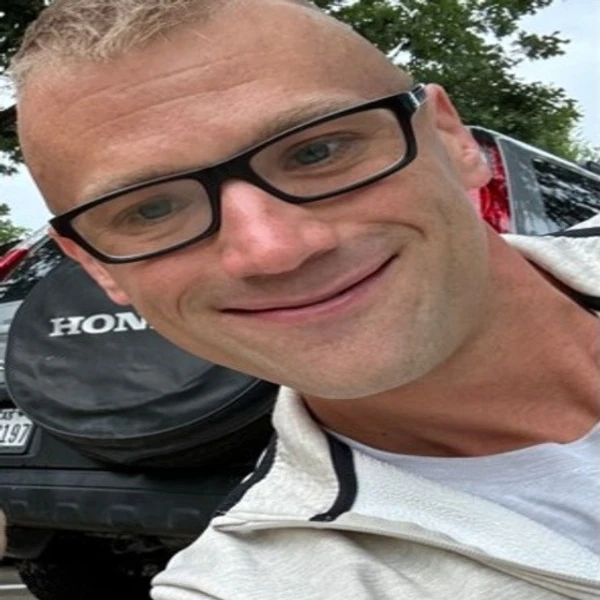
Hobbies and interests
Running
Swimming
Biking And Cycling
Research
Gaming
Sports
Baseball
Basketball
Football
Yoga
Cooking
Computer Science
Writing
Philanthropy
Movies And Film
Weightlifting
Travel And Tourism
Michael Broughton
1x
Finalist
Michael Broughton
1x
FinalistBio
Throughout his service, Mike tackled challenges with precision and creativity by managing intricate supply chains in South Korea, supporting aviation logistics in Alaska, or contributing to high-stakes operations like Operation Inherent Resolve, he proved himself to be a leader who thrived under pressure. His innovative approach to logistics led to the development of groundbreaking research; an automation system that revolutionized distribution. After 15 years of military service, Mike took on new challenges as Industrial Engineer/Distribution Center Engineer, he continued to bring his strategic mindset to the table, improving operations with advanced tech and methods. He demonstrates an ability to see not just what was but what could be, pushing boundaries to create lasting impact. His thirst for knowledge has been a constant throughout his life. With 4 master’s degrees and a slew of professional certifications, he has always embraced learning as both a personal and professional endeavor. As an academic author and mentor, he shares his expertise with others, helping to guide the next generation of leaders in logistics and engineering. Mike's life is a testament to the power of determination, innovation, and the belief that there is always room for improvement. From the battlefield to the boardroom, he has shown that success is not just about what you achieve but about how you use those achievements to inspire and uplift others. His story is not just one of personal triumph but a reminder of what is possible when curiosity and commitment lead the way.
Education
Colorado State University-Fort Collins
Doctoral degree program (PhD, MD, JD, etc.)Majors:
- Systems Engineering
Northern Illinois University
Master's degree programMajors:
- Industrial Engineering
Texas A&M University- College Station
Master's degree programMajors:
- Industrial Production Technologies/Technicians
Northern Illinois University
Master's degree programMajors:
- Industrial Production Technologies/Technicians
American Public University System
Bachelor's degree programMajors:
- Transportation and Materials Moving, Other
American Public University System
Master's degree programMajors:
- Transportation and Materials Moving, Other
Miscellaneous
Desired degree level:
Doctoral degree program (PhD, MD, JD, etc.)
Graduate schools of interest:
Transfer schools of interest:
Majors of interest:
- Systems Engineering
Career
Dream career field:
systems engineering
Dream career goals:
Industrial Engineer
Industry Fortune 50 Companies2018 – 20235 years
Sports
Swimming
Varsity1992 – 19997 years
Research
Systems Engineering
Academic — Researcher2019 – 2023
Arts
Northern Illinois University
IllustrationYes2022 – 2024
Public services
Public Service (Politics)
US Military — Army2003 – 2018
Future Interests
Advocacy
Politics
Volunteering
Philanthropy
Entrepreneurship
Taylor Swift Fan Scholarship
From Machine Guns to "Midnights": A Veteran’s Unlikely Melody
As a former combat infantryman who once carried a machine gun with the precision of a man who really, really didn’t want to accidentally shoot his own platoon (it happened, tragically), I’ve faced my share of chaos. But nothing prepared me for the sheer, unapologetic firepower of a Taylor Swift concert.
Let me backtrack. Deployment in Afghanistan, 2015. It’s 3 a.m., I’m guarding a ammo convoy, and my earbuds are blasting “Blank Space” on loop. Why? Because in a world of explosions, sandstorms, and the existential dread of wondering if you’ll live to see your 24th birthday, Taylor’s lyrical theatrics are the closest thing to a therapist you can stream on Pandora. She didn’t just write about heartbreak—she weaponized it, turning breakups into anthems sharp enough to slice through the boredom of war.
But my favorite Swift performance? The night I discovered her Reputation stadium tour in a dusty tent in Kuwait, courtesy of a laptop and a dying internet hotspot. Picture this: 20 grizzled soldiers, sunburned and armed, shouting lyrics to “Shake It Off” like it’s a battle cry. “You think I’m bad? You ain’t seen nothing yet!” We were a bunch of grown men in fatigues moonwalking while a Nashville pop star serenaded us from a screen. It was beautiful. It was chaotic. And yes, one of the guys did get reprimanded for air-guitar-ing too vigorously near the grenade launcher.
So why systems engineering? Well, managing a machine gun required the same skills as balancing a graduate program: precision, adaptability, and the ability to troubleshoot when your ammo belt jams and your radio dies and a sandstorm hits. Systems engineering feels like the ultimate upgrade from my old job—instead of saving lives with bullets, I’ll be saving them (or at least improving them) with smarter infrastructure. Plus, I’ve always had a knack for logistics. Ever tried calculating bullet trajectory while your heart races? It’s basically applied physics with more adrenaline.
Bold.org’s $500 scholarship? Let’s be real—it’s not going to buy me a new tactical gear set (those vests are pricey), but it’ll help me take the next step toward grad school. And let’s face it, $500 is just the military’s way of saying, “We love you, but we’re broke too.”
In the end, my journey is about more than Swift or systems. It’s about finding harmony in the chaos—whether it’s a battlefield, a concert, or a complex engineering problem. And if you need proof I’m destined for success, just ask my dog. He’s seen me dance to “All Too Well” while assembling IKEA furniture. That’s a skillset, folks.
Here’s to turning machine gun metaphors into Master’s degrees—one “Midnight” at a time.
Sabrina Carpenter Superfan Scholarship
Title: "From Boot Camp to Dissertation Camp: A Soldier’s Sabrina-Powered Plea for PhD Funds"
Dear Fellow Humans (and Potential Philanthropists),
Let me start by saying that retiring from the infantry was easy. Begging for grad school money? That’s the real hell. But here we are.
My name is Mike, a retired Army infantry soldier who’s traded his body for bullet points and now wants to trade bullet points for a PhD. But let’s be real—just like Sabrina Carpenter’s music, my journey from the battlefield to the boardroom needs a vibing comeback. And to make that happen, I need your help.
Picture this: 2018, a dusty barracks in Afghanistan, and me trying to stay sane. How? By blasting Sabrina Carpenter’s ”Why Martina” on repeat. Yes, that song. To me, it was the emotional equivalent of a warm shower and a decent meal. Sabrina became my unexpected morale officer—more reliable than the “motivational” pep talks from generals who’d never fired a rifle.
Now, I’m channeling that fandom into academia. I’m applying to PhD programs in Cultural Resilience Studies (yes, that’s a thing now—thanks, pandemic), exploring how music saves souls in crises. Sabrina’s discography? My primary research. But to write this thesis, I need more than just ”Feather”—I need funds. Tuition, books, and approximately 600 cups of coffee to stay awake during Zoom lectures.
Let’s talk numbers. $10 buys me a week of caffeine. $500? That’s a semester of analyzing Sabrina’s evolution from Disney star to “evil” pop savior (a hero’s journey if I’ve ever seen one). $1,000 could fund a single night’s worth of my dissertation’s fieldwork: rewatching her Sour concert film for the 47th time, noting how her choreography could teach the military a thing or two about precision.
I know what you’re thinking: “Why Sabrina? Why this ex-soldier?” Fair questions. Let me sell this like a mission brief:
Sabrina’s fanbase? A global network of superfans who’d probably fund a rocket to Mars if she tweeted about it.
My military background? I’ve survived sandstorms, bureaucratic hell, and bad unit patches. A dissertation is just another mission—except the enemy here is imposter syndrome.
The ROI? Imagine a world where my PhD thesis becomes required listening for Pentagon morale officers and Sabrina’s team. Win-win.
In return for your generosity, I offer:
A “Sabrina-themed military strategy” webinar (how to survive basic training to her music—”Nonsense” during PT? A classic).
Eternal gratitude, and maybe a personalized military-style “mission patch” with her face on it. (Don’t @ me. It’s art.)
So, if you’ve ever laughed at my meme about ”Please Please Please” being the modern-day ”Deployment Anthem”, or if you believe that ex-soldiers deserve a shot at peace and pop culture analysis, hit that donate button.
Let’s turn this vet from ”Nervous” to ”Necessary”—with a little help from Sabrina and your credit card.
Thank you,
Mike
“Infantry veteran. PhD hopeful. Sabrina Carpenter’s most analytical stan.”
P.S. No actual Sabrina look-alikes were harmed in the making of this plea. But if you have a spare $5… we can discuss options.
Ethel Hayes Destigmatization of Mental Health Scholarship
Title: From Trenches to Trials: A Veteran's Unexpected Detour
You know, there’s a saying: “What doesn’t kill you makes you stronger.” But I would like to amend that to “What doesn’t kill you might just make you quirky.” My name is mike, and I’m an infantry combat veteran with a side of complex PTSD and a dash of legal drama that would make the best courtroom series blush.
When I traded my camo for civvies, I thought I’d be stepping into a world of peace and quiet—oh, how naïve I was! Picture this: I spent years dodging bullets, navigating a minefield of chaos, only to come home and wade through the bureaucratic swamp of civil law. Who knew that the biggest battle of my life would be against the state? Talk about a plot twist!
Now, let’s not forget the “double whammy” of my life: I’m not just a combat veteran but also a crime victim who experienced K-12 abuse. It’s like getting hit with the “bad life choices” card in a game of Monopoly—I didn’t sign up for this mess! Thus began my decade-long saga with complex PTSD, a diagnosis that’s as fun as it sounds. Imagine trying to explain that to new acquaintances at parties: “Oh, you know, I’ve seen some things… and trust me, they weren’t in a Disney movie.”
But enough about my colorful history; let’s talk about this civil case I have going on with the state. Yes, I’m waging my own “war” for justice! Using equitable tolling laws, I’m bending the rules of the statute of limitations like a gymnast in a pre-Olympic training camp. My lawyer says it’s like finding a hidden level in a video game; you think you’re done, but surprise!
The state may have thought they could ghost me, but they underestimated the tenacity of a veteran. I mean, if a soldier can survive the horrors of war, navigating the labyrinthine legal system should be a cakewalk, right? Wrong! It's like assembling IKEA furniture without the manual. You think you've got everything figured out, only to find that the screws are missing and the instructions are in Swedish.
Sometimes, I find humor in the absurdity of it all. For instance, I’ll be sitting in the lawyer’s office, surrounded by stacks of paper, thinking, “This is what I trained for? Not an enemy on the battlefield, but a pile of forms?” I half expect the legal proceedings to end with a dramatic reveal: “And the defendant is… a fully functioning bureaucracy!” Cue the dramatic music.
I’m not just fighting for myself; I’m fighting for everyone else who’s had to endure their own unspeakable battles. I’m here to say, “You may knock me down, but I’ll be back—armed with paperwork and a relentless sense of humor.” Because at the end of the day, laughter truly is the best medicine, even if it’s laced with a touch of absurdity.
So here I am, a soldier in the trenches of both war and civil court, determined to conquer the chaos. If I can face down a battlefield, I can certainly face down a legal setback or two. And who knows? Maybe one day, I’ll pen a bestseller: “From Combat Boots to Courtroom Battles: How to Laugh Your Way Through the Legal Jungle.”
Now, if only I could find a way to bill my therapist for consulting on that idea.
MastoKids.org Educational Scholarship
My father’s world has shrunk to the size of a living room armchair. The journeys he now takes are the ones I describe, my academic adventures serving as his passport to a world he can no longer visit. For forty years, he charted different territories—not of distant lands, but of the curious minds of fifth-graders. He was a builder, first of things, then of thoughts. But the foundation of his own body was quietly eroding, laid low by a choice made in his youth, a choice made for money.
To pay for college, he worked as a carpenter in old houses, wrestling with timber and plaster in dusty, forgotten attics. He breathed in the air, unaware that it was laced with the invisible legacy of asbestos. Decades later, that dust settled. It first appeared as a rare, painful skin disease, a mysterious signal that his body was at war with itself. Soon after, rheumatoid arthritis followed, a brutal confirmation of an autoimmune system gone haywire, twisting his hands—the same hands that once built bookshelves and held the chalk to teach a child’s scrawl. We called it cruel, random luck.
But now, I understand it as a story of overlooked science. For years, his illness was a medical footnote. Recent research, however, points to a hidden culprit: overlooked for decades, mast cells may explain many mysterious illnesses like his. We now know that asbestos fibers don’t just sit in the lungs; they act as a key, unlocking mast cells, the sentinels of our immune system. These cells unleash a torrent of inflammatory mediators, a cascading signal of distress that can lead to the chronic, autoimmune conditions he endured. His suffering was not a mystery; it was a biological chain reaction, a slow-motion tragedy set in motion by a microscopic invasion.
This knowledge doesn’t heal him, but it redeems his story. He was a teacher for whom the greatest pain was a body that failed to heed his commands. Now, as his time grows short, I tell him about my work. He listens, his pride a palpable force in the quiet room. His life was spent building—from of old houses to of young minds. And I am spending mine understanding the unseen forces, the mast cells and invisible fibers, that can take it all apart. In teaching me about his life, he has given me my greatest and most heartbreaking subject.
It would make him very proud for his only son to earn a PhD.
ADHDAdvisor Scholarship for Health Students
You know, there’s a saying: “What doesn’t kill you makes you stronger.” But I would like to amend that to “What doesn’t kill you might just make you quirky.” My name is mike, and I’m an infantry combat veteran with a side of complex PTSD and a dash of legal drama that would make the best courtroom series blush.
When I traded my camo for civvies, I thought I’d be stepping into a world of peace and quiet—oh, how naïve I was! Picture this: I spent years dodging bullets, navigating a minefield of chaos, only to come home and wade through the bureaucratic swamp of civil law. Who knew that the biggest battle of my life would be against the state? Talk about a plot twist!
Now, let’s not forget the “double whammy” of my life: I’m not just a combat veteran but also a crime victim who experienced K-12 abuse. It’s like getting hit with the “bad life choices” card in a game of Monopoly—I didn’t sign up for this mess! Thus began my decade-long saga with complex PTSD, a diagnosis that’s as fun as it sounds. Imagine trying to explain that to new acquaintances at parties: “Oh, you know, I’ve seen some things… and trust me, they weren’t in a Disney movie.”
But enough about my colorful history; let’s talk about this civil case I have going on with the state. Yes, I’m waging my own “war” for justice! Using equitable tolling laws, I’m bending the rules of the statute of limitations like a gymnast in a pre-Olympic training camp. My lawyer says it’s like finding a hidden level in a video game; you think you’re done, but surprise! There’s more!
The state may have thought they could ghost me, but they underestimated the tenacity of a veteran. I mean, if a soldier can survive the horrors of war, navigating the labyrinthine legal system should be a cakewalk, right? Wrong! It's like assembling IKEA furniture without the manual. You think you've got everything figured out, only to find that the screws are missing and the instructions are in Swedish.
Sometimes, I find humor in the absurdity of it all. For instance, I’ll be sitting in the lawyer’s office, surrounded by stacks of paper, thinking, “This is what I trained for?
Now, if only I could find a way to bill my therapist for consulting on that idea.
Elijah's Helping Hand Scholarship Award
Let me preface this by saying: if filling out forms were an Olympic sport, I’d have a gold medal, a personal trainer, and a reality TV spinoff. As a medically retired army infantry soldier, I’ve swapped night-vision goggles for lumbar support cushions and flak jackets for posture correctors that look like medieval torture devices. My spine, once proudly bearing the weight of rucksacks and responsibility, now throws a tantrum if I lean over to tie my shoes. Spoiler: I wear slip-ons. Always.
My military career ended not with a bang, but with a series of ominous pops and a doctor saying, “Sir, you really shouldn’t be able to walk—but you’re doing it anyway. That’s impressive. And medically concerning.” Thanks, body. Real team player.
On top of the spine situation—because why have one challenge when you can have a whole themed buffet?—I’ve got stressor-related conditions that manifested from the delightful cocktail of physical pain and a complex PTSD diagnosis stemming from childhood abuse. Mental health and physical health are now roommates in my body, and they hate each other. One says, “Let’s go for a walk!” The other replies, “Absolutely not. Also, remember that traumatic thing from 4th grade?” They’re like a toxic sitcom duo.
I haven’t worked in three years. My most consistent job lately has been convincing my physical therapist that I did actually do my daily exercises (I did… mostly). I’ve filed for disability, which is less “I’m on easy street” and more “I’ve mastered the art of submitting appeals with Shakespearean levels of dramatic flair.”
But here’s the twist: I’m three semesters away from earning a PhD. Yes, a PhD. Because apparently, when your body says “sit down,” your brain hears “write 50 pages on post-traumatic resilience in veterans.” I’ve been soldiering through (pun fully intended), writing papers in 20-minute seated intervals, using ergonomic everything—chair, keyboard, water bottle with a stand. My home office looks like a sci-fi rehab lab. If Elon Musk visited, he’d think he’d invented it.
I just need tuition assistance to cross the finish line. Not because I want to impress dinner guests with my title (though “Dr.” does have a nice ring), but because I want to turn a lifetime of pain, service, and second chances into research that helps others who, like me, are trying to rebuild from the ground up—or, in my case, from a carefully adjusted standing desk.
So if there’s a scholarship out there with my name on it—maybe titled something like “The Don’t Let This Guy’s Spine Win Fund”—please, send it my way. I promise to acknowledge you in my dissertation. Or at least name a footnote after you. Footnotes are the unsung heroes of academia—kind of like me, but with better posture.
I have complex PTSD and my body is beat up from war………I don’t work. I need money for school. I filed for social security disability in 2025.
Bulkthreads.com's "Let's Aim Higher" Scholarship
I am an Army Logistics Officer with more than seven years of operational leadership in Army Aviation and a newly minted PhD candidate in Systems Engineering. From orchestrating the rapid deployment of rotary-wing units in austere environments to streamlining multimodal supply chains across international theaters, I have learned that the art of logistics is fundamentally an exercise in systems thinking. Now, I seek a scholarship to propel my transition from tactical logistics expert to aerospace systems innovator—where I can apply rigorous, multidisciplinary engineering principles to the next generation of flight.
My formative experiences in Army Aviation taught me to thrive where uncertainty is highest. During a recent deployment, I led a team to deliver maintenance parts for UH-60 Black Hawks to remote forward operating bases. Faced with limited runway access, unpredictable weather, and evolving mission priorities, we designed an adaptive logistics protocol that reduced resupply turnaround by 40 percent. That success did not come from rigid checklists, but from dynamically modeling risk factors, stakeholder requirements, and resource constraints—a microcosm of systems engineering at its best.
Driven by these real-world challenges, I enrolled in a PhD program to deepen my expertise in systems architecture, reliability analysis, and model-based design. My research focuses on digital twin frameworks that predict how complex assemblies respond to stress and wear over time. By integrating machine-learning-driven prognostics with traditional failure-mode assessment, I aim to transform maintenance from reactive to predictive, minimizing downtime and ensuring mission readiness. This scholarship will allow me to expand my research into high-stakes aerospace applications—where even the smallest component failure can have cascading effects on human safety and mission success.
Looking ahead, I am committed to a career in aerospace systems engineering, specializing in launch vehicle integrity and in-orbit servicing platforms. I believe that my military background, combined with advanced academic training, positions me uniquely to bridge the cultural gap between disciplined, mission-focused logistics and fast-paced, innovation-driven aerospace development. I plan to collaborate with industry leaders and government agencies to develop robust supply-chain models for reusable spacecraft, optimize ground-support networks for deep-space missions, and pioneer autonomous inspection systems that keep satellites operational.
By awarding me this scholarship, you will empower a proven leader and emerging scholar to tackle some of the most complex problems facing aerospace today. With your support, I will:
• Advance digital twin methodologies for aerospace maintenance integrity
• Translate battlefield-tested logistics strategies into space-launch logistics
• Mentor the next generation of systems engineers committed to mission success
Thank you for considering my application. I am eager to bring my blend of operational excellence, academic rigor, and visionary ambition to the aerospace sector—and with your help, to ensure that the future of flight is safer, more reliable, and more sustainable than ever before.
Jules Ehlers-Danlos Syndrome Resilience Scholarship
Let me preface this by saying: if filling out forms were an Olympic sport, I’d have a gold medal, a personal trainer, and a reality TV spinoff. As a medically retired army infantry soldier, I’ve swapped night-vision goggles for lumbar support cushions and flak jackets for posture correctors that look like medieval torture devices. My spine, once proudly bearing the weight of rucksacks and responsibility, now throws a tantrum if I lean over to tie my shoes. Spoiler: I wear slip-ons. Always.
My military career ended not with a bang, but with a series of ominous pops and a doctor saying, “Sir, you really shouldn’t be able to walk—but you’re doing it anyway. That’s impressive. And medically concerning.” Thanks, body. Real team player.
On top of the spine situation—because why have one challenge when you can have a whole themed buffet?—I’ve got stressor-related conditions that manifested from the delightful cocktail of physical pain and a complex PTSD diagnosis stemming from childhood abuse. Mental health and physical health are now roommates in my body, and they hate each other. One says, “Let’s go for a walk!” The other replies, “Absolutely not. Also, remember that traumatic thing from 4th grade?” They’re like a toxic sitcom duo.
I haven’t worked in three years. My most consistent job lately has been convincing my physical therapist that I did actually do my daily exercises (I did… mostly). I’ve filed for disability, which is less “I’m on easy street” and more “I’ve mastered the art of submitting appeals with Shakespearean levels of dramatic flair.”
But here’s the twist: I’m three semesters away from earning a PhD. Yes, a PhD. Because apparently, when your body says “sit down,” your brain hears “write 50 pages on post-traumatic resilience in veterans.” I’ve been soldiering through (pun fully intended), writing papers in 20-minute seated intervals, using ergonomic everything—chair, keyboard, water bottle with a stand. My home office looks like a sci-fi rehab lab. If Elon Musk visited, he’d think he’d invented it.
I just need tuition assistance to cross the finish line. Not because I want to impress dinner guests with my title (though “Dr.” does have a nice ring), but because I want to turn a lifetime of pain, service, and second chances into research that helps others who, like me, are trying to rebuild from the ground up—or, in my case, from a carefully adjusted standing desk.
So if there’s a scholarship out there with my name on it—maybe titled something like “The Don’t Let This Guy’s Spine Win Fund”—please, send it my way. I promise to acknowledge you in my dissertation. Or at least name a footnote after you. Footnotes are the unsung heroes of academia—kind of like me, but with better posture.
Frank and Patty Skerl Educational Scholarship for the Physically Disabled
Let me preface this by saying: if filling out forms were an Olympic sport, I’d have a gold medal, a personal trainer, and a reality TV spinoff. As a medically retired army infantry soldier, I’ve swapped night-vision goggles for lumbar support cushions and flak jackets for posture correctors that look like medieval torture devices. My spine, once proudly bearing the weight of rucksacks and responsibility, now throws a tantrum if I lean over to tie my shoes. Spoiler: I wear slip-ons. Always.
My military career ended not with a bang, but with a series of ominous pops and a doctor saying, “Sir, you really shouldn’t be able to walk—but you’re doing it anyway. That’s impressive. And medically concerning.” Thanks, body. Real team player.
On top of the spine situation—because why have one challenge when you can have a whole themed buffet?—I’ve got stressor-related conditions that manifested from the delightful cocktail of physical pain and a complex PTSD diagnosis stemming from childhood abuse. Mental health and physical health are now roommates in my body, and they hate each other. One says, “Let’s go for a walk!” The other replies, “Absolutely not. Also, remember that traumatic thing from 4th grade?” They’re like a toxic sitcom duo.
I haven’t worked in three years. My most consistent job lately has been convincing my physical therapist that I did actually do my daily exercises (I did… mostly). I’ve filed for disability, which is less “I’m on easy street” and more “I’ve mastered the art of submitting appeals with Shakespearean levels of dramatic flair.”
But here’s the twist: I’m three semesters away from earning a PhD. Yes, a PhD. Because apparently, when your body says “sit down,” your brain hears “write 50 pages on post-traumatic resilience in veterans.” I’ve been soldiering through (pun fully intended), writing papers in 20-minute seated intervals, using ergonomic everything—chair, keyboard, water bottle with a stand. My home office looks like a sci-fi rehab lab. If Elon Musk visited, he’d think he’d invented it.
I just need tuition assistance to cross the finish line. Not because I want to impress dinner guests with my title (though “Dr.” does have a nice ring), but because I want to turn a lifetime of pain, service, and second chances into research that helps others who, like me, are trying to rebuild from the ground up—or, in my case, from a carefully adjusted standing desk.
So if there’s a scholarship out there with my name on it—maybe titled something like “The Don’t Let This Guy’s Spine Win Fund”—please, send it my way. I promise to acknowledge you in my dissertation. Or at least name a footnote after you. Footnotes are the unsung heroes of academia—kind of like me, but with better posture.
Second Chance Scholarship
Title: From Trenches to Trials: A Veteran's Unexpected Detour
You know, there’s a saying: “What doesn’t kill you makes you stronger.” But I would like to amend that to “What doesn’t kill you might just make you quirky.” My name is mike, and I’m an infantry combat veteran with a side of complex PTSD and a dash of legal drama that would make the best courtroom series blush.
When I traded my camo for civvies, I thought I’d be stepping into a world of peace and quiet—oh, how naïve I was! Picture this: I spent years dodging bullets, navigating a minefield of chaos, only to come home and wade through the bureaucratic swamp of civil law. Who knew that the biggest battle of my life would be against the state? Talk about a plot twist!
Now, let’s not forget the “double whammy” of my life: I’m not just a combat veteran but also a crime victim who experienced K-12 abuse. It’s like getting hit with the “bad life choices” card in a game of Monopoly—I didn’t sign up for this mess! Thus began my decade-long saga with complex PTSD, a diagnosis that’s as fun as it sounds. Imagine trying to explain that to new acquaintances at parties: “Oh, you know, I’ve seen some things… and trust me, they weren’t in a Disney movie.”
But enough about my colorful history; let’s talk about this civil case I have going on with the state. Yes, I’m waging my own “war” for justice! Using equitable tolling laws, I’m bending the rules of the statute of limitations like a gymnast in a pre-Olympic training camp. My lawyer says it’s like finding a hidden level in a video game; you think you’re done, but surprise! There’s more!
The state may have thought they could ghost me, but they underestimated the tenacity of a veteran. I mean, if a soldier can survive the horrors of war, navigating the labyrinthine legal system should be a cakewalk, right? Wrong! It's like assembling IKEA furniture without the manual. You think you've got everything figured out, only to find that the screws are missing and the instructions are in Swedish.
Sometimes, I find humor in the absurdity of it all. For instance, I’ll be sitting in the lawyer’s office, surrounded by stacks of paper, thinking, “This is what I trained for? Not an enemy on the battlefield, but a pile of forms?” I half expect the legal proceedings to end with a dramatic reveal: “And the defendant is… a fully functioning bureaucracy!” Cue the dramatic music.
I’m not just fighting for myself; I’m fighting for everyone else who’s had to endure their own unspeakable battles. I’m here to say, “You may knock me down, but I’ll be back—armed with paperwork and a relentless sense of humor.” Because at the end of the day, laughter truly is the best medicine, even if it’s laced with a touch of absurdity.
So here I am, a soldier in the trenches of both war and civil court, determined to conquer the chaos. If I can face down a battlefield, I can certainly face down a legal setback or two. And who knows? Maybe one day, I’ll pen a bestseller: “From Combat Boots to Courtroom Battles: How to Laugh Your Way Through the Legal Jungle.”
Now, if only I could find a way to bill my therapist for consulting on that idea.
Best Greens Powder Heroes’ Legacy Scholarship
My parents’ chaos had grown too loud, too consuming, so I was sent—no, placed—into the quiet care of my grandparents;small town. Their house sat nestled between a sagging porch and a garden my grandmother tended like prayer. But it wasn’t the garden that shaped me. It was the man who still stood straight at seventy-eight like he’d never left the deck of a warship.
My grandfather. A quiet man with hands like tree roots and eyes that held entire oceans. He didn’t talk about the war, not at first. But he didn’t have to. The stories were in the way he folded his flag every Veterans Day. The way he squinted at the horizon like he was scanning for enemies that no longer existed. The way he’d pause when “Anchors Aweigh” played on the radio, just for a second, as if hearing footsteps that only he could.
Then one evening, with a glass of iced tea sweating in his grip and the sun bleeding gold across the marsh, he told me about the Enterprise.
“The Big E,” he called her like she was a lover or a saint. He was a young man, not much older than I was then, when he shipped out in ’42. The Pacific was fire and steel. Kamikaze attacks lit up the night like fireworks from hell. He saw ships vanish in seconds, men swallowed by the sea or flame. But the Enterprise? She kept sailing. Battle after battle. Coral Sea, Midway, Leyte Gulf. She earned twenty battle stars—more than any other ship in the fleet. And he was there. Not a hero, he’d say. Just a sailor doing his duty.
At seventeen, with a forged letter and a heart pulsing like a drumbeat, I enlisted. Combat infantry. My grandmother cried. My grandfather just nodded. “Then you best be ready,” he said, handing me a small, tarnished anchor pin from his old Navy uniform. “That ship didn’t sail on luck.”
In Iraq in 2005, I learned what he meant.
Ramadi wasn’t the Pacific. No vast oceans, just endless sand and the hum of IED warnings. We walked point through dust-choked streets, rifles ready, hearts tighter than our boots. One wrong step, one misjudgment—gone. I saw friends vanish in smoke and silence. The fear was constant, gnawing.
But in those long, sleepless nights under a brutal moon, I’d finger that anchor pin in my pocket. I thought of my grandfather on the burning deck of the Enterprise, holding his watch through typhoons and attacks, never quitting. I thought of his words—duty, discipline, the man next to you—and I stood watch not just for myself, but for the legacy he’d silently passed to me.
Combat stripped you down to your bones. But it was my grandfather’s service—the quiet dignity, the unyielding code—that taught me how to stand. Not because war is glorious. It’s not. But because someone before you stood, and you owe it to them—and to the ones beside you—to stand too.
When I returned, wounded but alive, he was waiting on that same porch. He didn’t say much. Just looked at me, placed a hand on my shoulder—solid, steady—and said, “You held the line.”
And in that moment, I realized the true weight of service isn’t in medals or memories. It’s in the silent inheritance—the values passed not in speeches, but in glances, in gestures, in the way a grandfather lives so a grandson knows how to stand.
The Enterprise is gone now, scrapped years ago. But the anchor remains. And so do we.
Learner Calculus Scholarship
I never imagined my life would revolve around matrices and MREs (that’s “Meals Ready to Eat,” not some secret society for ravenous 2 AM snackers)—but here I am, embarking on a PhD in systems engineering after graduating with honors from Northern Illinois University’s industrial and systems engineering program. As a logistics professional, I’ve discovered that behind every perfectly-timed delivery of combat boots or canned peaches lies a secret ingredient: mathematics. And no, that’s not just eating pie at 3.14 times the speed of light.
Let’s rewind. In grad school at NIU, I learned that forecasting isn’t a mystical power reserved for soothsayers and weather anchors with cheerfully inaccurate rainbows behind them. It’s hard-core linear programming, probability theory, and just a dash of caffeine. I spent nights calibrating supply-and-demand curves—and by “nights,” I mean every time my cat judged me for not petting her.
Fast-forward to my work in military logistics. Imagine dropping 10,000 units of camo paint in the Sahara because someone forgot to factor in troop deployment schedules. Spoiler alert: troops don’t appreciate looking like sad chameleons in the desert when an oiled-up armadillo parade was the real camouflage plan. It’s here that my inner math nerd truly goes wild: every convoy route, ammo cache location, and ration pack count must be optimized down to the decimal point. Skip the exponent on your echelon scaling, and you unleash the dreaded “supply chain sapphire,” also known as “That One Colonel Who Asks Why His Humvees Are Eating all the MREs.”
With a PhD in progress, I’m diving deeper into the algorithms that ensure “logistics” doesn’t get mistaken for “log rolls.” I’m building models that predict when and where ice cream (yes, ice cream) will be most critical for troop morale. Remove ice cream from the equation, and all that’s left is grumpy soldiers wielding spoons like medieval flails. Using stochastic simulations, I can pinpoint supply vulnerabilities faster than you can say “cone shortage.”
But let’s be real—no amount of highfalutin math jargon can prepare you for the true challenge: explaining to your family at Thanksgiving why “distributing airborne pneumatic tools” is decidedly not the same as “dropping hammers from a plane.” They still think I’m making bombs.
In the end, whether I’m sketching out a supply chain network in MATLAB or doing cartwheels through arcane formulas, the goal is the same: get the right thing, to the right place, at the right time—and maybe sneak in a “thank you” taco for my cat, who still hasn’t forgiven me for ignoring her during midterm week. Because in the wild world of military logistics, math isn’t just important—it’s the difference between a successful mission and an unexpected rubber-duck brigade.
Learner Mental Health Empowerment for Health Students Scholarship
Title: From Trenches to Trials: A Veteran's Unexpected Detour
You know, there’s a saying: “What doesn’t kill you makes you stronger.” But I would like to amend that to “What doesn’t kill you might just make you quirky.” My name is mike, and I’m an infantry combat veteran with a side of complex PTSD and a dash of legal drama that would make the best courtroom series blush.
When I traded my camo for civvies, I thought I’d be stepping into a world of peace and quiet—oh, how naïve I was! Picture this: I spent years dodging bullets, navigating a minefield of chaos, only to come home and wade through the bureaucratic swamp of civil law. Who knew that the biggest battle of my life would be against the state? Talk about a plot twist!
Now, let’s not forget the “double whammy” of my life: I’m not just a combat veteran but also a crime victim who experienced K-12 abuse. It’s like getting hit with the “bad life choices” card in a game of Monopoly—I didn’t sign up for this mess! Thus began my decade-long saga with complex PTSD, a diagnosis that’s as fun as it sounds. Imagine trying to explain that to new acquaintances at parties: “Oh, you know, I’ve seen some things… and trust me, they weren’t in a Disney movie.”
But enough about my colorful history; let’s talk about this civil case I have going on with the state. Yes, I’m waging my own “war” for justice! Using equitable tolling laws, I’m bending the rules of the statute of limitations like a gymnast in a pre-Olympic training camp. My lawyer says it’s like finding a hidden level in a video game; you think you’re done, but surprise! There’s more!
The state may have thought they could ghost me, but they underestimated the tenacity of a veteran. I mean, if a soldier can survive the horrors of war, navigating the labyrinthine legal system should be a cakewalk, right? Wrong! It's like assembling IKEA furniture without the manual. You think you've got everything figured out, only to find that the screws are missing and the instructions are in Swedish.
Sometimes, I find humor in the absurdity of it all. For instance, I’ll be sitting in the lawyer’s office, surrounded by stacks of paper, thinking, “This is what I trained for? Not an enemy on the battlefield, but a pile of forms?” I half expect the legal proceedings to end with a dramatic reveal: “And the defendant is… a fully functioning bureaucracy!” Cue the dramatic music.
I’m not just fighting for myself; I’m fighting for everyone else who’s had to endure their own unspeakable battles. I’m here to say, “You may knock me down, but I’ll be back—armed with paperwork and a relentless sense of humor.” Because at the end of the day, laughter truly is the best medicine, even if it’s laced with a touch of absurdity.
So here I am, a soldier in the trenches of both war and civil court, determined to conquer the chaos. If I can face down a battlefield, I can certainly face down a legal setback or two. And who knows? Maybe one day, I’ll pen a bestseller: “From Combat Boots to Courtroom Battles: How to Laugh Your Way Through the Legal Jungle.”
Now, if only I could find a way to bill my therapist for consulting on that idea.
Learner Math Lover Scholarship
I never imagined my life would revolve around matrices and MREs (that’s “Meals Ready to Eat,” not some secret society for ravenous 2 AM snackers)—but here I am, embarking on a PhD in systems engineering after graduating with honors from Northern Illinois University’s industrial and systems engineering program. As a logistics professional, I’ve discovered that behind every perfectly-timed delivery of combat boots or canned peaches lies a secret ingredient: mathematics. And no, that’s not just eating pie at 3.14 times the speed of light.
at NIU, I learned that forecasting isn’t a mystical power reserved for soothsayers and weather anchors with cheerfully inaccurate rainbows behind them. It’s hard-core linear programming, probability theory, and just a dash of caffeine. I spent nights calibrating supply-and-demand curves—and by “nights,” I mean every time my cat judged me for not petting her.
Fast-forward to my work in military logistics. Imagine dropping 10,000 units of camo paint in the Sahara because someone forgot to factor in troop deployment schedules. Spoiler alert: troops don’t appreciate looking like sad chameleons in the desert when an oiled-up armadillo parade was the real camouflage plan. It’s here that my inner math nerd truly goes wild: every convoy route, ammo cache location, and ration pack count must be optimized down to the decimal point. Skip the exponent on your echelon scaling, and you unleash the dreaded “supply chain sapphire,” also known as “That One Colonel Who Asks Why His Humvees Are Eating all the MREs.”
With a PhD in progress, I’m diving deeper into the algorithms that ensure “logistics” doesn’t get mistaken for “log rolls.” I’m building models that predict when and where ice cream (yes, ice cream) will be most critical for troop morale. Remove ice cream from the equation, and all that’s left is grumpy soldiers wielding spoons like medieval flails. Using stochastic simulations, I can pinpoint supply vulnerabilities faster than you can say “cone shortage.”
In the end, whether I’m sketching out a supply chain network in MATLAB or doing cartwheels through arcane formulas, the goal is the same: get the right thing, to the right place, at the right time—and maybe sneak in a “thank you” taco for my cat, who still hasn’t forgiven me for ignoring her during midterm week. Because in the wild world of military logistics, math isn’t just important—it’s the difference between a successful mission and an unexpected rubber-duck brigade.
John Acuña Memorial Scholarship
Title: From Trenches to Trials: A Veteran's Unexpected Detour
You know, there’s a saying: “What doesn’t kill you makes you stronger.” But I would like to amend that to “What doesn’t kill you might just make you quirky.” My name is Mike, and I’m an infantry combat veteran with a side of complex PTSD and a dash of legal drama that would make the best courtroom series blush.
When I traded my camo for civvies, I thought I’d be stepping into a world of peace and quiet—oh, how naïve I was! Picture this: I spent years dodging bullets, navigating a minefield of chaos, only to come home and wade through the bureaucratic swamp of civil law. Who knew that the biggest battle of my life would be against the state? Talk about a plot twist!
Now, let’s not forget the “double whammy” of my life: I’m not just a combat veteran but also a crime victim who experienced K-12 abuse. It’s like getting hit with the “bad life choices” card in a game of Monopoly—I didn’t sign up for this mess! Thus began my decade-long saga with complex PTSD, a diagnosis that’s as fun as it sounds. Imagine trying to explain that to new acquaintances at parties: “Oh, you know, I’ve seen some things… and trust me, they weren’t in a Disney movie.”
But enough about my colorful history; let’s talk about this civil case I have going on with the state. Yes, I’m waging my own “war” for justice! Using equitable tolling laws, I’m bending the rules of the statute of limitations like a gymnast in a pre-Olympic training camp. My lawyer says it’s like finding a hidden level in a video game;
The state may have thought they could ghost me, but they underestimated the tenacity of a veteran. I mean, if a soldier can survive the horrors of war, navigating the labyrinthine legal system should be a cakewalk, right? Wrong! It's like assembling IKEA furniture without the manual. You think you've got everything figured out, only to find that the screws are missing and the instructions are in Swedish.
Sometimes, I find humor in the absurdity of it all. For instance, I’ll be sitting in the lawyer’s office, surrounded by stacks of paper, thinking, “This is what I trained for? Not an enemy on the battlefield, but a pile of forms?” I half expect the legal proceedings to end with a dramatic reveal: “And the defendant is… a fully functioning bureaucracy!” Cue the dramatic music.
I’m not just fighting for myself; I’m fighting for everyone else who’s had to endure their own unspeakable battles. I’m here to say, “You may knock me down, but I’ll be back—armed with paperwork and a relentless sense of humor.” Because at the end of the day, laughter truly is the best medicine, even if it’s laced with a touch of absurdity.
So here I am, a soldier in the trenches of both war and civil court, determined to conquer the chaos. If I can face down a battlefield, I can certainly face down a legal setback or two. And who knows? Maybe one day, I’ll pen a bestseller: “From Combat Boots to Courtroom Battles: How to Laugh Your Way Through the Legal Jungle.”
Now, if only I could find a way to bill my therapist for consulting on tha
Bryent Smothermon PTSD Awareness Scholarship
Title: From Trenches to Trials: A Veteran's Unexpected Detour
You know, there’s a saying: “What doesn’t kill you makes you stronger.” But I would like to amend that to “What doesn’t kill you might just make you quirky.” My name is Mike, and I’m an infantry combat veteran with a side of complex PTSD and a dash of legal drama that would make the best courtroom series blush.
When I traded my camo for civvies, I thought I’d be stepping into a world of peace and quiet—oh, how naïve I was! Picture this: I spent years dodging bullets, navigating a minefield of chaos, only to come home and wade through the bureaucratic swamp of civil law. Who knew that the biggest battle of my life would be against the state? Talk about a plot twist!
Now, let’s not forget the “double whammy” of my life: I’m not just a combat veteran but also a crime victim who experienced K-12 abuse. It’s like getting hit with the “bad life choices” card in a game of Monopoly—I didn’t sign up for this mess! Thus began my decade-long saga with complex PTSD, a diagnosis that’s as fun as it sounds. Imagine trying to explain that to new acquaintances at parties: “Oh, you know, I’ve seen some things… and trust me, they weren’t in a Disney movie.”
But enough about my colorful history; let’s talk about this civil case I have going on with the state. Yes, I’m waging my own “war” for justice! Using equitable tolling laws, I’m bending the rules of the statute of limitations like a gymnast in a pre-Olympic training camp. My lawyer says it’s like finding a hidden level in a video game; you think you’re done, but surprise! There’s more!
The state may have thought they could ghost me, but they underestimated the tenacity of a veteran. I mean, if a soldier can survive the horrors of war, navigating the labyrinthine legal system should be a cakewalk, right? Wrong! It's like assembling IKEA furniture without the manual. You think you've got everything figured out, only to find that the screws are missing and the instructions are in Swedish.
Sometimes, I find humor in the absurdity of it all. For instance, I’ll be sitting in the lawyer’s office, surrounded by stacks of paper, thinking, “This is what I trained for? Not an enemy on the battlefield, but a pile of forms?” I half expect the legal proceedings to end with a dramatic reveal: “And the defendant is… a fully functioning bureaucracy!” Cue the dramatic music.
I’m not just fighting for myself; I’m fighting for everyone else who’s had to endure their own unspeakable battles. I’m here to say, “You may knock me down, but I’ll be back—armed with paperwork and a relentless sense of humor.” Because at the end of the day, laughter truly is the best medicine, even if it’s laced with a touch of absurdity.
So here I am, a soldier in the trenches of both war and civil court, determined to conquer the chaos. If I can face down a battlefield, I can certainly face down a legal setback or two. And who knows? Maybe one day, I’ll pen a bestseller: “From Combat Boots to Courtroom Battles: How to Laugh Your Way Through the Legal Jungle.”
Now, if only I could find a way to bill my therapist for consulting on that idea.
James T. Godwin Memorial Scholarship
From Boots to Books: My Reluctant Evolution from Infantry Grunt to PhD Candidate (With a Spine Held Together by Duct Tape)
Let me set the scene: I once carried enough gear to open a small camping store—M16, body armor, hydration pack, the kitchen sink (probably). I was an 11C (mortarman, because dropping bombs from afar is slightly classier than running at the enemy) and later an 11B (infantryman, AKA “volunteer for getting yelled at in the mud”). I’ve done things in the desert that would make a cactus say, “Whoa, slow down, buddy.” And now? I sit at a desk wearing pajama pants, writing about post-colonial literature. My biggest physical challenge these days is standing up before my spine locks into permanent “fetal position.”
But hey, that’s the evolution of a modern warrior: from chasing insurgents to chasing citations.
My Army story started in 2003—right when the world decided boots, bullets, and bad decisions were the new normal. I served nearly 15 years, fought in a couple of sandboxes, earned some medals, and eventually, through ROTC, transformed from “sir, yes sir” private to “please don’t mess up the PowerPoint” second lieutenant. Officer school: where they teach you how to salute while hiding your panic.
And yes, military service runs deep in my blood. Both my grandparents served in WWII—one of them actually fought aboard the legendary USS Enterprise, the most decorated ship in U.S. Navy history. Meanwhile, my most decorated possession is a pair of orthopedic shoes prescribed by the VA.
My career ended not with a bang, but with a groan—specifically, my spine saying, “Nope, we’re done.” After years of rucking, jumping, and doing push-ups like my life depended on it (sometimes it did), my back said, “Let’s try chronic pain and early retirement.” So, here I am: retired Army, disabled veteran, government-issued cane optional, officially unemployed, and bravely (or foolishly) pursuing a PhD.
Now I spend my days reading 17th-century metaphysical poetry and trying to remember what sunlight feels like. Tuition? Sky-high. Housing? Also sky-high. My Social Security checks? Let’s just say they cover half a cup of coffee at a trendy campus café.
Which brings me to why this scholarship would be, frankly, a godsend.
Your scholarship contribution would be extremely beneficial for me so that I can cover some of these expensive costs of tuition and housing.
Imagine helping a former infantryman trade in his combat boots for scholarly slippers—without him having to sell his medals on eBay or start a GoFundMe titled “Please Help Me Finish My Thesis Before I Turn Into a Library Ghost.”
I’m not asking to live lavishly. I’d just like to finish my PhD without having to write my dissertation in the glow of a laundromat’s vending machine. Every dollar you contribute is one less reason for my spine to protest with a sharp twinge during a long day of academic overthinking.
In short: I went from throwing grenades to throwing around theoretical frameworks. And honestly? The frameworks are heavier. With your support, I’d love to prove that a soldier’s grit doesn’t retire—it just finds a new battlefield. Even if that battlefield is Word documents and obscure footnotes.
Thank you for considering me. My spine thanks you too. (It’s shy, but appreciative.)
Priscilla Shireen Luke Scholarship
My Philanthropy comes as Legal Advocacy: Establishing a Nonprofit for Juvenile Abuse Victims. The intersection of philanthropy and legal advocacy represents a powerful catalyst for reform, particularly within the juvenile justice system. In 2024, I founded a nonprofit charity, officially recognized with an Employer Identification Number (EIN), dedicated to supporting victims of juvenile abuse. This initiative marks the genesis of my philanthropic journey and underscores my commitment to effecting systemic change as a legal advocate. This essay argues that establishing a nonprofit organization uniquely empowers advocates to address the multifaceted challenges faced by juvenile abuse victims, while simultaneously advancing essential reforms within the justice system.
The Urgency of Addressing Juvenile Abuse
Juvenile abuse remains a pervasive issue with profound legal, social, and psychological ramifications. Victims often encounter barriers to justice, including inadequate legal representation, systemic bias, and a lack of tailored support services. The justice system, historically punitive rather than rehabilitative, frequently fails to recognize the complex needs of abused youth. Establishing a nonprofit focused on juvenile abuse victims is not simply charitable; it is a strategic intervention aimed at redressing institutional failures and advocating for a justice system that prioritizes rehabilitation and protection.
Philanthropy as a Vehicle for Systemic Change
Philanthropic organizations wield unique capacities to mobilize resources, foster community partnerships, and influence policy. By securing an EIN and adhering to rigorous legal standards, my nonprofit achieves credibility and transparency essential for stakeholder trust. More importantly, it provides a structured platform to amplify the voices of juvenile abuse victims and to advocate for policy reforms. Through targeted educational programs, legal assistance, and public awareness campaigns, nonprofits can challenge entrenched narratives that perpetuate injustice and marginalization.
The philanthropic model also enables collaboration with legal professionals, mental health experts, and community leaders, facilitating a multidisciplinary approach to advocacy. This collective action is paramount in addressing the complex, intersecting issues that juvenile abuse victims face, and in pushing for reforms such as trauma-informed judicial procedures and expanded access to legal counsel.
Legal advocacy within the nonprofit sector is particularly potent in driving change. By leveraging legal expertise, the organization can identify gaps in existing laws, litigate for the rights of abuse victims, and lobby for legislative reform. As a legal advocate, my role extends beyond representation; it encompasses education, empowerment, and the transformation of legal norms that have historically disadvantaged vulnerable populations. The nonprofit structure offers the flexibility and mission-driven focus necessary to pursue these objectives with both agility and persistence.
The establishment of a nonprofit charity for juvenile abuse victims represents a strategic convergence of philanthropy and legal advocacy. This approach not only provides direct support to those most in need but also serves as a platform for challenging and reforming the justice system. By leveraging organizational legitimacy, collaborative partnerships, and legal expertise, such initiatives can effect meaningful and enduring change. Ultimately, the pursuit of justice for juvenile abuse victims is best advanced through sustained, systemic advocacy rooted in both compassion and a commitment to legal reform.
www.thetigerclause.com
Dr. G. Yvette Pegues Disability Scholarship
As a disabled combat veteran grappling with neurology spine problems, my pursuit of Social Security Disability Insurance (SSDI) is not merely a bureaucratic formality; it is a lifeline for my education and future. The SSDI program requires substantial proof that my disability prevents me from engaging in any meaningful work. With three years of unemployment due to debilitating health issues, I find myself at a critical juncture where financial support becomes essential for my academic endeavors as I work towards earning my PhD.
Navigating the labyrinthine process of obtaining Social Security benefits is challenging under any circumstance, but for a disabled combat veteran contending with neurology spine issues, the journey assumes a distinctly arduous dimension. The rigorous demands of military service have often left veterans vulnerable to a host of physical and mental health challenges, with spinal problems and neurological conditions being notably prevalent. As combat missions expose service members to extreme physical stressors, the spine frequently endures significant strain that may manifest years later in debilitating conditions. For veterans, the transition to civilian life is not merely a psychological shift but one compounded by the inertia of commonplace physical pain, further exacerbating the pursuit of essential assistance from programs like Social Security Disability Insurance (SSDI). Understanding the nuances of neurology in the context of spinal health, veterans must articulate and document their conditions with precision, often necessitating a singular focus on procurement…
Securing tuition challenge for any claimant, but for disabled combat veterans afflicted with neurological spine disorders, the process can become exceptionally arduous. Military service often imposes profound physical and psychological demands, leading to a higher prevalence of spinal and neurological impairments among veterans. The journey to obtain Social Security Disability Insurance (SSDI) is further complicated by the necessity for precise medical documentation and the intricate nature of benefit eligibility requirements. This essay examines the particular hurdles disabled combat veterans with neurology spine issues face in navigating the Social Security system, drawing upon recent research on optimal claiming strategies and compliance challenges.
The Social Security Administration (SSA) requires claimants to thoroughly document the severity and functional impact of their impairments, especially for conditions as complex as neurological spine disorders. Veterans must not only demonstrate the existence of medically determinable impairments but also articulate how these conditions preclude substantial gainful activity. The process becomes even more convoluted when considering the optimal timing for claiming benefits, as delaying can yield higher lifetime payouts but may not be feasible for those with urgent financial or health needs.
Documentation and Compliance Barriers
Beyond the financial calculus, regulatory compliance and accurate self-reporting present significant barriers. Cruyff et al. (2008) identify the phenomenon of “self-protective response behavior” in social security surveys, wherein respondents—fearing negative consequences—consistently provide non-incriminating answers, regardless of their actual status. This behavior can lead to underreporting of disabilities or noncompliance, further complicating veterans’ efforts to document their conditions adequately (Cruyff et al., 2008). For disabled combat veterans, the stigma associated with disability and the complexity of regulatory language may exacerbate these issues, increasing the risk of claim denial or prolonged adjudication.
Disabled combat veterans with neurological spine conditions encounter a labyrinthine system when seeking Social Security benefits. Optimal claiming strategies, as modeled by Diamond et al. (2021), are often less relevant for those with urgent needs and limited financial reserves. Furthermore, compliance challenges, as identified by Cruyff et al. (2008), reveal that procedural and psychological barriers can undermine the accurate articulation and documentation of disabilities. Addressing these challenges requires not only systemic simplification but also targeted support for veterans navigating the intersection of physical impairment, regulatory complexity, and financial precarity.
Enders Scholarship
Healing Through Presence: A Persuasive Narrative for the “Trauma‑to‑Transformation” Scholarship
The soft clink of a glass, the faint smell of cheap whiskey, and the hollowed‑out laughter that filled my grandmother’s living room are indelible images that have shaped my entire worldview. My grandmother was an alcoholic; her dependence was not merely a personal failing but a chronic trauma that rippled through three generations of my family. The loss I experienced was not a single, dramatic event but a prolonged erosion of stability, trust, and self‑worth. Confronted with this inheritance of pain, I have turned to two disciplined practices—meditation and journaling—to forge an inner sanctuary, to rewrite the narrative of my lineage, and to illuminate a path toward communal healing.
The impact of sustained exposure to addiction is well documented: heightened anxiety, depressive symptomatology, and a pervasive sense of hopelessness (Kelly & White, 2022). Yet research also affirms that mindfulness‑based interventions and reflective writing can reverse these neuro‑psychological sequelae, fostering neuroplasticity, emotional regulation, and a renewed sense of agency (Creswell, 2021). By committing to a daily twenty‑minute meditation and a nightly yoga ritual, I have witnessed a measurable decline in rumination and an increase in compassionate self‑awareness. In the margins of my notebook I have charted the evolution of my internal dialogue—from “I am a product of my grandmother’s despair” to “I am a catalyst for resilient transformation.”
These practices have not remained private exercises; they have become the foundation of my community service. For the past two years I have facilitated mindfulness in development of my charity for abused juveniles; as a chart down the path of philanthropy. The participants—many of whom have witnessed parental substance abuse or neighborhood violence—have reported reduced irritability, improved academic focus, and a renewed willingness to seek supportive resources. Witnessing this collective uplift has solidified my vocational ambition: to obtain a Ph.D.
My academic journey has been anything but linear. After leaving a high‑stress corporate role that exacerbated my own anxiety, I returned to university as a mature student, earning a master’s degree. The adversity of this period deepened my conviction that education is not merely a personal ladder but a conduit for societal change. It also refined my core values: empathy rooted in lived experience, intellectual rigor tempered by humility, and an unwavering commitment to dismantling the stigmas surrounding addiction and trauma.
The “Trauma‑to‑Transformation” scholarship aligns precisely with my mission. Financial assistance would alleviate the burden of tuition and research expenses, allowing me to devote uninterrupted focus to my dissertation—an investigation into the synergistic effects of mindfulness and narrative therapy on adolescents exposed to familial substance abuse. Moreover, the scholarship’s emphasis on survivors of violence, drugs, or alcohol validates the lived reality that fuels my scholarly inquiry, positioning me among peers who share a common impetus for change.
In granting me this scholarship, you would not only invest in a student but in a ripple effect: the knowledge I acquire will be translated into curricula, workshops, and policy recommendations that empower countless young people to rewrite their own stories. By honoring my journey—from the dim kitchen where my grandmother’s bottle clinked to the bright lecture hall where I now stand—I endorse the transformative power of presence, reflection, and purposeful education.
Thank you for considering my application and for championing the healing of communities scarred by addiction and loss.
My grandmother abused alcohol and died of heart complications during surgery; her alcoholism drove a wedge in our relationship, towards the end of her time we shared together. It was sad, that she had mood swings.
Debra S. Jackson New Horizons Scholarship
Michael Curtis Broughton is an American industrial engineer, military officer, academic author, logistics operative, strategic gamer, and athlete whose career bridges combat operations, global logistics systems, and large scale retail supply chains. Across military and civilian environments, Broughton has held pivotal leadership roles in high consequence logistics operations, shaping modern approaches to transportation, surface mobility, and material handling efficiency. His work reflects a rare combination of battlefield experience, academic rigor, and industrial engineering discipline applied to real world problems at scale.
He is widely credited as the founder of Large Retail Logistics Material Handling Equipment concepts, including Robot enabled Material Handling Equipment and Dynamic Integrated Bulk Slotting, known as DIBS. These concepts have influenced how large retail organizations approach bulk inventory movement, automation, and cost focused engineering design.
Broughton’s career is further distinguished by his role in life saving Joint Precision Air Drop System missions during Operation Inherent Resolve. His technical leadership directly supported humanitarian and military operations that aided Peshmerga refugees fleeing ISIL during the United States led intervention in Iraq from 2014 to 2015. For this work, he received prestigious recognition and top United States military service medals awarded by Operation Inherent Resolve Commanding Generals.
Michael Curtis Broughton was born in Bloomington, Illinois. He is of German and Irish English descent and a direct descendant of Jack Broughton, the eighteenth-century English bare-knuckle boxer who codified the first formal rules of boxing. Raised in a household that emphasized education, teaching, and knowledge sharing, Broughton developed an early respect for structured learning and intellectual discipline.
In 2003, after completing two full years of high school, Broughton earned his GED. Shortly thereafter, he enlisted in the United States Army. That decision marked the beginning of a career defined by self driven advancement, practical mastery, and continuous education.
With the support of the GI Bill, Broughton enrolled at Lincoln Land Community College in 2004. Over the following years, he pursued higher education alongside full time service, earning a Bachelor of Science from Sam Houston State University in 2010 and a Bachelor of Arts from American Military University in 2018. His academic path continued with four master’s degrees earned through institutions including Northern Illinois University and Texas A and M University. Complementing his degrees, he obtained professional certifications such as Lean Six Sigma Green Belt and the Master Logistician credential.
Broughton began his military career as an infantryman in 2003. During the Global War on Terrorism, he served in active combat zones from 2005 to 2006. His service during this period was defined by direct engagement, high risk responsibility, and operational intensity.
His duties included service as an M1114 turret gunner, squad machine gunner, door breach technician, combat lifesaver, metal detector operator, and Protective Security Detail operative. These roles placed him consistently at the tactical edge of combat operations and demanded precision under extreme conditions.
For his actions in ground combat, Broughton earned the Combat Infantryman’s Badge, one of the most respected awards in the United States Army. This experience provided him with a deeply practical understanding of mission sustainment, troop support, and the consequences of logistical failure, lessons that later shaped his approach to engineering and logistics leadership.
Michael Curtis Broughton’s career reflects an uncommon integration of combat leadership, industrial engineering, academic rigor, and strategic foresight. His success across military operations, global logistics systems, and large scale retail environments underscores a consistent commitment to precision, efficiency, and disciplined execution. Whether designing supply chains, leading humanitarian missions, or mentoring future engineers, Broughton’s work demonstrates how analytical thinking and operational excellence can shape outcomes across every domain he enters.
Speed League Swimming: Rising Stars Scholarship
From the moment I first slipped into a chlorinated lane as a five‑year‑old in the 1990s, swimming became more than a pastime—it became the framework through which I learned discipline, resilience, and the power of solitary focus. Winning regional competitions in those early years was not simply a trophy on the mantle; it was the first evidence that I could translate dedication into measurable results. Those victories taught me that success in an individual sport is earned by staying “in your own lane,” a principle that continues to shape my training philosophy, my academic pursuits, and my long‑term athletic ambition. As I now train for an Ironman triathlon while juggling graduate research, I have come to understand the gaps in our current swimming ecosystem and why a professional, athlete‑centric organization like Speed League Swimming is not only timely but essential. I am convinced that my background, my vision, and my willingness to serve as both competitor and advocate make me the archetype of the athlete for whom Speed League was designed. Early morning pool sessions, afternoon strength work, evenings devoted to homework—could be sustained through sheer mental discipline.
When I entered graduate school, the sport’s demands shifted from pure speed to functional integration. I began to view swimming as the stabilizing axis of a triathlete’s training trinity: running, biking, and swimming. The water offers a low‑impact environment that protects joints while developing core strength and cardiovascular efficiency—attributes that translate directly to the brutal demands of a 140.6‑mile Ironman. My weekly schedule now reads like a scientific experiment: two pool sessions focused on interval work, a long endurance swim at dawn, brick workouts that blend bike‑to‑run transitions, and recovery protocols informed by the very research I help produce. This synthesis of elite swim technique with multidisciplinary endurance training is precisely the kind of holistic athlete that Speed League seeks to showcase.
Ambition: From Ironman Aspirant to Swimming Innovator. My immediate goal is to qualify for the Ironman World Championship in Kona within the next two years. To achieve that, I must shave seconds off my 2.4 km swim—an improvement that can only be realized through access to specialized coaching, advanced analytics, and competitive race environments that reward both speed and consistency. Beyond personal achievement, I aspire to become a conduit between sport science and elite swimming, publishing peer‑reviewed studies on biomechanics while mentoring younger swimmers on how to integrate data‑driven training into their routines. In the longer view, I see myself shaping policies that protect athletes from the “post‑collegiate abyss” that currently leaves many talented swimmers without a professional pathway. I want to contribute to a model where elite swimmers can earn a living wage, receive health benefits, and retain agency over their branding—elements that are conspicuously absent from the present system. The United States swimming infrastructure excels at discovering talent through age‑group clubs and collegiate programs, yet it falters when athletes transition out of the NCAA pipeline. Professional leagues are nonexistent, sponsorships are scarce, and the prize‑money structure rewards only a handful of marquee events. Moreover, the system tends to marginalize swimmers whose aspirations extend beyond the pool—triathletes, open‑water specialists, and those pursuing rigorous academic careers. The result is a talent drain: athletes either abandon competitive swimming or resort to fragmented support networks that rarely provide stability.
For swimmers like me, who split time between the pool and a demanding research agenda, the lack of a coherent professional framework translates into financial insecurity. I have applied for multiple athletic scholarships and small grants, but the majority have been denied on the basis that my primary sport—triathlon—is not “pure” swimming. This systemic oversight underscores the need for an organization that recognizes the multidimensional nature of modern athletes and rewards performance across contexts, not just within the traditional 50‑meter pool. I envision a swimming world where the sport is as inclusive and adaptable as the athletes who compete in it. At its core, Speed League would establish a tiered competition calendar that integrates pool sprint events, distance races, and open‑water challenges, all linked by a unified points system. For me personally, joining the league would mean access to high‑caliber meets that directly benchmark my Ironman swim splits, while providing the financial resources to cover travel, equipment, and the inevitable costs of a dual‑career path. Beyond the lane, I intend to serve as a defining voice for the league. By sharing my own story of navigating limited scholarship opportunities, I can help the league refine its support structures for athletes facing similar hurdles. To date, I have received a modest graduate research stipend covering tuition and a portion of living expenses, but no dedicated athletic scholarship. I applied for the National Swimming Foundation’s Elite Athlete Grant and the USA Triathlon Scholarship—both of which were awarded to athletes whose primary focus was a single sport. Consequently, my annual budget for competition travel, elite coaching, and performance analytics exceeds my available resources by roughly 30 %. A Speed League scholarship would bridge this gap, allowing me to allocate funds toward high‑quality race entries, sports‑medicine services, and the cutting‑edge technology needed to refine my swim mechanics. Speed League Swimming represents a paradigm shift: a league built for athletes who see swimming not as an isolated discipline but as a cornerstone of a broader athletic identity. My journey—from a regional champion in the 1990s to a triathlete‑researcher striving for the Ironman podium—exemplifies the kind of multifaceted competitor the league aims to empower. I bring a proven record of discipline, a clear vision for the sport’s evolution, and a commitment to championing the league’s mission both inside and outside the water. By investing in me, Speed League would not only gain a dedicated athlete capable of earning points across diverse events, but also an advocate who will help sculpt a future where swimming thrives as a professional, inclusive, and sustainably funded sport. Together, we can turn the lanes of today’s pools into the highways of tomorrow’s athletic possibilities.