Hobbies and interests
Dance
Journaling
Tennis
Meghana Choragudi
1x
Finalist
Meghana Choragudi
1x
FinalistBio
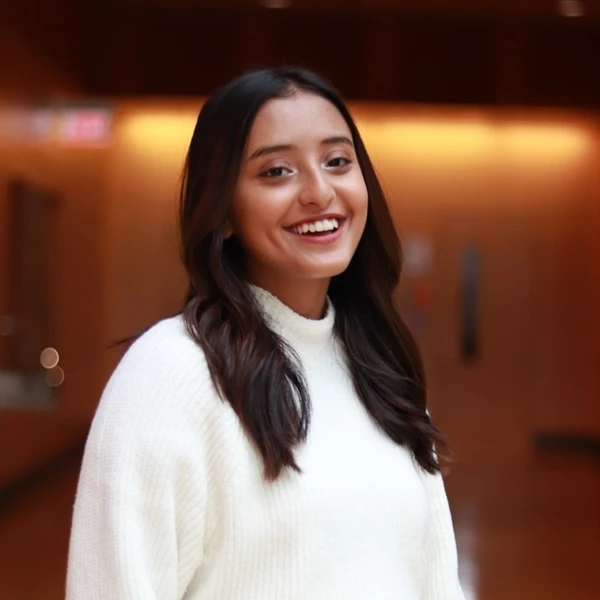
Meghana Choragudi is a senior at the University of Michigan studying Public Health Sciences with a minor in Biochemistry. Her work sits at the intersection of research, policy, and health equity, with a focus on improving outcomes for women and underserved populations. As a research assistant in the DiFeo Lab, she investigates racial disparities in ovarian cancer outcomes, analyzing survival data to understand structural inequities in precision medicine. Meghana also serves as Team Coordinator for Partners In Health Engage, where she has led federal advocacy efforts and organized over 30 meetings with congressional offices to advance global health policy. Through her leadership in student organizations and community initiatives, she is committed to translating evidence into policy and building equitable health systems. She plans to pursue an MPH and a career at the intersection of medicine and policy, advancing maternal and reproductive health equity.
Education
University of Michigan-Ann Arbor
Bachelor's degree programMajors:
- Public Health
Lambert High School
High SchoolMiscellaneous
Desired degree level:
Master's degree program
Graduate schools of interest:
Transfer schools of interest:
Majors of interest:
Career
Dream career field:
Medicine
Dream career goals:
Saswati Gupta Cancer Research Scholarship
My career goal is to become a physician leader who advances cancer research through both scientific discovery and equitable implementation. I am particularly interested in how molecular mechanisms translate into clinical outcomes and how disparities in access, representation, and treatment shape survival. Through my work, I aim to ensure that innovations in cancer care are not only effective, but accessible to all populations.
As an ovarian cancer research assistant in the DiFeo Lab at Michigan Medicine, I have investigated microRNA pathways involved in tumor progression and chemoresistance, with a focus on miR 181a. By analyzing survival data and contributing to experimental optimization, I have seen how molecular differences influence patient outcomes. Presenting this work at the University of Michigan Pathology Symposium reinforced my commitment to translational research that bridges laboratory findings with clinical relevance and addresses gaps in representation within cancer datasets.
My clinical experiences have deepened this perspective by showing me the human impact behind the data. As a medical assistant and hospital volunteer, I have supported over 150 patients and families navigating complex care systems, often witnessing delays due to insurance barriers and care coordination challenges. These experiences showed me that even the most advanced treatments are only as effective as the systems that deliver them and shaped my goal to integrate clinical insight with research.
Through Partners In Health Engage, I have organized over 35 advocacy meetings with congressional offices to support policies that strengthen healthcare access and funding. This work taught me that sustainable change requires aligning scientific evidence with policy and implementation.
Ultimately, I plan to pursue an MD and MPH, focusing on cancer research and equitable care delivery. I aim to lead initiatives that integrate molecular research with population level interventions so breakthroughs in cancer treatment benefit all communities.
Janice Louise Olach Scholarship
I learned early that hard work does not always translate into equitable outcomes. Growing up, I watched family members and people in my community navigate healthcare systems that were confusing, inaccessible, and often dismissive of their needs. Even when they did everything “right” by seeking care, following instructions, and advocating for themselves, they still faced delays, financial barriers, and unequal treatment. That realization stayed with me, but it became deeply personal when I began working in clinical settings and saw those same patterns unfold in real time.
As a medical assistant and volunteer in pediatric emergency and critical care units, I witnessed how systemic barriers shaped patient outcomes long before a provider entered the room. I saw families struggle with insurance prior authorizations that delayed essential care, parents trying to understand discharge instructions written in inaccessible language, and children returning to the hospital because the system failed to support them outside of it. It was difficult to reconcile that medicine could offer life saving interventions, yet still fall short in delivering equitable care. This was not a single moment of hardship, but a repeated confrontation with a system that was not designed to serve everyone equally.
Instead of accepting this as an unchangeable reality, I began to take action in ways that were within my reach. In clinical spaces, I focused on improving patient experience by supporting over 150 patients with care coordination, reducing wait times, and helping families navigate next steps after visits. Beyond the clinic, I expanded my efforts into research, where I now study racial disparities in ovarian cancer outcomes. Analyzing survival data revealed stark inequities, including the underrepresentation of Black patients in datasets and worse outcomes even when controlling for clinical variables. This reinforced that inequity is not incidental, it is structural.
At the same time, I turned to advocacy to address these challenges at a systems level. Through Partners In Health Engage, I organized over 35 meetings with congressional offices, advocating for policies that strengthen global and domestic health systems. These experiences taught me that evidence alone is not enough to drive change. Effective solutions require navigating political feasibility, funding constraints, and competing priorities. Learning how to translate research into actionable policy became one of the most meaningful ways I responded to the challenges I had witnessed.
This journey reshaped how I understand hardship. Rather than a single obstacle to overcome, it became an ongoing awareness of inequity and a responsibility to address it. It taught me resilience, but more importantly, it taught me to think critically about systems, not just individual outcomes. I learned how to move between roles as a clinician, researcher, and advocate, recognizing that lasting change requires integration across all three.
Looking forward, I plan to pursue a career at the intersection of medicine and health policy, focusing on maternal and reproductive health equity. The hardships I have witnessed and worked through have given me both clarity and urgency. I want to build systems that do not require patients to navigate unnecessary barriers in order to receive quality care. By combining research, clinical insight, and policy implementation, I aim to create solutions that are not only effective, but equitable and sustainable.