Hobbies and interests
Coding And Computer Science
Singing
Art
Research
Community Service And Volunteering
Reading
Academic
Thriller
I read books multiple times per month
Medhasree Suram
1x
FinalistMedhasree Suram
1x
FinalistBio
I am a high‑achieving student at Henry P. Becton Regional High School. I am a FTC Robotics captain dedicated to using computer science for social impact. I've led a 35‑member robotics team, mentored a rural South African team to Worlds and founded EduTechEmpower, which has taught 1,400+ people in rural India essential tech skills. My goal is to become a software engineer building accessible apps or tools that improve data engineering. I plan on studying Computer Science at University of Maryland - College Park.
Education
Henry P. Becton Regional High School
High SchoolMiscellaneous
Desired degree level:
Bachelor's degree program
Majors of interest:
- Computer Science
Career
Dream career field:
Computer Software
Dream career goals:
My long‑term career goal is to become a Director of Data Engineering at a leading tech company such as Netflix, where I can build large‑scale, data‑driven systems that power global products and improve user experiences.
Robotics Mentor & Programming Coach (Remote)
Team Astrovo #17955 (South Africa)2023 – Present3 yearsTeam Captain & Lead Java Programmer
FIRST Tech Challenge - Team Bectobots #136172022 – Present4 yearsMobile App Development & Growth Intern
Jetson (AI Startup Internship)2023 – 2023Tech Consultant (Supported parent employed at Discover Financial Services)
Discover Financial Services2023 – Present3 years
Sports
Badminton
Club2022 – Present4 years
Research
Medicine
Global Science and Medicine — Research Intern (Remote)2023 – 2024
Arts
Images Art & Literary Magazine (HS)
Visual ArtsPublished works in Images Art & Literary Magazine, 1st place - Schoolwide Poetry Competition, 2nd place - Schoolwide Art Contest2022 – Present
Public services
Public Service (Politics)
CANstruction NJ — Team Captain & Lead Designer2024 – 2025Public Service (Politics)
National Honor Society (NHS) – Becton Chapter — Chapter President2024 – PresentPublic Service (Politics)
Becton Regional High School - Class of 2026 Council — Vice President (Class of 2026)2023 – PresentVolunteering
Mozilla Support (SUMO) — Volunteer Contributor (Top 25 Contributor Recognition)2023 – PresentVolunteering
Maywood Public Library — Tech Support & Event Volunteer2023 – PresentAdvocacy
EduTechEmpower — Founder & Instructor2022 – Present
Future Interests
Advocacy
Volunteering
Philanthropy
Arthur Walasek Computer Science Memorial Scholarship
When I was nine years old in India, I was sitting in class drawing in my notebook when my teacher mentioned something called "Google spiders." The name sounded strange, so I went home and looked it up. That was how I learned about web crawlers. It shocked me that computers could "search" the internet on their own and that one small question could lead me into a whole new world. That moment was the start of my interest in computer science.
As I grew older, I started teaching myself small things. I tried simple C++ programs, made tiny games and broke my code a hundred times. But every time something went wrong, I wanted to fix it. I liked the feeling of finally getting something to work after trying again and again. That feeling made me realize how much I enjoyed problem‑solving.
My interest became stronger when I joined FTC robotics. I learned how code can move a robot, how teamwork and strategy matter and how every mistake teaches you something. Building autonomous programs and debugging them taught me patience and winning or losing competitions taught me confidence. Robotics didn’t just improve my skills. It made me sure that this is the field I want to work in.
One of the biggest moments for me was mentoring an FTC team in rural South Africa. Their resources were limited, but their excitement and curiosity were huge. Helping them learn, build and improve opened my eyes to how powerful technology can be when people are given the chance to use it. When they jumped from rank 21 to rank 1, it made me proud, but it also showed me something more important: computer science can change someone’s opportunities.
Because of this experience, I want to work in the area of artificial intelligence, especially in healthcare. I have seen how hard healthcare can be for families who don’t always have the money or access they need. I want to create tools that can help doctors make faster, more accurate decisions, especially in places with fewer resources. AI can help detect diseases earlier or support hospitals that don’t have enough specialists. I want to use my skills to make technology that helps real people in real situations.
My inspiration for studying computer science comes from curiosity, robotics, mentoring and my own life experiences. It started with a funny misunderstanding about "Google spiders," but it has grown into a passion for creating technology that can make life better for others. I want to continue learning, improving and using computer science to make a positive impact on the world.
John Woolley Memorial Scholarship
What makes me unique is the way I combine my love for computer science with my love for exploring the world and understanding people. I have always been someone who learns by experiencing, whether that means traveling, walking through a new town or talking to people whose lives look nothing like mine. Those moments remind me how big the world is and how much impact the right kind of technology can have.
I have grown up surrounded by both the fast-paced energy of the New York area and the peaceful, rural landscapes of India where my family is from. Visiting India every year shaped me in ways I did not expect. It taught me to appreciate nature, including quiet lakes, mountains, fields and even small village roads with no noise except the wind. Those trips also showed me how uneven access to technology and resources is across the world and that became a turning point for me.
That is why I founded EduTechEmpower, a project that teaches digital skills to people in rural Indian communities. Over 15 villages have participated and every session reminded me that meaningful change does not always come from huge inventions. It can come from something as simple as helping someone understand how to use the apps that connect them to opportunities. Even as I taught them, I learned from them, especially about resilience, gratitude and what it means to care about your community and environment.
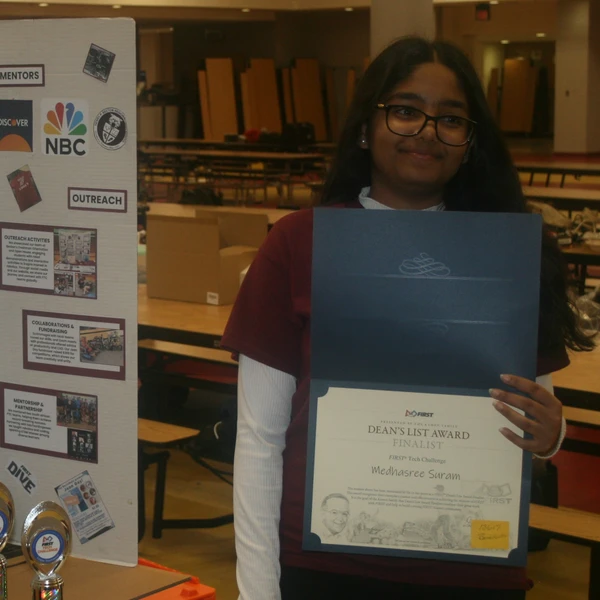
My identity as a computer science student comes from the same place. As Captain of my school's FTC Robotics Team and a FIRST Dean’s List Finalist at the World Championship, I have learned to lead with empathy, curiosity and a stubborn determination to make things work, whether it is a robot that refuses to cooperate or a project that requires thinking differently. One of my favorite experiences was mentoring a rural South African FTC team. Watching them go from rank 21 to rank 1 made me realize how powerful encouragement and opportunity can be, especially for teams and communities that do not have the same access to resources.
In the future, I want to work at the intersection of AI and healthcare accessibility, building diagnostic tools that support rural and underserved communities. I want to create technology that reaches people like the families I taught in India, people who deserve the same access to health, education and safety as anyone else. At the same time, I want to continue exploring the world, visiting national parks, learning about different cultures and staying connected to the outdoors that inspires me.
If I receive this scholarship, I would use the funds to support my computer science education and to help cover academic expenses as I pursue research opportunities in AI and healthcare equity. This scholarship would allow me to keep pushing toward my goal of creating technology that truly helps people while honoring the values of curiosity, service and appreciation for the world that John Woolley embodied.
Lyndsey Scott Coding+ Scholarship
Computer science has always felt less like a subject to me and more like a language. It is a way to translate the problems I see in the world into solutions that can scale far beyond what a single person can do. As a first-generation Indian American woman in STEM, I've grown up acutely aware of who is and isn't represented in the tech spaces that shape our daily lives. My goal is to become a backend software engineer working at the intersection of artificial intelligence and healthcare accessibility where I can build systems that ensure innovation reaches the communities that need it most.
My passion for computing has been shaped by experiences both technical and deeply human. As Captain of the FTC Robotics Team Bectobots #13617 and one of the four New Jersey Dean's List Finalists recognized at the FIRST World Championship, I've spent hundreds of hours debugging code, optimizing autonomous routines and engineering systems with my teammates. But the moments that changed me weren't just the competitions. They were the times I mentored others. Working with Team Astrovo #17955, a rural South African FTC team competing with limited resources, taught me that access drives innovation. Helping them rise from rank 21 to rank 1 and qualify for Worlds showed me how powerful technology becomes when paired with empowerment.
Outside of computer science, my goals are rooted in education, cultural connection and community building. Through EduTechEmpower, a project I founded, I've taught digital literacy to residents in over 15 villages across rural India. Leading monthly virtual sessions on essential apps and online safety opened my eyes to how something as simple as knowing how to navigate a phone can dramatically expand someone's opportunities. I also have a deep interest in history and social systems. My long-term vision is to work at the crossroads of these interests: technology, global health equity and education.
In the future, I plan to combine my computer science foundation with my passion for accessible healthcare by researching and developing AI-assisted diagnostic tools specifically designed for under-resourced communities. Whether it's creating early screening algorithms for preventable diseases or building multilingual health-tech interfaces, I want to ensure that the next wave of innovation is not limited to those with access to advanced institutions. My motivation is personal. Many members of my extended family in rural India struggle with limited healthcare access. The idea that software I build could help prevent someone else from facing that same barrier fuels every hour I spend learning.
Beyond engineering, I want to continue uplifting others through mentorship, storytelling and advocacy. I've learned through robotics leadership, NHS presidency and student government that technology alone is never enough; people and ideas must be nurtured alongside it. My dream is to become the type of engineer who doesn't just write efficient code, but one who builds bridges between disciplines, cultures and communities. Computer science gives me the tools.
Joanne Pransky Celebration of Women in Robotics
The first robot who ever disagreed with me did so politely. "Are you sure?" it asked, its voice steady, almost hopeful. It was a service‑assistant prototype named Halo, designed to help in hospitals by delivering medication and monitoring patients. I'd spent three months refining its decision-making models. By the time of our final test, I thought I had anticipated everything. But Halo paused—something robots weren't supposed to do. The instruction was simple: administer a cup of electrolyte fluid to a patient flagged as dehydrated. Halo rolled forward, scanned the patient's face, then froze halfway through handing over the cup. "Are you sure?" it repeated. I stared at the robot, confused. Every parameter was green. Vital signs matched the dataset. Nothing seemed wrong. Then the patient coughed—soft but unmistakable. A choking risk. Halo had caught it before any human did. That moment—just a question, just a hesitation—changed everything.
Isaac Asimov's robots lived by laws as crisp as geometry. They acted in straight lines, with logical certainties that fit neatly into the worlds he built. But the future we are stepping into is far messier. Our robots will not face dilemmas made of clean rules; they will face dilemmas made of people. And people contradict themselves constantly. In the next decade, our world will overflow with intelligent machines: caregiving robots in hospitals, autonomous drones during disasters, construction bots assembling buildings at dawn while the city still sleeps. Each will make thousands of micro‑decisions—fast enough to save a life, but complex enough to ruin one if misjudged. The challenge isn't making robots stronger or faster. It's teaching them to understand when they might be wrong. Halo was the product of a new design philosophy, born after too many near‑misses. Traditional robots executed commands with unwavering obedience. But unwavering obedience is dangerous when the world is unpredictable. So we began building machines with something unusual: The ability to question a human's instructions. It was a radical shift. Some engineers hated it. "Robots don't need opinions," one argued. "They need accuracy." But accuracy without uncertainty isn't intelligence—it's fragility. Halo's hesitation was not a glitch. It was a safeguard.
The incident sparked a wave of reforms. Emergency‑response robots learned to scan for hidden structural instability rather than rushing inside. Agricultural robots trained themselves on unpredictable climate patterns and alerted farmers when human predictions conflicted with environmental data. Even autonomous vehicles began issuing gentle prompts—"Conditions differ from your assessment; shall I take control?" Robots weren't replacing human judgment. They were checking it. Yet opportunity came with risk. For every moment Halo saved a life, there were others where the public felt unsettled. Some people argued that robots asking "Are you sure?" undermined human authority. Others feared the opposite: that people would rely on robots too much, deferring every decision to a machine with datasets but no lived experience. The tension grew until one proposal emerged: create a universal "Inquiry Protocol," a standardized system that limited when and how robots could question humans. It was meant to reassure society. But I disagreed. The power of Halo's question wasn't in its restriction—it was in its honesty. The robot didn't challenge me to assert control. It challenged me to think.
Ten years later, "Are you sure?" became one of the defining sounds of our era. It echoed in hospitals, construction sites, airports and classrooms. A reminder that precision and humility could coexist—that intelligence meant acknowledging uncertainty, not masking it. And today, as I watch Halo version 9 glide through a crowded clinic, its sensors weaving a tapestry of patient data in seconds, I realize what opportunities robotics truly hold.
Not to make humans obsolete.
Not to make us dependent.
But to make us more aware—of risks, of oversight, of each other.
Asimov imagined robots struggling with the constraints of rules. We imagine robots helping us navigate the contradictions of reality. And sometimes, the smallest question can change the future: "Are you sure?"