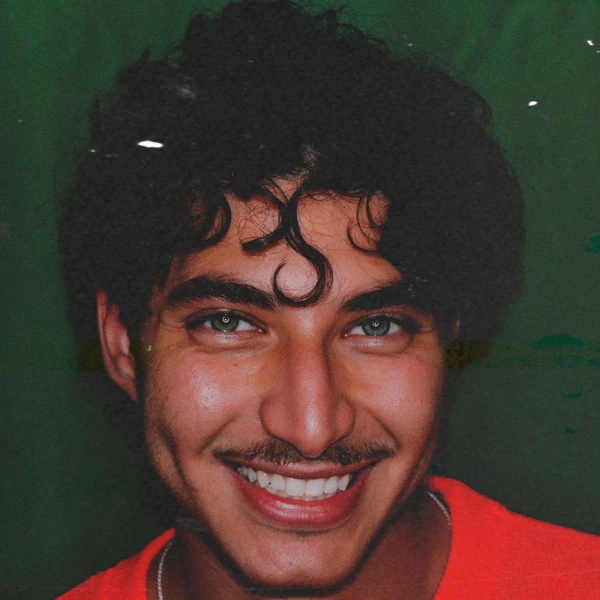
Mark Boules
1x
Nominee1x
Finalist1x
Winner
Mark Boules
1x
Nominee1x
Finalist1x
WinnerBio
I signed my first lease at 17, still in high school. No family here, no safety net — just me figuring it out. I've been paying my own rent and bills ever since, working 40+ hours a week while going to school full-time. I'm not saying that for sympathy. Where I come from, I learned you can get by with very little and still be happy. That stuck with me.
I started at Pasadena City College, led the MENA Club as President, and transferred to UCLA studying Psychology pre-med with a 4.0 GPA. I work in Dr. Matthew Lieberman's cognitive neuroscience lab studying how the brain processes social experience.
But not psychiatry as a career move. I have a family member who has spent 5 years going back and forth with doctors for a mental disorder — still undiagnosed. I've taken clinical psychology. I've spoken to professionals worldwide about their case. They agree with me. Their doctor doesn't care. And there is nothing I can do about it right now. That feeling — knowing the answer and being powerless — is exactly why I'm doing this.
I've seen doctors in Egypt who had nothing and still gave everything to their patients. I've never seen that here. I want to be that doctor here.
I'd rather be a broke psychiatrist who actually changes something than a comfortable one who doesn't.
Education
University of California-Los Angeles
Bachelor's degree programMajors:
- Psychology, General
Pasadena City College
Associate's degree programMajors:
- Psychology, Other
- Natural Sciences
- Biology, General
Arcadia High
High SchoolMiscellaneous
Desired degree level:
Doctoral degree program (PhD, MD, JD, etc.)
Graduate schools of interest:
Transfer schools of interest:
Majors of interest:
Career
Dream career field:
Medical Practice
Dream career goals:
Clinic Manager Assistant
Medical Clinic2022 – 20231 year
Sports
Track & Field
Varsity2022 – 20264 years
Research
Neurobiology and Neurosciences
University of California, Los Angeles (UCLA) — Research Assistant2023 – Present
Arts
Self
Sculpture2026 – 2026
Public services
Volunteering
Lancers for Life — Volunteer2021 – 2023
Catrina Celestine Aquilino Memorial Scholarship
My name is Mark Boules. I am a first-generation Egyptian-American student at UCLA studying Psychology on a pre-med track with a 4.0 GPA, and I am working toward becoming a psychiatrist. My path here has not been a straight line, and I think that is exactly why I belong in medicine.
I came to the United States at the end of my senior year of high school, completely alone, at 17. No family, no safety net. I signed my first lease while still in high school and worked 40 or more hours a week while finishing school and later attending college. I started at Pasadena City College, where I served as president of the MENA Club, and then transferred to UCLA. The financial pressure has been constant. But so has the purpose.
That purpose comes from watching my brother struggle with severe depression in Egypt for years. He suffered quietly while the people around him had no real vocabulary for what was happening to him, no framework for mental illness, and no accessible care. I could not help him then. I was too young, too far away, and too underprepared. But that experience fundamentally shaped who I am and what I am building toward.
I chose psychiatry because I believe the future of medicine cannot ignore the mind. I am currently a research assistant in Dr. Matthew Lieberman's Social Cognitive Neuroscience Lab at UCLA, where we study how the brain processes social information. This research has reinforced my conviction that the science of the brain and the practice of compassionate care are not separate, they are the same work. I want to be a psychiatrist who understands both the neuroscience and the human story behind every patient.
This summer, I am traveling to Bolivia with CFHI to gain global health experience. I want to understand how mental health care, or the lack of it, affects communities across cultures and economic realities. That experience will make me a better doctor.
My goal is to serve communities that have historically been underserved in mental health care: low-income patients, immigrant families, first-generation Americans, people who grew up in environments where mental illness was dismissed or stigmatized. I want to be the kind of physician who does not rush through appointments, who asks about context, who sees the whole person. I want to be the kind of doctor my brother never had access to.
Catrina's story, as I understand it, is one of someone who cared deeply about others and wanted to change the world through her work. I hope to do the same. This scholarship would help me stay focused on that mission without the weight of financial instability pulling me away from it. Every step forward in my education is a step closer to the patients I am meant to serve.
Michael Rudometkin Memorial Scholarship
There was a student at PCC who used to stand outside the financial aid office for twenty minutes before going in. I noticed her doing it twice and finally asked her why. She said she was scared they would figure out she did not really belong there. She was the first person in her family to go to college, recently immigrated, and she had convinced herself that asking for help was somehow suspicious.
I had been that person a year earlier.
When I came to the United States at 17, alone, I spent months trying to figure out systems that everyone around me seemed to already know. FAFSA, credit scores, lease agreements, office hours, the difference between a counselor and an advisor. Nobody explained any of it, and I did not know I could ask. That isolation is what eventually drove me to become president of the MENA Club at Pasadena City College. I wanted to make sure students from our community had someone who would just sit with them and walk through things.
Selflessness, for me, has never been a dramatic gesture. It is staying after a club meeting when someone is confused about a transfer application. It is tracking down a classmate I have not seen in two weeks to make sure they are doing okay. It is organizing a resource fair that brings financial aid, mental health counseling, and academic advising together in one room, with translators present, because I knew our students would not go to five different offices but might show up for one event where someone they knew was waiting.
What I learned from those experiences is that the most impactful help is the kind that respects someone's dignity. The student I mentioned outside the financial aid office was not struggling because she was incapable. She was struggling because the system was not designed with her in mind. My job was not to fix the system that day, it was to walk into the office with her so she did not have to feel alone in it.
I carry this into everything else I do. This summer I am going to Bolivia through Child Family Health International to work in underserved communities and understand how healthcare gaps operate in different contexts. I work in a neuroscience research lab at UCLA studying social connection, because the science of loneliness and belonging matters to people who have felt on the outside of both. My goal is to become a psychiatrist, and the communities I want to serve are the ones where asking for mental health help still feels dangerous.
Selflessness is not something I do on special occasions. It is the lens I bring to being a student, a researcher, a leader, and eventually a doctor. Michael Rudometkin understood that making the world better is not one big moment. It is a long series of small ones, repeated with intention.
Learner Mental Health Empowerment for Health Students Scholarship
Mental health became personal for me long before I knew the clinical terms for it.
Growing up in Egypt, I watched my older brother slowly disappear. He stopped leaving his room, stopped eating with the family, stopped being the person I had known my entire life. My parents did not call it depression because that word barely existed in our household vocabulary. In our culture, mental suffering was framed as weakness, or spiritual failure, or something you quietly pushed through. Nobody suggested a therapist. Nobody talked about it openly. And so nothing changed, and my brother got worse, and I grew up understanding that the absence of mental health language is itself a form of harm.
That understanding shaped everything that came after. I came to the United States at 17, alone, and enrolled at Pasadena City College. When I became president of the MENA Club, I made mental health resources a central part of what we offered. Many of the students in our community came from the same cultural silence I had grown up in. They did not know that campus counseling existed. They did not feel like they could admit to struggling without risking their reputation in their community. Part of advocating for mental health in my community meant naming the stigma directly, talking about it in club meetings, and making it clear that asking for help was not weakness but the opposite.
I also advocate through my research. I work in Dr. Matthew Lieberman's Social Cognitive Neuroscience Lab at UCLA, where we study the neural underpinnings of social connection and rejection. What I have learned there reinforced what I already felt intuitively: social pain is biological. The brain processes rejection and loneliness in many of the same regions that process physical pain. Understanding this scientifically has made me a more effective advocate, because I can explain to people in my community that what they feel is not imaginary or dramatic. It is real. It is in the brain. It can be treated.
Mental health matters to me as a student because I have seen what happens when it is ignored and what becomes possible when it is taken seriously. My goal is to become a psychiatrist, and I want to practice in communities where mental illness is undertreated because of poverty or cultural stigma. I am spending this summer in Bolivia with Child Family Health International, working in global health settings and learning how mental health care functions across very different systems. Every step I take is shaped by the same belief: that mental suffering does not have to be permanent, and that the people who understand stigma from the inside are often the ones best positioned to help dismantle it.
Charles B. Brazelton Memorial Scholarship
My most awkward quality is that I showed up to America at 17, alone, and had to learn everything at once.
In Egypt, I had a family, a neighborhood, a language I could navigate without thinking. Then I came to the United States for my last year of high school and all of that disappeared overnight. I did not move here with parents or relatives. I signed my own lease at 17, opened my own bank account, figured out what a credit score was while simultaneously trying to pass AP English. I was the kid in class who knew the material but would sometimes still translate the teacher's idioms in my head before raising my hand. I was the one who worked 40 hours a week and then walked into school smelling like the restaurant I had just left, sitting next to kids who were debating which college had the best dining hall.
If that is not awkward, I do not know what is.
But here is what I learned from being that kid: awkward does not mean wrong. It means you are in a situation that was not designed for you, and you are figuring it out anyway. I did not know how to fill out the FAFSA. I did not know that community college could be a serious path to a great university. I did not know what office hours were or that professors could actually help you if you just walked in and asked. Every single thing I know about navigating higher education, I learned the hard way, on my own, without a safety net.
That experience changed how I see the world. When I got to Pasadena City College, I became president of the MENA Club not because I was the most organized person in the room, but because I knew what it felt like to be completely lost in a system that assumed you already knew the rules. I organized resource fairs to connect first-generation and immigrant students with financial aid offices, counseling, and mental health support. I sat with students who were exactly where I had been two years earlier and helped them find their footing.
Now I am at UCLA studying Psychology, working in a neuroscience research lab, and preparing for a summer global health program in Bolivia. I am still the kid who grew up too fast, still the one navigating things that are not always designed for me. But I stopped seeing that as a disadvantage a long time ago. The awkwardness of being an outsider gave me something most people spend years trying to develop: genuine empathy. I know what it means to need help and not know how to ask for it, and that has shaped every decision I have made since I got here.
So my awkward thing is that I came here alone at 17 and figured it out. I am still figuring it out. And I think that might be the most useful thing about me.
RonranGlee Literary Scholarship
The paragraph I have chosen is from Aristotle's Nicomachean Ethics, Book I, Chapter 7:
"Now we call that which is in itself worthy of pursuit more final than that which is worthy of pursuit for the sake of something else, and that which is never desirable for the sake of something else more final than the things that are desirable both in themselves and for the sake of that other thing, and therefore we call final without qualification that which is always desirable in itself and never for the sake of something else."
Central Thesis: Aristotle is not simply defining happiness as an end goal. He is arguing that true human purpose must be self-justifying, pursued not as a means but as the very substance of a life well-lived. The underlying claim is that the things we treat as instruments are, in fact, measures of what we truly value.
Aristotle distinguishes between what is pursued for its own sake and what is pursued for the sake of something else. He builds toward the conclusion that only something always desirable in itself, never merely instrumental, can be called "final without qualification." This is the foundation of his concept of eudaimonia, often translated as happiness but more accurately understood as flourishing.
What Aristotle is doing in this passage goes deeper than most readings acknowledge. He is not simply making a hierarchy of goods. He is exposing the nature of human motivation itself. When we pursue health, we pursue it because it lets us do other things. When we pursue wealth, it is for what wealth enables. But what, he asks, is the thing we seek that requires nothing else to justify it? That thing, he argues, is what we are actually built for.
As someone who studies social cognitive neuroscience and plans to practice psychiatry, I find Aristotle's reasoning remarkably aligned with what modern science shows about human wellbeing. Research on social connection, meaning, and self-determination consistently reveals that people do not thrive simply from the absence of suffering. Thriving requires something positive: purpose, relationship, engagement with something that matters. Aristotle named this in the fourth century BCE. We are still trying to operationalize it.
The reason this passage resonates is also personal. I left Egypt at 17 to pursue medicine in the United States, and for years I told myself I was pursuing a career in psychiatry to help people. But Aristotle's framing made me ask a sharper question: is psychiatry the end, or is it the instrument? What I eventually understood is that what I am actually pursuing is the reduction of invisible suffering, the kind that goes unnamed because there is no language for it in certain communities. That pursuit needs no further justification. It is, in Aristotle's terms, final.
The broader implication of this passage is a challenge to examine whether the things we call goals are truly final or are secretly instrumental. A student who pursues a degree to get a job, to earn money, to live well, has a chain of means without a recognized end. Aristotle argues that at some point in that chain, there must be something we want for itself. His project in the Ethics is to show that this something is flourishing, and that flourishing is achieved through virtuous activity sustained over a complete life.
What makes this argument enduring is not its optimism but its demand. Aristotle does not say happiness is given. He says it is earned through activity, through choices made consistently in the direction of what we actually value most. That is not a comforting idea. It is a clarifying one.
The paragraph is, in short, a diagnostic tool. Read carefully, it reveals what a person is actually oriented toward, beneath the reasons they give themselves.
Harry & Mary Sheaffer Scholarship
Growing up in Egypt, I watched my brother disappear into his own mind. Depression took him somewhere the rest of us couldn't follow, and nobody around him had the language, the tools, or the access to help. Mental illness, in our culture, was something you didn't talk about. It was weakness, or spiritual failure, or both. There were no professionals knocking on his door. There was just the silence of a family that didn't know how to respond.
That is where my understanding of empathy comes from. Not from a classroom, but from years of watching someone I love go unheard.
I moved to the United States alone at 17, during my final year of high school. I signed my first lease while still in high school and have been supporting myself financially ever since, working 40+ hours a week while taking a full course load. I transferred from Pasadena City College to UCLA, where I study Psychology on a pre-med track with a 4.0 GPA. Being a first-generation college student in this country means I've had to learn how education works, what doors exist, and which ones I have to push open myself. That experience doesn't just shape my resume. It shapes how I see other people navigating systems that weren't designed for them.
At UCLA, I work in Dr. Matthew Lieberman's Social Cognitive Neuroscience Lab, where we study how the brain processes social pain and connection. What the research tells us is what I've already lived: exclusion is not just emotional. It registers in the brain like a wound. That knowledge gives me a framework for building empathy that goes beyond good intentions. If we can understand the science of how isolation harms people, we can build systems and communities that actually prevent it.
As president of the MENA Club at Pasadena City College, I worked to create a community for students whose backgrounds were rarely acknowledged in mainstream campus conversations. Many of those students had never had a space to process what it means to be both American and something else, both here and still tied to a place that shaped them. Giving people room to tell their stories is one of the simplest, most powerful acts of community-building I know.
This summer, I'll be in Bolivia with Child Family Health International, providing community health education in underserved regions. It's the same instinct carried forward: show up, listen, and give people access to something that improves their lives.
My goal is to become a psychiatrist who works in communities that have been failed by the mental health system. Immigrant families. Low-income neighborhoods. Populations where asking for help still carries a cost. The way I will use my skills to build a more empathetic world is simple: I will keep showing up in places where empathy is scarce, and I will treat every patient with the kind of attention I wished someone had given my brother.
Understanding a global community means understanding that some people arrive at life's starting line carrying much more weight than others. My unique position is that I know exactly how heavy that weight is. And I know what changes when someone finally decides to help you carry it.
Our Destiny Our Future Scholarship
The day I left Egypt at 17, I carried one suitcase and a picture of my brother. He wasn't in a photo I chose on purpose. It was just the last one on my phone before I boarded the plane. He had been struggling with depression for years, and I was leaving without him, because opportunity had opened its door on this side of the ocean and not the other.
I think about him every time I show up somewhere to help. Not because helping is a way to ease guilt, but because I've seen what it looks like when no one shows up. My brother had no system around him, no professionals who actually understood his mind, no community resources that acknowledged how alone he felt. I don't want to spend my life watching people fall through gaps that exist only because nobody decided to close them.
At UCLA, where I'm studying Psychology on a pre-med track with a 4.0 GPA, I'm also a research assistant in Dr. Matthew Lieberman's Social Cognitive Neuroscience Lab. Our work looks at how the brain processes social connection and rejection. What that tells me, more than any textbook, is that community is not just a nice word. It's a biological need. When people feel unseen, unheard, or without a network, it shows up in their brain activity the same way physical pain does. That's not a metaphor. That's neuroscience.
Before UCLA, I was president of the MENA Club at Pasadena City College. We created a space for Middle Eastern and North African students who often felt invisible in larger campus conversations. Some of those students had never spoken publicly about their cultural identity before, never thought their background was something worth celebrating in an American classroom. Watching that shift happen over the course of a semester meant more to me than any grade.
This summer, I'm going to Bolivia with Child Family Health International to provide community health education in underserved regions. I've been self-supporting since I arrived in this country my last year of high school, signing my first lease at 17 and working 40+ hours a week alongside my classes. That background doesn't make me special. It makes me someone who has had to think carefully about what resources exist, who has access to them, and what it costs people when they don't.
I plan to become a psychiatrist, specifically to work in communities that have historically been failed by the mental health system. That includes immigrant families, low-income communities, and populations where mental illness carries stigma that keeps people from seeking help in the first place. I want to be the professional who shows up in those rooms and earns trust not by having all the answers, but by listening long enough to understand the question.
Impact, for me, is not a single action. It's a direction. I want to practice medicine in places where it matters most, run research that pushes our understanding of the social brain, and be the kind of person that others can point to and say that someone who went through what I went through still chose to reach back.
That is how I plan to make a positive impact on the world.
Bulkthreads.com's "Let's Aim Higher" Scholarship
What I want to build is trust between psychiatry and the communities that have been failed by it.
I grew up watching my older brother struggle with severe depression in Egypt, mostly in silence. In our community, seeking help for mental illness was something you did not talk about. The stigma was too heavy, the resources too scarce, the system too distant from the lives of the people who needed it most. He suffered longer than he should have, and nothing about that was inevitable. It was a failure of infrastructure, of access, and of care that actually showed up for people.
That experience is what brought me to UCLA. I am studying psychology with a pre-med focus, working in Dr. Matthew Lieberman's Social Cognitive Neuroscience Lab, and building toward a career in psychiatry. What I am trying to build is not just a practice, but a presence in communities that rarely see physicians who look like them, who came from similar circumstances, who understand what it costs to ask for help.
I came to the United States alone at seventeen, at the start of my senior year of high school. I signed my first lease before I graduated. I have worked forty hours a week while carrying a full course load for years. My 4.0 GPA at UCLA is not just a number to me. It is proof that the investment is real, and it represents every student who ever told me they did not think this was possible for someone like them.
This summer I am going to Bolivia with CFHI to work alongside local health providers in underserved areas. I am going because I believe building something lasting starts with showing up in places that have been overlooked. That is the foundation of the career I want.
Every dollar of support I receive brings me closer to the work. This scholarship would help me stay focused on building something that lasts: a practice grounded in genuine care, and a career that proves that the students who started with nothing can become the doctors who give everything.
Patricia Lindsey Jackson Foundation - Eva Mae Jackson Scholarship of Education
Faith, for me, is not something I learned in a classroom or read in a textbook. It is something I lived through.
I came to the United States from Egypt alone at seventeen, at the start of my senior year of high school. No family here. No safety net. Just a lease I had signed before I even graduated, a job to keep the bills paid, and the belief that if I showed up, worked hard, and stayed honest, things would work out. That belief did not come out of nowhere. It came from how I was raised, from watching my parents treat every person they encountered with dignity, from a culture that taught me that what you do for others comes back to you, that integrity is not situational, that you are accountable not just to yourself but to something larger.
That foundation is what I carried with me when I got here. And I needed it.
My first year in the US was genuinely difficult. I was working forty hours a week, adjusting to a new country, learning to navigate systems nobody had prepared me for, and doing it all without the people who knew me best. What kept me moving was not ambition alone. It was something more like faith in the process, trust that the effort was not wasted even when I could not see where it was going. I found that same belief reflected in the communities I joined. At Pasadena City College, I started the MENA Club, a space for Middle Eastern and North African students who, like me, were navigating this country without a manual. Leading that club taught me what it means to be responsible for something beyond yourself. It pushed me to be honest even when it was inconvenient, to show up even when I was exhausted, and to remember that how I led mattered as much as what I built.
Faith also showed up for me in the hardest parts of my story. My older brother struggled with severe depression back in Egypt for years. He suffered mostly in silence because where we are from, asking for help with mental health carries a weight that most people do not want to carry. I watched the people I loved be failed by stigma and by systems that did not see him clearly. That experience planted something in me that I cannot fully explain except to say it felt like a calling. I am now at UCLA studying psychology with a pre-med focus, working in Dr. Matthew Lieberman's Social Cognitive Neuroscience Lab, and building toward a career in psychiatry. Not because it is a practical path, but because I believe, deeply, that the care I give to patients someday will matter. That the way I show up for them will matter. That belief is faith, even if I do not always call it that.
This summer I am going to Bolivia with CFHI to work alongside local healthcare providers in underserved communities. I am going because I believe that knowledge is only meaningful when it is shared, that education is not something to accumulate for yourself. Patricia Lindsey and Eva Mae Jackson understood this. They were pillars not because of what they achieved for themselves, but because of how they invested in the people around them. That is the kind of person I am trying to become.
What has pushed me toward higher education is, honestly, everything. The years of work. The sacrifices my family made. My brother's silence. The students I met at PCC who needed someone to see them. My 4.0 GPA at UCLA is not just a number to me. It is proof that the investment was worth it. It is something I hold onto when things get hard, and something I want to pass forward.
Faith, in my experience, is what you return to when the evidence is not yet in. It is what made me sign a lease at seventeen, start a club for students no one else was building community for, board a plane to Bolivia, and sit in a neuroscience lab asking questions about how the mind experiences connection. It is what keeps me honest, even when being honest is hard.
I want to use my education to serve others. That is not a goal I arrived at. It is a conviction that grew from everything I have lived through.
@mboules_ (Instagram)
Forever90 Scholarship
Service is not something I decided to do. It is something I fell into out of necessity, and somewhere along the way, it became the reason I get up every morning.
I came to the United States alone at seventeen, at the start of my senior year of high school. No family, no safety net, just a lease I signed before I even graduated and a job to make sure I could keep the lights on. Those first months were hard in ways that are difficult to describe. But I found a community at Pasadena City College, and I found purpose in building one for others like me.
I started the MENA Club at PCC because I kept meeting students who felt invisible. Egyptian, Yemeni, Lebanese, Palestinian students who were navigating financial aid offices, transferring credits, dealing with family pressures back home, and doing it all without anyone in their corner who truly got it. I became that person. I organized cultural events, connected students with resources, and made a point of sitting with the ones who looked like they were eating lunch alone. Leading that club was not glamorous. It was a lot of late nights and small moments. But watching a first-generation student finally feel like they belonged somewhere was worth every one of them.
That same instinct drove me to volunteer with CFHI this summer in Bolivia, where I will be working alongside local health providers in underserved communities. I have always believed that the best doctors are not the ones who show up and dispense solutions. They are the ones who listen, who understand context, who treat the whole person. That is what I am going to Bolivia to learn, and it is the kind of physician I intend to become.
My brother's experience back in Egypt shaped a lot of this. He struggled with severe depression for years, mostly in silence, because seeking mental health care carried such a heavy stigma in our community. Watching him suffer while the system failed him made me furious and heartbroken at the same time. It also made my path clear. I am at UCLA studying psychology with a pre-med focus, working in Dr. Matthew Lieberman's Social Cognitive Neuroscience Lab, and heading toward psychiatry. Not because it is a prestigious field, but because I know what it feels like to watch someone you love fall through the cracks.
Mrs. Marion Makins dedicated ninety years to faith, education, and lifting others up. She believed that service was not optional, that it was the point. I share that conviction. Every step of my journey, from signing a lease at seventeen to transferring to UCLA to boarding a plane to Bolivia, has been shaped by the belief that the gifts I have been given are not meant to stop with me. I am the first in my family to attend an American university, and I carry that weight with gratitude, not pressure.
I will use my education to become a psychiatrist who makes people feel seen. Who serves communities that have been overlooked. Who understands that healing is not just clinical. It is deeply human. That is a life of service, and it is the only one I have ever wanted.
Tawkify Meaningful Connections Scholarship
Responding to Option 1: Relationships and Impact
The relationship that shaped me most was not one I chose. It was the one I was born into, with my older brother.
Growing up in Egypt, my brother and I were close in the way brothers are when there is not much else around. He was older and I looked up to him. But sometime during my early teenage years, something shifted. He became quieter. He withdrew from family meals, from conversations, from the things he used to love. What I know now is that he was experiencing severe depression. What I knew then was only that he was disappearing in front of us, and nobody in our family or community had any language for what was happening.
In Egyptian culture, mental illness is rarely named out loud. It carries shame. You push through it, or you pretend it is not there. My parents did not know how to help him, and there was no system around us that made it easy to ask. I watched him suffer for years in a silence that felt both enormous and ordinary. That experience fundamentally changed how I understand human connection, because I saw what happens when it breaks down at the most basic level, when a person cannot be seen, cannot be heard, and cannot reach out.
What I took from that was not just grief. It was a question I have been trying to answer ever since: what makes people feel connected enough to ask for help?
That question has driven every significant decision I have made. I moved to the United States alone at 17, finished high school, and started college while working full-time. I led the MENA Club at Pasadena City College because I wanted to build a space where people from similar backgrounds could actually feel seen. I transferred to UCLA with a 4.0 GPA and joined Dr. Matthew Lieberman's Social Cognitive Neuroscience Lab, where we study exactly the kinds of questions that have been at the center of my life since I was a teenager: how the brain processes social information, how connection functions at a neurological level, what it means for human beings to feel understood.
I want to be a psychiatrist. Not because it is a prestigious career, but because of what I saw in that room in Egypt where my brother had no one who truly understood him. I want to be the person who closes that gap for other people.
Every meaningful relationship in my life has confirmed the same thing: connection is not automatic. It requires someone to show up with the capacity to understand another person without judgment. My brother taught me what it looks like when that is missing. My research teaches me what it looks like in the brain. My goal is to bring those two things together in a career that actually makes a difference in people's lives.
Tawkify's belief that strong relationships can change lives is not abstract to me. I have seen it proven in both directions. I know what is lost when connection fails, and I know what becomes possible when it holds.
Elijah's Helping Hand Scholarship Award
Mental health shaped my life long before I knew how to talk about it.
Growing up in Egypt, I watched my older brother disappear into himself over the course of several years. It was not dramatic or sudden. It was quiet. He stopped eating at the table with us. He stopped laughing. He stayed in his room. When I asked my parents what was wrong, the explanation was always vague. He is tired. He is going through something. There was no language in our household for what he was experiencing, and certainly no professional help. The stigma around mental illness in our community made asking for help feel like admitting something shameful.
What I understood, even as a teenager, was that something was deeply wrong and nobody had the tools to address it. I felt helpless watching him suffer. I felt angry that a person could be in that much pain and receive so little in response. And I felt something else, something harder to name: a pull toward understanding why this happened and how it could be different.
That pull is what eventually directed my entire academic and professional path. When I moved to the United States alone at 17 to finish high school, I carried my brother's story with me. I started at Pasadena City College and eventually transferred to UCLA, where I am now studying Psychology on a pre-med track with a 4.0 GPA. My goal is to become a psychiatrist.
I chose psychiatry specifically because of what I saw happen to my brother. I do not want to be a doctor who treats symptoms from a distance. I want to be someone who understands the whole person, the family they come from, the culture that shaped how they see themselves, the silence that kept them from getting help sooner. I work as a research assistant in Dr. Matthew Lieberman's Social Cognitive Neuroscience Lab at UCLA, studying how the brain processes social information. The science deepens my understanding. But the reason I show up every day goes back to a room in Egypt where my brother was suffering and no one knew what to do.
Mental health touched my life the way it touches so many families: quietly, behind closed doors, without a name. Elijah's story, as I understand it, is about exactly that kind of invisible struggle. Honoring that memory by supporting students who carry those experiences feels important. I carry mine with me every day, and I am turning it into something that will help other people before they reach the point my brother did.
This scholarship would support a student who is going into medicine specifically to fix what went wrong for someone he loves.
First Generation College, First Generation Immigrant Scholarship
I moved to the United States alone at 17, at the end of high school. No family, no guide, just a lease I signed myself and a full-time job I picked up to stay afloat while finishing school. I was the first in my family to pursue college, and I arrived in a country where I did not know how any of it worked.
What that experience gave me was a deep understanding of what it means to build something from scratch without a blueprint. I saw how much harder every step is when you have no one who has done it before you. And I carried with me something from Egypt that mattered just as much: watching my brother suffer from severe depression without access to real care, without anyone who truly understood what was happening to him.
Those two realities shaped everything. I started at Pasadena City College, transferred to UCLA with a 4.0 GPA, and I am now studying Psychology on a pre-med track. I work in a cognitive neuroscience research lab and plan to become a psychiatrist who serves patients from communities that have been overlooked, the same communities I come from.
My purpose is not abstract. It is built from everything I had to figure out on my own, and from every person I saw struggle without support. That is the doctor I intend to be.
Pay It Forward Scholarship
Growing up in Egypt, I watched my brother struggle with severe depression for years. He suffered quietly, and the people around him had no real understanding of what he was going through. The stigma was thick, the resources were almost nonexistent, and the gap between needing help and actually getting it felt impossible to cross. I was a teenager then, and I did not fully understand why that gap existed. I just knew it was wrong.
When I moved to the United States at the end of my senior year of high school, completely alone, I carried that memory with me. I had no family here, signed my first lease at 17, and worked full-time while finishing high school and then starting college. The financial pressure was real, and there were moments when I understood, on a personal level, what it feels like when the system is not built for you. I started at Pasadena City College and eventually transferred to UCLA, where I am now studying Psychology on a pre-med track with a 4.0 GPA. But the field I have always been moving toward is psychiatry.
I chose psychiatry because it sits at the exact intersection of medicine and human understanding. It is not just about prescribing medication. It is about actually sitting with a person, understanding their history, their culture, their pain, and helping them find a way forward. I have seen what happens when people do not get that. I lived alongside it in my family. And coming from a background where mental health is often dismissed or misunderstood, I know how much it matters to have a doctor who genuinely cares, not just one who checks boxes.
At UCLA, I work as a research assistant in Dr. Matthew Lieberman's Social Cognitive Neuroscience Lab, where we study how the brain processes social information. This experience has deepened my understanding of the science behind human behavior and reinforced why I want to bridge that research with real clinical care. This summer, I am also traveling to Bolivia with CFHI to gain global health experience, because I want to understand how healthcare challenges differ across communities and cultures.
My goal is straightforward: become a psychiatrist who actually shows up for patients who feel like the system has overlooked them. Patients from low-income backgrounds, first-generation families, immigrant communities, people who have been told their struggles are not a priority. I want to be the kind of doctor my brother never had access to.
This scholarship would directly ease the financial strain I carry as a self-supporting, first-generation student. Every dollar helps me stay focused on school and on the work I know I am meant to do. I am not going into medicine for prestige. I am going because I have seen the damage that untreated mental illness leaves behind, and I refuse to do nothing about it.
Mikey Taylor Memorial Scholarship
Growing up, I did not know the words for what was happening to my brother. I just knew something was wrong, and nobody around me was willing to say it out loud.
He was struggling with what I now believe was serious mental illness. But in Egypt, where I grew up, mental illness is not something families talk about. They called him lazy. They said he needed to pray more, try harder, stop feeling sorry for himself. Doctors handed him vitamins and sent him home. Nobody gave it a name. Nobody tried to actually help.
I watched this for years. And it shaped everything about how I see the world now.
It changed what I believe. I used to absorb the same assumptions everyone around me had, that struggle is a personal failing, that if someone cannot function they are choosing not to. Watching my brother taught me that is wrong. The mind gets sick the same way any other part of the body does. The difference is that no one punishes you for having a broken leg.
It changed how I relate to people. I became the kind of person who pays attention. When someone goes quiet, I notice. When someone says they are fine and does not mean it, I stay. I do not rush people, I do not minimize, and I do not pretend things are simpler than they are. Those are skills I learned the hard way, from years of watching what happens when nobody does those things.
And it completely determined the path I am on. I am a first-generation college student at UCLA, studying psychology on a path to psychiatry. I came to the United States alone, at 17, in my last year of high school, specifically because I wanted an education that would let me understand what happened to my brother and eventually help people like him. I signed my first lease that year. I have been working and supporting myself since then.
I maintain a 4.0 GPA while working and doing research in a cognitive neuroscience lab at UCLA under Dr. Matthew Lieberman. This summer I am going to Bolivia with Child Family Health International for clinical experience with underserved communities. Every single step I take is connected to the same thing: my brother, and the gap between what he needed and what he got.
Mental health shaped my ambition more than anything else in my life. I want to be a psychiatrist who actually stays in the room. The kind who grew up around people who never got real help and decided to go become someone who gives it. My brother is still undiagnosed today, years later. That is not acceptable to me. And the only way I know how to respond to that is to become someone who changes it, one patient at a time.
Mental health did not just influence my career. It is the reason I have one.
WCEJ Thornton Foundation Low-Income Scholarship
The first lease I ever signed, I was 17. Still in high school. No parent to co-sign, no family member nearby to ask for help. I just figured it out.
That was my introduction to adult life in the United States. I had moved here from Egypt alone, in my last year of high school, with the intention of building something different for myself. And I did. I got the apartment, started working, kept going to school, and did not stop. By the time I arrived at Pasadena City College, I was already working more than 40 hours a week just to cover rent and stay enrolled. I did not see that as a hardship worth complaining about. It was just the reality of what it took.
The question the Thornton Foundation is really asking is one I have been answering my whole life: is education worth the sacrifice? For me, the answer has never been in doubt. Not because I did not feel the weight of it. But because I knew exactly what I was working toward.
I am at UCLA now, studying psychology on a path to psychiatry. I maintain a 4.0 GPA while working and serving as a research assistant in a cognitive neuroscience lab under Dr. Matthew Lieberman. I transferred from PCC with a clear purpose, and I have not let up since.
The impact I want to create is specific. I grew up watching my brother struggle with what I believe was a serious mental health condition. In Egypt, nobody had the language for it. Doctors dismissed him. My family blamed him for being weak. He spent years suffering in a system that refused to take him seriously, and he is still undiagnosed today.
That is why I came here. Not just for a degree, but for the knowledge and the credentials to do something about that. I want to become a psychiatrist who works with patients who fall through the cracks. People who have been told they are fine when they are not. People from communities where mental illness is still treated as a character flaw. I came from that world, and I know how much damage that silence does.
Higher education is the only path to that goal. There is no shortcut to becoming a psychiatrist. It takes years of serious study, clinical exposure, and research experience. The work I am doing now in Dr. Lieberman's lab, studying how the brain processes social pain and emotion, is laying the foundation for how I will eventually approach patients. This summer I am traveling to Bolivia with Child Family Health International to gain direct global health experience in an underserved community. Each step is intentional.
I also want to be honest about what financial support means at this stage. I have no family here to fall back on. Every bill, every tuition payment, every cost of being a student is mine alone. I work to cover it, but working this many hours alongside a full course load and research commitments is genuinely hard to sustain. Scholarships like this one are not just helpful. They are what allow me to keep going without having to choose between school and survival.
The positive impact I am working toward is not abstract. It is the psychiatrist who actually sits with a patient and listens. The one who grew up poor and knows what that does to a person. The one who came from a culture that dismissed mental illness and decided to go back and fight that dismissal with real knowledge and real care. That is who I am building myself into. Higher education is how I get there.
Ethel Hayes Destigmatization of Mental Health Scholarship
When my brother started pulling away from life, nobody called it mental illness. They called it weakness.
In Egypt, where I grew up, mental health is not something families talk about. People do not go to therapy. They do not name what is happening. They push through, pray harder, or tell the person to try harder too. So when my brother stopped functioning, stopped leaving his room, stopped being the person I had always known, my family did the only thing they knew how to do. They blamed him.
They said he was lazy. Listless. Not trying. Relatives would visit and shake their heads. Even doctors dismissed him, handing him vitamins and telling him to get more sleep. Nobody was willing to look at what was actually in front of them.
I was watching all of it. And I could not make sense of what I was seeing. The person I grew up with was still in there somewhere, but something had gone very wrong, and nobody around me had the language to describe it or the tools to address it.
The night everything came to a head, we were physically holding him back from hurting himself. That is when it finally became undeniable. Not because anyone got the right diagnosis or said the right words, but because the crisis was too big to explain away anymore.
That night changed what I believe about people and about suffering. I stopped seeing struggle as a character flaw. I started understanding that the mind can get sick the same way any other part of the body does, and that silence about it does not protect anyone. It just lets things get worse in the dark.
It also changed every relationship I have. I listen differently now. When someone says they are fine, I pay attention to whether they actually mean it. I became the kind of person who notices when someone goes quiet, because I spent years watching what happens when that goes unnoticed. The friends and classmates who have come to me when they were struggling will tell you that I do not rush them, I do not minimize, and I do not offer easy answers. What I learned from my brother taught me to just be present.
His story is also the reason I am at UCLA studying psychology on a path to psychiatry. I came to the United States specifically for this. I wanted to learn what had happened to him, in a place that actually takes mental illness seriously. I wanted to understand the science of it. But beyond the science, I wanted to understand how to reach people the way no one was able to reach him.
I work in a cognitive neuroscience lab at UCLA now, under Dr. Matthew Lieberman, studying how the brain processes social and emotional experience. It is one of the most meaningful things I do, because behind every data point is a person whose inner life is not being seen clearly. That has always felt personal to me.
What Dr. Hayes is doing with this scholarship, honoring his mother by refusing to let mental illness stay hidden, is the exact work I want to spend my life doing. Ethel Hayes struggled in a world that did not have space for her pain. My brother struggled in a world that had no language for his. The only way to change that is to bring it into the open, to make it something people can name and seek help for without shame.
My goal is to become a psychiatrist who does that work from the inside of the system. Not the kind who rushes through appointments and moves on. The kind who sits with a patient until they feel safe enough to tell the truth. The kind who treats mental illness as the real and serious condition it is, not a moral failure.
I still do not know exactly what my brother has. He is still undiagnosed after years of trying to get help. That has shaped my understanding of the world more than anything else: that the gap between suffering and getting the right care is enormous, and someone has to be willing to close it.
Brian J Boley Memorial Scholarship
WinnerI know what it looks like when a system fails someone. I watched it happen to my brother.
He struggled with mental illness and depression for years, but in Egypt, the doctors never believed him. They called him lazy. They said he was just being dramatic. My family, my relatives, even the people around us blamed him for not trying hard enough. Nobody used the word "sick." Nobody offered real help. I watched someone I love fall further and further into himself while every person who was supposed to help him looked the other way.
It escalated. There came a night where we were physically holding him back from hurting himself. That was the moment my family stopped blaming him. That was the moment everyone realized something was really wrong. But by then, years had already passed. Years of suffering that did not have to happen.
I came to the United States partly because of him. I wanted an education that would let me understand what happened to him, and eventually help people like him. I enrolled in psychology, started working in a cognitive neuroscience lab at UCLA, and I have not stopped since. What I am studying now feels personal to me in a way I cannot fully explain.
I read about Brian. I read about the system that failed him too, how the mental health struggles and the substance use became tangled together, how the people who should have caught it earlier did not. That story is not unfamiliar to me. That is why this scholarship means something to me beyond the financial help it offers.
The system that failed Brian and the system that failed my brother share the same flaw: the people inside them stopped treating patients like people. They went through motions. They handed out diagnoses or refused to give them. They moved on to the next appointment. My brother spent five years going back and forth between doctors who could not care less, and he is still undiagnosed.
I want to be a psychiatrist who actually sits with a patient. Who listens long enough to notice what is underneath the surface. Who does not dismiss someone because their illness is inconvenient to explain or because the insurance system makes it easier to skip the hard work. I have studied healthcare systems around the world and I believe there are better ways to do this. Longer appointments. Earlier intervention. Treatment that actually treats the whole person.
I am paying my own way through school. I have been since I was 17, when I signed my first lease and started figuring out how to make rent while also going to class. I am a first-generation student, and I have no family here to fall back on. This scholarship would genuinely matter to me.
But more than the money, I want you to know what I will do with the education. I will sit with the patients that other doctors write off. I will stay in the room when it gets uncomfortable. I will build the kind of care that Brian deserved, that my brother deserved, and that a lot of people who are still out there waiting deserve right now.
Treye Knorr Memorial Scholarship
I want to tell you a little about what determination looks like from where I am standing.
I came to the US in my last year of high school. I was 17, alone, no family here, and I signed my first apartment lease before I ever walked into an American college class. I worked full time through high school and through community college because no one else was going to pay my rent. That was just the reality I was living in, and I am not saying that for sympathy. I am saying it because it shaped who I am. I had to figure things out fast, and I had to stay focused on something bigger than the hardship.
That something bigger is psychiatry. And it comes from my family.
I have a brother back in Egypt who has struggled with mental illness for years. In Egypt, the medical system does not really believe in mental illness the way it should. When my brother started suffering, everyone around him called it laziness. Weakness. A choice. Doctors, family, neighbors, they all had the same explanation and none of it was right. I watched years go by without him getting real help. I watched the situation get so bad that we were literally holding him back from hurting himself before anyone took it seriously. By then so much time had been lost.
That is what drove me to come here. I wanted to understand what happened to him and I wanted to be the kind of doctor who could have helped him before things got that far.
I transferred to UCLA after starting at Pasadena City College, where I was president of the MENA Club. At UCLA I study Psychology pre-med with a 4.0 GPA and work in a cognitive neuroscience research lab. This summer I am going to Bolivia through CFHI to see how healthcare works in underserved communities in a completely different context. Every step of this is intentional. I know exactly why I am doing each thing and where it is leading.
The Knorr family talks about faithfulness, determination, and contributing to the community. I think about those three things a lot because they describe the kind of doctor I am trying to become. Faithfulness means showing up for your patients the way I wish someone had shown up for my brother. Not rushing, not dismissing, not blaming them for their condition. Determination means staying on this path even when it is exhausting, which it often is. Community contribution means using what I learn and what I have been through to actually change something for people who are still waiting for someone to take them seriously.
I am funding my education entirely on my own. There is no family money, no one to call when things get tight. A scholarship like this is genuinely meaningful because it is not just money, it is someone believing that a life lived with intention and purpose is worth investing in. That is what the Knorr family is doing with this memorial, and I am honored to apply.
Treye did not get to grow up and live out his dreams. But his family is making sure someone else can. I do not take that lightly, and I will not waste it.
Christina Taylese Singh Memorial Scholarship
I want to be a psychiatrist. Not because it's a prestigious specialty, and not for the income — I've lived with very little and I've been okay. I want to be a psychiatrist because I grew up watching a medical system tell my brother that his suffering was his own fault, and I've spent my entire adult life trying to understand why, and how to fix it.
I'm Mark, an Egyptian-American first-generation college student at UCLA studying Psychology pre-med with a 4.0 GPA. I came to the United States in my last year of high school, alone, without family support, and signed my first lease at 17. I've worked full-time since then, putting myself through school while doing research in a cognitive neuroscience lab and serving as president of the MENA Club at Pasadena City College before transferring. This summer I'm traveling to Bolivia through CFHI's global health program to better understand how healthcare reaches underserved communities in different systems.
But the reason I'm in medicine at all starts with my brother.
In Egypt, mental illness is not something the healthcare system takes seriously. It's not in the curriculum, not in the culture, and not in the conversation. When my brother started struggling, our entire community — family, doctors, neighbors — reached for the same explanation: he was being lazy. Listless. Difficult. Years passed with that verdict standing in for a diagnosis. The system had no framework for what he was going through, so it offered blame instead of care.
We didn't confront the reality of his situation until we were physically holding him back from hurting himself. By then, years had been lost. He never got the support he needed in Egypt.
I came to the US partly because I believed in a healthcare system that understood the mind. But what I've learned since arriving is that the US system has its own failures — doctors rushed by insurance structures that prioritize volume over depth, diagnostic timelines that stretch far longer than they should, and patients who fall through the cracks of a system designed for efficiency, not for people.
I want to practice psychiatry at the intersection of those two worlds. I want to bring the cultural competency I've developed as an immigrant from the Middle East into a field that still struggles to reach communities that have been taught to see mental illness as weakness. I want to practice in a way that takes time — that treats each patient as a person, not a billing code.
I've taken clinical psychology. I've consulted with professionals around the world about cases like my brother's. I've seen how diagnosis gets lost when culture and stigma override clinical observation. And I believe that with the right training and a commitment to actually listening, there is a better way to practice.
This field chose me before I chose it. I didn't arrive at psychiatry through a career fair or a salary table. I arrived through my family, through grief, and through the conviction that medicine should be something people can actually trust.
Made for More Educational Scholarship: A Truly Wicked, Inc. (TWSC) Initiative
The future I'm working toward has a specific shape in my mind. I want to be a psychiatrist who actually listens — who takes the time to understand a person before reaching for a diagnosis, and who doesn't send someone home with shame in place of answers. That image comes from a very specific place: watching my brother suffer through a system that had no idea what to do with him.
I grew up in Egypt, where mental illness was not something the medical system recognized as real. When my brother started struggling, everyone around us — family, doctors, community — defaulted to blame. He was called lazy. Difficult. Unwilling to try. For years, that was the only answer anyone offered. Until the day we found ourselves physically holding him back from hurting himself. That was the moment the denial ran out. But by then, so much time had already been lost.
We never found the support he needed in Egypt. I came to the United States partly because I believed a better system existed here, and partly because I wanted to be part of building it.
I arrived in my last year of high school, alone, with no family here and a lease I had to sign at 17. I worked full-time throughout school because there was no other choice. But I never lost sight of why I came. Every hour I spent working was an hour I was moving toward something.
At Pasadena City College, I led the MENA Club as president and built community for students navigating two cultures at once. I transferred to UCLA where I'm now studying Psychology pre-med with a 4.0 GPA and conducting research in a cognitive neuroscience lab. This summer I'm traveling to Bolivia through CFHI's global health program to see firsthand how healthcare systems in other countries reach underserved communities — and what we can learn from them.
What brings me pride is not the GPA or the lab or the title. It's the clarity of purpose. I know exactly why I'm doing this. Not for money, not for status — I grew up with very little and I've been fine. What I cannot be fine with is becoming a doctor who looks at a suffering person and decides their pain is a character flaw.
I want to practice psychiatry in a way that takes culture and context seriously, because I know that diagnosis is not just clinical — it's also a negotiation against stigma, against tradition, against every voice around a patient that has already made up its mind. I want to work on systemic change too, because the insurance-driven model of care pushes doctors toward volume and away from depth, and I've seen what that costs patients.
This scholarship would give me the financial breathing room to stay focused on that path — to invest fully in my education and research, rather than splitting my energy between school and survival. That matters to someone who has been doing both since 17.
The future I'm working toward is one where someone like my brother walks into a doctor's office and leaves with real help. I intend to be that doctor.
Maxwell Tuan Nguyen Memorial Scholarship
The answer to why I want to go into medicine isn't complicated. It starts with my brother.
I grew up in Egypt, where mental illness wasn't part of the medical conversation. When my brother started showing signs of serious distress, no one — not our family, not the doctors — knew what to do with it. The system didn't have a framework. So he got what so many people in that situation get instead: blame. He was called lazy, difficult, listless. For years, that was the diagnosis. Not a real one — just a verdict. That he wasn't trying hard enough to be okay.
We didn't understand the severity of what was happening until we were physically restraining him from harming himself. That was the moment the denial broke. But by then, years had passed, and we never found the support he needed in Egypt.
That experience changed everything about what I wanted to do with my life.
I came to the United States in my last year of high school, alone, with no family support and a lease I signed at 17. I worked full-time while finishing school because there was no other option. But the reason I came wasn't just survival. I came because I believed in a medical system that took the mind seriously — and I came with a specific goal: to become the kind of psychiatrist my brother never had access to.
At Pasadena City College, I built community as president of the MENA Club while balancing work and school. I transferred to UCLA, where I'm studying Psychology pre-med with a 4.0 GPA and conducting research in a cognitive neuroscience lab. This summer, I'm traveling to Bolivia through CFHI's global health program to better understand how healthcare reaches underserved communities across different systems.
Every part of my path has been shaped by one question: how do we fix a system that leaves people behind before it's too late?
I plan to make a difference by practicing psychiatry differently. I've seen what happens when doctors don't listen — when diagnosis is rushed, when patients are reduced to symptoms, when stigma substitutes for science. I've also seen, in Egypt, doctors who showed up with genuine presence and care. That's the standard I hold myself to.
I also want to address the systemic side. Healthcare systems fail patients partly because of how they're designed — how insurance structures incentivize volume over depth, how diagnostic timelines stretch far beyond what patients can endure. I believe that with the right training and exposure to how other countries handle these failures, there are better answers. I'm committed to finding them.
My brother deserved a doctor who took him seriously from the beginning. So do the millions of others who are still waiting for one.
Goobie-Ramlal Education Scholarship
I came to the United States in my last year of high school — alone, no family, no financial safety net. I signed my first lease at 17 while my classmates were focused on senior year. I was focused on making rent.
But I didn't come here just to survive. I came here because of my brother.
Growing up in Egypt, mental illness wasn't something people talked about. It wasn't something the medical system believed in. When my sibling started struggling, no one around us reached for a diagnosis. They reached for blame. They called him listless. Lazy. Difficult. A problem he was creating for himself. For years, that was the answer — that he just wasn't trying hard enough, that if he wanted to be better, he would be. That is what passes for mental healthcare in a culture that refuses to acknowledge that the mind can break.
We didn't get the truth until we were physically holding him back from doing something that couldn't be undone. That was the moment everyone finally stopped making excuses and admitted something was deeply, seriously wrong. But by then, years had already passed. Years of him being dismissed, blamed, misunderstood — and no one in Egypt's medical system willing to offer anything real.
We never found the support he needed there.
I came to the United States because I believed in better. Better education, a system that at least acknowledged mental illness as real, and people who were trained to actually help. I came here with my brother in the back of my mind every single day, with a fire to understand what happened to him and to make sure it doesn't keep happening to others.
I started at Pasadena City College, worked full-time, led the MENA Club as president, and transferred to UCLA where I'm studying Psychology pre-med with a 4.0 GPA. I'm a research assistant in a cognitive neuroscience lab and traveling to Bolivia this summer through CFHI's global health program. None of it came easy. None of it was supposed to.
What drives me isn't ambition for a title or a salary. I've lived without money and I've been okay. What I can't live with is becoming the kind of doctor who looks at a suffering person and tells them it's their fault. I saw what that does to a family. I watched it happen to mine.
I want to be a psychiatrist because the world still has too many places — and too many doctors — who don't believe in mental illness until someone is standing at the edge. I want to work at the intersection of cultural understanding and modern psychiatry, because I know firsthand that a diagnosis isn't just clinical — it's also a battle against stigma, against tradition, against everyone around a patient who has already decided they know the answer.
My brother deserved better. So do the millions of people in communities like the one I grew up in, who are still being told their pain is a character flaw.
I'm going to spend my career making sure they get it.
Jeune-Mondestin Scholarship
I didn't choose healthcare because it seemed like a stable career. I chose it because I've watched people I love not get the care they needed, and I couldn't stop thinking about why.
I grew up in Egypt and moved to the United States alone at 17. No family here, no financial support. I enrolled in college while working over 40 hours a week to pay my own rent. I started at Pasadena City College, where I led the MENA Club as President and found a community that mattered to me. Now I'm at UCLA studying Psychology on a pre-med track, carrying a 4.0 GPA, and working as a research assistant in Dr. Matthew Lieberman's cognitive neuroscience lab. We study how the brain processes social behavior, and it's convinced me that mental and physical health aren't separate things.
The reason I'm headed toward psychiatry is personal. Someone close to me went through serious mental health challenges. I watched how hard it was for them to find care that actually understood who they were, where they came from, what they'd been through. The system felt like it was built for someone else. That stayed with me. I want to be the kind of doctor who closes that gap, not just technically, but as a human being who gets it.
I've also spent time on the other side of the exam table. I worked as a clinic manager assistant for about nine months, which gave me a different view of how healthcare actually operates, how administrative realities affect who gets seen and when, and how much the experience of care depends on the people running it. It made me more serious about the system I want to practice in and change.
Being first-generation and financially independent has shaped how I think about health equity. I've had to figure out most of my path on my own, and that's taught me to understand what it's like to navigate systems without a guide. That's the perspective I want to bring into medicine. Not sympathy from a distance, but actual understanding of what it means to access care when you're already stretched thin.
The difference I want to make is specific. I want to practice psychiatry in a way that takes culture, immigration, financial stress, and identity seriously as clinical factors, not just background noise. I want to be a physician who treats the whole person.
I'm early in that path, but I'm committed. Every step has pointed me here.
Travel Not to Escape Study Abroad Scholarship
I was 17 when I moved to the United States alone. No family here. No financial support. I enrolled in college while working over 40 hours a week to pay rent, and I kept going because stopping wasn't really an option. That period taught me something I couldn't have learned in a classroom: that survival requires not just endurance, but active decision making under pressure. Every semester I chose to stay enrolled was a choice to believe that something better was possible.
What I didn't expect was how much that experience would shape what I want to do with my life. I'm now at UCLA studying Psychology on a pre-med track, carrying a 4.0 GPA, and working as a research assistant in Dr. Matthew Lieberman's cognitive neuroscience lab. I want to become a psychiatrist. And a lot of that comes from watching someone I love struggle to find mental health care that could actually meet them where they were. I kept thinking: what if the doctor had understood their context? What if the system was built for them, not just around them?
That question is part of why this program in Bolivia matters to me.
I've been accepted to CFHI's Global Health Internship in La Paz, Bolivia, running from June 20 to August 15, 2026. CFHI places participants inside existing health systems, embedded with local practitioners and communities. I'm not going to teach anyone anything. I'm going there to learn what healthcare looks like when it's built around a community's actual needs, not imported assumptions. Bolivia has created a health system that integrates traditional medicine with modern care, and that kind of structural humility is something American medicine often lacks.
I want to see what it means to practice with cultural competence, not just talk about it. I want to understand how health equity looks different at 11,000 feet in the Andes than it does in Los Angeles. And I want to carry that understanding into every clinical encounter I have for the rest of my career.
But there's something more personal here too. I spent years just surviving. Working, studying, keeping my head down. I didn't let myself think too far ahead because I couldn't afford to. This internship is the first time I've committed to something because of what I want to become, not just what I need to get through. That shift matters.
Travel not to escape. I understand that phrase. I'm not going to Bolivia to get away from my life. I'm going because it's part of building one. A life where I can practice medicine with real understanding of human context. A life shaped by the kind of curiosity and humility that comes from stepping outside your own world and genuinely paying attention.
I've been surviving long enough. This is where I start creating.