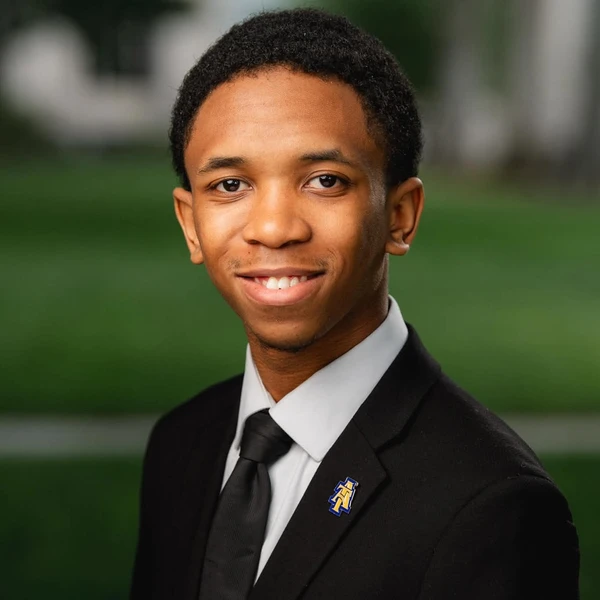
user profile avatar

Mark Gaskins

3x

Finalist

1x

Winner

General information

US Citizenship
US Citizen

Hobbies & Interests

  • Coding And Computer Science
  • Engineering
  • Physics

Reading

  • Academic

I read books multiple times a week.

Bio

I am a Physics student at North Carolina A&T with a deep curiosity for understanding how the world works and how science can be used in the service of people and communities. My academic interests sit at the intersection of physics, engineering, and problem-solving, where theory becomes a tool for real-world impact. Alongside my studies, I have been involved in STEM education and mentorship, working with young people to make technical concepts more accessible and to help them see themselves as capable learners and leaders. These experiences have reinforced my belief that knowledge is most powerful when it is shared and when it opens doors for others. My work and outlook are shaped by the African principle of Sankofa, the idea that we look to the past to move forward with intention. I carry that mindset into both my academic journey and my community engagement, striving to grow while remaining grounded in purpose. Ultimately, I aim to use physics not only to advance innovation, but to contribute to building pathways, representation, and opportunity for those who have historically been underrepresented in STEM.

Education

North Carolina A & T State University

Bachelor's degree program

2025 – 2028

Majors:
  • Physics
  • Engineering Physics
GPA4.0 GPA

Campbell High School

High School

2022 – 2025

GPA3.8 GPA

Miscellaneous

Desired degree level:
Master's degree program
Majors of interest:
Aerospace, Aeronautical, and Astronautical/Space Engineering, Physics, Physics and Astronomy
Medical school interest:
No
Test scores:
  • SAT1240

Career

  • Teacher (Youth Educator)

    Education · The Hidden Genius Project

    Jan 2022 – Jan 2025

  • Software Developer/AI Devleoper

    Technology · ScholarPrep Nation

    Jan 2025 – Present

  • Navigator/Youth Supporter

    Education · ScholarPrep Nation

    Jan 2025 – Present

Miscellaneous

Dream career field:
Aviation & Aerospace
Dream career goals:
Physics
Has nursing license:
No

Future Interests

  • Advocacy
  • Volunteering
  • Entrepreneurship
Private (PVT) Henry Walker Minority Scholarship
If given the opportunity, I would expand the informal tutoring I started at North Carolina A&T into a consistent, free peer learning program in calculus, physics, and introductory programming. I want students to have a place where they can ask questions without embarrassment and work through difficult material with someone who remembers learning it. My goal would be to help classmates build enough understanding and confidence to continue pursuing the opportunities that brought them to college. Since arriving at A&T, I have volunteered my time to tutor students, mainly in calculus and occasionally physics. I organized this independently through student group chats rather than through an official campus position. Starting informally allowed me to offer help, but it also made me think about what a more organized effort could provide. Regular sessions, a clear schedule, and additional student tutors could make that support easier to find and sustain beyond one person’s availability. I would begin by working with interested students and campus partners to establish recurring sessions around courses that often lead into more advanced STEM coursework. Small group sessions could give students room to explain their reasoning, compare approaches, and identify where their understanding breaks down. I would also invite classmates with strengths in different subjects to contribute. The program should not depend on me having every answer. It should create a community in which students are comfortable learning from one another. My experience with The Hidden Genius Project helped shape how I would approach this work. Through teaching programming and leadership to young Black men, I learned that knowing a subject and helping someone else understand it are different responsibilities. An explanation that makes sense to me may not make sense to the person hearing it. Effective instruction requires listening and finding another approach when the first one does not connect. I would bring that same attention to tutoring at A&T, where students arrive with different academic backgrounds and ways of learning. As the program develops, I would add introductory programming workshops and short educational videos students could revisit between sessions. My background in software development and my recent work creating physics animations would help me produce resources that explain difficult ideas visually. However, those materials would support, not replace, the opportunity to sit down with another person and ask a question. This matters to me because my own education has been strengthened by people willing to invest in me. My Physics Department chair encouraged me to pursue summer research at MIT, and mentors there helped me work through unfamiliar scientific problems. Their support did not remove the effort required, but it gave me guidance while I developed the ability to do the work myself. That is the kind of support I want to offer other students. Improving my community does not have to begin with creating something entirely new. It can begin by making the help I already provide more dependable and available to more people. At an HBCU, I see peer tutoring as one practical way to support our collective progress: students using what they have learned to help others continue forward. I would consider the program successful if students eventually returned not only for help, but also to offer it.
William A. Lewis Scholarship
I was sitting in my office at MIT, working on my summer research, when I received an unexpected call from the assistant dean of North Carolina A&T’s College of Science and Technology. She wanted to know whether I was doing okay and whether I would be able to return to school. I was confused. I thought I had already settled my balance from the previous semester. That call prompted me to investigate a financial problem I did not know I had. During the spring, my account had included a $2,000 “Blue and Gold” Scholarship. On April 12, I finished paying my remaining charges and saw a zero balance. However, three days later, the scholarship was reduced to $1,000. I had not received a notification that I was aware of, so I continued believing the semester was paid in full. By summer, that adjustment had become an outstanding $1,000 balance that threatened my registration. My dad and I spent time reviewing records and going back and forth with university offices by phone. I had documentation showing the original scholarship amount, but understanding what had changed and finding someone who could resolve it were separate challenges. The approaching deadline made each unanswered question more stressful. I was already trying to figure out how to fund the upcoming semester, and now I had an unexpected balance from the previous one. The contrast was difficult to ignore. At MIT, I was gaining experience in theoretical astrophysics and becoming more confident about pursuing research. At the same time, I was uncertain whether a financial issue would prevent me from continuing to study at my home institution, A&T. Academic progress did not make the funding problem disappear. The person who helped me most was Dr. Shelly R. Lesher, my Physics Department chair. She had already encouraged me to apply to the MIT Summer Research Program and supported my application. When I reached out about difficulty funding the semester, she took the concern seriously and helped secure a $2,000 scholarship from the college. That support covered the outstanding balance and helped resolve the immediate financial barrier to returning. I appreciated that she responded with action. I did not have to convince her that my education was worth protecting. Her willingness to look for funding reinforced my trust in the relationships I had built at A&T. My dad’s persistence also mattered. While I was away conducting research, he helped me examine the records and keep pursuing answers from the administration. This experience taught me that advocating for my education includes work beyond the classroom. I need to keep documentation, ask direct questions, and seek help before an unresolved issue becomes an interruption. It also showed me how much an individual faculty member’s support can matter when an institution’s processes are difficult to navigate. Looking back, what stands out most is how willing people were to help me continue. Dr. Lesher’s support resolved the financial obstacle and reinforced my trust in the relationships I had built at A&T. As I pursue research and graduate study, I want to carry her example forward by taking students’ concerns seriously and helping them find practical ways to keep going.
Hines Scholarship
Before college, I knew I enjoyed solving problems. What I did not yet know was how that interest could become a career, or how many different ways I could use it to help others. Attending North Carolina A&T State University has given me room to explore those possibilities. To me, going to college means learning enough to make informed choices about my future while becoming better equipped to contribute to someone else’s. As an Applied Physics major, I am interested in questions that do not come with answers at the back of a textbook. My curiosity has led me toward scientific research, and college has let me test that interest through experience rather than imagination alone. In the spring, my department chair, Dr. Shelly R. Lesher, brought me and another student to Duke University to participate in nuclear physics research at a particle accelerator facility. That experience introduced me to an environment where the concepts I studied in class became part of an actual experiment. This summer, I spent nine weeks in the MIT Summer Research Program, working with Dr. Lina Necib’s group on computational astrophysics research. Our project investigated whether different dark matter models could affect the evolution of a spiral pattern in the motions of Milky Way stars. I worked with simulations and presented the research at poster sessions. The experience strengthened my interest in graduate study, but it also showed me how much I still need to learn. College is helping me develop the foundation to pursue difficult questions without expecting the answers to come quickly. However, I do not want my education to benefit only my own career. Since arriving at A&T, I have independently organized volunteer tutoring in calculus and physics through student group chats. This began as an informal way to help classmates, not an official position. Sharing what I understand gives my coursework another purpose: something I learn can become useful to someone who is working through the same material. I recently launched a physics YouTube channel with that same goal. Using animation and original music, I created a video introducing dark matter and the evidence behind it, with scientific references cited throughout. I wanted people to have a way into the subject without first needing advanced mathematics. When interested students visited my research poster, I could give them a resource to keep exploring after our conversation ended. I am also serving as a paid MSRP ambassador alongside three other A&T students who participated in the program. We recently hosted information sessions to help other Aggies understand the opportunity and consider applying. Having benefited from a professor who encouraged me to pursue MIT, I value being able to offer encouragement and practical information to the next group of applicants. Through my education, I hope to prepare for graduate study and a career in physics research while continuing to teach and communicate science. Attending an HBCU has placed that ambition within a community whose support I can recognize in each opportunity I pursue. Going to college means developing my abilities, but it also means deciding what I will do with them. I want to leave A&T prepared to investigate questions about the universe and willing to help other students find their own place in that work.
Sherman S. Howard Legacy Foundation Scholarship
At Zion Hill Baptist Church, I learned that responsibility does not stop with my own choices. It includes how those choices affect others and whether I am willing to contribute when my community needs help. That lesson became especially clear through the church’s Rites of Passage program, a thirteen-week experience in which elders guided us through principles intended to prepare us for adulthood. The program helped me understand that becoming an adult means more than gaining independence. It means becoming someone other people can count on. The principle that stayed with me most was collective responsibility. During the program, one person’s actions could affect the entire group. At the time, being held accountable for someone else’s mistake was frustrating. However, it made the connection between individual conduct and collective well-being difficult to ignore. Our decisions were not isolated. We had to consider the people beside us, hold ourselves accountable, and understand that respect was something we demonstrated through our behavior. One experience put those lessons into practice in a way I still remember. After an overnight session spent listening to elders discuss principles for our lives, the boys traveled to another church in central Atlanta that was undergoing renovation. For hours, we moved furniture, cleaned, and helped with repairs. The work was physically demanding, especially after a long night, but it was also one of the most substantial community service experiences I had. What stayed with me was the transition from listening to serving. We had spent the night hearing about responsibility, and then we were asked to exercise it when we were tired and the work was difficult. The church needed help, and we could provide it. That experience taught me that service cannot depend entirely on whether I feel rested, comfortable, or enthusiastic. Sometimes it means recognizing a need and doing my part anyway. Rites of Passage also strengthened my respect for elders and brought me closer to the people who had invested their time in guiding us. Outside the program, I regularly helped prepare Thanksgiving food boxes for distribution to food pantries and assisted with tasks around the church, including moving furniture and cleaning. These responsibilities reinforced that contributing to a community often involves ordinary work that still needs someone willing to do it. I carry that understanding into my life at North Carolina A&T, where I have independently organized free tutoring in calculus and physics. Although the setting is different, the responsibility feels familiar: if I have knowledge that can help someone else, I should be willing to share it. My involvement at Zion Hill has made my Christian faith more practical. Loving my neighbor means being accountable for how I treat people and contributing where I can. The elders who guided me modeled that commitment by giving their time to prepare us for adulthood. Their example continues to influence how I use my own time and abilities in service to others.
Rev. and Mrs. E B Dunbar Scholarship
Pursuing higher education has required me to confront obstacles that were not always visible from the outside. While I was fortunate to grow up in a household that valued education, my greatest challenges came from navigating isolation, self-doubt, and the pressure to define my own path during critical years of development. During the COVID-19 pandemic, the sudden loss of structure, peer connection, and in-person learning deeply affected me. Like many students, I struggled with isolation and uncertainty at a time when identity, confidence, and direction were still forming. Rather than retreat from those challenges, I chose to face them directly by turning inward and investing in my growth. I began exploring programming, engineering, and creative technology on my own, not as a hobby, but as a way to regain purpose and momentum when traditional pathways felt unavailable. This period led me to seek out community-driven opportunities such as the Hidden Genius Project, a rigorous program focused on technology, leadership, and entrepreneurship. Entering that space was challenging in itself. I often questioned whether I belonged, whether my skills were strong enough, or whether my voice would be taken seriously. Over time, those doubts became motivation. I learned how to collaborate, lead projects, and support others who were navigating similar uncertainty. What began as a response to isolation became a foundation for confidence and discipline that carried me into college. As a Physics major at North Carolina A&T, I continue to face the demands of a rigorous STEM curriculum while balancing leadership, mentorship, and financial responsibility. Physics challenges me daily to think critically, persist through failure, and trust the process even when answers are not immediate. These obstacles have taught me resilience and the importance of asking for help, building community, and staying committed to long-term goals rather than short-term comfort. I plan to use my education to give back by expanding access to STEM knowledge and mentorship for students who may not see themselves represented in technical fields. I have already taken steps in this direction through mentoring, leading workshops, and supporting younger students interested in technology and leadership. In the future, I hope to contribute through educational outreach, community-based STEM programs, and by serving as a visible example of what is possible with persistence and support. The obstacles I have faced did not deter me from pursuing higher education; they clarified my purpose. Through my education, I intend not only to advance my own career, but to reinvest in the communities that helped shape me, ensuring that others have the guidance and encouragement they need to overcome their own challenges.
Mohamed Magdi Taha Memorial Scholarship
Being an up-stander, to me, does not always begin with a microphone or a large audience. It often starts with noticing who is being left out, who feels unheard, and who needs someone willing to step forward. Throughout my life, I have learned that using your voice is as much about listening and acting with intention as it is about speaking. My first real understanding of advocacy came during high school, when I served as Chapter President of the Future Business Leaders of America. In that role, I was not simply organizing meetings or preparing students for competitions. I was responsible for creating an environment where students felt confident enough to lead, present ideas, and see themselves as capable of success. Many of my peers were unsure whether business or leadership spaces were meant for them. I made it a priority to encourage participation, mentor younger members, and advocate for resources that would make our chapter more inclusive and accessible. Standing up for others sometimes meant challenging norms, and other times it meant taking the time to sit with someone one-on-one and remind them that their voice mattered. As I grew older, my understanding of being an up-stander expanded beyond formal leadership titles. Through my involvement in STEM education and mentoring, I saw firsthand how access to information can change trajectories. I worked with students who were curious and capable but lacked guidance or representation in technical spaces. Instead of waiting for someone else to step in, I chose to share what I knew, lead workshops, and support younger students as they navigated paths in technology, entrepreneurship, and leadership. These moments reinforced my belief that advocacy can be quiet, consistent, and deeply impactful. Now, as a Physics major at North Carolina A&T, I continue to use my voice to build community through service, mentorship, and example. In a field where Black students are often underrepresented, simply persisting and excelling becomes an act of advocacy. I speak up by collaborating with peers, asking questions that invite others into the conversation, and sharing opportunities that could benefit those around me. I believe that progress happens when people are willing to stand beside each other, not just ahead of each other. Inspired by the life of Mohamed Magdi Taha, I am committed to using my voice to advocate for equity, curiosity, and collective growth. His compassion and courage remind me that leadership is not about recognition, but responsibility. Moving forward, I plan to continue building spaces where young people feel empowered to speak, learn, and lead. Whether through STEM education, community engagement, or mentorship, I intend to use my voice to stand up for others and help create pathways where none previously existed. In doing so, I hope to honor the idea that even small acts, when rooted in purpose and empathy, can help shape stronger and more just communities.
Hector L. Villarreal Memorial Scholarship
When I think about aviation, I do not just think about airplanes in the sky. I think about motion, forces, navigation, and the human curiosity that has always pushed us to understand what lies beyond the horizon. That same curiosity is what has guided my journey, both academically and personally, and it is why I feel called to contribute to the aviation industry through physics and engineering. I am a sophomore Physics major at North Carolina A&T, an HBCU that has shaped my understanding of what it means to pursue excellence with purpose. From an early age, I was drawn to solving problems and understanding how systems work. As a student, I found myself asking why objects move the way they do, how forces interact, and how mathematical models translate into real-world applications. Physics became the language that helped me answer those questions, and aviation is one of the most powerful expressions of that language in action. My interest in aviation is rooted in its intersection of physics, engineering, and impact. Aircraft do not simply fly because of machinery alone, but because of precise calculations involving air pressure, lift, thrust, and energy. As someone who studies the fundamental laws that govern motion and matter, I see aviation as a field where theory meets responsibility. Every equation matters because lives depend on accuracy, safety, and innovation. I am particularly interested in how physics informs aircraft design, flight systems, and the advancement of safer and more efficient air travel. As a student in an underrepresented minority in STEM, my path has not always been straightforward. There were moments when I questioned whether I belonged in technical spaces, especially early on when access to guidance felt limited. What carried me forward was ambition and drive, along with mentors and programs that helped me see my potential more clearly. Experiences such as leading technical workshops, participating in rigorous STEM programs, and mentoring younger students reinforced my belief that knowledge is meant to be shared and used to uplift others. The legacy of Hector L. Villarreal resonates deeply with me because it highlights how aviation can open minds, connect cultures, and create life-changing experiences. His journey reminds me that technical skill paired with purpose can transform not only individual lives, but families and communities as well. This scholarship would help relieve the financial pressure that often accompanies pursuing a demanding STEM degree, allowing me to focus more fully on research, academic growth, and experiential learning opportunities related to aerospace and aviation systems. With this support, I can continue building the foundation necessary to make meaningful contributions to industries where physics drives innovation. My goal is not only to work within aviation-related fields but to help shape a future where access, safety, and excellence take flight together.
Matthew E. Minor Memorial Scholarship
The importance of strengthening our efforts to minimize forms of online bullying and uplift our communities is rooted in the importance of our mental health—especially following the aftermath of the period of isolation imposed on us during the years of the coronavirus. Cyberbullying can lead to severe emotional distress, anxiety, and depression, and when added with the fact that not all of us have the outlets we had before the pandemic, online bullying, can even result in tragic outcomes like self-harm and suicide. Beyond personal impact, it creates an overall toxic online environment which discourages meaningful interaction and makes room for negativity and the cycle of cancel culture. By strengthening our efforts to delete cyberbullying, we can build a safer, more inclusive digital space in which people can feel valued, respected, and empowered to express themselves without fear of harassment or being canceled by their online peers. This is a critical concept, and to maximize my efforts to uplift my community, I have constantly devoted my life to ensuring our communities can thrive, and everyone has a chance at being successful online and in person. Through my work, I’ve led many workshops for middle and high school students on technology, entrepreneurship and leadership skills, and encouraged them to come up with ideas that can be beneficial to their own communities. Additionally, I founded and maintained a YouTube channel and online forum for more than 50,000 aspiring programmers globally to post weekly programming tutorials, answer questions, and provide help and guidance. I’ve taught computer programming to high schoolers in person in Atlanta, Oakland and Detroit, and internationally in England through my work with the Hidden Genius Project organization. As the President of the FBLA during my last year in high school, I was responsible for promoting business education, organizing leadership events, and guiding the members of my student organization. In the process, I have helped develop leadership, teamwork, and hands-on skills in myself and others. As a college graduate, I will continue motivating students online by developing further the educational platforms that I have developed and which are currently used by hundreds of thousands of people all over the world. I believe in leading the advancements in the space industry and making sure that Black students can be leaders in areas where they have been traditionally missing. In the process, I want to ensure that education, particularly in technology and entrepreneurship, is accessible to underrepresented groups and inspire them to attend college and get good jobs. It is my work in tech and business to create a paradigm of success for others, to encourage them to pursue their dreams and to overcome cultural and economic barriers.
First-Gen Flourishing Scholarship
Before I embraced the importance of Sankofa-- the principle from my African heritage teaching us to look back and study the wisdom of our ancestors-- I often found myself struggling with a lack of identity. This challenge left me feeling lost and disconnected, uncertain of my direction and purpose. However, as I began to study my ancestry, I realized that I am part of a much larger story, not just an individual navigating life. This understanding transformed my outlook, giving me clarity about my passions and helping me envision a future not just for myself, but for the communities I serve. Embracing Sankofa allowed me to confront this lack of identity, which had made me reluctantly introverted. Without a sense of who I was, I felt baseless, unmotivated, and at times lost. Despite this uncertainty, one thing remained clear: I was always incredibly creative. My interests in programming, tinkering with hardware, and assisting with IT almost everywhere I went offered me moments of clarity and purpose. Even though I didn’t fully understand where this passion would take me, I knew there was something to be done in this space, and I was eager to explore it. During the pandemic, what could have been a period of isolation became an opportunity for growth. I used this time to dive into technology, leadership, and entrepreneurship through the 15-month Hidden Genius Project in 2021. Starting as a student, I advanced to lead programmer and eventually became the director of programming cohorts in Detroit, Oakland, Atlanta and going global in several locations in the UK by 2024, earning a letter of recommendation from the CEO along the way. These roles allowed me to give back by sharing my knowledge with others, embodying the principles of Sankofa by uplifting the next generation. In addition, I mentored over 50,000 aspiring programmers through a YouTube series and an online forum on Discord, where my audience ranged from middle schoolers to college students and even a professor. This experience reinforced the importance of community upliftment, which I also promoted through my work with The Village Method, teaching elementary students about our ancestors and supporting their virtual learning sessions. These initiatives helped me embody Sankofa, leading by example and giving back to my community as I continued to grow. The pandemic not only deepened my understanding of my culture and the African principle of Sankofa, but it also taught me the importance of leading rather than following. During that period of isolation, I was able to break away from the pressure to conform and discovered the power of forming my own opinions. Homeschooling from 2020 to 2021 gave me the space to think independently, rooted in the belief that reclaiming our past is essential to moving forward. This realization allowed me to see the world differently and embrace my identity with purpose. As I reflect on my journey, I see how the principles of Sankofa have shaped who I am today and the leader I aspire to be. By looking back to understand my history, I’ve gained the tools to navigate the present and shape the future-- for myself and the communities I serve. My experiences with the Hidden Genius Project, community service and mentoring others taught me that leadership isn’t just about being at the forefront; it’s about guiding others toward collective progress. Just as I’ve learned from the past, I now move forward, passionate about building on what has come before and paving the way for those who will follow.
Elijah's Helping Hand Scholarship Award
The years of the coronavirus brought life to a standstill, forcing us to confront challenges we never anticipated. While the pandemic's effects faded for many, its impact on me has lingered, shaping my perspective and ambitions. The coronavirus was a time defined by an overwhelming sense of loneliness, uncertainty, and isolation. While I worked tirelessly to pursue my dream of attending university and one day innovating within the aerospace industry, the overwhelming time of solitude casted a shadow over my ambitions. The pandemic created a world in which the outside community was out of reach, and, at times, the idea of serving as a leader and carving my own unique path seemed almost implausible. It felt easier to follow the crowd than risk the isolation that comes with standing out, especially during a time when many in my generation turned to social media, online gaming, and artificial intelligence to satisfy our deep need for community. A national state of emergency was declared for children’s health– and as a result, the effects of the isolation on my mind, and the importance of my mental health could not be denied. Furthermore, I realized that if I allowed the effects of isolation to gain any more of a stronghold on my mind, I may not pursue university, I may not strive to reach my dreams, I may not keep that drive. I understood that I needed to combat this, and I could not allow my isolation and sense of loneliness to maintain its grip over my life. I strengthened my efforts to strive for my goals and what I believe in. I conducted workshops aimed at training middle and high school students in technology, entrepreneurship and leadership skills and helping them to come up with projects that will benefit their communities. Moreover, I maintain a YouTube platform and an online forum with more than 50,000 aspiring programmers globally where I upload software engineering tutorials, provide technical support and guidance on a weekly basis. I also taught software engineering fundamentals to high schoolers in-person in cities like Atlanta, Oakland and Detroit, as well as London, via the Hidden Genius Project programming sessions. During senior year in high school, I served as Chapter President of the Future Business Leaders of America, which involved me advocating for business education, leading leadership events and mentoring peers. In doing so, I have helped to nurture leadership, teamwork, and practical skill-building in myself and others. As a college graduate, I plan to continue inspiring students online by expanding the educational platforms I’ve created, which currently reach hundreds of thousands globally. I aim to lead advancements in the space industry, demonstrating that Black students can excel in traditionally underrepresented fields. In the process, I dream of making education accessible to underrepresented groups, particularly in technology and entrepreneurship, to empower students to pursue higher education and meaningful careers. This is all the result of my realization of the requirement of consistent effort through practices like therapy, rest, and self-compassion to grow and sustain our standing in mental health. In embracing the importance of mental health, I’ve found the strength to overcome isolation, rekindle my ambition, and forge a path toward a future where my dreams of innovation take flight. My work in tech and business will serve as an example of this, encouraging others to strive for their goals while breaking mental and social boundaries.
Trees for Tuition Scholarship Fund
The African principle of Sankofa teaches my people to look back and study the wisdom of our ancestors, so we can go forwards and use that wisdom as our foundation. Before I embraced this, I often found myself struggling with a lack of identity, causing me to be lost, disconnected, and unsure of my purpose. Added with the voices of the people who I thought were my friends, the media, and the public school system which constantly tried to “define” me, there was no room for me to discover my purpose. It wasn't until the world came screeching to a halt during the coronavirus when I had the room to grasp this fundamental principle. From 2020-2021, my parents homeschooled me about my ancestry, the African principles, and exposed me to what my people have done for this country and humanity—topics the school system would never teach me. They placed me into programs centered around technology and entrepreneurship with other Black youth; and with this as my foundation, my role as a servant leader became clear to me. No longer am I bound by the pathway which too many are stuck to. I am creating a new path, one guided by Sankofa. Through this path, I not only discovered my identity but also my passion for innovation and problem-solving. As I embraced the principles of Sankofa, I began to see how technology, particularly in aerospace, could be a powerful tool for shaping the future—one that must be guided by both progress and responsibility. Guided by the wisdom of Sankofa and a renewed sense of purpose, I now turn my attention to the rapidly evolving world of technology. Today, we are witnessing an unprecedented rate of human advancement. According to the World Intellectual Property Organization (WIPO), in just the past twelve years, we have lowered costs of technology while increasing the efficiency of the same. We have increased life expectancy, production of supercomputers, and scientific publications. When artificial intelligence and spacecraft are added into the mix, our rate of innovation skyrockets at a level which simply hasn’t been observed before throughout our human history. This is without a doubt an era of innovation sparked by the innovation of the transistor; however, with great innovation, there's questioning on whether or not we will be able to continue to innovate sustainably. The Trees for Tuition Scholarship will provide me with the opportunity to access the resources, mentorship, and education necessary to develop groundbreaking solutions in aerospace and beyond. With this assistance, I will be able to refine my ideas, collaborate with experts, and work toward sustainable advancements in space exploration and technology. The support from this scholarship will allow me to focus on the challenges ahead, ensuring that my work benefits future generations. The climate crisis is having real-world repercussions outside of scientists wagging a finger and saying “no-no.” For the first time in over 120 years, it snowed in the Gulf of Mexico. Back-to-back hurricanes in the South, yet our leaders, blinded by wealth, have done little-to-nothing to combat this nor prepare the world for future generations to come. While I see a future for myself in aerospace, I will not allow myself to turn a blind eye to the dangerous impacts our spacecraft has on Earth—nor will I be content solely because my business is making profit. It is this fundamental idea—my baseline plan—to ensure our propulsion chemicals are affording sustainability in the otherwise unsustainable spacecraft industry. My goal is to bridge aerospace innovation with environmental responsibility, ensuring progress in space does not come at the cost of Earth's well-being.
Julius Quentin Jackson Scholarship
The African principle of Sankofa teaches us to look back and study the wisdom of our ancestors, so we can go forwards and use that wisdom as our foundation. Before I embraced this, I found myself struggling with a lack of identity, causing me to be lost, disconnected, and unsure of my purpose. Added with the voices of the people who I thought were my friends, the media, and the public school system which constantly tried to ‘define’ me, there was no room for me to discover my purpose. It wasn't until the world came screeching to a halt during the coronavirus when I had the room to grasp this fundamental principle. In addition to my academic pursuits, I became deeply involved in various extracurricular activities. I served as the lead programmer and educator for the Hidden Genius Project, teaching youth in cohorts in Atlanta, Detroit, Oakland and going global when I taught in sessions around England. As a mentor, I guided over 40,000 aspiring programmers through a YouTube series and an online forum I developed on Discord. I also composed music, played the violin, and developed games. In my senior year of high school, I became the President of Future Business Leaders of America. Furthermore, I am an animator and AI programmer, having created several AI applications when the technology was still emerging. Through these experiences, I’ve honed skills in leadership, mentorship, and creativity, and the importance of balancing my mental health with my academic and extracurricular life. While I come from a family of servant leaders and community builders who work tirelessly to uplift others, my parents have struggled to secure sufficient funding within the school systems they serve. Months often pass in our household with the understanding that we can only afford necessities. My parents have been transparent about their inability to fund my college education, even though I have been admitted into four top HBCUs. Though I plan to work during my education, I am still bound to graduate with significant debt, which could take over a decade to repay. This financial burden would hinder my ability to effectively pursue my vision of building businesses and advancing innovation in the aerospace sector. Scholarships like these are crucial to my mission, as they would alleviate financial strain and allow me to focus on my education, ambitions, and long-term impact. With this assistance, I will fully dedicate myself to my studies and goals as I aim to build businesses fostering innovation while creating opportunities for underrepresented communities to thrive in aerospace and technology. Our people can only thrive when we are not just considering ourselves, but are actively making opportunities for generations.
Theresa Lord Future Leader Scholarship
Before I embraced the importance of Sankofa--a principle from my African heritage that teaches us to look back and embrace the wisdom of our ancestors--I often found myself struggling with a lack of identity. This challenge left me feeling lost and disconnected, uncertain of my direction and purpose. However, as I began to study my ancestry, I realized that I am part of a much larger story, not just an individual navigating life. This understanding transformed my outlook, giving me clarity about my passions and helping me envision a future not just for myself, but for the communities I serve. Embracing Sankofa allowed me to confront this lack of identity, which had made me reluctantly introverted. Without a sense of who I was, I felt baseless, unmotivated, and at times lost. Despite this uncertainty, one thing remained clear--I was always incredibly creative. My interests in programming, tinkering with hardware, and assisting with IT almost everywhere I went offered me moments of clarity and purpose. Even though I didn’t fully understand where this passion would take me, I knew there was something to be done in this space, and I was eager to explore it. During the pandemic, what could have been a period of isolation became an opportunity for growth. I used this time to dive into technology, leadership, and entrepreneurship through the 15-month Hidden Genius Project in 2021. Starting as a student, I advanced to lead programmer and eventually became the director of a programming cohort in Detroit, Oakland, Atlanta and going global in several locations in the UK by 2024, earning a letter of recommendation from the CEO along the way. These roles allowed me to give back by sharing my knowledge with others, embodying the principles of Sankofa by uplifting the next generation. In addition, I mentored over 40,000 aspiring programmers through a YouTube series and an online forum on Discord, where my audience ranged from middle schoolers to college students and even a professor. This experience reinforced the importance of community upliftment, which I also promoted through my work with The Village Method, teaching elementary students about our ancestors and supporting their virtual learning sessions. These initiatives helped me embody Sankofa, leading by example and giving back to my community as I continued to grow. In 2022, I took this understanding further by participating in a 15-week intensive program at Zion Hill Baptist Church called the Rites of Passage Program. Through this brotherhood, I was educated about my ancestry, culture, and what it means to be a Black man in the United States and beyond. The elders in the program saw value in us that we had yet to realize within ourselves. They guided us through difficult conversations about America’s harsh realities--lessons that can only be taught within a close-knit community. This experience was crucial to my development as a young man, hardening my resolve and deepening my understanding of who I am. As I reflect on my journey, I see how the principles of Sankofa have shaped who I am today and the leader I aspire to be. By looking back to understand my history, I’ve gained the tools to navigate the present and shape the future--for myself and the communities I serve. My experiences with the Hidden Genius Project, mentoring others, and the Rites of Passage Program taught me that leadership isn’t just about being at the forefront; it’s about guiding others toward collective progress. Just as I’ve learned from the past, I now move forward, passionate about building on what has come before and paving the way for those who will follow.
Peter and Nan Liubenov Student Scholarship
The principles which my African ancestors have left with my people have given me the confidence I needed to achieve my goals. The principle of Sankofa encourages my people to study their wisdom so that it can be used as a reference while pursuing our goals. Prior to accepting this, I struggled with my identity, feeling lost, disconnected and without a goal. Together with the pressure of the people who I thought were my friends, the media and the public schools, which were always trying to ‘tell’ me who I am, there was no way for me to find out what I was supposed to do. It was not until the world was shut down by COVID-19 when I understood this fundamental concept. Homeschooling me, my parents for two years taught me about my history, the African culture and way of life, and the principles through which I learned that my people have contributed positively to this country and the world—things that the school has never and will never introduce to me. I was put in programs that were related to technology and business for black youths; therefore, my base was strong, and I knew what my role as a servant leader was. I am not anymore trapped in the road which so many people are still trapped in. I am creating a new way, a way that is based on the Sankofa concept. This path did not only help me to discover my real self but also revealed to me my interest and zeal in innovation and problem solving. In this paper, I will explain how I incorporated the principle of Sankofa into my leadership journey and how I am using it to shape my future in aerospace. As a strong believer in knowledge sharing and community empowerment, I sought to extend these principles beyond myself. I have conducted workshops to train middle and high school students in technology, entrepreneurship and leadership skills, and make sure they are able to develop projects that create a tangible impact in their communities. Furthermore, I launched a YouTube platform and online forum that has reached over 40,000 students globally and share programming tutorials, provide technical support and guidance weekly. Teaching programming fundamentals in-person to high-schoolers in cities like Atlanta, Oakland and Detroit and London through sessions with the Hidden Genius Project has allowed me to see firsthand how access to education changes lives. I also celebrate Kwanzaa annually using its values of unity and purpose to strengthen my ties to my heritage and guide my community focused efforts. These experiences have not only solidified my leadership abilities but have reinforced my commitment to using technology as a tool of empowerment. Guided by the of my ancestors, I am working to contribute to aerospace innovation in the right way, making sure that technology improves people’s lives, conserves our environment, and leads to a sustainable future through research, collaboration, and entrepreneurship. My goal is to bridge aerospace innovation with environmental responsibility, ensuring that our progress uplifts communities and preserves our world for generations to come, while also lighting the path for others focused on carrying the torch.
Mark Gaskins Student Profile | Bold.org