user profile avatar

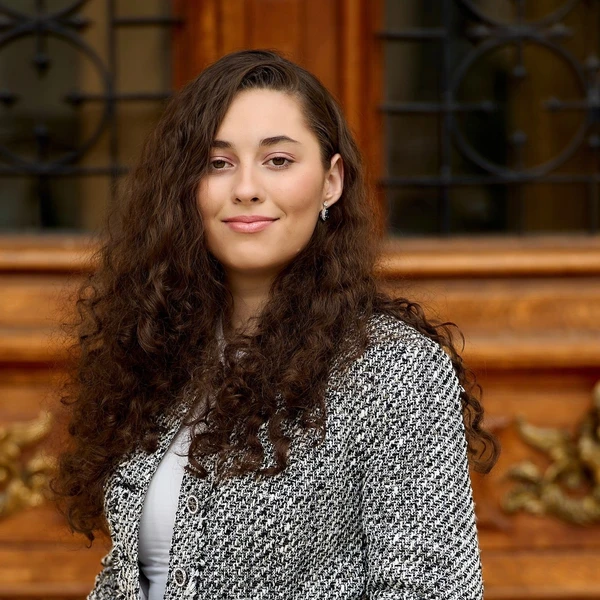
maria timbus

1x

Finalist

Bio

My life goal is to use technology to build systems that expand access to opportunity, especially for people and communities that are often overlooked. I am passionate about creating solutions that do more than exist on paper: tools, teams, and projects that improve how people live, learn, and connect. That passion comes from my own experience of creating opportunities where they did not exist. I taught myself programming, built technical projects from scratch, and led initiatives that reached over 300,000 people through STEM outreach. Through AlphaZ, the second FRC team in Romania, I helped grow a robotics community in a country where access to large-scale engineering programs is still limited. In our rookie year, we advanced to the FIRST Robotics Competition World Championship and won the Rookie All-Star Award, proving how far students can go when given the chance to build. One of my most meaningful projects was ElderConnect, a platform connecting elderly individuals with volunteers for tech help, chores, and companionship. After helping my grandmother when she could not walk, I learned that technology is most powerful when it is designed around dignity, trust, and real human needs. I believe I am a strong candidate because I combine technical skill with initiative and measurable impact. I do not wait for structure; I build it. Whether through data science projects, outreach programs, robotics leadership, or platforms for vulnerable communities, I turn ideas into practical systems.

Education

Stevens Institute of Technology

Bachelor's degree program
2026 - 2030
  • Majors:
    • Computer Science

Miscellaneous

  • Desired degree level:

    Master's degree program

  • Graduate schools of interest:

  • Transfer schools of interest:

  • Majors of interest:

  • Not planning to go to medical school
  • Career

    • Dream career field:

      Computer Software

    • Dream career goals:

    • Information Technology Advisor

      KPMG
      2023 – 2023

    Research

    • Astronomy and Astrophysics

      University of Physics - Magurele — Assistant Resercher
      2022 – 2026

    Arts

    • none

      Drawing
      2020 – Present

    Public services

    • Volunteering

      Casa Buna — tutor
      2023 – 2025

    Future Interests

    Volunteering

    Entrepreneurship

    Tinkerer’s Path Scholarship
    One project that best reflects my curiosity and creativity is Invisible Borders, a platform I created to explore how people express themselves when identity is removed. The idea began with a simple question that stayed with me: how honest are people when they feel completely safe? I noticed that in many environments, especially online, people filter their thoughts out of fear of judgment, social pressure, or exposure. I wanted to understand what happens when those barriers are removed. To explore this, I built a platform where users could anonymously share personal stories, thoughts, and experiences. While the concept seemed simple, the challenge was much deeper than just creating a submission form. I had to think carefully about how to design a space that people would actually trust. I experimented with different ways of structuring submissions, filtering sensitive content, and presenting stories so that they felt personal, but still protected the identity of the author. I also thought about how small design decisions, such as language, layout, and tone, could influence whether someone felt safe enough to share something real. The result was a collection of over 100 testimonies and a growing community of more than 200 people. What stood out to me was not just the number of submissions, but their depth. People shared experiences about identity, insecurity, pressure, and relationships in ways that were far more honest than what I usually saw on traditional platforms. This made me realize that the problem was not a lack of willingness to share, but a lack of environments designed for safe expression. This project shaped the way I approach problem solving. I do not start with the assumption that the problem is purely technical. Instead, I begin by trying to understand the human behavior behind it. In this case, the challenge was not “how to build a platform,” but “how to design trust.” Once I understood that, the technical decisions became clearer. I focused on building something simple, but intentional, where each feature served a purpose. My approach is also iterative. I build quickly, observe how people interact with the system, and then refine it. For Invisible Borders, this meant adjusting how content was displayed, how users interacted with submissions, and how the platform evolved based on real usage. I see problem solving as a cycle of curiosity, experimentation, and improvement. This mindset directly shapes how I want to make a positive impact in the world. I am not just interested in building efficient systems, but in creating technology that changes how people interact, access support, and express themselves. Invisible Borders showed me that even a small platform can reveal deeper needs if it is designed with intention. In the future, I want to apply this approach to larger systems, especially those that address access to information and services. Whether it is helping people connect, share, or receive support, I want to build technology that is not only functional, but also thoughtful and human-centered. I believe that meaningful impact comes not just from what we build, but from how well we understand the people we are building for.
    Lyndsey Scott Coding+ Scholarship
    My computer science goals are centered on building scalable systems that address real-world problems related to access, identity, and information. I am particularly interested in artificial intelligence and data-driven platforms, where I can design systems that are not only efficient, but also meaningful for the people who use them. One example of this is a machine learning project where I classified over 5,000 stellar spectra using Python and TensorFlow, improving the model’s accuracy by over 20 percent. Through this, I learned how to structure data pipelines, evaluate performance, and iterate on models based on real results. During my studies, I want to deepen my knowledge in algorithms, machine learning, and distributed systems, while continuing to build projects that move beyond theory into practical applications. Beyond computer science, my goals are strongly connected to understanding people and creating impact within communities. This is what led me to create Invisible Borders, a platform where individuals can anonymously share personal stories and experiences. Through this project, I collected over 100 testimonies and built a growing community of over 200 people. I focused on designing a system that allows users to share without revealing their identity, prioritizing safety and trust. This experience taught me that access is not only about resources, but also about creating environments where people feel safe to express themselves. I also worked on ElderConnect, a platform designed to connect elderly individuals with volunteers for everyday support. The system included features such as location-based matching and a validation mechanism that rewarded reliable volunteers. This project addressed a tangible issue I observed in my community: elderly individuals struggling with daily tasks and lacking consistent support networks. By designing this platform, I learned how to translate real-world problems into structured digital solutions. In parallel, my involvement in robotics allowed me to scale impact at a larger level. As a team leader, I managed over 20 members and contributed to outreach initiatives that reached more than 300,000 people annually through events, workshops, and digital campaigns. These efforts focused on creating access to STEM education, especially for students who would not otherwise have exposure to it. This experience strengthened my ability to lead, communicate, and build systems that extend beyond a single project. In the future, I plan to combine my computer science and non-computer science goals by building technology that is both scalable and human-centered. I want to develop platforms that enable people to safely access services, share information, and connect without barriers. Projects like Invisible Borders and ElderConnect represent early steps in this direction, where technical systems are designed with a clear understanding of human needs. Ultimately, my goal is to work at the intersection of technology and society, where I can design systems that are not only technically strong, but also inclusive, responsible, and impactful. By combining engineering with a deep awareness of people and communities, I aim to build solutions that scale while remaining grounded in real-world challenges.