Hobbies and interests
Military Sciences
Crossfit
Embroidery And Cross Stitching
Knitting
Running
Reading
Reading
Academic
Adventure
Book Club
Economics
History
Fantasy
Family
Mystery
Women's Fiction
Travel
I read books daily
Margaret Williams
1x
Nominee1x
Finalist1x
Winner
Margaret Williams
1x
Nominee1x
Finalist1x
WinnerBio
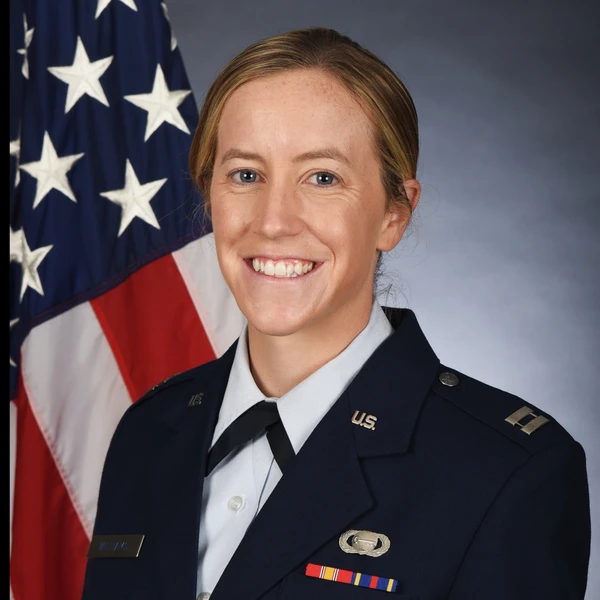
I am an Active Duty U.S. Air Force intelligence officer transitioning out of service in October 2025 after nearly a decade of public service. I graduated summa cum laude and Phi Beta Kappa from the University of North Carolina at Chapel Hill with a degree in Political Science and Peace, War, and Defense, along with a minor in German.
I’ve recently been accepted into RAND Corporation’s Technology and Security Policy program, where, as a veteran, I will pursue a master’s degree focused on national security, technology, and government transparency. My goal is to bridge my operational military experience with policy work that strengthens trust between the U.S. public and its institutions, and ensures national policy truly supports both servicemembers and citizens.
As a survivor of service-related PTSD, chronic depression, and anxiety, I’ve spent over five years in therapy rebuilding my life and voice. I’m passionate about creating spaces—especially in policy and defense—that allow women and veterans to thrive. I care deeply about mental health, reproductive healthcare access, and safe, supportive environments for those who serve.
Above all, I’m service-driven, curious, compassionate, and deeply committed to using my lived experience to shape a more transparent, thoughtful, and people-centered national security strategy.
Education
Pardee RAND Graduate School
Master's degree programMajors:
- Public Policy Analysis
University of North Carolina at Chapel Hill
Bachelor's degree programMajors:
- International Relations and National Security Studies
Miscellaneous
Desired degree level:
Master's degree program
Graduate schools of interest:
Transfer schools of interest:
Majors of interest:
- Public Policy Analysis
- International Relations and National Security Studies
Career
Dream career field:
Technology
Dream career goals:
Intelligence Analyst
United States Air Force2019 – 20256 yearsIntelligence Analyst
USAF2019 – Present7 years
Research
Aerospace, Aeronautical, and Astronautical/Space Engineering
USAF — Analyst2020 – 2025
Public services
Volunteering
USAF — Advocate2022 – 2024
Tawkify Meaningful Connections Scholarship
During my military service and now in graduate school, I have learned that the relationships we build shape not only our careers, but also the way we understand responsibility, trust, and community. The people who have influenced me most have not simply helped me succeed in the moment. They have shaped the way I communicate, the way I lead, and the way I show up for others. Those lessons have stayed with me, and they continue to guide the future I want to build.
In the military, I quickly learned that no one accomplishes important work alone. The environments I worked in were fast-moving, high-stakes, and often unpredictable. In those settings, trust mattered just as much as skill. Whether I was working with fellow service members, supporting pilots, or helping translate complex intelligence into something useful and actionable, the strongest results always came from relationships built on respect, reliability, and clear communication. I saw that people do their best work when they feel heard, valued, and supported. That experience taught me that leadership is not only about giving direction. It is also about creating the kind of environment where others can do their best work.
That lesson has carried into my graduate education at Pardee RAND, where I am pursuing national security policy in a partially online program. At first, I worried that a virtual or hybrid environment might feel less personal. Instead, I have found that it has pushed me to be more intentional about connection. In online classes, discussion boards, group projects, and virtual meetings, I have had to be deliberate about how I engage with others. That has made me a better listener and a more thoughtful communicator. It has also reminded me that real connection is not dependent on physical proximity. It grows when people are willing to be present, attentive, and generous with one another.
Some of the most meaningful relationships in my life have also helped me understand resilience. The people who have encouraged me through transitions, challenged me to keep growing, and reminded me of what matters most have given me a stronger sense of purpose. Their support has not made the journey easier in every way, but it has made it more meaningful. They have taught me that progress is often slow, that growth is rarely linear, and that staying committed to your goals is itself a form of strength.
Looking ahead, I hope to build a career in public service that strengthens both systems and relationships. In national security policy, success depends on more than technical expertise. It also depends on trust between people, institutions, and communities. I want to be part of work that helps bridge those gaps, whether by translating complex information into practical decisions, improving communication across organizations, or helping people feel more connected to the systems that affect their lives. My goal is not only to contribute to policy, but to help build a culture of collaboration and mutual responsibility.
On a personal level, I also want to build a life rooted in the same values that the most important people in my life have modeled for me: empathy, accountability, and service. Those values matter in any field, but especially in work that affects the safety, security, and well-being of others. I have come to believe that relationships are not separate from success; they are part of how success is created and sustained.
The relationships in my life have taught me that we become stronger through connection. As I continue my education, I hope to carry those lessons forward in a way that strengthens both my future and the communities I serve.
Elevate Women in Technology Scholarship
WinnerArtificial Intelligence (AI) inspires me not only because of its power to improve how we process information, but also because of its potential to transform how we make decisions that protect lives and preserve peace. As a former U.S. Air Force intelligence officer, I saw firsthand how the growing volume of raw intelligence data—from satellite imagery to open-source information—has outpaced our ability to process and contextualize it in real time. AI can change that.
The sheer scale of modern data collection in the intelligence community (IC) demands new tools. During my time supporting operations in the Indo-Pacific, analysts like myself were inundated with information requiring rapid analysis and dissemination. We often worked long hours triaging what data we could manage, knowing much of it might go untouched—simply because we lacked the bandwidth. AI models, like large language models (LLMs), offer a scalable solution. Properly trained, they can help extract meaning from massive datasets, flag anomalies, summarize patterns, and reduce human error. They won’t replace the need for human analysts—but they can empower us to focus on the nuance, context, and judgment that machines cannot replicate.
But with that promise comes a responsibility. I’m inspired not just by AI’s technical capabilities, but by the opportunity to help shape how we use it. Competent, ethical technology policy will determine whether AI strengthens democracy and global stability—or undermines it. Without guardrails, algorithmic bias, opaque decision-making, or malicious manipulation of AI systems could compromise security and civil liberties. That’s why I’m pursuing a dual degree in national security and technology policy. I want to help bridge the gap between engineers, analysts, and policymakers to ensure that the tools we use to safeguard our country are transparent, equitable, and responsibly governed.
AI is not inherently good or bad—it reflects the intentions and oversight of those who develop and deploy it. I believe the future of national security will depend on leaders who understand both the promise and the pitfalls of emerging technology. By studying policy alongside technical innovation, I hope to shape how tools like GPT are integrated into the intelligence enterprise in ways that strengthen—not erode—trust, safety, and ethical standards.
AI inspires me because it has the potential to do what the best technologies have always done: extend human capacity for understanding, and help us solve problems that once seemed impossible. My goal is to make sure we do that wisely.
Dr. Tien Vo Federal Agents To-Be and Public Service Scholarship
My name is Margaret Williams, and I am a U.S. Air Force veteran and intelligence analyst with a deep commitment to public service. I served for over six years, primarily focused on defense intelligence and national security operations across the Indo-Pacific. During my time in uniform, I supported joint operations, led analytic teams, and helped decision-makers navigate rapidly evolving situations. One pivotal moment that shaped my future path was Speaker Nancy Pelosi’s 2022 visit to Taiwan. I was stationed in the region and witnessed firsthand the People’s Republic of China’s military escalation and response. This experience showed me the critical link between tactical intelligence and strategic policy—and the high stakes of getting both right.
That moment, among many others, motivated me to return to school to pursue a dual master’s degree in National Security and Technology Policy. My goal is to become a strategic intelligence analyst who not only understands threats on the ground, but also helps shape forward-looking policy that protects national interests and promotes stability. I want to be the kind of analyst who helps decision-makers cut through noise, synthesize complex data, and act ethically and decisively in high-stakes environments.
While I bring deep operational experience, I recognize that the world of national security is changing fast—especially with the rise of artificial intelligence and other emerging technologies. I am pursuing additional education so I can understand, anticipate, and responsibly integrate these technologies into our national security framework. I want to be fluent in both policy and technology, so I can help bridge the gap between those who design tools and those who make decisions with them.
This scholarship would allow me to fully focus on my studies without the burden of financial stress. As a first-generation graduate student, I know how transformative access to education can be. With your support, I will deepen my understanding of security strategy, sharpen my analytic skills, and return to public service better equipped to protect and inform the American public.
My long-term career goal is to return to the intelligence community and contribute to building a more agile, ethical, and inclusive national security enterprise. I believe that public trust and smart policy go hand in hand, and I want to be part of the next generation of leaders who make our government work better—for everyone.
Thank you for considering my application. This scholarship would be an important step in helping me continue a life of service, now from the policymaking and analytical side of the table.