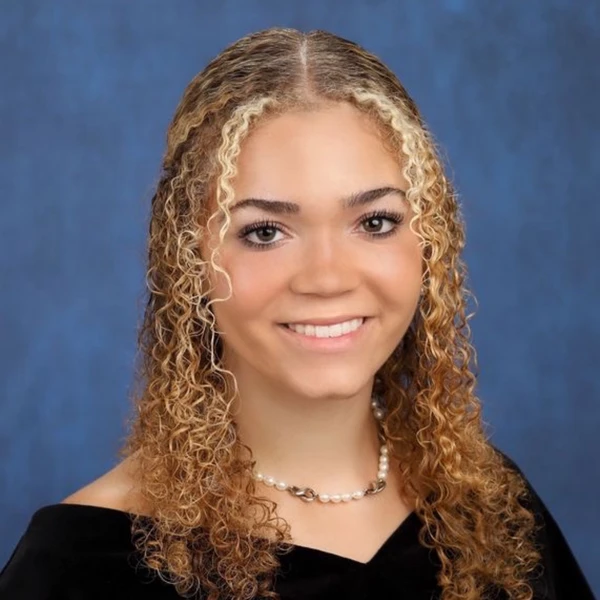
Hobbies and interests
Basketball
Ice Skating
Lacrosse
National Honor Society (NHS)
Coaching
Running
Bible Study
Reading
Sports and Games
I read books daily
Madison Jennings
1x
Finalist
Madison Jennings
1x
FinalistBio
I am a high-achieving student and disciplined competitor whose academic dedication matches the same focus and resilience I bring to athletics. With a 4.32 GPA and six AP courses, I have consistently excelled in a rigorous academic environment while balancing year-round varsity competition. My success reflects strong time management, intellectual curiosity, and a commitment to growth.
I approach challenges with a coachable mindset and a willingness to improve. Beginning basketball in eighth grade and quickly earning a varsity role taught me how persistence, preparation, and feedback drive progress; principles I apply equally in the classroom. As a multi-sport varsity captain and athlete, I have developed leadership rooted in accountability, communication, and consistency.
Six years of varsity cross country strengthened my endurance and mental stamina, while earning All-Conference honors in multiple sports reflects adaptability and discipline. What distinguishes me is my ability to sustain high academic performance while leading and competing at a high level. I am prepared to contribute to a college community through intellectual engagement, integrity, and a strong work ethic, while continuing to pursue excellence in every area of growth.
Education
Trinity Christian School of Fairfax
High SchoolMiscellaneous
Desired degree level:
Bachelor's degree program
Majors of interest:
- Political Science and Government
- Law
- Business/Corporate Communications
Career
Dream career field:
- Law Practice
Dream career goals:
Coach
Local Figure Skating Club and Basketball Training/College Prep Program2025 – 20261 year
Sports
Lacrosse
Varsity2025 – Present1 year
Figure Skating
Club2012 – Present14 years
Awards
- Multiple Competitions
Cross-Country Running
Varsity2021 – 20265 years
Awards
- State Qualified Runner
Basketball
Varsity2023 – Present3 years
Awards
- All Conference and Leadership/Character Awards
Research
Bible/Biblical Studies
Trinity Christian School — Researcher/Senior Dissertation2024 – Present
Arts
Trinity Christian School
Sculpture2025 – Present
Public services
Volunteering
Student Leadership Representative — Student Leader2024 – PresentVolunteering
Awarded Presidential Service Award — Awardee2024 – 2025Volunteering
Operation Homefront — Top 5 Finalist for Air Force Military Child of the Year2024 – 2025Volunteering
Figure Skating Rink — Coach2025 – 2026Volunteering
National Honor Society — President2024 – Present
Chris Jones Innovator Award
“Starting over” is something I’ve become accustomed to doing for as long as I can remember. My family is military, so every couple of years we would pack up and move to a different place. For me, that meant making new friends and adjusting to a new school system. I became very resilient and learned to make myself at home quickly. However, I also learned early on how lonely that feeling can be if you don’t know how to explain it. It wasn’t until I was in school that I realized other military students felt the same way. We all understood each other. We’ve all dealt with deployments, long goodbyes, or constant transitions, but rarely was it talked about. There was no room for us to just be around people who get it without having to explain. I know how much that would’ve helped me through some of my earlier moves, and when I realized, nobody was going to make that space for us, I decided I would.
From that realization, my military student club was sparked. It started as an idea and some conversations. I spent hours writing my proposal to get it approved, created a mission, and started reaching out to students. When we first started meeting, we were only a small group, but those few meetings meant everything. People started opening and sharing their stories. Before I knew it, we were all just talking. Topics that I once thought were hard to discuss became the easiest.
We have since expanded to focus on leadership, lean on each other during hardships, and look outward to see how we can best serve military families and connect with veterans in our community. What started as my way of solving a problem has now become a club that will continue to make an impact.
I carried this impact into athletics as well. As a varsity athlete and captain, I ensure my teammates know they are seen and valued. I think about what it might feel like not to know if you belong, and I try to be the one to reach out to them first. If that means giving someone praise, they didn’t think they deserved after a hard practice, or helping one of the underclassmen find their footing, I have learned that the small things you do can have the biggest impact. I hope to continue this in the future by creating more spaces where people feel heard.
Outside of school, I hope to one day major in political science and become a lawyer so I can fight for communities that may feel like no one is listening to them. I know because I’ve seen firsthand that change does not always start with something huge. Sometimes, change starts with identifying a problem that not many people are talking about and deciding to do something about it. For me, that meant starting a club where people could feel like they belonged. In the future, I hope to continue creating spaces like this- because when people feel seen and supported, they can create real change.
Tawkify Meaningful Connections Scholarship
One of my earliest memories of my dad and my mom both serving in the military was the sound of their combat boots hitting the floor just inside our front door. After long days in uniform, they would always stop there, set their boots down, and step back into being Mom and Dad. Sometimes they were still carrying the weight of the day, but they never let it keep them from asking about school, helping with homework, or sitting down together for dinner. To me, that small moment captured something important about my parents and about their service. The job was demanding and serious, but when they walked through our door, their focus shifted completely to our family.
Growing up with two military parents meant service was never an abstract idea. I watched them lead quietly every day, supporting others without hesitation, stepping in when something needed to be done, and facing uncertainty with calm determination. Moves, deployments, and new communities were simply part of our lives. Each new place meant learning to adapt, building new friendships, and finding ways to feel at home again. Through it all, my parents approached each challenge with resilience and optimism. They never talked about leadership as something you announce or claim. Instead, they demonstrated it through their actions.
One lesson from my parents that has always stayed with me is that leadership begins with taking care of the people around you. Whether helping a neighbor, supporting someone in their unit, or making sure our family stayed strong during difficult moments, my parents showed me that the most impactful leaders are often the ones working quietly behind the scenes. Their example taught me that leadership is less about recognition and more about responsibility. It means paying attention to others' needs, stepping forward when help is needed, and making choices that strengthen those around you.
That lesson became even more meaningful when my mom was battling cancer. During that time, our family had to become a team in a new way. Responsibilities were shared differently, and everyday routines required extra effort and patience. I watched my parents continue to support each other and others around them, even while facing one of the hardest challenges our family had ever experienced. Seeing their resilience and compassion showed me that true strength isn’t about appearing fearless; it’s about showing up for others even when life is difficult. Even on the hardest days, my mom continued to encourage the people around her, reminding me that courage often looks like quiet determination rather than dramatic moments.
Thanks to my parents, I strive to carry their lessons into everything I do. Whether I am starting a club for military-connected students, serving as President of my school’s National Honor Society, or supporting my teammates as a four-sport athlete, I aim to lead by the principles they taught me: listening first, being dependable, and ensuring no one feels isolated. I know what it feels like to be the new student searching for a sense of belonging, and I try to create environments where others feel welcomed and supported. Their example reminds me that leadership often begins with small acts of kindness, consistency, and encouragement.
The sound of those boots by the door may seem like a small memory, but to me it represents something much bigger. It represents sacrifice, service, and the ability to balance duty with compassion. Most importantly, it reminds me that leadership is lived in everyday moments. The most powerful lessons often come quietly from the people who show us what service truly means, and those lessons continue to guide the way I lead, learn, and support the people around me.
Christian Fitness Association General Scholarship
One of my earliest memories of my parents serving in the military is the sound of their combat boots hitting the floor just inside our front door. After long days in uniform, they would stop there, set their boots down, and step back into being Mom and Dad. Sometimes they were still carrying the weight of the day, but they never let it keep them from asking about school, helping with homework, or sitting down together for dinner. To me, that small moment captured something important about my parents and about service. Their jobs were demanding and serious, but when they walked through our door, their focus shifted completely to our family.
Growing up with two military parents meant service was never an abstract idea. I watched them lead quietly every day, supporting others without hesitation, stepping in when something needed to be done, and facing uncertainty with calm determination. Moves, deployments, and new communities were simply part of our lives. Through it all, my parents never spoke about leadership as something you announce or claim. Instead, they lived it through their actions.
One lesson from my parents that has stayed with me is that leadership begins with responsibility for the people around you. Whether helping a neighbor, supporting someone in their unit, or ensuring our family remained strong during difficult moments, they showed me that the most impactful leaders are often the ones working quietly behind the scenes. Their example taught me that leadership is less about recognition and more about responsibility.
That lesson became even more meaningful when my mom was battling cancer. During that time, our family had to become a team in a new way. I watched my parents continue to support each other and others around them even while facing one of the hardest challenges our family had ever experienced. Seeing their resilience and compassion showed me that true strength is not about appearing fearless; it is about showing up for others even when life is difficult. Even on the hardest days, my mom continued to encourage the people around her.
Because of my parents, I have tried to carry those lessons into everything I do. As a high-achieving student with a 4.32 GPA taking six AP courses my senior year, I understand that success in the classroom requires preparation, discipline, and perseverance. Those same principles guide me as a leader and athlete. As a captain of multiple varsity teams and a four-sport athlete competing nationally, I have learned that progress, whether on a team, in school, or in society, only happens when people prepare well, maintain the right mindset, and make thoughtful decisions under pressure.
Through academics and athletics, I have come to see leadership as responsibility rather than power. Communication, trust, and accountability determine whether a group succeeds. These lessons apply far beyond sports. Systems function more effectively when leaders listen to different perspectives, evaluate evidence, and consider how their decisions will affect others. I have worked to develop these skills through challenging coursework, leadership roles, and teamwork.
These experiences are part of what led me to develop a strong interest in political science. I have always been fascinated by how institutions, culture, and history shape decision-making and determine group outcomes. History teaches us why society functions the way it does and reveals how past choices have shaped our current institutions. By studying political science, I hope to understand both the successes and failures of past leaders so that we can continue improving the systems we rely on today.
Another concept that fascinates me is the balance democracy must maintain between individual freedoms and collective responsibility. Geography, culture, and access to resources all influence how societies develop political beliefs and solve problems. My experiences competing in sports across the country have allowed me to meet people from many different backgrounds. These interactions have reinforced the importance of perspective. No two communities are exactly alike, and solutions that work in one place may not work in another.
Understanding these differences is essential when addressing global challenges such as inequality, violence, and access to opportunity. Progress does not happen by chance. It happens when leaders are willing to learn from the past, listen to others, and adapt to a changing world.
In the future, I hope to pursue a career that allows me to serve the public through politics, policymaking, or advocacy. There is too much division in our world today, and meaningful progress requires thoughtful dialogue and mutual respect. I strive to approach disagreements with curiosity rather than hostility and to lead in ways that bring people together rather than push them apart.
The lessons my parents taught me, through their service, resilience, and quiet leadership, continue to guide me. Just as they set aside their boots each day and stepped fully into caring for the people around them, I hope to approach leadership in the same way: with humility, responsibility, and a commitment to making the lives of others better.
Whether I am helping a teammate improve on the court or working to understand complex political systems in the classroom, my goal remains the same. I want to prepare myself as thoroughly as possible so that one day I can contribute to building stronger communities and a more effective, compassionate society.
Resilient Scholar Award
One of my earliest memories of my dad and my mom both being in the military was the sound of their combat boots hitting the floor just inside our front door. After long days in uniform, they both would always stop there, set the boots down, and step back into being Mom and Dad. Sometimes they would still be carrying the weight of the day, but they never let it keep them from asking about school, helping with homework, or sitting down together for dinner. To me, that small moment captured something important about my parents and about their service. The job was demanding and serious, but when they walked through our door, their focus shifted completely to our family.
Growing up with two military parents meant service was never an abstract idea. I watched them lead quietly every day, supporting others without hesitation, stepping in when something needed to be done, and facing uncertainty with calm determination. Moves, deployments, and new communities were simply part of our life. They never talked about leadership as something you announce or claim. Instead, they lived it through their actions.
One lesson from my parents that has always stayed with me is that leadership starts with taking care of the people around you. Whether helping a neighbor, supporting someone in their unit, or making sure our family stayed strong during difficult moments, my parents showed me that the most important leaders are often the ones working quietly behind the scenes. Their example taught me that leadership is less about recognition and more about responsibility.
That lesson became even more meaningful when my mom was battling cancer. During that time, our family had to become a team in a new way. I watched my parents continue to support each other and others around them, even while facing one of the hardest challenges our family had ever experienced. Seeing their resilience and compassion showed me that true strength isn’t about appearing fearless; it’s about showing up for others even when life is difficult. Even on the hardest days, my mom continued to encourage the people around her.
Thanks to my parents, I strive to carry their lessons into everything I do. Whether I'm starting a club for military-connected students, serving as President of my school's National Honor Society, or supporting my teammates as a four-sport athlete, I aim to lead by the principles they taught me: listening first, being dependable, and ensuring no one feels isolated. Their example reminds me that leadership often begins with small acts of support and consistency.
The sound of those boots by the door may seem like a small memory, but to me it represents something bigger. It reminds me that leadership is lived in everyday moments, and that the most powerful lessons often come quietly from the people who show us what service truly means.
Raise Me Up to DO GOOD Scholarship
One of my earliest memories of my dad and my mom both being in the military was the sound of their combat boots hitting the floor just inside our front door. After long days in uniform, they both would always stop there, set the boots down, and step back into being Mom and Dad. Sometimes they would still be carrying the weight of the day, but they never let it keep them from asking about school, helping with homework, or sitting down together for dinner. To me, that small moment captured something important about my parents and about their service. The job was demanding and serious, but when they walked through our door, their focus shifted completely to our family.
Growing up with two military parents meant service was never an abstract idea. I watched them lead quietly every day, supporting others without hesitation, stepping in when something needed to be done, and facing uncertainty with calm determination. Moves, deployments, and new communities were simply part of our life. They never talked about leadership as something you announce or claim. Instead, they lived it through their actions.
One lesson from my parents that has always stayed with me is that leadership starts with taking care of the people around you. Whether helping a neighbor, supporting someone in their unit, or making sure our family stayed strong during difficult moments, my parents showed me that the most important leaders are often the ones working quietly behind the scenes. Their example taught me that leadership is less about recognition and more about responsibility.
That lesson became even more meaningful when my mom was battling cancer. During that time, our family had to become a team in a new way. I watched my parents continue to support each other and others around them, even while facing one of the hardest challenges our family had ever experienced. Seeing their resilience and compassion showed me that true strength isn’t about appearing fearless; it’s about showing up for others even when life is difficult. Even on the hardest days, my mom continued to encourage the people around her.
Thanks to my parents, I strive to carry their lessons into everything I do. Whether I'm starting a club for military-connected students, serving as President of my school's National Honor Society, or supporting my teammates as a four-sport athlete, I aim to lead by the principles they taught me: listening first, being dependable, and ensuring no one feels isolated. Their example reminds me that leadership often begins with small acts of support and consistency.
The sound of those boots by the door may seem like a small memory, but to me it represents something bigger. It reminds me that leadership is lived in everyday moments, and that the most powerful lessons often come quietly from the people who show us what service truly means.
Best Greens Powder Heroes’ Legacy Scholarship
One of my earliest memories of my dad and my mom both being in the military was the sound of their combat boots hitting the floor just inside our front door. After long days in uniform, they both would always stop there, set the boots down, and step back into being Mom and Dad. Sometimes they would still be carrying the weight of the day, but they never let it keep them from asking about school, helping with homework, or sitting down together for dinner. To me, that small moment captured something important about my parents and about their service. The job was demanding and serious, but when they walked through our door, their focus shifted completely to our family.
Growing up with two military parents meant service was never an abstract idea. I watched them lead quietly every day, supporting others without hesitation, stepping in when something needed to be done, and facing uncertainty with calm determination. Moves, deployments, and new communities were simply part of our life. They never talked about leadership as something you announce or claim. Instead, they lived it through their actions.
One lesson from my parents that has always stayed with me is that leadership starts with taking care of the people around you. Whether helping a neighbor, supporting someone in their unit, or making sure our family stayed strong during difficult moments, my parents showed me that the most important leaders are often the ones working quietly behind the scenes. Their example taught me that leadership is less about recognition and more about responsibility.
That lesson became even more meaningful when my mom was battling cancer. During that time, our family had to become a team in a new way. I watched my parents continue to support each other and others around them, even while facing one of the hardest challenges our family had ever experienced. Seeing their resilience and compassion showed me that true strength isn’t about appearing fearless; it’s about showing up for others even when life is difficult. Even on the hardest days, my mom continued to encourage the people around her.
Thanks to my parents, I strive to carry their lessons into everything I do. Whether I'm starting a club for military-connected students, serving as President of my school's National Honor Society, or supporting my teammates as a four-sport athlete, I aim to lead by the principles they taught me: listening first, being dependable, and ensuring no one feels isolated. Their example reminds me that leadership often begins with small acts of support and consistency.
The sound of those boots by the door may seem like a small memory, but to me it represents something bigger. It reminds me that leadership is lived in everyday moments, and that the most powerful lessons often come quietly from the people who show us what service truly means.
James T. Godwin Memorial Scholarship
One of my earliest memories of my dad and my mom both being in the military was the sound of their combat boots hitting the floor just inside our front door. After long days in uniform, they both would always stop there, set the boots down, and step back into being Mom and Dad. Sometimes they would still be carrying the weight of the day, but they never let it keep them from asking about school, helping with homework, or sitting down together for dinner. To me, that small moment captured something important about my parents and about their service. The job was demanding and serious, but when they walked through our door, their focus shifted completely to our family.
Growing up with two military parents meant service was never an abstract idea. I watched them lead quietly every day, supporting others without hesitation, stepping in when something needed to be done, and facing uncertainty with calm determination. Moves, deployments, and new communities were simply part of our life. They never talked about leadership as something you announce or claim. Instead, they lived it through their actions.
One lesson from my parents that has always stayed with me is that leadership starts with taking care of the people around you. Whether helping a neighbor, supporting someone in their unit, or making sure our family stayed strong during difficult moments, my parents showed me that the most important leaders are often the ones working quietly behind the scenes. Their example taught me that leadership is less about recognition and more about responsibility.
That lesson became even more meaningful when my mom was battling cancer. During that time, our family had to become a team in a new way. I watched my parents continue to support each other and others around them, even while facing one of the hardest challenges our family had ever experienced. Seeing their resilience and compassion showed me that true strength isn’t about appearing fearless; it’s about showing up for others even when life is difficult. Even on the hardest days, my mom continued to encourage the people around her.
Thanks to my parents, I strive to carry their lessons into everything I do. Whether I'm starting a club for military-connected students, serving as President of my school's National Honor Society, or supporting my teammates as a four-sport athlete, I aim to lead by the principles they taught me: listening first, being dependable, and ensuring no one feels isolated. Their example reminds me that leadership often begins with small acts of support and consistency.
The sound of those boots by the door may seem like a small memory, but to me it represents something bigger. It reminds me that leadership is lived in everyday moments, and that the most powerful lessons often come quietly from the people who show us what service truly means.
Kalia D. Davis Memorial Scholarship
My name is Maddie, and I am a senior multi-sport varsity athlete who tries to live with intentionality, discipline, and a sense of humor. I currently have a 4.17 GPA while taking six Advanced Placement classes this year alone. I challenge myself every day in and out of the classroom while balancing leadership, athletics, and service. In all that I do, I strive to simply be excellent. To me, that doesn’t mean perfection, but showing up day in and day out with hard work, integrity, and a persevering heart.
Sports have made me who I am today. Being a varsity cross-country runner, basketball player, and lacrosse athlete, while also being competitive in figure skating for 13 years, has taught me discipline, time management, and a tough mind. Getting up early and pushing my body through tough workouts teaches me focus and sacrifice. However, it has also taught me perseverance.
Leadership through sports has shown me that a leader is someone who doesn’t seek recognition but stays strong, encouraging, and accountable when others look to them for that strength. This lesson hit home when my family began experiencing my mother’s battle with cancer. I watched my mother graciously meet each day with fear and uncertainty, and it changed me. Juggling school, sports, and leadership, all while supporting my family, taught me how to be strong and emotionally mature. There were some days when I felt like staying in bed instead of attending cross-country practice, but I learned to show up no matter what, with gratitude, guts, and faith. My mother inspired me. She showed me that being excellent never takes a break. Even when life is hard, you show up and do your best.
Outside of sports, I have a huge passion for serving and mentoring others. I coach youth ice skating, tutor at our school’s Writing Lab, serve as a Teacher's Assistant, and am a summer camp counselor. Spending time mentoring underclassmen has taught me the importance of investing in others. There is something so special about building someone up. I try to be that person for others. Someone who others can come to for encouragement, positivity, and dependability.
Reading Kalia D. Davis' story touched me. Like her, I want to strive to live life to the fullest by excelling in my academics, athletics, leadership, and serving others. As a child of two retired military parents, I was really caught by the fact that she wanted to join ROTC and serve something bigger than herself. I, too, want to serve others beyond just my students and athletes. I want my life to reflect more than basketball games or accolades earned. I want to make an impact and leave my fingerprints on the hearts of the people I have the opportunity to interact with now and in my future.
If awarded this scholarship, I would continue to spread Kalias philosphy of “Living, Loving, Laughing, Learning, Leaving a Legacy” by simply being excellent in all that I do. Not by trying to be the best, but by impacting as many as I can with humility and a whole lot of heart.
Chi Changemaker Scholarship
A problem I identified in my own learning community was the absence of a club focused on supporting students connected to the military. At my school, many of my classmates have family members serving (or hoping to serve) in our armed forces. Kids move frequently and face deployments or terrifying separations for long periods of time; however, nobody really talks about it.
Motivated by this, I decided to start a club called Virtue & Valor in my school! I wanted my military-connected friends to have a space to be themselves around people who understand them without having to explain anything. I also wanted future-minded club members to have a safe space to ask questions about branches of service and life in the military. I began by submitting a club proposal to school leadership, writing our mission statement, and recruiting club members. From there, we have started meeting weekly with discussion topics centered around our shared identity. We have established a reliable group of members and held meetings on military-specific topics such as deployments, developing leadership character, and exploring different careers in the military. My members have loved connecting over shared service and have told me that they feel like they finally fit in where they didn't before.
As I look toward graduation, I hope to transition club leadership so we can begin to collaborate with local veterans’ groups, bring in guest speakers who served in different branches of the military, and participate in service projects that support our country beyond our school. With this long-lasting plan and strategic vision for the future, the club’s connection within our school should continue to strengthen.
Ava Wood Stupendous Love Scholarship
"Kindness in Action"
One of the most meaningful acts of kindness I have offered took place at the ice rink where I coach young figure skaters. During one lesson, a beginner fell while attempting a new skill. She wasn’t physically hurt, but the embarrassment overwhelmed her. She stood at the boards, fighting back tears, convinced she couldn’t do it.
I recognized that feeling immediately. As a competitive skater for over ten years, I have experienced falls, both literal and emotional. Instead of calling encouragement from across the ice, I skated over and sat beside her. I shared a story about a time I fell during a competition and wanted to give up. I told her that falling is not failure; it is proof that you are trying something brave.
I held her hands as she stood back up and skated slowly beside her while she retried the skill. When she completed it, I celebrated her courage more than the execution itself.
That moment was important because kindness meant slowing down and choosing empathy over efficiency. I could have continued teaching the rest of the group, but she needed someone to believe in her. By the end of practice, she was smiling again, proud not because she was perfect, but because she persevered.
Kindness, I’ve learned, is helping someone find the courage to get back up.
"Creating Connection"
As a varsity basketball player and team captain, I have learned that belonging does not happen automatically; it must be intentionally built. One season, our team welcomed a extremely talented 8th grader who was initially noticeably quiet. She avoided speaking in huddles and hesitated during plays, even though she had earned her spot.
I made it a priority to include her. I partnered with her in drills, offered specific encouragement, and made sure to acknowledge her contributions during games. Off the court, I invited her to team dinners, volunteered to give her rides when she needed one, regularly texted her to check in and continue building our relationship, and spent time with her whenever opportunities presented themselves.
At the same time, I worked to strengthen our overall team culture. I reminded teammates that value is not measured solely by minutes played or points scored. We began celebrating defensive stops and hustle plays as much as scoring. During film review, I encouraged constructive feedback that focused on growth rather than blame.
By mid-season, our 8th grader was confidently serving as the point guard, calling plays and encouraging others. More importantly, the atmosphere of our team shifted; we competed hard, but we supported harder.
Creating connection taught me that leadership is not just about performance. It is about ensuring every person feels seen, valued, and empowered to contribute.
Ryan T. Herich Memorial Scholarship
As a high-achieving student, leader, and competitor, I have come to understand that progress in any meaningful capacity, on a team, in the classroom, or throughout society at large, is only made when you prepare adequately, have the right mindset, and make good decisions when faced with pressure. I am a student with a 4.32 GPA taking six AP classes my senior year, and I plan to major in political science because I have always been fascinated by how institutions, culture, and history shape decision-making and can determine group outcomes. I want to further my understanding of these forces to help create a more effective and equitable world.
Leadership is defined by responsibility, not power. Through academics and captaining various varsity-level sports teams, I have learned that communication, trust, and accountability play pivotal roles in a group’s success. These lessons translate to politics and governance. Systems run more smoothly when leaders listen to all sides, examine evidence, and understand how their decisions will affect others. I have cultivated these skills through difficult courses and my time as a leader.
History and political science can teach us why our society functions the way it does. By learning about past situations through a factual lens, we can understand how decisions made by our predecessors have laid the foundation for our institutions today. History can teach us what works and what doesn’t. As a student of political science, I hope to learn from past successes and failures to help improve our current political climate. Progress does not happen by chance. It is formed through strong leadership, civic involvement, and adaptation to our ever-changing world.
Another concept I find fascinating is how democracy balances individual freedoms and group needs. How can we, as a society, improve the systems we value? How can we exercise our rights responsibly? Geography and cultural anthropology also play important roles in this discussion. Why do people behave the way they do? Location, culture, and resource availability are just a few of many factors that affect political ideologies and behavior. Competing in various sports at a high level nationally has allowed me to meet people from all kinds of backgrounds. This has shown me the importance of perspective. We cannot approach problems with a one-size-fits-all mentality and expect them to go away. Every situation is unique and will require different solutions. We must take these aspects into account when seeking ways to address global issues such as inequality, violence, and access to opportunity.
I hope to one day pursue a career that allows me to serve the public in some capacity, whether through politics, policymaking, or advocacy. There is too much division in our world today. We should aim to uplift one another and debate with knowledge and respect, not through polarization. I do my best to make my teammates better every time we step on the court. I want to do the same for society by using my knowledge and preparing to the best of my ability.