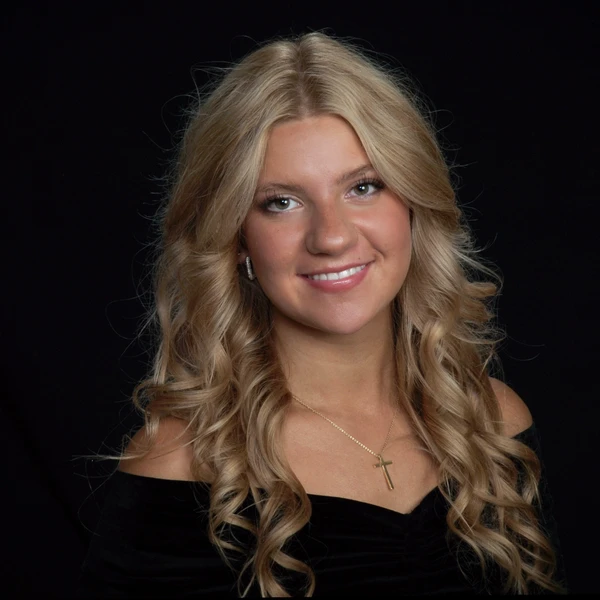
Hobbies and interests
Acting And Theater
Advocacy And Activism
Violin
Piano
Music Composition
Orchestra
Band
Research
Biochemistry
Biology
Neuroscience
Science
Running
Soccer
Snowboarding
Hiking And Backpacking
Bible Study
Church
Reading
Songwriting
Writing
Poetry
Choir
Singing
Public Speaking
Exercise Science
Spending Time With Friends and Family
Speech and Debate
Studying
Reading
Action
Academic
Science
Christian Fiction
Contemporary
Christianity
Classics
Romance
Historical
Novels
Music
I read books multiple times per week
Mackenzie Turner
1x
Finalist
Mackenzie Turner
1x
FinalistBio
I am a dedicated student with a passion for creative problem-solving and a strong interest in nuclear engineering. Through my involvement in music, student government, and community service, I strive to be both a thoughtful leader and a collaborative team member. I enjoy helping others learn and grow, and I regularly tutor peers to share my enthusiasm for STEM and the arts. Whether I’m leading an initiative, performing on stage, or volunteering in my community, I bring curiosity, discipline, and heart to everything I do. I am seeking scholarship opportunities that will support my academic journey and empower me to make a meaningful impact in science and society.
Education
Faith Christian Academy
High SchoolMiscellaneous
Desired degree level:
Doctoral degree program (PhD, MD, JD, etc.)
Majors of interest:
- Biochemistry, Biophysics and Molecular Biology
- Chemistry
- Neurobiology and Neurosciences
- Nuclear Engineering
Career
Dream career field:
Mechanical or Industrial Engineering
Dream career goals:
Apply principals of physics and research to contribute to efficient energy production via nuclear engineering.
Hostess/Order Coordinator
Family Owned Restaurant2023 – 20241 yearServer
Living Branches2024 – Present2 yearsBook Keeper
GT Automotive Center2022 – 2022
Sports
Snowboarding
Intramural2016 – Present10 years
Track & Field
Varsity2021 – Present5 years
Soccer
Varsity2012 – Present14 years
Research
Neurobiology and Neurosciences
Pennsylvania Junior Academy of Science — Researcher2021 – 2022
Arts
School Theater Departments
ActingThe Sound of Music (Junior), The Sound of Music (Full), The Lion, the Witch, and the Wardrobe, Wrangler Ranch, The Secret Garden, The Little Mermaid, Leaving Iowa, A Christmas Carol2017 – PresentSchool Choir Department
Music2022 – PresentSchool Orchestral Department
Music2022 – Present
Public services
Public Service (Politics)
Faith Christian Academy Student Council — Treasurer2024 – PresentAdvocacy
Faith Crusaders — Co-Founder and Leader2023 – Present
Future Interests
Advocacy
Volunteering
Kalia D. Davis Memorial Scholarship
When I learned about Kalia D. Davis, I felt more than admiration, I felt kinship. Her resilience, compassion, and quiet determination reflect qualities I have tried to cultivate in my own life. Like her, I’ve learned that striving for excellence often begins in the space between hardship and hope. Her legacy is a reminder that life’s fragility makes every moment, every opportunity, profoundly sacred.
When I was younger, I learned that truth firsthand. I had an accident that changed everything. I was snowboarding when I fell from a cliff. It was catastrophic blur of ice, speed, and gravity. In an instant of exhilaration turned to silence. I ended in a hospital with a bruised spinal cord and a severe concussion. In those first days, I didn’t understand permanence, but tie seemed to stop when I was told I may never walk again. I remember staring at my legs, willing them to move, realizing that something as simple as standing could no longer be taken for granted.
The months that followed were filled with physical therapy, frustration, and small victories. I had to relearn how to walk, how to balance, how to trust my body again. Each step was its own milestone, sometimes celebrated with tears, sometimes with laughter. It was humbling to start over, but in that process, I discovered how precious motion and life itself really is.
I often think about how many people never regain what I was lucky enough to recover. That thought grounds me. My story is not about strength alone; it’s about gratitude. I was given a second chance, and I feel a deep responsibility to honor it fully. So I dance. I perform in theatre. I run. I live in color, because to move freely again is its own kind of joy. Each day, I carry with me the quiet memory of hospital halls and the steady voice of nurses cheering me on.
Academically, I’ve brought that same perseverance into my studies, pushing myself to excel with both humility and purpose. I plan to study nuclear engineering, as I’m drawn to the balance it holds between power and restraint, creation and control. The science of energy fascinates me because it mirrors life after recovery: even from pressure and fracture, something luminous can emerge.
Kalia’s commitment to excellence and compassion reflects everything I hope to embody. Like her, I want to combine achievement with empathy, serving others while striving to be my best self. This scholarship would not only relieve the financial strain of college but also remind me why I work so hard: to live with gratitude and to give back in ways that reflect the blessings I’ve been given.
Every motion I make, every goal I chase, is a tribute to those who didn’t have the same chance to heal. I move for them. I learn for them. And like Kalia, I want to make every step forward a reflection of resilience, kindness, and joy. It’s a legacy not of perfection, but of purpose.
Valerie Rabb Academic Scholarship
The world taught me its complexities early. Before I understood equations or energy, I understood fear. Despite parents who poured bounds of love and protection into me, the world still found cracks and crannies to slip into that nobody could have prevented. I grew up learning how silence can be both a shield and a prison, how trust can turn to betrayal so quickly it leaves you questioning what love truly means in the presence of sexual abuse.
When I was fifteen, that silence became unbearable. I was raped by an older student who I had trusted, who had said they cared for me, and the weight of that violation crushed every part of me that believed I had control over my own story. I didn’t move from my bed for days. I didn’t eat or drink. I disappeared inside myself. There was no sense of strength or bravery, just numbness.
But pain, I discovered, doesn’t vanish quietly. It demands transformation. When I finally returned to life, I carried invisible scars but an unexpected clarity. If I couldn’t undo what had been done to me, I could choose how to live beyond it. So I worked. School became the one place where effort could rewrite meaning, where discipline could be the language of recovery. I poured every broken piece of myself into learning, into proving that I could still grow despite the darkness that tried to define me.
In science, I found honesty and the kind of truth that doesn’t bend under pressure. Chemistry gave me something that the world around me often lacked: structure, predictability, reason. Nuclear science, in particular, drew me in because it reflects the paradox of destruction and creation. From extreme conditions comes energy; from decay, renewal. In that way, nuclear engineering felt strangely personal, it mirrored how survival can be its own act of transformation.
I now hope to contribute through this field by developing sustainable nuclear technologies that bring light to communities and protect our planet. My motivation isn’t only academic, but it’s human. The same resilience that helped me endure inspires me to help others thrive. Nuclear energy has so much power, to do good, and to do harm. The world needs dedicated people willing to harness that power for ca clean and safe infrastructure. Likewise, our most defining moments hold that same power,for transformation or destruction. I want survivors to see that our experiences do not strip us of worth; they deepen it. We do not need to be victims written by circumstance but victors rewriting what strength means.
I am only one story among millions, but I carry mine with hope. What once silenced me now propels me. Life begins amid chaos, yet I have learned to create light from it, to turn something broken into energy that moves the world forward.
InnovateHER Engineering Scholarship
Leadership, at its best, is an act of service; an invitation to listen, guide, and cultivate growth rather than to command it. My most meaningful experiences have emerged not from the authority a title grants, but from the quiet trust built through shared purpose. In high school, I learned to lead by fostering spaces where curiosity, conviction, and collaboration could thrive, whether through faith fellowship or student governance.
As the leader of a student fellowship group, I sought to create an environment where open dialogue about faith was not only permitted but encouraged. Many of my peers approached spirituality cautiously, uncertain whether their questions would be welcomed. I wanted our group to be different, to make inquiry a form of devotion rather than doubt. We began each meeting not with answers, but with questions that challenged us to think deeply: about conscience, truth, and compassion. Over time, these conversations transformed the group from a small assembly into a community defined by intellectual openness, the pursuit of truth, and genuine care. The most rewarding moments were not the times I spoke, but when others felt free enough to speak honestly, regardless of their religion, faith, or curiosity. In that setting, leadership meant relinquishing control so that others could find their voice.
My role as student council vice president demanded a different kind of leadership. It was organizational, strategic, and public-facing. Whereas fellowship leadership required introspection, student government demanded initiative and decisive action. I coordinated service projects, organized school events, and worked with faculty to translate student concerns into policy changes. Each endeavor reminded me that governance depends on empathy and the ability to perceive diverse needs and pursue solutions that serve all. I learned to balance diplomacy with determination, articulating consensus without sacrificing conviction. Through this, my understanding of leadership matured: it is not dualism between authority and humility, but an ongoing harmony between the two.
In the future, I hope to carry those lessons into my pursuit of engineering; a field that inherently bridges human aspiration with material reality. Engineering, at its most profound, is communal work: it shapes infrastructure, influences environmental stewardship, and uplifts the living conditions of society. As a nuclear engineer, I aspire to advance sustainable energy systems that reinforce both safety and accessibility. My vision is not limited to technological innovation, but to social responsibility by ensuring that energy, the lifeblood of modern civilization, becomes cleaner and more equitable.
I also hope to bring ethical clarity into engineering discourse. The questions about purpose and responsibility resonate deeply within scientific contexts. Technology, for all its power, remains morally neutral until guided by conscience. I want to engage in that dialogue: designing energy solutions that respect creation, and mentoring others to approach scientific progress with integrity. In this way, engineering becomes not just a career but a continuation of leadership rooted in empathy, reflection, and stewardship.
Both my leadership experiences, spiritual and institutional, have taught me that the most enduring impact begins with understanding people in their complexity. My aim as an engineer is to extend that understanding into the realm of energy and technology, where precise equations meet shared humanity. Through innovation grounded in ethics, I hope to strengthen the communities I serve, illuminating pathways toward progress that are both sustainable and just.
William L. Keltz Engineering Scholarship
Ever since I first discovered how the smallest components of matter could produce the largest forces imaginable, I’ve been fascinated by energy, and not only the kind that splits nuclei but also the kind that drives people to question, build, and transform the world around them. Pursuing engineering feels like the natural extension of that fascination: it’s where creativity meets precision, and where curiosity becomes action.
My interest in nuclear engineering began with a simple question: How does our world run? This question grew into a driving force during my high school years as I explored chemistry and physics, often staying after class to discuss atomic structure or radiation shielding with my teachers. I was curious about this force that powered my home, my life, our infrastructure. Laboratory experiments like mixing solutions, measuring half-lives, analyzing reaction rates gave theory a sense of urgency and reality. I realized that science isn’t static information; it’s an evolving dialogue between imagination and data. That realization solidified my desire to pursue an engineering path centered on discovery, responsibility, and innovation.
Beyond the classroom, my experiences in music and theatre have shaped how I think as an engineer. Performing in musical productions taught me the value of harmony not just in sound, but in teamwork. Leading a section in choir or coordinating timing in a performance mirrors the collaboration necessary in engineering. I was taught that each voice (or perspective) matters, and precision determines success. The performing arts also trained my creativity and resilience: every show required problem-solving under pressure, quick adaptation, and fine-tuned communication. These traits, I’ve learned, are equally essential in engineering.
Service and leadership during high school have further defined how I hope to apply my technical skills. Working at an elder care facility, I saw firsthand how technology could enrich lives. I experienced tech from improved medical devices to energy systems that keep facilities safe and efficient. It made me realize that engineering is ultimately a human-centered profession. Whether through designing sustainable reactors or optimizing power grids, I want my work to expand access to energy while protecting the environment and improving daily life. To me, the equations and reactors aren’t ends in themselves; they’re expressions of empathy powered by physics.
Faith has also guided the ethical dimension of my engineering interest. Believing that creation reflects order and purpose, I see scientific exploration as both a responsibility and a privilege. It calls for stewardship by using knowledge to repair, not to harm. That perspective inspires me to approach engineering decisions with integrity, especially in fields like nuclear science where public trust is crucial.
As I prepare to enter college, I know that the curiosity, discipline, and creativity I’ve nurtured in high school will anchor my next steps. Engineering isn’t just a career path; it’s a calling to solve problems that outlast our own generation. By combining scientific rigor with human understanding, I hope to contribute to an energy future that is cleaner, safer, and filled with possibility.
Nick Lindblad Memorial Scholarship
Music has been the pulse of my high school life. When I first joined the music program as a freshman, I didn’t feel that rhythm. Music seemed more of a chore than a passion, a series of notes played without purpose that I did for a resume. But my director, Mr. Arvelo, saw something in me that I couldn’t yet see in myself. He taught me to conduct, to explore music, and most importantly, to understand my worth as a musician. Under his guidance, I began to see music as more than sound but as emotion, storytelling, and connection through a repitoire.
By my sophomore year, that lesson took on new meaning. That winter, Mr. Arvelo traveled to his home country, the Dominican Republic, to visit family. What was meant to be a short trip turned into an emergency three unexpected months abroad. The man who had given me guidance, direction, and purpose suddenly had to leave his band, his choir, his entire department under my partial command as student director. That included conducting and helping in middle school classes and in the high school choir and symphony orchestra. It was a responsibility that tested my every ounce of patience, adaptability, and courage. I devoted countless hours to rehearsals, motivating others, and holding a space of focus. It was exhausting, but deeply fulfilling. When Mr. Arvelo returned, I realized that I hadn’t just kept the program afloat, I had grown into the role he had unknowingly prepared me for.
That experience redefined what music meant to me. I began to see its purpose not in perfection, but in connection. Conducting, teaching, and leading showed me that music could move people, and that I could play a part in that movement. It gave me a sense of meaning I’d never known before.
But during that same year, my world quietly collapsed. My sophomore year was also the year I was raped. The experience shattered my sense of safety and identity, leaving me silent and unsure as the weight and ramifications rained down. The stage that had once felt like home became a reminder of how drastically my life had changed. For a time, I thought I’d lost my voice entirely. But when I couldn’t speak, I turned to music once again.
The nights were hard. When I couldn’t sleep, I reached for my guitar. At first, I’d strummed to quiet my thoughts. Soon, I started composing music in raw, wordless melodies that expressed emotions I couldn’t bring myself to say aloud. Through those late nights, my guitar became my safe place. Writing music turned into a dialogue with my own healing, a way to make peace with what had happened without letting it define me.
I kept those songs private, but they built my confidence piece by piece. Composing became the foundation of a new skill set that translated into all my other instruments. It eventually inspired me to learn music production and create art that tells stories of strength and resilience.
Looking back, I see that music did more than shape my high school years. It saved them. It saved me. It gave me mentors who believed in me, students who inspired me, and a reason to keep moving forward. Through every rehearsal, every trembling note, and every song written in the dark, I rediscovered my voice.
Music taught me that suffering and growth coexist. It became my way to speak, to make a difference, and to remind others that even pain can find harmony when given the chance to be heard.
Matthew E. Minor Memorial Scholarship
I gingerly walked into the music room on my first day of high school with trembling hands and a silent prayer begging to belong. I didn’t know a single face. What I did know was that music could speak when I couldn’t. But the moment I left those four walls, I felt the weight of judgment: stereotypes about music and theater, silent hierarchies, whispered comments. That day, I promised myself no one else would ever feel that way if I could help it. Later on, as student director, that promise became my mission. I would make our music room more than a class, but a refuge, where every student in middle and high school, regardless of skill or background, belongs.
As I’ve grown throughout high school, I’ve come to understand that leadership isn’t about being in charge but it’s about making space for others to shine. Whether as a student council officer or as the founder of a student-led service organization; I’ve focused on creating opportunities for connection, fellowship, and belonging. In my theater department, I strive to lead not just as a lead performer or dance captain, but as someone younger students and peers can look to for encouragement and support. Onstage, I make sure every cast member knows they’re essential. Similarly to life, in a show every role matters.
Over the years I also learned the sacrifices my parents made to support my growth develop and keep me safe in the world. From an early age my twin brother were taught how valuable each and every life was. Additionally, they instilled a sprit for contributing a meaningful impact on an uncompassionate world. Through my parents example of perseverance and devotion to our family, they taught us that through determination and hard work, you can build a fulfilling life from nothing. As both my twin brother and I are now pursuing college at the same time---our family’s financial resources are stretched thin, and our family's financial burden has doubled. I am applying for scholarships in hope that I can focus entirely on my education and leadership. This support would be seen not only as a charity, but as an investment in someone committed to giving back.
One can notice that a vital issue young people face is our safety. We not only face abrasion from others in school or public, but from the supposed comfort of our homes. While the online world has the capability for connection, it leaves kids and teens vulnerable. After witnessing bullying in the hallways and on screens, I have taken up an active role in supporting expression instead of seclusion. To create safe havens of inclusion for students I ran multiple Instagram and TikTok pages representing different school organizations. Through our theatre department's accounts I encouraged laughter, connection, and a myriad of perspectives. Additionally, I co-founded a student-led organization that united high school students across all grades and social groups. We shared a common goal was to create a refuge where we could all be seen and appreciated. This initiative quickly branched out into other friend groups, and quickly grew an online presence. Suddenly, widespread encouragement was shared and a beautiful conglomeration of diverse students was created that reached outside of our school's walls.
What I carry forward is through leadership and a belief in the worth of everyone, I’ve worked to build spaces where people feel heard and empowered---just like I once hoped to feel. With support, I know I can continue this mission through higher education and beyond, making a lasting impact on others, just as so many have done for me.
David Foster Memorial Scholarship
The first thing I remember about that audition wasn’t the spotlight. It was the way my heart pounded like it was trying to outrun the moment. I had spent months preparing, convinced this was the key to the music scholarship I’d dreamed about at my dream prep school. The stage had always felt like home. But halfway through the piece, I caught the music director’s expression shift. Her warm gaze narrowed. I felt the hope drain from the room. Worse, I started to believe I hadn’t deserved that future in the first place.
I walked off without the dignity to even hold my tears back. I didn’t get the scholarship or into the prep school I had longed to attend. I believed that moment had shut the door on my future in music, which was the cure to any pain i had suffered in my childhood.
So I gave up. I followed my brothers to a small private school. Music felt like a closed chapter. Still, some part of me; maybe stubbornness, maybe hope pushed me to sign up for symphonic band and choir. A last-ditch effort to reconnect with a piece of myself.
That’s how I met Mr. Arvelo.
He stood in front of the band room on my first day with a gentle smile and a keyboard at his side. I barely had the courage to play or sing. I expected judgment. Instead, he offered space to experiment, to mess up, to grow. He believed in our potential before we had proven anything. That terrified me.
At first, I lived in fear of the next mistake. Every wrong note felt like confirmation that I didn’t belong. I worked endlessly, not to improve, but to avoid failure. I couldn’t stand the thought of seeing that look of disappointment again. But Mr. Arvelo didn’t flinch when we stumbled. He encouraged risk-taking over perfection. Slowly, my hands stopped shaking and started expressing. I began to feel joy again and not in being flawless, but in making music.
One afternoon, after a particularly rough rehearsal, he asked to speak with me. I braced myself for critique. Instead, he offered me the role of student director.
I was stunned. I hadn’t felt like a leader, I still didn’t. But his offer forced me to reconsider everything I thought I knew about success. I realized my worth wasn’t in never messing up. It was in how I responded when I did.
Taking on that role changed everything. I began leading middle and high school ensembles. I studied conducting and learned how to guide others while continuing to improve myself. For the first time, I wasn’t performing to prove anything. I was creating something with others, something honest, imperfect, and meaningful.
My path hasn’t followed the trajectory I imagined. I didn’t end up at the dream school, and I’m glad I didn’t. Because what I found instead was far more important: the understanding that failure isn’t the opposite of progress but it’s part of it. That growth often hides behind the moments we want to run from. That the right mentor, at the right moment, can remind you who you are when you’ve forgotten.
I no longer measure my success by perfect auditions. I measure it by how I lift others up, how I keep showing up, and how music continues to shape the way I live and lead. And while the spotlight may not always shine my way, I’ve found where I truly belong: in the music, in the process, and in the quiet confidence that I’ve built something real.