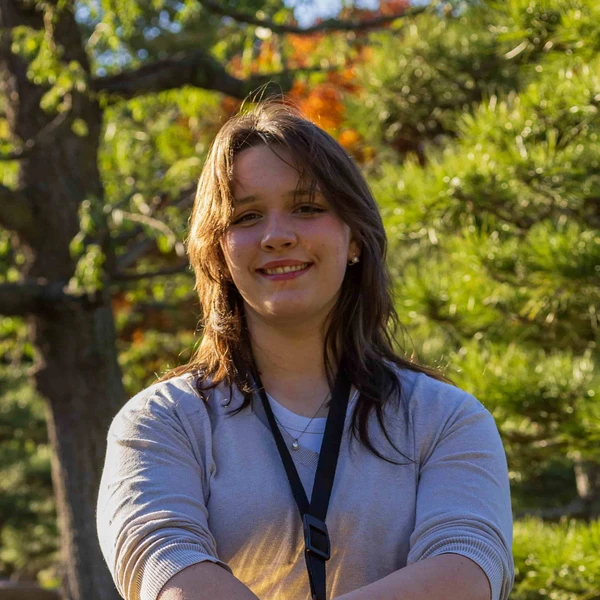
user profile avatar

Lyra Butoi

1x

Finalist

Bio

Hi! My name is Lyra Butoi, and I will attend the University of Minnesota Twin Cities to major in Computer Engineering. I am in marching band, jazz band, Science Olympiad, and my school's National Honor Society organization. I enjoy programming and circuits, playing the bari sax, volunteering, drawing and painting, crocheting, and playing video games in my free time! I want to become a firmware engineer after I graduate college.

Education

University of Minnesota-Twin Cities

Bachelor's degree program
2025 - 2030
  • Majors:
    • Computer Engineering

Eagan Senior High

High School
2022 - 2026

Miscellaneous

  • Desired degree level:

    Bachelor's degree program

  • Graduate schools of interest:

  • Transfer schools of interest:

  • Majors of interest:

    • Computer Engineering
    • Computer Science
  • Not planning to go to medical school
  • Career

    • Dream career field:

      • Computer Software
    • Dream career goals:

      Develop medical products that improve patients' quality of life

    • Center Referee and Sideline Referee

      Southside RefereesLLC
      2023 – Present3 years

    Sports

    Swimming

    Club
    2017 – 20214 years

    Soccer

    Junior Varsity
    2021 – 20254 years

    Research

    • Marine Sciences

      Zooniverse - Dolphin Spotting — Volunteer
      2025 – Present

    Arts

    • Eagan High School Bands

      Music
      School concerts, Halftime shows, ENCORE! 2025 & 2026, Frozen 2025
      2022 – Present

    Public services

    • Volunteering

      National Honor Society — Volunteer and organization member
      2024 – Present

    Future Interests

    Advocacy

    Volunteering

    Entrepreneurship

    StatusGator Women in Tech Scholarship
    During my junior year of high school and after months of my friends convincing me to join our school’s Science Olympiad team, I attended the interest meeting. The coaches of the team guided prospective club members through all of the different science-related concepts we’ll learn, and how competition would be applied to the subjects through competitive test taking and build events. The latter specifically caught my attention, especially after they explained an event titled Electric Vehicle. The goal of EV was to create a small, battery-powered car that could traverse a specified distance as quickly as possible. However, the catch was the vehicle couldn’t be steered with a remote controller; it had to be commanded entirely by code. I was suddenly reminded of the times my father tried to teach me how to code when I was younger. I initially didn't enjoy it too much; it was difficult to conceptualize and my seven-year-old self would rather play video games than "create my own," as my father urged. However, upon hearing this new opportunity through Science Olympiad, I decided to sign up. A small team and I began to work together to learn the basics of mechanical, electrical, and computer engineering to construct this machine. We utilized skills like 3D printing, wiring circuits, using power tools, and, of course, programming. On top of struggling to fix coding bugs and mitigating broken parts, we were challenged after half our team quit mid-season. This left me in charge of writing all of the code for the vehicle by myself. I took the vehicle home regularly to ask my father for guidance. Unlike our frustrating learning sessions in the past, we worked well together and eventually solved the car’s issues. It was finally ready for competitions. During this period, my coach placed me in charge of the event as a lead, entrusting me with teaching the younger members how to build a second car for our junior varsity team. I finally understood the goal of passing on my knowledge to my younger teammates that my father strove for with me. We earned gold at the regional conference, and with our momentum, we managed to win the state competition and compete at nationals. Testing my skills on the highest stage solidified my drive to cultivate a career in computer engineering. It includes my favorite aspects from both the worlds of programming and electronics, and allows me to continue learning about my fascination with robotics; another subject I am considering minoring in. Using my skills gained from college, I want to take my career in the direction of developing products like medical devices to help improve others' quality of life and health. I would be able to combine my passion for robotics with the opportunity to help people. Lastly, especially when it comes to studying in a field dominated by men, I want my drive to inspire other girls and young women like me to pursue this kind of dream. I've had my fair share of discouraging experiences trying to convince me that I don't belong in STEM spaces because of my gender identity, but that only pushed me to prove them wrong and create that space for myself and other women. Seeing representation in this field myself, especially through my Science Olympiad team that was led largely by women, is the final important aspect that encouraged me to study in STEM. Just like my father, coaches, and women that came before me, I want to one day be that same inspiration for the generation of young scientists, engineers, and mathematicians that come after me.
    Julie Adams Memorial Scholarship – Women in STEM
    While others grew up in a household listening to discussions of politics and sports at the dinner table, the convoluted world of mathematics and science spilled from mine. My father, passionate about unfamiliar subjects like calculus and robotics, would quiz my older brother with equations and concepts. I, at the age of seven and unfortunately learning math at the second grade level, wracked my brain to keep up. To include me, my father asked me to solve an equation with a variable. I still struggled to memorize my multiplication tables, let alone fathom what solving an equation that included letters meant. My father laughed, and told me to wait until I heard that some equations don’t use numbers at all. We repeated this ritual nightly, the conversations sparking my curiosity in all things STEM. When I was in middle school, my father excitedly introduced me to coding. Instead of telling me to “stop playing video games all day,” he suggested I create my own. He set me up with a laptop, an Arduino, and a dream. After what felt like a lifetime, I managed to power an LED and command it to blink, and, as any kid with the attention span of a goldfish, decided to call it a day. When my father urged me to take on more challenging projects, I shied away. I don’t think it was because I was opposed to learning something new. Maybe, in my phase of teenage stubbornness and journey for individuality, I shunned programming simply because my father wanted me to do it. Instead of hearing him out, I began to explore my other art-related interests and dread those nerdy dinner conversations. This continued until my junior year of high school. After months of my friends convincing me to join our school’s Science Olympiad team, I attended the interest meeting. The coaches of the team guided prospective club members through all of the different science-related concepts we’ll learn, and how competition would be applied to the subjects through competitive test taking and build events. The latter specifically caught my attention, especially after they explained an event titled Electric Vehicle. The goal of EV was to create a small, battery-powered car that could traverse a specified distance as quickly as possible. However, the catch was the vehicle couldn’t be steered with a remote controller; it had to be commanded entirely by code. Upon learning this, with flashbacks of learning how to code with my father all those years ago playing in my mind, I signed up. A small team and I began to work together to learn the basics of mechanical, electrical, and computer engineering to construct this machine. We utilized skills like 3D printing, wiring circuits, using power tools, and, of course, programming. On top of struggling to fix coding bugs and mitigating broken parts, we were challenged after half our team quit mid-season. This left me in charge of writing all of the code for the vehicle by myself. I took the vehicle home regularly to ask my father for guidance. Unlike our frustrating learning sessions in the past, we worked well together and eventually solved the car’s issues. It was finally ready for competitions. During this period, my coach placed me in charge of the event as a lead, entrusting me with teaching the younger members how to build a second car for our junior varsity team. I finally understood the goal of passing on my knowledge to my younger teammates that my father strove for with me. We earned gold at the regional conference, and with our momentum, we managed to win the state competition and compete at nationals. Testing my skills on the highest stage solidified my drive to cultivate a career in computer engineering. I look back on those nights learning how to code with my father with fondness, and now greatly enjoy our nerdy dinner conversations. With this experience, I am driven to pursue a career in Computer Engineering. It includes my favorite aspects from both the worlds of programming and electronics, and allows me to continue learning about my fascination with robotics; another subject I am considering minoring in. Using my skills gained from college, I want to take my career in the direction of developing products like medical devices to help improve others' quality of life and health. It would allow me to combine my passion for robotics with the opportunity to help people. Lastly, especially when it comes to studying in a field dominated by men, I want my drive to inspire other girls and young women like me to pursue this kind of dream. I've had my fair share of discouraging experiences trying to convince me that I don't belong in STEM spaces because of my gender identity, but that only pushed me to prove them wrong and create that space for myself and other women. Seeing representation in this field myself, especially through my Science Olympiad team led largely by women, is the final important aspect that encouraged me to study in STEM. Just like my father, coaches, and women that came before me, I want to one day be that same inspiration for the generation of young scientists, engineers, and mathematicians that come after me.