
Hobbies and interests
Singing
Piano
Guitar
Flute
Music Composition
Music
Music Production
Songwriting
Writing
Journaling
Art
Acting And Theater
Business And Entrepreneurship
Choir
Painting and Studio Art
Reading
Academic
Book Club
Classics
Fantasy
Historical
Literature
Science Fiction
I read books daily
Lydia Wendell
1x
Finalist
Lydia Wendell
1x
FinalistBio
Class of 2026
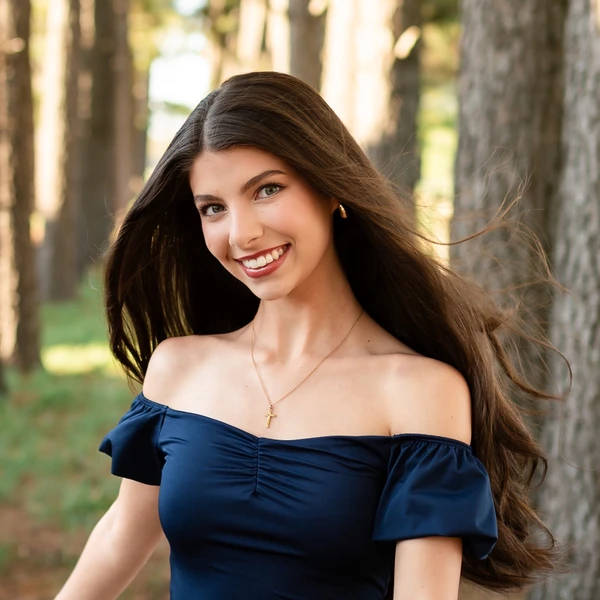
My name is Lydia Wendell, and I’m an aspiring composer. Music has been my passion since I was old enough to reach the piano bench, and now I’m looking to study music composition or commercial music to pursue a career in songwriting. My dream is to create unforgettable music that impacts and inspires my listeners.
Education
Homeschooled
High SchoolMiscellaneous
Desired degree level:
Bachelor's degree program
Majors of interest:
- Music
- Entrepreneurial and Small Business Operations
Career
Dream career field:
Music
Dream career goals:
Composer
Piano Accompanist
Trinity Grace Church2023 – Present3 yearsLive Event Piano Performer (weddings, galas, etc)
Self-employed2024 – Present2 yearsPiano Teacher
self-employed2024 – Present2 years
Sports
Pickleball
Intramural2025 – Present1 year
Track & Field
Club2024 – 20251 year
Arts
Self-taught
Painting2024 – PresentASMTA Sonata Festival - "Superior Plus" Rating
Music2023 – 2026MTNA State Level Composition Competition Winner
Music2025 – 2025ASMTA 1st Place State Winner
Music2024 – 2024Grace Classical Co-op - Lead Roles
Acting2025 – Present
Public services
Volunteering
Camp Invention — Intern2022 – 2024Volunteering
Beautiful Live Thrift Boutique — Volunteer2023 – PresentVolunteering
Camp Barnabas — "Barnstormer"2022 – 2022
Future Interests
Entrepreneurship
Dan Leahy Scholarship Fund
“She’s going to grow up to be the dictator of a small country!”
My parents voiced this concern to each other in hushed voices as I took command of –or rather, terrorized– every group of young children. They didn’t tell me this, of course, until I was old enough to have outgrown my dictatorial tendencies. As a kid, I was bright, manipulative, and bossy. I was that kid. I wasn’t spoiled –no, my strict Cajun mother made sure of that– but that didn’t stop me from being a holy terror. I had to grow up, mature, and endure some tough times to learn some much-needed soft skills. It took growth in every area to go from “terrifying little dictator” to “pleasant, mature leader.” It also involved stepping out of my comfort zone in speech and debate, as well as the loving influence of my mother.
The first thing I needed to work on was communication. Don't get me wrong– I was very comfortable communicating. Loudly. The issue was that I couldn’t communicate well. My whole leadership philosophy was “Look at me! I know what I’m doing, so you should listen to me!” Most of the time, people don’t take that very well. I remember my mom telling me, “Lydia, the only way you can make people do what you want them to do is by making them want to do it.” Contrarian that I was, I racked my brain to find an example where that didn’t hold true, but she was right. No one will listen to you unless you give them a good reason to. That’s where Speech and Debate came in, teaching me to communicate persuasively. I noticed that the students who came across as self-absorbed and prideful rarely won, regardless of the quality of their debates. I found that a lack of humility instantly undermines your trustworthiness. I learned to think critically, put those thoughts into words effectively, and present them with confidence and a smile.
No-one pushed me further or gave me more confidence than my mother. She made it her mission to give me the best education possible, and that meant educating herself on how to best do that. Growing up, I watched her read stacks of books about the mind, behavior, and growth. She set an example of someone who is always learning; She is both a student and a teacher.
Still, a sharp mind devoid of empathy leads right back to the dictator mindset I started with. As a kid, my lack of care for others was a huge concern of my mother’s, and i is looking back, I can see why. Thankfully, though, we humans are not stagnant beings. Especially in our youth, we’re capable of tremendous growth. I became an emotionally intelligent person because of my patient mom, and I learned to communicate those emotions with the help of speech and debate.
In a few months, I’ll turn the page to the next chapter of my life. I earned one of the highly competitive spots in Baylor University’s music composition program, and I hope to hone both my musical and interpersonal skills there. Through effective communication, collaborative leadership, and an abundance of empathy, I hope to make a positive impact on my community. In my career as a songwriter, producer, and entrepreneur, these skills will prove invaluable. I want to bridge emotional experiences, bring wildly different people and genres together, and create uniqueness and depth. In case you were wondering, my family no longer worries about me becoming a dictator. Now, they believe I’ll change the world for the better.
Valerie Rabb Academic Scholarship
Behind every treasured song, whether that’s a string quartet or a pop ballad, is the invisible composer. They tend to be the last thing we think about when listening to a piece of music– we’re distracted by the singer or perhaps the instruments. However, without composers, there would be nothing to sing and nothing to play. For me, songwriting is an outflow of emotion. It’s a way to communicate what words can’t. Music has the power to comfort those who are hurting, empower those who need confidence, and transport you to another time and place. Composers like me capture those emotions in musical notes, so they can be felt by those who need them most.
Music helped carry me through pain and weakness. I was twelve when POTS symptoms turned up, and as I aged, they broadened into Dysautonomia. It’s a weird medical condition with weird effects; I worried the doctors wouldn’t believe that I became blind with sparkles and static, or that I can’t sleep because the world is shrinking and expanding. As I neared sophomore year, my ocular migraines were so severe that I became bedridden for days. I wondered how I would keep up with my studies and my musical passion. Physics class was the first to go, and as an academically driven student, I was crushed. Would I have to drop out of my other classes, too? How would this affect my GPA? If I don’t qualify for merit scholarships, will I even be able to afford college?
There was only one thing to do. I had to learn how to work with my body, instead of against it.
My two biggest takeaways seem contradictory at first. First: I can do hard things. My circumstances are not an excuse. Change-makers throughout history have dealt with much worse than I have, and they didn’t let it stop them. Second: there’s no shame in resting. I can work twice as hard when I feel well, and I can rest twice as hard when a migraine hits. The two are not mutually exclusive; after all, life is more than constant productivity. That’s why it’s so important to find balance. I’ve found mine despite my health; I've found a balance that allows me to hone my musical talents and academic prowess while prioritizing health and rest.
Even when my health was at its worst, creativity brought me joy. Like me, people are hungry for uniqueness and creativity in music. Perhaps they want what feels human in the midst of a world changed by AI, or maybe they’re just tired of repetitive pop songs with the same four chords. Either way, I want to write music that fulfills that desire for originality and freshness. I want to capture human emotion in a way that heals and comforts. I want to combine wildly different genres and bring together wildly different people. Maybe I can bring a little more beauty into the world– a little more magic.
David Foster Memorial Scholarship
“Poop on their heads!”
I hear this often, coming from the over-caffeinated lips of my eccentric piano teacher. It’s just one of her many unusual phrases; phrases that leave me thinking, “This woman does not care what anyone thinks.”
Mrs. Treese found me halfway through high school and changed everything. I’ve had every stereotypical piano teacher, from the strict one who whacked my fingers when they weren’t curved to the too-sweet lady who would rather me not compete to avoid hurt feelings. Nobody has come close to Mrs. Treese.
Piano was my first love. As soon as I could reach the piano bench, I was up there trying to play (an extremely simplified) Pachabell’s Canon. But strange as it sounds, I didn’t think of myself as truly talented until Mrs. Treese banged me over the head with it. It was a confidence deficit, and if there’s anything Mrs Treese knows about, it’s confidence.
Barely a month after our first lesson, she plopped Gershwin’s First Prelude in front of me. “I think you should play this for the ASMTA competition,” she stated. “You’re gonna love it.”
She was right. I did love it. Small problem– the competition was in just two months, and Gershwin had the biggest hands known to man. My small hands could barely stretch to all the notes this long-fingered genius played with ease. I knew –or thought I knew– there was no chance of winning, especially in the advanced level she’d put me in.
That’s the thing about Mrs. Treese, though. She fully, genuinely believes you can do whatever you set your mind to. That shows up in her community impact; she finds ways to bring music and joy to everyone. She has this way of encouraging you with an almost angry, sarcastic tone, like she’s frustrated that you can’t see what she sees. “You’ll be fabulous!” with a growl. “You’ll blow their minds,” with a glare. With a tight squeeze, she sent me spinning out of my comfort zone. And, as you might’ve guessed by now, it paid off. The regional competition led to the state competition, which led to a first-place medal, and many more followed.
Now, at the end of senior year, I no longer need her to push me out of my comfort zone. I’ve sent in my compositions to national competitions and music conservatories. Next year, I will study at Baylor, Mrs. Treese’s alma mater, where I earned one of the few music composition spots. I even started my own piano studio, and she guided me in teaching my own students. “It’s not just about the instrument,” she told me. “Really, it’s about relationships.” She has no idea how much I felt that in my core, because it’s not her fingering or the theory that changed me. It’s the relationship she built, the confidence she instilled, and the encouragement she shared.
“Just play your best!” I hear her say. “And if they don’t like it, poop on their heads!”
Nick Lindblad Memorial Scholarship
For lunch, I’d have Beethoven. For dinner, some Cecelia Bartoli or Miles Davis. Breakfast might involve waking up to Broadway soundtracks from old musicals. Growing up, I never realized that my parents'menu of music was a bit… unique. I owe a lot to the depth and variety of music I was exposed to as a child– it shaped me as a person, a pianist, and a composer. High school, however, was when I began taking control over music’s influence in my life. Every chapter had its own soundtrack, and each one is representative of my evolution as a person.
Due to my parents –huge, lovable dorks, if you hadn’t already noticed– I wasn’t exposed to pop music until freshman year. Like most freshmen, I was new to having ownership over myself. As I explored my own identity, I realized I don’t have to just listen to what my parents like. My first foray into pop involved 21 Pilots, Imagine Dragons, and One Republic. It’s an era I look back on with laughter, but it was the first step in refining my own voice and taste. Sophomore year was similar; I found popular music like Dua Lipa and Taylor Swift that gave me a sense of belonging and connection with friends, at least for a little while. However, this set the stage for an important shift. I was yearning for authenticity.
It was time to reconnect with my roots. I remember outlining my family tree for a school project, tracing those branches back to New Orleans, the birthplace of jazz. I was missing the depth and complexity of the music I was raised on. As I matured, I gained a greater understanding of the emotional power music holds– how it can be used to communicate emotion, culture, and unity. That’s when sparks lit up inside me, and I decided I wanted to be the one bringing that unity through music.
Senior year is when I truly discovered my passion for innovation, originality, and sheer creativity in music. I love the jazz and classical styles now more than ever, but I don’t want to just copy them. Songwriter and singer RAYE may have rocked my world a little bit with her record "This Album May Contain Hope." The fusion of orchestral and pop, Broadway and EDM, vintage and modern– it sparks so much joy. Worlds collide in jaw-dropping ways, and I love it. Similarly, I fell in love with Laufey’s modern take on classical, bossa nova, and jazz music, and Harry Styles' most recent experimental pop. Some of the most amazing music, I realized, happens when you mix wildly different genres or styles. Music has a way of bringing together wildly different people, too. That’s one of my favorite things about it; it’s a shared love that creates connection and unity.
Through every era, I can trace the impact music has had on who I am. I wish I could thank each influential musician for teaching me more about myself and what I want to do with my talent and passion. As a composer, I hope to have that kind of impact on future generations. I want to write music so raw and authentic that it helps young people find their voice. I want to write music so joyful and complex that it brings people together. I want to take inspiration from musicians throughout the ages to create something innovative, emotional, and unique.
Robert and Suzi DeGennaro Scholarship for Disabled Students
Clunk!
I passed out again. It was a few minutes before my mom found me on the floor, and my vision wasn’t back yet.
I was twelve when POTS symptoms started showing up, but for a while, we thought I was just… weird. Passing out was a part of daily life, and “Alice in Wonderland” symptoms kept me up all night. (I know, it sounds made up!) It wasn’t until I started having debilitating ocular migraines that the cardiologist told me this was bigger than POTS – it was Dysautonomia. It explained a lot– the migraines that blind me, my complete inability to regulate temperature, and the serious weight loss that officially put me in the “malnourished” category. As I neared sophomore year, my ocular migraines were so severe, I became bedridden for days. I felt crazy, and I wondered how I would keep up with school. Physics class was the first to go, and as an academically driven student, I was crushed. Would I have to drop out of my other classes, too? How would this affect my GPA? If I don’t qualify for merit scholarships, will I even be able to afford college?
There was only one thing to do. I had to learn how to work with my body, instead of against it.
My two biggest takeaways seem contradictory at first. First: I can do hard things. My circumstances are not an excuse. Change-makers throughout history have dealt with much worse than I have, and they didn’t let it stop them. Second: there’s no shame in resting. I can work twice as hard when I feel okay, and I can rest twice as hard when a migraine hits. The two are not mutually exclusive; after all, life is more than constant productivity.
So although I still deal with the dizziness, discomfort, and danger, I choose to live with joy and intentionality. I am not crazy, and I am not weird. My health struggles have helped me become the passionate, empathetic person I am today. That’s why, even when I’m in pain, I feel no bitterness. I’ve found my balance, despite my health. I can confidently say that my circumstances don’t define me; my actions do.
Knowing this, I put my all into studying and applying for colleges. However, when I got accepted into my dream school, Baylor, I felt no excitement. Why would I? Tuition alone is 67K a year. My parents saved what they could for my college, but it would hardly make a dent in one year at Baylor. The academic scholarships they gave me, however, sparked a little hope. Maybe, if I work during college and write scholarship essays like it’s my job, I could make it happen.
My mom is not so sure. She’s already worried about me going away, given the state of my health. “What will happen on the nights where you wake up in pain, ready to pass out? Who will take care of you?”
I’m confident I'll be able to find good friends who will care for me when I'm sick, but college debt is a harder problem to solve. Private scholarships like this one are the only way I could graduate from my dream school without thousands of dollars of debt.
Even so, if there’s anything I’ve learned these past few years, it’s that I can overcome huge obstacles. I will continue to face them my whole life, so I’m determined to meet them with joy and determination.
RJ Memorial Scholarship
"Jesus paid it all,
All to him I owe.
Sin had left a crimson stain–
He washed me white as snow."
These lyrics bring a powerful memory to my mind. I’m standing in a room filled with believers. Our faces are turned to Heaven, eyes closed, tears running down our cheeks. For the final chorus, every instrument stops playing and we sing acapella. All I hear is voices in unison, praising God for his mercy, and I think, “I owe Him everything.”
Music has a way of impacting us, especially music that shares the gospel message. Truths about who I am and what God has done for me are stored as melodies in my mind. When I’m overwhelmed by anxiety, fear, or pain, those lyrics come to mind and encourage me. I often think about the composers of classic hymns like “Jesus Paid it All.” Did they have any idea their compositions would bring tears to the eyes of Christians, even decades after their death?
For me, writing is an involuntary response to emotion. When I’m overwhelmed by the goodness of God, I put it in song.
When I was twelve, I had the opportunity to join the worship team at my church, playing piano. That’s quite a young age, and if I’m being honest, I was probably not ready for that. However, It was exactly what I needed. Years of leading worship created growth both as a person and a musician. Over time, I didn’t just play piano– I shared songs that I wrote.
I’ve noticed many people I know saying the same thing: We need more great worship music. We don’t have much modern worship with theologically deep lyrics. I would love to create songs that glorify God and are creative and unique– songs that soften hearts and minds. This coming fall, I will be studying music composition at my dream school, Baylor. I will study under Dr. McAllister, a gifted composer whose love for the Lord is clear in all that he does. I’m confident that I will be equipped to write beautiful music there, but since my parents can’t contribute meaningfully to my college education, private scholarships like this one are the only way for me to graduate without thousands of dollars in debt. I trust that God will provide, though. He’s the one who gifted me with music and talent, after all– I owe Him everything. Our God sent His only son to save me from my sin! The least I can do is share that message using the gifts He’s given me.