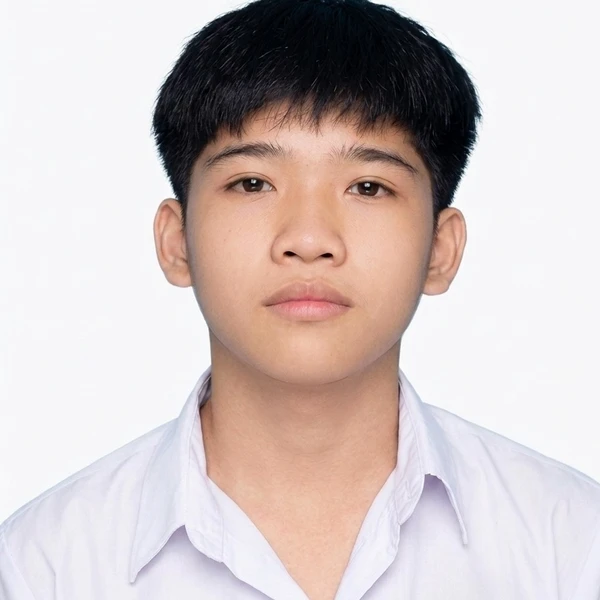
user profile avatar

Luan Tran

1x

Finalist

1x

Winner

General information

Location
Houston, TX
Gender
Male

Hobbies & Interests

  • Chess
  • Badminton
  • Swimming
  • Mathematics

Reading

  • Adult Fiction
  • Fantasy
  • Science Fiction

I read books multiple times a week.

Bio

Hi, I'm Luan Tran, and I'm an undergraduate student. My life goal is to use science and engineering to make a meaningful impact in communities. I am passionate about solving problems through analytical thinking and hands-on application, whether in the classroom, tutoring others, or working through challenges at my part-time job. I believe I am a strong candidate because I have demonstrated resilience, determination, and the ability to adapt to difficult circumstances. Learning a new language while excelling in rigorous coursework has taught me persistence and discipline. Helping my peers understand complex concepts has not only strengthened my commitment to being a leader but has also improved my communication and English skills. I am ready to bring the same dedication, curiosity, and problem-solving mindset to my future endeavors. Currently, I am an undergraduate researcher at The University of Texas at Austin under the guidance of professors.

Education

The University of Texas at Austin

Bachelor's degree program

2026 – 2030

Majors:
  • Mechanical Engineering

Klein Forest High School

High School

2024 – 2026

Miscellaneous

Desired degree level:
Bachelor's degree program
Majors of interest:
Engineering, General, Mechanical Engineering, Mechatronics, Robotics, and Automation Engineering
Desired degree modality:
Full-Time, In-Person, Hybrid, Online
Medical school interest:
No
English as first language:
No
Homeschooled:
No

Career

  • Construction laborer (part-time)

    Construction · N/A

    Jun 2024 – Aug 2024

  • Salon cleaner

    Cosmetics · Be May & CO Nail Salon Park

    Jan 2024 – Jan 2026

Miscellaneous

Dream career field:
Mechanical or Industrial Engineering
Dream career goals:
Engineering
Work experience:
1 year
Has nursing license:
No
Leadership experience:
No

Future Interests

  • Volunteering
Carlos F. Garcia Muentes Scholarship
I left my chalk-stained notebooks in Vietnam, where the air smelled dusty, and the old paper reminded me of home. In Houston, behind a nail salon counter, I faced textbooks in a language I barely knew. Still, each page I tried to understand felt like rewriting a small part of my story. I arrived in the U.S. two years ago, in the middle of 10th grade. My desk stayed quiet. My hand stayed down as questions flew. At lunch, I chose the library over the cafeteria, not for quiet, but because no one there expected me to talk. But something in me refused to quit. I rewrote my notes after every class. On the bus, I whispered new words, watching them blur past the window with every stop. Before bed, I replayed TED-Ed videos, mouthing every sentence along with the English captions, until my accent slowly changed. When I mispronounced a word, I rewound. Again. And again. After the final bell each day, my classroom shifted to a different environment: a nail salon where I worked part-time. I stacked towels, cleaned workstations, and assisted technicians. Between buzzing drills and the scent of acetone, I learned to work through the noise. I folded, wiped, and mopped while memorizing thirty new English words. I learned to read gestures when customers spoke too fast. When the stockroom was messy, I reorganized it so my coworkers could find items faster. That small act helped me notice patterns. I started using the same thinking at my cramped kitchen table at home. At home, I spread my notebooks and textbooks across the kitchen table under a dim light. The warmth from the stove kept me awake, while the sound of pans, oil popping, and cooking filled the air. Late into the night, my hands and eyes drooped in exhaustion. Still, I kept turning pages, now with a clearer purpose. Our dinner and my homework shared the same table, the same space, the same hope. One evening, while mopping, I looked at my mother’s hands, cracked from acetone and long hours of work. “Are you tired?” she asked, still painting a customer's nails. “No, I’m okay, Mom,” I said, though my body ached. Her tired smile, worn but warm, told me she knew. “Try to study hard,” she added. “Maybe you won't have to work here later.” That night, I opened my notebook again with more determination. The pages smelled of salon dust, but to me, they smelled like promise. I am pursuing Mechanical Engineering because of observations I could not stop thinking about: the way my mother’s wrist bent at the same angle for hours, the quiet tremor in her steady fingers after gripping small tools all day, and the way her shoulders carried tension like a constant load. I want to design assistive systems that adapt to workers' rhythms without erasing their skills. I won’t have to choose between technical rigor and human connection; they’re woven together, like dinner and derivatives, physics problems beside pho broth at my kitchen table. Higher education and the support from this scholarship will give me the tools, mentors, and research environment necessary to turn questions from the nail salon into technologies. My path from nail dust to notebooks isn’t over yet. Folded towels, misunderstood words, and late nights taught me: understanding was built slowly. One word. One task. One graph. And one notebook at a time. The questions I carry into engineering began in that salon, with the people I know best and the problems I learned to notice by watching them work.
WCEJ Thornton Foundation Low-Income Scholarship
I remember crouching by my neighbor's old koi pond in Vietnam, watching a toy fish move among real ones. Beneath the water, a quiet buzz hummed from its motor. I didn't know how it worked, only that I wanted to make things that move. Years later, in Houston, I still want to make “something moving.” But now, I observe different kinds of movement: my mother’s bent back under the repeated force of work, and her stiff wrist under the friction after long hours of using tools. I realized that I didn't want to fix her pain, but I needed to understand the mechanics behind it. Because, in that understanding, I felt closer to everything she gave. In the nail salon, I folded towels and wiped stations, but what stayed with me wasn’t the work; it was the motion. The way my mother’s wrist bent at the same angle for hours, the quiet tremor in her steady fingers after gripping small tools all day, the way her shoulders carried tension like a constant load. I didn’t see pain. I saw questions: What force acts here? Why does this motion wear the body down? At home, under the dim kitchen light while broth simmered on the stove, I turned those questions into free-body diagrams. My notebook wasn’t for class; it was where I tried to trace the invisible mechanics behind her silence. Later, when I used sketches to help a classmate with physics, his “Oh! I get it!” reminded me that sometimes understanding doesn’t need words, just a clear line, a balanced arrow, and a way to see how things connect. That’s when I realized, I don’t study to fix what’s broken. I study to honor what was given. Technology, at its best, is the bridge between observation and understanding, between seeing someone struggle and knowing how to help. And in mechanical engineering, I finally found the language to describe what I’d been watching all along. Looking forward, I want to focus on assistive robotics. Through research opportunities and collaboration, I can develop the foundation needed to transform observations into tested solutions. I believe in robotics not as a replacement, but as a partnership. I want to develop systems that adapt to a worker’s rhythm, that sense fatigue before it leads to injury, and that redistribute load. I want to develop technology that asks, “Does this work for the people who need it most?” instead of “Does this work?” I won’t have to choose between technical rigor and human connection; they’re woven together, like dinner and derivatives at my kitchen table, physics problems beside pho broth. Higher education will give me the tools, mentors, and research environment necessary to turn questions into technologies. This is the core of my engineering philosophy: systems that honor human dignity rather than erasing it. But technology's greatest impact isn't only in what it builds. It's in who it reaches. I want to sit quietly in nail salons, sketching their hand motions, noting where tension builds, and asking: “Does this hurt?” I’ll bring those observations back to the team, translating what I’ve seen into engineering questions we can work on and design together. I don’t aim to just solve my mother’s labor. I want to honor it by designing tools that carry her dignity as much as her work, and the workers whom engineering often overlooks. Beyond education, my commitment to creating a positive impact extends into the university community itself. I hope to create study sessions where we share sketches, not just solutions, where "Can you draw that again?" is the highest form of respect. I'll mentor first-year students, especially those navigating engineering in a new language. They don't have to eat lunch alone as I did, or stay silent when they don't understand. Years from now, I may still sit at a kitchen table with my mother. I won’t show her a new tool or a patent. I’ll show her a page filled with vectors, equations, and a single note: “This is how your motion shaped my mind.” Every arrow drawn, every labeled force will quietly echo her actions at work. Still, I study mechanical engineering not to change the world, but to honor the one who taught me to see it, force by force, motion by motion, sacrifice by silent sacrifice.
First Generation College, First Generation Immigrant Scholarship
After my shifts at the nail salon, I walked home past Houston's restaurants. Through the windows, I watched families eating together at their tables. My stomach was empty, not just from hunger, but from wondering if I'd belong. Some assumed I'd settle for labor. I doubted I could dream beyond survival. But each time I passed those windows, I stopped seeing what I couldn't have and started seeing where I was headed. Those evenings taught me to study when exhausted and keep going when everything felt out of reach. Gradually, I stopped being the one outside looking in. I used to eat lunch in the library, not for quiet, but because no one there expected me to talk. Later, I saw a classmate hovering near a study group. So I slid my calculator toward him and said, “Want to join us?” He whispered, “Thanks.” I realized that learning isn’t just understanding the equation; it’s helping someone else reach theirs. In my senior year, I was named a Jack Kent Cooke Foundation Scholarship Semifinalist. It reminded me that quiet efforts that no one sees can still matter. That was enough to keep walking. A successful college experience mirrors what I learned staring through those windows. Success is continuing forward when hungry and exhausted, but never alone. It means graduating not just with knowledge, but knowing that the best tables are the ones we build together, where everyone finds a seat, and no one stands outside the window wondering if they belong.
Luan Tran Student Profile | Bold.org