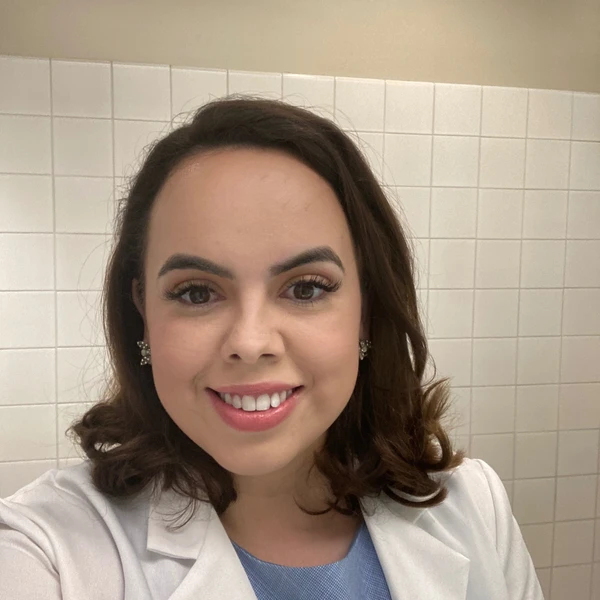
Lizbeth Alvarez
1x
Finalist
Lizbeth Alvarez
1x
FinalistBio
I am a first-generation, low-income medical student at the University of California, Davis School of Medicine and the first person in my family to pursue a career in medicine. My commitment to healthcare was shaped by both personal experience and a passion for advancing health equity.
Before medical school, I earned a Master of Public Health and served as a Graduate Health Fellow with the Congressional Hispanic Caucus Institute in Washington, D.C., where I worked on healthcare and social policy issues. These experiences deepened my understanding of how policy and healthcare access affect patient outcomes.
My path to medicine was profoundly influenced by my father's diagnosis with end-stage colon cancer. His cancer was detected late after years without adequate screening or advocacy. During his treatment, I became one of his primary caregivers while also serving as the primary financial provider for my family. Balancing caregiving responsibilities, work, and my educational goals required me to delay my entry into medical school, but it strengthened my commitment to becoming the physician I wish my father had, one who listens, advocates, and ensures patients receive compassionate, equitable care.
Through medicine, research, and service, I hope to improve healthcare access and outcomes for underserved communities while honoring the lessons my family taught me about resilience, empathy, and advocacy.
Education
University of California-Davis
Doctoral degree program (PhD, MD, JD, etc.)Majors:
- Medicine
George Washington University
Master's degree programMajors:
- Public Health
Mount Saint Mary's University
Bachelor's degree programMajors:
- Biological and Biomedical Sciences, Other
Miscellaneous
Desired degree level:
Doctoral degree program (PhD, MD, JD, etc.)
Graduate schools of interest:
Transfer schools of interest:
Majors of interest:
Career
Dream career field:
Medicine
Dream career goals:
LMSA Vot-ER intern
Vot-ER2023 – 20241 year
Research
Health Professions Education, Ethics, and Humanities
National Medical Fellowship — Medical Education Researcher and Curriculum Developer2022 – 2024Medicine
UCSF — Selected as a UCSF Emergency Medicine URM Fellow, I researched anti-Black racism in mental health emergency care, presented findings nationally at SAEM, and co-authored a systematic review published in JAMA Internal Medicine.2021 – 2021
Public services
Advocacy
Latino Medical Student Association — National Policy Chair2025 – 2026
Future Interests
Advocacy
Politics
Volunteering
Philanthropy
Entrepreneurship
Women in Healthcare Scholarship
My decision to pursue a career in healthcare is deeply personal and shaped by my lived experience as a first-generation, low-income woman navigating both caregiving and medicine. I did not come to this path through abstraction or idealism alone, but through witnessing my father’s illness and stepping into roles I never expected to hold.
My father was diagnosed with end-stage colon cancer after delayed screening and a lack of preventive advocacy. By the time we entered the healthcare system, his disease was already advanced. I became one of his primary caregivers while also serving as the primary financial provider for my family. I managed appointments, helped translate complex medical information, and tried to make sense of a system that often felt overwhelming even for me, let alone for my father as a patient.
In that period, my life narrowed to two responsibilities: caring for my father and keeping my family afloat. I delayed my entry into medical school because there was no one else who could take on those roles. While that decision was difficult, it grounded me in a reality that continues to shape how I understand healthcare, not as an abstract system, but as something that directly determines whether families remain stable or fall apart under the weight of illness.
What stayed with me most was how much depended on having someone to advocate. I saw how easily preventive care can be missed and how late diagnosis can define an entire trajectory of illness. I also saw how confusing, exhausting, and isolating the healthcare system can be for patients who are already vulnerable. I often found myself acting as the bridge between my father and his care team, asking questions he could not always ask, and trying to ensure his voice was not lost in the process.
These experiences are why I have chosen healthcare. I want to become the kind of physician I had to learn to be for my father in an informal way: someone who listens carefully, explains clearly, and advocates persistently. More importantly, I want to ensure that patients do not need a family member to compensate for gaps in communication or access. I want to be the physician who recognizes those gaps early and works to close them.
As a woman in healthcare, I also understand what it means to navigate spaces where my background is not always represented. Being first-generation and low-income has shaped how I move through academic and clinical environments. It has taught me to be resourceful, observant, and intentional about creating space for others whose experiences differ from the dominant narrative in medicine. I carry my identity not as an afterthought, but as a central part of how I understand patients, families, and systems.
I hope to make a positive impact by bringing that perspective into every space I enter, clinical care, research, and leadership. I want to advocate for earlier detection, more equitable access to care, and communication that meets patients where they are. I also want to mentor other women and first-generation students who may not initially see themselves reflected in medicine, but who belong in it nonetheless.
Ultimately, I am pursuing healthcare because I have lived what happens when care is delayed, when systems are difficult to navigate, and when families are forced to fill in the gaps. My father’s illness did not just influence my path, it defined my sense of responsibility. I am entering medicine to ensure that other patients and families are not left to navigate that experience alone.
Sharra Rainbolt Memorial Scholarship
My family’s life changed irrevocably when my father was diagnosed with end-stage colon cancer. His diagnosis came late, after years without appropriate screening or someone to advocate for preventive care. By the time his illness was identified, the disease had already progressed significantly, and what followed was a rapid transition from uncertainty to a daily reality defined by treatment decisions, hospital visits, and difficult conversations about prognosis.
As his condition worsened, I became one of his primary caregivers. I accompanied him to appointments, helped manage his medications, and translated complex medical information into decisions our family could understand. At the same time, I took on the role of primary financial provider, balancing work responsibilities with the demands of caregiving. The emotional weight of watching a parent suffer, combined with the financial strain of prolonged cancer treatment, reshaped every aspect of my life. I ultimately had to delay my entry into medical school in order to remain present for my family during this period.
What I remember most is not only the difficulty, but the responsibility. My father’s illness exposed how easily patients can fall through gaps in the healthcare system when they lack consistent access, health literacy, or an advocate to ensure timely preventive care. His late diagnosis was not only a medical reality, but also a systems failure that made me question how many other patients experience similar delays in care simply because no one is there to guide them through screening and early detection.
Through this experience, I learned that cancer is never an individual illness; it is a family illness that restructures relationships, responsibilities, and stability. I witnessed resilience in my father’s determination to continue treatment despite immense suffering, and in my family’s ability to adapt to circumstances we never anticipated. At the same time, I came to understand the fragility of financial security in the face of serious illness, and how quickly medical needs can overwhelm even the most carefully built plans.
Caregiving also taught me what it means to advocate for someone who is vulnerable within the healthcare system. I learned to ask questions when answers were unclear, to persist when care pathways were complicated, and to recognize the importance of having someone who can navigate systems on behalf of patients who are exhausted, overwhelmed, or uninformed. These lessons fundamentally shaped my understanding of what it means to be a physician.
My father’s experience with cancer is the reason I am pursuing medicine. It clarified for me that clinical expertise alone is not enough; patients need physicians who actively advocate for early detection, equitable access, and compassionate communication. I strive to become the physician I wish my father had, one who ensures that patients are not only treated, but also seen, heard, and guided through every step of their care.
Although cancer brought profound loss and hardship to my family, it also gave me purpose. It taught me resilience, responsibility, and the importance of advocacy in healthcare. These lessons continue to guide my training and will remain central to how I practice medicine in the future.