user profile avatar

Lisa Lam

2x

Finalist

1x

Winner

Bio

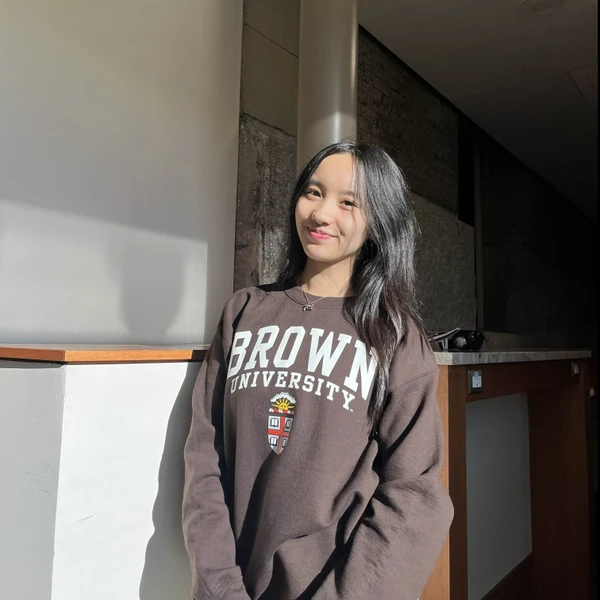
Hi, my name is Lisa, and I'm currently studying Neuroscience and Literary Arts at Brown University. I'm extremely proud to be a first-generation student at such an elite institution! I hold a firm passion and drive for healing others, whether through research, patient care, or advocacy. My life has been a series of trials and hardships, but I've learned to ride the waves of change as I glide towards my goals. As a rising sophomore at Brown University, I'm so excited to continue my education and use my experience to give back to my communities! I'm passionate about advocating for underrepresented communities due to my own background growing up without a strong Vietnamese community. As I continue on my journey into life, I know my values will continue to guide me into new waves of change and foreign paths of self-discovery. I’ve always held a deep desire to make a difference and plan to do so by deepening my understanding of the brain’s complex codes and translating its unique language. I’m drawn to neuroscience not only due to its delicate intricacies but also to its potential to help patients with neurological diseases and improve their quality of life. Just as my parents provided me with opportunities to shape my future, I want to contribute to a world where everyone is capable of living to their fullest. There is little in life that parallels the vast and uncharted frontiers of the brain, something so fascinating and wondrous that there is still so much left to discover.

Education

Brown University

Bachelor's degree program
2025 - 2029
  • Majors:
    • Literature
    • Neurobiology and Neurosciences

Greater Lowell Technical High School

High School
2023 - 2025

Leominster Trade High School

High School
2021 - 2023

Miscellaneous

  • Desired degree level:

    Doctoral degree program (PhD, MD, JD, etc.)

  • Graduate schools of interest:

  • Transfer schools of interest:

  • Majors of interest:

    • Health/Medical Preparatory Programs
    • Medicine
    • Neurobiology and Neurosciences
    • Biological and Biomedical Sciences, Other
    • Mental and Social Health Services and Allied Professions
  • Planning to go to medical school
  • Career

    • Dream career field:

      Medicine

    • Dream career goals:

      Clinical Neurologist or Pediatrician

    • Personal Care Assistant

      Tempus Unlimited
      2026 – Present6 months
    • Founder and Head Editor

      BetterThings Poetry
      2023 – Present3 years
    • Certified Nursing Assistant

      Fairhaven Healthcare Center for Rehabilitation and Nursing
      2023 – 20241 year
    • First Grade Student Teacher Assistant

      Frances Drake Elementary School
      2022 – 20231 year
    • Pharmacy Technician Trainee

      Remedium Pharmacy
      2024 – Present2 years

    Sports

    Dancing

    Club
    2021 – Present5 years

    Awards

    • Underclassmen MVP
    • Most Distinguished

    Research

    • Civil Engineering

      University of Massachusetts Lowell — Research Assistant
      2024 – 2024

    Arts

    • Greater Lowell Technical High School

      Music
      2023 – 2026
    • WALLSTRAIT

      Visual Arts
      2026 – Present
    • Leominster High School Dance Team

      Dance
      2021 – 2024

    Public services

    • Volunteering

      Steere Nursing Home — Student Volunteer
      2026 – Present
    • Volunteering

      The Wish Project — Student Volunteer
      2023 – 2025
    • Volunteering

      Alzheimer Activists — Student Volunteer
      2025 – Present
    • Advocacy

      The Youth Health Alliance — Program Manager
      2024 – Present
    • Volunteering

      University of Massachusetts Lowell - VSA — Student Volunteer
      2023 – Present
    • Volunteering

      The College Board — Student Representative
      2024 – 2025
    • Volunteering

      Leominster Public Library — Young Adult Center Volunteer
      2022 – 2023

    Future Interests

    Advocacy

    Volunteering

    Philanthropy

    RonranGlee Literary Scholarship
    “You have power over your mind—not outside events. Realize this, and you will find strength.” At first glance, the line feels almost too simple. It has the kind of clarity that makes it easy to quote and easy to flatten into something inspirational. In modern culture, Stoicism is often reduced to short phrases about resilience or emotional control, stripped of their complexity until they become indistinguishable from popular self-help slogans you find on cheap stickers. But the more I return to this passage, the more unsettled it makes me. Marcus Aurelius was not writing from comfort or certainty. He was an emperor living through war, plague, political instability, and constant reminders of mortality. More importantly, "Meditations" was never even meant to be published. The text feels deeply private, almost intrusive to read at times, because it is not performance; rather, I read it as self-correction. That changes the tone of the sentence and whole collection entirely. It is not triumphant. It reads like someone trying to hold himself together. The central tension of the passage lies in the distinction between “your mind” and “outside events.” Marcus Aurelius is not denying that external suffering exists, nor is he pretending human beings can simply think their way out of pain. In fact, the opposite is true: his philosophy begins from the assumption that suffering is unavoidable. Illness, grief, loss, uncertainty, aging, and death are all treated as fundamental conditions of being alive. What Marcus Aurelius is trying to determine is where human freedom still exists within those conditions. If the external world cannot be controlled, and his life repeatedly proved that it cannot, then the only remaining territory a person can truly govern is the self. That idea becomes especially meaningful through the phrasing “realize this.” Marcus Aurelius does not say “develop strength” or “become stronger.” Strength is framed as something already latent within the mind, something uncovered through recognition rather than manufactured from nothing. The sentence suggests that people often lose access to their own resilience because they become consumed by forces outside themselves. In that sense, the passage feels less like instruction and more like a reminder repeated during moments of instability: focus on what still belongs to you. I think that distinction matters because the passage is often misread as an argument for emotional suppression. Modern interpretations of Stoicism sometimes reduce it to detachment, as if Marcus Aurelius is advising people not to feel deeply. But the line itself does not reject emotion in the way you would expect, but it rejects blatant surrender. There is a difference between experiencing grief and allowing grief to entirely define the self. Marcus Aurelius understands pain intimately; what he resists is psychological domination by pain. His philosophy attempts to preserve moral and mental integrity without pretending suffering disappears. This tension becomes even more interesting when considering the role of perception in Stoic thought. Marcus Aurelius repeatedly returns to the idea that external events themselves are not what destroy people; it is the interpretation of those events that determines psychological suffering. That does not mean reality is imaginary, but it does mean human beings participate in constructing meaning from what happens to them. Two people may endure similar circumstances and emerge entirely differently because perception itself shapes experience. The mind therefore becomes both vulnerable and powerful: vulnerable because it can distort reality through fear or despair, and powerful because it retains the ability to reinterpret what it encounters. What makes the passage feel enduring to me is how relevant it remains to modern life. Contemporary culture often encourages a kind of emotional dependence on unstable external structures. Identity becomes tied to achievement, validation, productivity, reputation, or certainty. Social media intensifies this further by conditioning people to measure themselves through outside response. Selfhood becomes reactive, constantly shaped by shifting external feedback. Marcus Aurelius offers a fundamentally different framework. He argues that anything dependent on the external world is inherently unstable because the external world itself is unstable. Wealth disappears. Relationships change. Bodies fail. Political systems collapse. Even memory, the very thing that allows people to preserve identity over time, eventually fades. I think this is why the passage feels simultaneously comforting and harsh. It offers agency, but only within strict limits. Marcus Aurelius does not promise control over outcomes, fairness, or happiness. In fact, he assumes the opposite: that chaos and suffering are inevitable parts of existence. The freedom he offers is narrower but more durable. Human beings cannot always choose what happens to them, but they can choose whether external instability completely erodes their sense of self. The line also gains complexity because of who is writing it. Marcus Aurelius was one of the most powerful men in the world, yet even he arrives at the conclusion that external authority is unreliable. Political power cannot prevent illness. Wealth cannot stop grief. Status cannot protect against mortality. In that sense, the passage quietly collapses the distinction between emperor and ordinary person. No matter how much control someone appears to possess externally, everyone remains equally vulnerable to time, suffering, and death. The statement therefore becomes not just philosophical, but existential. It asks what remains of a person once illusions of control disappear. I also think the passage reveals something deeply human about Marcus Aurelius himself. The sentence sounds simple, but its repetition throughout "Meditations" suggests that he struggled to fully believe it. The text is filled with recurring reminders about patience, mortality, self-discipline, and perception, almost as if he is constantly trying to convince himself of the same truths. That repetition makes the philosophy feel less distant and more vulnerable. Marcus Aurelius is not presenting himself as someone untouched by fear or frustration; he is presenting himself as someone repeatedly pulled back into those emotions and repeatedly trying to resist them. To me, the underlying meaning of the passage is not that human beings should detach from the world, but that they must learn how to exist within instability without becoming psychologically consumed by it. Marcus Aurelius is trying to locate dignity inside limitation. He understands that suffering is unavoidable, but he refuses to believe suffering should completely dictate identity. The mind becomes significant not because it controls reality, but because it remains the final place where interpretation, meaning, and moral choice still exist. That is what makes the line feel so enduring centuries later. It does not offer easy comfort or unrealistic optimism. It simply insists that even in chaos, there remains some small part of the self capable of staying intact. In a world where external certainty constantly collapses, Marcus Aurelius argues that strength comes not from mastering the world but from preserving the humanity inside of it.
    The Best is Yet to Come- August Engler Memorial Scholarship
    There was a time when I struggled to believe that. Depression has a way of distorting reality, making the future feel like an unreachable concept rather than a promise of something better. I spent years trapped in a cycle of exhaustion, weighed down by expectations I felt I could never live up to. My mind told me I wasn’t enough, that no matter how hard I tried, I would always fall short. But something inside me, however faint, refused to let go of the possibility that life could be more than just survival. Growing up, I often felt the weight of my family's sacrifices on my shoulders. As immigrants, my parents endured countless hardships to give me a better life, and I felt an immense pressure to succeed. But as much as I excelled in academics, inside, I was struggling. The burden of expectations, combined with personal doubts and isolation, chipped away at me. I began to lose myself in the chaos of my mind, questioning whether I truly belonged anywhere. My turning point came when I realized I didn’t have to face it alone. I found strength in the people who saw me even when I couldn’t see myself, teachers who reminded me of my potential, friends who listened without judgment, and family members who, despite not fully understanding, supported me in their own ways. Slowly, I started to embrace vulnerability, recognizing that asking for help wasn’t a sign of weakness but rather an act of courage. I sought therapy, practiced self-compassion, and allowed myself to take life one step at a time. Through this journey, I discovered a renewed sense of purpose. I realized that my struggles did not define me; rather, they shaped me into someone who deeply understands the importance of mental health. I became passionate about using my experiences to help others who might be feeling the same darkness I once did. More than anything, I want to be a source of hope, proof that healing is possible. I now carry the belief that “The Best is Yet to Come” not just as a phrase but as a guiding truth. I’ve seen firsthand how resilience, support, and hope can transform lives, including my own. As I move forward, I do so with the determination to create a future where mental health is understood, where those struggling are met with compassion, and where no one feels alone in their journey. As I continue on my journey into life, I know this value will continue to guide me into new waves of change and foreign paths of self-discovery. I’ve always held a deep desire to make a difference and plan to do so by deepening my understanding of the brain’s complex codes and translating its unique language. I’m drawn to neuroscience not only due to its delicate intricacies but also to its potential to help patients with neurological diseases and improve their quality of life. I want to contribute to a world where everyone is capable of living to their fullest. There is little in life that parallels the vast and uncharted frontiers of the brain, something so fascinating and wondrous that there is still so much left to discover. I will continue to push forward, not only for myself but for those who need a reminder that even in the darkest times, the best is always yet to come.