Hobbies and interests
Advertising
Anime
Art
Athletic Training
Mandarin
Community Service And Volunteering
Orchestra
Guitar
Piano
Tennis
Reading
Writing
Reading
Academic
Contemporary
Adult Fiction
Law
Literary Fiction
Self-Help
I read books daily
Linh Dong
1x
Finalist
Linh Dong
1x
FinalistBio
I aspire to pursue a bachelor’s degree in public policy and attend law school. My ultimate goal is to become a lawyer, which will enable me to offer legal assistance and representation to individuals within and beyond my community.
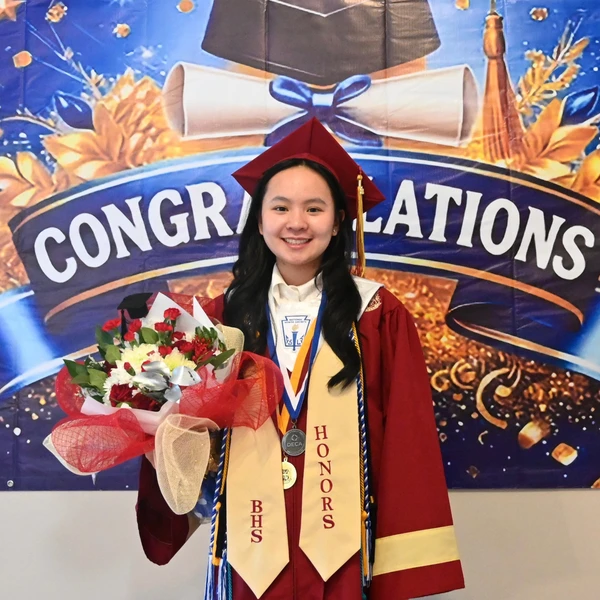
I’m currently attending Brookwood High School and was recently accepted to Georgia State University’s Honors Program. I’m very excited and looking forward to attending college.
Education
Brookwood High School
High SchoolMiscellaneous
Desired degree level:
Bachelor's degree program
Majors of interest:
- Public Policy Analysis
- Foreign Languages, Literatures, and Linguistics, Other
- Finance and Financial Management Services
- Law
Career
Dream career field:
Law Practice
Dream career goals:
Sports
Tennis
Varsity2018 – 20257 years
Awards
- USTA Championship
- Varsity Regional Award
Arts
Greater Atlanta Christian School
Visual ArtsWatercolor Painting, Multi-media Painting, Oil Pastel Painting, Architectural Painting2023 – 2024Brookwood Orchestra
Music2024 – 2026
Public services
Volunteering
Ming Dang Quan Buddhist Temple — ESOL teacher2025 – PresentVolunteering
Holy Martyrs Vietnamese Church — Vietnamese language teacher2025 – PresentVolunteering
MERGE Mentor — Mentor2025 – PresentVolunteering
Boat People SOS — Vietnamese-English translator2023 – Present
Future Interests
Advocacy
Politics
Volunteering
Philanthropy
Entrepreneurship
Nicholas Hamlin Tennis Memorial Scholarship
Trailing after my parents to their tennis lesson at 10 is when I first fell in love with a sport. I was not even playing yet. I was just watching, the way the ball arced through the air, the sharp crisp pop of the racket making contact. Something about it pulled me in completely. From that moment on, I convinced my parents to let me start practicing. Tennis became my world.
What I did not know then was that tennis would become one of my greatest teachers.
The court has a way of creating a miniature version of real life, with every emotion amplified and every lesson made immediate. When I win a point, the joy is instant. When I lose a match, the frustration is agonizing with nowhere to hide from it. There were no teammates to mitigate the loss, no one else to rely on. It is just me, the racket in my hand, and my next decision. Tennis taught me early that how you respond to a hard moment matters more than the moment itself.
I learned that the hard way during one varsity match I still think about. I had not played in six months due to a hip injury, and it showed. My timing was off, my confidence was shaky, and I kept losing points that I had no business losing. What I did not know until after the match was that my racket strings had loosened so badly that every full swing sent the ball flying wild. The whole match, without realizing why, I had been compensating by slicing almost every shot, finding a way to keep the ball in play with a completely different game than the one I usually play. I lost to an opponent I should have beaten.
However, when my coach pulled me aside afterward, she told me she was proud of me. Not because of the score, but because I had recognized something was wrong and I adjusted on the fly without anyone telling me to. She said that kind of instinct, the ability to change your approach mid-match when your original plan stopped working, is what makes me a great player in her mind and solidifies her trust in my potential.
That conversation stayed with me. Tennis does not always go the way you prepared for it. Neither does anything else. What matters is whether you can think clearly when the conditions shift and keep competing anyway.
The team side of varsity taught me something different. I came in expecting an individual sport and found something closer to a family. The people I practiced with, competed beside, and pushed through exhaustion became some of my closest friends. We cheered, we cried, and we did everything connected hip by hip. That kind of trust, built through shared joy and difficulty is what makes tennis beautiful. It shaped how I think about community and what it means to be someone you can count on.
Those qualities are exactly what I want to carry into the future. I am heading to Georgia State University this fall to study public policy on a pre-law track, with the goal of becoming an immigration attorney. The law, like tennis, rewards the people who prepare relentlessly, who adapt when the conditions change, and who refuse to quit when the match gets difficult. I have spent my whole tennis career learning how to do all three, and I plan to continue proving that I can and will excel at what I do.
Vietnamese Freedom and Heritage Scholarship
I still remember the stack of papers spread across our kitchen table. My parents sat across from each other, voices rising, neither of them fully understanding what the documents were asking. Deadlines were printed in bold at the top of each page, but the words around them were an impenetrable wall. We had come to America looking for stability, and instead we found a system that felt designed to cut us loose. That night, I realized we had nearly missed a filing deadline that could have changed our immigration status entirely. Not because my parents were careless, but because no one had made it easy for them to understand.
Coming to the United States at thirteen, I expected the hard part to be the language. What I did not expect was how much the hardship would pile on top of itself. The language barrier did not just make conversations difficult. It made paperwork terrifying, medical visits and everyday decisions feel like walking on egg shells. I watched as stress and despair settle into my family. My parents, who had sacrificed so much to get us here, were now stretched thin by a system that gave no grace to people still finding their footing. I could not fix the system then. But I told myself that one day, I would understand it well enough to fight back.
That determination has shaped every decision I have made since. I began finding small ways to close the gap between my community and the resources they deserved. I helped families navigate appointment scheduling, school registration, and medical visits. I sat with people as they filled out forms and made sure they understood what they were signing. Each time, I thought about my parents at that kitchen table, and I felt more certain that this work was not just
something I wanted to do. It was a purpose that I was meant to fulfill.
But my individual contribution has limits. A single person can only translate so many documents, attend so many appointments, sit beside so many families. To create change that actually lasts, I know I need to go deeper into the systems themselves. That is why I am committed to studying public policy and pursuing a career in immigration law. I want to understand why the immigration process is so difficult to navigate, where the gaps are, and what it would take to make the path forward clearer and more compassionate for families like mine.
Immigration law has historically been written without the voices of the people most affected by it. I want to be in that room and decide what is acceptable and what is not. As a lawyer, I want to advocate for policies that are easier to understand, deadlines that come with proper notice and support, and legal protections that do not slip through the cracks simply because someone did not have access to the right information in time. I want to be the person that my family needed and did not have.
The Vietnamese community taught me that perseverance is how we can emerge from the worst storm and come out on top. The kind of perseverance that keeps going even when the system pushes back. I carry that with me into every next step. And I intend to use everything I learn to make sure the families who come after mine do not have to sit at that kitchen table alone and buried in the fear of the unknown. I want to be capable of giving them the clarity, support and guidance that they need.