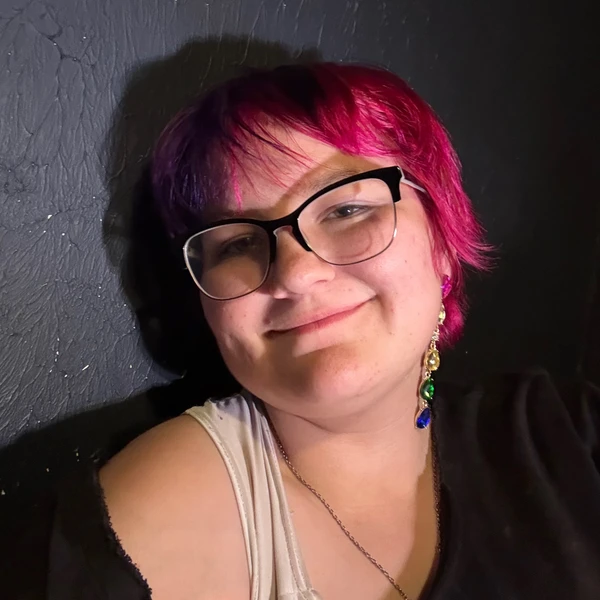
When asked to write about myself and my life for a scholarship, my first instinct is to write about my accomplishments, the things that prove I'm smart, charitable, and driven enough to deserve a scholarship. But for this—the Andrea Worden Scholarship—I was specifically instructed not to write about that, but about who I am as a person, what my life looks like, and everything that's real. In my many previous attempts to write this essay, I struggled to concisely describe my life, probably because I wasn't being completely honest. I’m an impressive person who has done a lot of stuff that's worth bragging about, but who I am is more than my success. My story isn't beautiful or clean, there are plenty of parts I would prefer to edit out. But my story is my story, both the golden accomplishments, and the dirty secrets. So…
My name is Lin (or Angel) Summers, and I'm a non-binary high school senior who plans to attend Aberdeen University in Scotland for Psychology and Philosophy. I've always loved psychology, both in the sense that I want to be a therapist who helps people with severe mental health struggles, and in the sense that I like psychoanalyzing everyone around to figure out how they tick. My story is one of generational struggle, resilience, and most of all hope.
Part of the prompt asks how I'm an unconventional student, and while I could talk about being on the AP track, my frankly exhausting list of extracurriculars, or any of the other things that make me an ‘advanced student’, none of that actually speaks to how my organic experience is different from average. So instead, I'll talk about growing up dirt poor in a family known for addiction, and a household known for conflict.
I grew up on food stamps and hand-me-downs in a small trailer with four half-siblings and parents who spent more time arguing than raising their children. Since before I was born my family has struggled with instability and drug abuse. Neither of my parents graduated, my mom didn't even finish middle school, they met on crack after they both already had kids from failed toxic relationships. My aunt died of an overdose when I was 15, and my grandpa has lived in the same run-down house with a rotating door of criminals and bums since I can remember. My earliest memories are of my brother drunkenly fighting with my parents—both physically and verbally, quickly followed by my parents engaging in a screaming match until my older siblings finally took me out of the house.
The struggles of my home life have affected me and my schooling for longer than I can remember. I've missed school because my parents were too hungover to drive me in the morning, I developed an addiction to alcohol at a young age, and I've spent my childhood struggling with a host of mental health issues. But despite all of this, I'm still here, testing in the 90th percentile, soon to graduate with a diploma and a thousand stories. I'm going to get my master's in psychology one day and become a great therapist and psychological researcher. A major reason I've been able to push through everything, is because of my aunt. She taught me that if reality is dull, then you should learn to see magic in the mundane.
On the first day of my sophomore year of high school, my aunt died. My parents will tell you she died of an aneurysm, which is mostly true. But the aneurysm was largely affected by the amount of non-prescription drugs she had taken a couple of hours prior. Losing my aunt meant losing a part of myself, and gaining acceptance of part of my reality.
I lost my ability to believe in magic. I never wished I had religion more than when I had to face the reality that the crazy, fearless woman who taught me to believe in fairies was gone. Fairies aren't real, she wasn't a witch, and as much as I've tried to, I can't believe that she still exists in any meaningful way. Since losing her I've had to rebuild my sense of wonder, a skill she taught me.
But I also gained something from her death. My aunt could create a weekend getaway out of five dollars, she was good at hiding the family issues and making everything seem like sparkles and rainbows. Her death, the dark reality that caused it, taught me that the world I live in isn't perfect. I have a family history of addiction and grew up dirt poor. And as much as I miss that child-like innocence that protected me from these realities, I'm also glad that I can see the world for what it is, that I love and accept where it came from, and still push forward for something better.
I will always miss my aunt, it's heartbreaking to know that she will never get to see me graduate. She won't get to see the life I built, and I don't get to see what she could've built with more time. To her, I will always be 14, and to me, she will always be the crazy woman who lived in a crack house with mountains of financial and mental problems. But most of all she will always be my aunt, she will always be with me in the ashes I carry around my neck. And she will always be there to remind me that no matter how hard reality gets, with enough elbow grease and imagination you can turn it into a fantasy.
So that's my story, I'm a kid with a history of pain, but a legacy of hope. My parents overcame addiction, created their own businesses despite everything, and gave their kids a chance to believe. To believe in magic, to believe in the future, and to believe in themselves. It's not necessarily pretty, but it's real, and it's me.