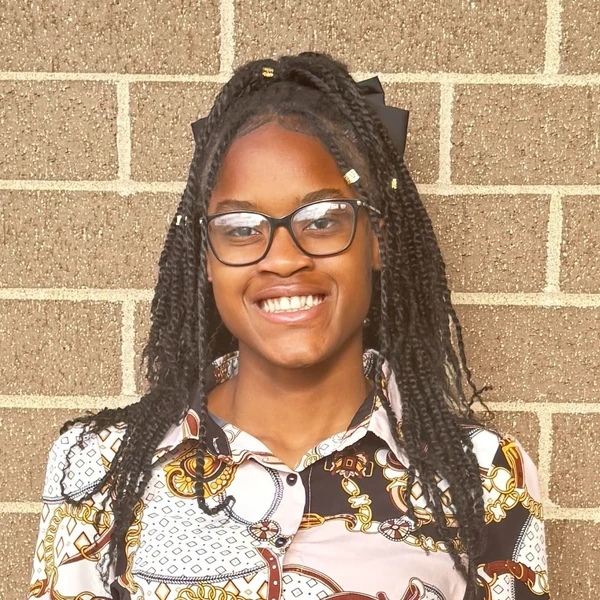
Urbana, IL
Age
18
Gender
Female
Ethnicity
Black/African
Religion
Christian
Church
Apostolic
Hobbies and interests
Art
Running
Track and Field
Basketball
Soccer
National Honor Society (NHS)
French
Trombone
Bible Study
Church
US CITIZENSHIP
US Citizen
LOW INCOME STUDENT
Yes
FIRST GENERATION STUDENT
Yes
Lavie Maisha-Wema
1x
Nominee1x
Finalist
Lavie Maisha-Wema
1x
Nominee1x
FinalistBio
Hi, I'm Lavie Maisha-Wema. I am very passionate about furthering my education and am excited to do so!
Education
Urbana High School
High SchoolMiscellaneous
Desired degree level:
Bachelor's degree program
Majors of interest:
- Accounting and Computer Science
Career
Dream career field:
Accounting
Dream career goals:
Accounting
Crew Member
Culver's2022 – 20242 years
Sports
Basketball
Varsity2023 – 20252 years
Awards
- Most Improved
Cross-Country Running
Varsity2022 – Present4 years
Public services
Volunteering
Habitat for Humanity — Volunteer2024 – PresentVolunteering
Life Church CU — Sunday School Teacher2021 – Present
Future Interests
Volunteering
Entrepreneurship
YOU GOT IT GIRL SCHOLARSHIP
Determination is the quality that best makes me a "You Got It Girl." Throughout my life, I have learned that success isn't about never facing challenges but about persevering when things become difficult. Whether in athletics, academics, leadership, or my personal life, determination has helped me overcome obstacles and become a stronger version of myself.
Sports have played a major role in shaping who I am today. I have competed in cross-country for six years and have been a varsity runner for five of those years. Along the way, I received the Tiger Pride Award and qualified for sectionals with my team. I also played girls' basketball for two years as a varsity athlete and earned the Most Improved Award. Through both sports, I was recognized with the IHSA Scholar Athlete Award and the Big 12 Award. While I am proud of these accomplishments, the lessons I learned through athletics are even more meaningful than the awards themselves.
One of the most challenging moments of my athletic career came during my junior year cross-country season. The summer before, I trained harder than ever. Every morning at 6:30 a.m., I was at the track with my team, preparing for what I hoped would be my best season yet. As a varsity runner since eighth grade, I had high expectations for myself and believed my hard work would finally pay off.
Instead, on the morning of my first race, I was rushed to the emergency room. After five hours, I was diagnosed with severe tonsillitis and other illnesses that required weeks of antibiotics and recovery. I tried to push through the illness because I was afraid of falling behind, but my race times slowed, my ranking dropped, and I felt like I was losing the identity I had built as an athlete.
For the first time, I considered quitting. I had tied so much of my self-worth to my performance that when I struggled, I questioned whether I belonged in the sport at all. Eventually, I realized that my value was not determined by a stopwatch. I stopped focusing on the season I thought I deserved and started appreciating the opportunity I still had. I continued showing up, continued training, and continued believing in myself even when the results were not what I wanted.
By my senior year, I continued running on varsity and fought my way to sectionals. While that achievement was rewarding, the greatest victory was learning that perseverance matters more than perfection. That experience taught me resilience and showed me that setbacks are growth opportunities.
Another person who inspires me to keep pushing forward is Sydney McLaughlin-Levrone. I admire her not only because of her success as an athlete but because of the way she openly credits her faith in Jesus Christ for her accomplishments. Her humility reminds me that talent and hard work are important, but staying grounded in faith and purpose is what truly matters.
This scholarship would help support my journey in practical ways. During one cross-country season, I experienced painful blisters after nearly every run because I was wearing shoes that did not properly fit my wide, flat feet. Quality running shoes can be expensive, and this scholarship would allow me to invest in footwear designed specifically for my needs. Having the right equipment would help me train more comfortably and reduce the risk of injury.
As a first-generation college student from a low-income family, this scholarship would also help ease the financial burden of pursuing higher education. I will be attending Oberlin College, where I plan to study Financial Economics before pursuing a master's degree in accounting and becoming a CPA. Every scholarship I receive helps bring me one step closer to those goals.
Although I will not be competing as a varsity athlete in college, athletics will remain an important part of my life. I hope to join the running club at Oberlin and, if possible, become involved with the women's club basketball team. If one does not exist, I would love to help start one. Being a student-athlete has taught me discipline, time management, teamwork, and perseverance, skills that will continue to serve me.
Being a "You Got It Girl" means believing in yourself even when life does not go according to plan. It means getting back up after setbacks, trusting the process, and continuing to work toward your goals. My experiences in athletics have taught me that determination is not about never falling; it is about always finding the strength to keep going. That lesson will stay with me wherever life takes me.
Rose Ifebigh Memorial Scholarship
For much of my life, I felt caught between worlds. I was born in the Democratic Republic of the Congo, and when my mother won the Visa Lottery, my family immigrated to the United States in search of greater opportunities. Like many children of immigrants, I grew up balancing two cultures. At home, I spoke Lingala with my family, followed Congolese customs, but outside, I learned to navigate American culture.
This experience shaped my identity and values. My parents worked tirelessly to provide for my sisters and me, often moving from apartment to apartment and living paycheck to paycheck. Watching their resilience taught me the importance of perseverance, hard work, and gratitude. As a member of the African diaspora, I have learned to appreciate both where I come from and the opportunities available to me because of my family’s sacrifices.
Living in the United States also exposed me to challenges that helped me grow. I attended a predominantly White church where I was often the only Black girl in my Sunday School class. At school, I attended a predominantly Black school but was often viewed as different because of my African background and the way I spoke. I felt as though I never fully belonged in either environment. While these experiences were difficult, they taught me to adapt to different cultures, communicate with people from diverse backgrounds, and appreciate perspectives that differed from my own.
As an immigrant and a student navigating multiple cultural identities, I learned that belonging is not about fitting perfectly into one group. Instead, it is about embracing the experiences that make you unique. Over time, I stopped viewing my differences as weaknesses and began seeing them as strengths. Exposure to different communities taught me that people often make assumptions about one another based on limited experiences. This realization taught me the importance of empathy, open-mindedness, and building connections across cultures.
My educational journey has also transformed the way I see myself and the world. From a young age, I was drawn to mathematics and problem-solving. While my sisters often played outside, I spent hours completing educational programs. My academic curiosity eventually led me to advanced and honors courses, making me one of the first in my family to pursue such opportunities. Through education, I gained confidence in my abilities and discovered that success is not determined by where someone starts but by their willingness to learn and grow.
This passion for numbers ultimately led me to accounting and finance. During my junior-year accounting course, I realized that I was interested not only in calculations but also in the stories that numbers tell about opportunity, stability, and access to resources. I plan to study Financial Economics and later earn a Master’s degree in Accounting before becoming a Certified Public Accountant.
My long-term goal is to use my financial knowledge to strengthen nonprofit organizations and improve financial literacy in underserved communities. I have seen how many organizations and families struggle due to a lack of access to financial guidance and resources. By helping nonprofits manage their finances effectively and educating individuals, I hope to create opportunities for others to succeed.
Receiving this scholarship would bring me one step closer to achieving these goals. It would reduce the financial burden of college, allowing me to focus on my education and professional development. More importantly, it would help me continue the journey my parents began when they left Congo in search of a better future. Through education and service, I hope to use my experiences to create lasting change in my community and beyond.
Learner SAT Tutoring Scholarship
"The SAT is not that serious. It's just a test over stuff I've already learned, so I should be fine," I'd say in order to prevent myself from stressing out. Because I decided not to study for the SAT, I would often convince myself that it was just another silly test. On top of that, I would recall that many schools go test-optional; if the rest of my application looked good, then one test score would not have a huge impact.
I've since realized how mistaken I was about the SAT. It is a common metric for colleges to evaluate students. The last thing I'd want is for them to see me as an "1190". After receiving that PSAT score, I was incredibly discouraged. I was confident in my ability to score high, but that confidence immediately vanished. As an overachiever, seeing such a low score meant I had to work ten times harder. But I'm not motivated unless I find my "Why?", so I began to ask some essential questions. "Why does the SAT matter?" "Why should I score high?" "Why are some schools test-optional?" "How do I improve my score?" "What are the best methods for studying?" After getting my answers, I was ready to do great.
I have always taken pride in my intelligence, but recently, I have become more and more indifferent. Laziness doesn't get anyone anywhere. Laziness doesn't help Lavie's SAT score. I had to eliminate every lazy habit—procrastination, lack of goals, lack of discipline, excuses, and avoiding challenges. Once the behaviors that hindered my productivity were gone, I shifted my focus to relearning everything, whether I remembered it or not. Schoolhouse, Khan Academy, and Kaplan Test Prep Courses contribute much-needed assistance to me, and I am forever grateful for those resources. I make sure to practice at least 30 minutes every day because consistency is key.
I remain determined by knowing that one of my main goals is to make my parents proud. Succeeding in my education is one of the best ways I can bring them joy. The primary reason my parents brought me and my four sisters from the Democratic Republic of the Congo to the United States of America was for all the opportunities available. Having the opportunity to pursue higher education in a developed country is one of the greatest blessings, and I now recognize that the SAT plays a major role in that. The SAT is the foundation for me to achieve my goal of making my parents proud. I need a strong foundation. I need a higher SAT score.