Hobbies and interests
Writing
Advocacy And Activism
Environmental Science and Sustainability
Gender Studies
Anthropology
Running
Painting and Studio Art
Photography and Photo Editing
Journalism
Meditation and Mindfulness
Mental Health
Reading
Academic
Anthropology
Novels
Poetry
Cultural
Speculative Fiction
I read books daily
Lalini Ranaraja
1x
NomineeLalini Ranaraja
1x
NomineeBio
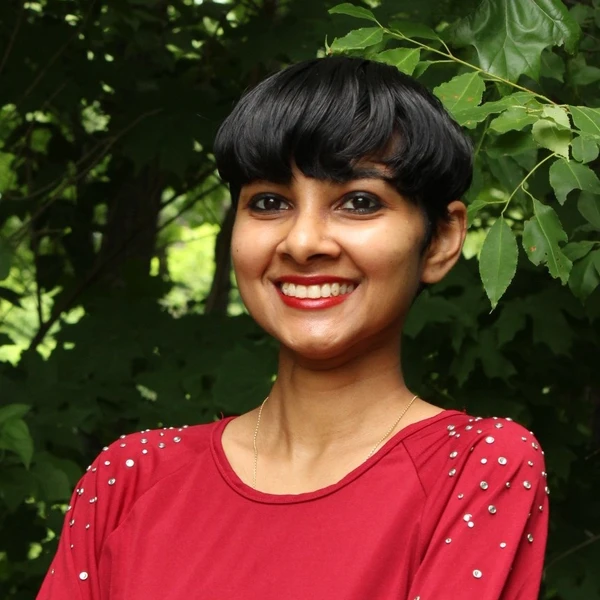
Hello there! I'm Lalini.
I’m originally from Kandy, Sri Lanka, one of the most multicultural places you can imagine, but I have studied in both the Netherlands and the USA, and am currently based in Illinois. I’m fluent in four languages - English, Sinhala, French and German - and I’m conversant in Dutch.
I graduated cum laude and Phi Beta Kappa from Augustana College, Illinois in May 2021, majored in Anthropology and Creative Writing, and completed a minor in Multimedia Journalism. I’ve taught English as a Second Language to recent immigrants, tutored college-level reading and writing, and worked as a reporter and editor for my college newspaper.
Writing is my main creative vehicle; my poetry, nonfiction, fiction and fine art have appeared in numerous online and print publications. I explore language, culture, identity, and survivorhood. I’ve completed research on the migrant narratives of Sri Lankans living in the Netherlands, and on gender stereotypes in Sri Lankan ESL textbooks; I plan to further study these intersections during my upcoming time at the University of San Francisco, where I will be completing an MA in International Studies.
I've met people from all walks of life, and the communities I serve thrive on connection via storytelling. I'm fascinated by that encounter where two people experience the world from the other person’s perspective, just for a moment, because that encounter may change the world. I want to study, create, and participate in those encounters however I can.
Thank you for engaging with my story, and for helping me continue it!
Education
University of San Francisco
Master's degree programMajors:
- International/Globalization Studies
Augustana College
Bachelor's degree programMajors:
- Rhetoric and Composition/Writing Studies
- Anthropology
Minors:
- Journalism
Miscellaneous
Desired degree level:
Doctoral degree program (PhD, MD, JD, etc.)
Graduate schools of interest:
Transfer schools of interest:
Majors of interest:
Career
Dream career field:
International Studies
Dream career goals:
Researcher/Activist/Creative
Adjunct ESL Instructor
Black Hawk College2021 – 20221 year
Sports
Track & Field
Varsity2013 – 20163 years
Awards
- Under-19 Women's Championship (CISK, 2016)
Research
Anthropology
Augustana College — Lead Researcher2020 – 2021
Arts
Alliance Francaise De Kandy
PaintingNow You See Me - Fine Art Exhibition2016 – 2016
Future Interests
Advocacy
Volunteering
Philanthropy
Bold Art Matters Scholarship
Imagine that one of the people you love most has been immortalized in a portrait. You love this portrait because it shows the world something you already know: this person is amazing. Then your person dies. Then you and your family have to flee your country, and terrible crimes are committed against your people. The painting is stolen by those whose hatred changed your life forever. Decades later, you will have to sue an entire government to reclaim what is rightfully yours.
This is the story behind Gustav Klimt’s “Adele Bloch Bauer I.” If you’re interested in modern art, you’ve heard of this rebellious, brilliant Austrian artist, and you’ve seen his arguably more famous piece “The Kiss.” But Adele’s story is what makes her portrait special. She and her husband were Jewish; they were enthusiastic sponsors of the Viennese art scene. It was their niece, Maria Altmann, who fled Hitler's regime to America, and in her eighties fought a prolonged legal battle for her family’s paintings.
The case was widely popularized, drawing necessary attention to the underreported issue of art repatriation. So much of the art looted by the Nazis has not yet been returned to its owners. European museums are full of precious objects stolen by colonialists, some of which have been disputed for years - the Koh-i-noor diamond, the Elgin Marbles, the bust of Nefertiti, and even the thousand-plus artefacts from my home country of Sri Lanka that are being held in Amsterdam’s Rijksmuseum. In America, millions of Native American artefacts languish behind glass instead of enriching the lives of the tribes who created them.
We have a long way to go, but it was this painting that showed me how one family’s story could play out on the world stage, and make change a little more possible.
Bold Future of Education Scholarship
When you read the phrase “sex education,” what’s your first thought?
Maybe it’s “condoms on bananas.” Maybe it’s the eponymous Netflix series starring Gillian Anderson. Maybe it’s the biology lesson on reproductive systems that your teacher decided to skip. Whatever the answer, it probably differed vastly according to your birth country, age, gender, race, socioeconomic status, religious beliefs, political leanings, and internet access. That shouldn’t be the case. If you had access to any level of education, sexual education should have been included.
I believe that a standardized and mandatory sexual education curriculum is an essential addition to schools around the world. And no, that does not mean teaching kids how to have sex.
In the United States, mandating sex education in school is still left up to individual states; less than forty states currently require some form of sexual education (Planned Parenthood). These programs often have a narrow, abstinence-only focus which leaves vast gaps in student knowledge. In developing nations, programs can be few and far between, as I know from personal experience. Meanwhile, European countries such as Sweden and the Netherlands, which have comprehensive sex education programs, have teen birth rates far lower than the US (PubMed).
Limited access to sexual education programs leaves students ignorant of basic information about their bodies, their reproductive rights, their relationships with each other - and puts the responsibility of sharing this knowledge on their families, which are very often unequipped or opposed to doing so. As they reach reproductive age, young people across the globe are dangerously ill-informed on the realities of contraception, sexually transmitted diseases, pregnancy, sexual abuse, gender stereotypes and gender identity, intimate partner violence - complicated topics they may not have the opportunity to learn of until thrust into a situation - assault, gender-based discrimination, pregnancy - that could change the course of their education, and thus their life.
Reproductive health and sexuality applies to every single human being on earth. That’s why a standardized program needs to come from a global regulatory body such as the World Health Organization, or an independent national institution like the Center for Disease Control, so that political, religious, or cultural agendas cannot restrict access to information. Information is power, and every individual deserves that access. Interpersonal relationships make up such a huge part of our lives that it is essential for everyone in the world begin on a level playing field, at the most basic level - having the information necessary to protect our bodily autonomy, and our future.
Bold Great Minds Scholarship
Imagine that it’s 1925. You’re in a classroom at Columbia, discussing cultural relativity---the idea that cultural differences do not make one society inferior to another---with Margaret Mead and Ruth Benedict, the foremost female anthropologists of the time. Your mentor arrives and encourages you to assign your own culture equal academic value. His name is Franz Boas, and he’s the father of modern anthropology.
Your name is Zora Neale Hurston, and you are the first Black female anthropologist.
I learned about Hurston during my junior year of college, a month before the COVID-19 pandemic stranded me and the rest of my international student community on our campus. The years that followed encompassed many struggles, but nothing close to what Hurston survived.
Hurston was not celebrated in her lifetime. Although her anthropological work and her fiction explored African American culture in the South with a seriousness that few had done before, the critics could never form a concrete opinion of her. While the careers of Benedict and Mead flourished, Hurston was constantly on the verge of poverty, and died in a welfare home. It took decades, and the dedication of Alice Walker, another phenomenal Black activist and writer, to champion her work and find her grave.
There have been countless unappreciated individuals throughout history, or even today---Ada Lovelace, Henrietta Lacks, Hedy Lamarr and so many others. But Hurston’s story stays with me because the intersectional forces she was fighting---racism, sexism, economic inequality--are still prevalent in my chosen field of study, and the country at large. As a woman of color in anthropology, it was essential for me to see the realities of standing up to these systems of oppression---and the bravery in doing it anyway, as Hurston did. She was a reminder to never take progress for granted.
Bold Creativity Scholarship
Do you take creativity for granted?
Not everyone has the time or budget for practices that don't guarantee results. And if you do, you’re probably expected to monetize or organize them. Play the piano? You should film YouTube tutorials. Embroider your own clothes? Open an Etsy store. If you follow a creative impulse without making it a side-hustle, you’re robbing yourself.
That’s false.
Creativity sparks when you go above and beyond to put your own spin on something ordinary, in a way that only you could. The portrait you drew with ketchup on a fast food wrapper won’t become an NFT, but when you coaxed something lovely from the mundane---that moment meant everything. That will feed your soul.
Creativity is my way of life. I’ll use three serif fonts on a resume even though the blogs say to use just one. I’ll wear the red jacket instead of the gray to work, even if---especially if---the day is overcast. I keep four different notebooks so I'm prepared whenever the muse comes knocking---on the bus, in a meeting, in the middle of the night. And every so often, for the price of a gallon of milk, I submit a poem or a painting for publishing consideration. Sometimes they are successful, and people I love thank me for sharing them. Those connections are precious. But they're just as valuable as the first time a line settles perfectly on the page, or the moment an acrylic shade is mixed just right.
I put my own spin on life because I want to know---like everyone else---that I didn’t just pass through the world blindly. That even if I was the only one to see it, I made the world a little bit lovelier, or deeper, or stranger, because I left it something unique.
Bold Great Books Scholarship
You probably wouldn’t guess that World War I and II Europe defined the books I read in adolescence and young adulthood. But growing up in Sri Lanka, formerly a British colony, books about that era were often the most available in libraries, schools, and stores. From “Goodnight Mr. Tom” to “The Book Thief” to “Atonement,” I immersed myself in countries, cultures, and conflicts diametrically opposed to those of my childhood.
Trezza Azzopardi’s “Remember Me”, however, is a book I have loved for years because it is unique, even among these conflict narratives. The protagonist is Winifred, an elderly, unhoused woman who is robbed of a briefcase containing all her meager belongings. From there, the story of Winifred's life unfolds in hauntingly told flashbacks, war looming large over the landscape. The book considers memory, grief, mental illness, stigma, and the aftermath of trauma, but to this day, I have unanswered questions about what really happens, because Azzopardi’s nuanced, intricate, and painful writing is faithful to the idea that you can never assume you know everything about someone's story.
Most outsiders encountering a narrative expect the answers to these questions:
"What exactly happened?"
"Why did it happen?"
"How did it end?"
But the human experience just isn’t that linear.
As a writer and a researcher of narratives, I know how dangerous it can be to demand that rigid format from human storytellers, especially from vulnerable individuals living with trauma, intellectual disabilities, and mental health challenges. “Remember Me,” despite being fiction, was the first reassurance I had that the choice of when to tell a story, how much to reveal, or even whether to tell it at all was mine alone. I reread the book every year, letting Winifred and Azzopardi choose when to entrust new facets of their story to me.