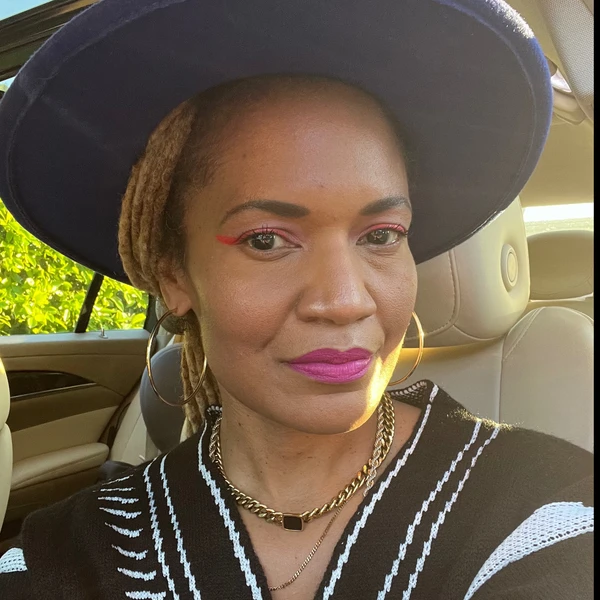
My journey has never been traditional—but it has always been intentional. I am a mother, therapist, artist, writer, and doctoral student. Each of those identities has shaped the way I walk through the world, and they all come together in how I serve my community today.
I began my formal education in the arts, earning a Bachelor of Arts in Fine Arts with a minor in Fashion Design. Creativity was my first language, and design became my means of storytelling. In 2008, I launched a small business designing handmade kimonos, which became both a source of empowerment and economic independence. I learned how to market myself, connect with people emotionally through aesthetics, and build something from scratch—skills that now serve me in every corner of my work. This company is still active and when I have time to make custom kimonos for clients is gratifying. I am an artist and nuturing my creativity is essential to my well-being.
As I grew as an artist and businesswoman, I also began healing from generational and personal traumas I had long suppressed. Therapy changed my life, and I felt called to offer that same space to others. I pursued and completed my Master of Arts in Clinical Psychology at Pepperdine University, where I trained as a psychotherapist and began working with children, adolescents, and families navigating anxiety, trauma, and identity.
My path took on deeper meaning when I became a mother—and even more so when my youngest child was diagnosed with Autism. Overnight, I stepped into roles I wasn’t prepared for: advocate, therapist, teacher, and fierce protector. Navigating therapy schedules, IEP meetings, meltdowns, and isolation became our new normal. But rather than fall apart, I leaned into my calling. I became an adovcate for my son and now for others on this journey of neurodiversity.
I am now a doctoral student in the Psy.D. in Clinical Psychology program at Pacifica Graduate Institute, a school known for integrating depth psychology, cultural awareness, and soul-centered practice. Pacifica has already changed my life and I cannot see myself attending another PsyD program. My work focuses on supporting families with special needs children and helping underserved populations access healing in meaningful, culturally sensitive ways. In June 2025, I published my first children’s book What About Me?, which gives voice to the often-overlooked siblings of special needs children. It is part of a larger series aimed at increasing emotional literacy and connection within diverse families.
This journey hasn’t been easy. I am a single mother managing a full-time graduate education while raising a neurodivergent child. Financial instability is an ongoing reality, and yet I persist—because I know this work matters. I have been the parent searching for help at 3 AM. I have been the student crying quietly during online classes, overwhelmed but determined. I have also been the therapist witnessing the exact kind of transformation I was once desperate for.
Throughout my education, I have remained committed to blending clinical practice with creative expression. I believe that healing doesn’t always begin in a therapy room—sometimes it begins in a story, a piece of art, or a shared moment of recognition. That belief has shaped the way I design therapeutic materials, write children’s books, and connect with families. My training in psychology is informed by my art, just as my art is now grounded in trauma-informed, culturally responsive care.
Beyond my academic goals, I am deeply invested in community work. I regularly speak with parents of special needs children, provide emotional support and referrals, and use my platforms to educate others about the emotional landscape of caregiving. I have created resources that help parents talk to siblings about disability, and my vision is to expand this into a full nonprofit organization that offers workshops, books, and emotional toolkits for families of color.
One of my long-term goals is to establish a private practice that centers on healing for women, families, and children who often feel excluded from traditional therapeutic spaces. I want to train and mentor young clinicians, especially other Black women, to enter the field with confidence, cultural awareness, and compassion. I see myself not just as a therapist, but as a bridge-builder—someone who connects clinical knowledge with lived experience, professional ethics with empathy, and research with real life.
I am also keenly aware of how race, socioeconomic status, gender, and ability intersect to impact access to mental health services. As a Black woman, a single parent, and the caregiver of a neurodivergent child, I have firsthand experience navigating systems that are not built with families like mine in mind. These lived experiences have shaped my clinical lens, strengthened my advocacy work, and pushed me to question the dominant narratives around wellness and success.
The psychological field is evolving, but we still have a long way to go. That’s why I am committed to being a part of the change—whether that’s through inclusive clinical care, culturally resonant children’s books, or speaking engagements that amplify underrepresented voices. I want my work to challenge stigma, celebrate complexity, and create healing spaces for those who have been told their needs are too much or their pain is too inconvenient.
My education is not a solo endeavor. Every paper I write, every practicum hour I complete, and every child I support is done with my community in mind. I want to take everything I have learned—from the canvas to the classroom, from the therapy room to the kitchen table—and pour it back into the people who need it most. This is how I create legacy. This is how I create change.
I carry with me the wisdom of survival, the drive of a mother, and the vision of an artist who believes in better worlds. This scholarship would not only alleviate the financial barriers that threaten to disrupt my education, but it would also affirm that stories like mine matter—and that the future of mental health must be inclusive, creative, and radically compassionate.
Thank you for seeing me—and for considering this investment in the next generation of healing.