Hobbies and interests
Dance
Band
Baking
Biochemistry
Biotechnology
Chemistry
Classics
Cleaning
Choir
Engineering
English
Math
Meditation and Mindfulness
Mathematics
Movies And Film
Music
Yoga
Writing
Walking
Tutoring
YouTube
Teaching
Theater
Sustainability
STEM
Studying
Spirituality
Spending Time With Friends and Family
Reading
Spanish
Physics
Ballet
Reading
Fantasy
Romance
Young Adult
Childrens
Classics
Literature
Retellings
Realistic Fiction
Novels
Mystery
Literary Fiction
Historical
I read books multiple times per week
Kriti Polimera
1x
Finalist
Kriti Polimera
1x
FinalistBio
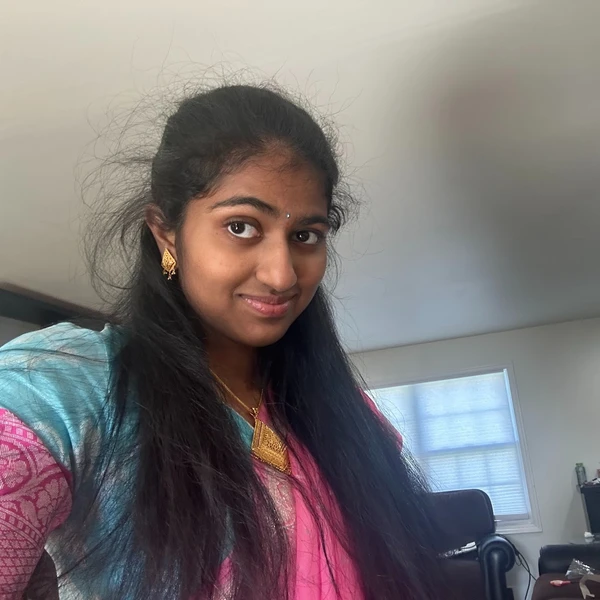
Hi! I'm a high school in NJ who has gotten into one of my dream schools, but I might need some financial help to attend. I want to pursue engineering, somewhere in between the chemical, civil, and environmental fields. I have a lot of fields I'm interested in, including biotechnology with pharmaceuticals, or food production. However, recently, when working on a bioremediation project for Newark in my bioengineering class, I became passionate about contributing to the clearing of toxic chemicals from our waterways.
My favorite subjects are chemistry and physics, and outside of school, I am the stage manager for our school play and part of our Science Olympiad team. I love reading (I'm always talking my sister's ear off about books) and dancing Kuchipudi, a classical Indian style.
My dad sadly passed away in 2023 when I was a sophomore, and for a while, my family was planning to move to India, so every day, I really do try to appreciate the gift of life and just being in my home in the United States!
Education
Biotechnology High School
High SchoolGPA:
4
Miscellaneous
Desired degree level:
High School
Majors of interest:
- Chemical Engineering
- Biomedical/Medical Engineering
- Civil Engineering
- Environmental/Environmental Health Engineering
Career
Dream career field:
Civil Engineering
Dream career goals:
Working for a company in the environmental, food, cosmetics, or biotechnology field
Tutor
Mathnasium2024 – 20251 year
Arts
Chinmayi Nrithyalaya
DanceSrinivasa Kalyanam, Navarasa Natabhamini, Goda Kalyanam, Girija Kalyanam, Vasavi Kanyaka Parameswari2018 – PresentBiotechnology High School
TheatreAnastasia, Little Shop of Horrors, Freaky Friday2024 – 2026
Public services
Volunteering
SiliconAndhra Manabadi — Assistant Teacher (Balaguruvu)2023 – Present
Future Interests
Advocacy
Volunteering
InnovateHER Engineering Scholarship
Leadership, to me, means spreading the gift of knowledge as wide and deep as possible. For most of my high school experience, I have jumped at every opportunity to teach, My community service has been a masterclass in this, from helping students build number sense at Mathnasium and tackle the SAT on Schoolhouse, to guiding middle schoolers through complex lab work like gel electrophoresis at Biotech Bootcamp, and even volunteering to teach Telugu to kindergarteners.
My biggest leadership lesson arrived during a simple strawberry DNA extraction project with three 4th graders. It took intense patience and empathy (so much repetition and task redirection!), but seeing the genuine pride on their faces when they presented their project to the StemFest science fair judges was amazingly rewarding. True leadership is the compassionate focus that ensures knowledge doesn’t just stick, but profoundly sinks in, like raising global awareness through my Kuchipudi choreography for the Aseemkala Initiative about the intense burden facing healthcare systems today.
At the same time, my interest in STEM has grown alongside these experiences. Through Science Olympiad, especially the Water Quality event, I found myself drawn into understanding how something as everyday as water can be so complex. Learning about indicators like pH, dissolved oxygen, and turbidity, and how they all connect, made me start to see science as something that could directly impact people’s lives. Due to this, I convinced my friends to do water quality for our IB Collaborative Sciences project. We got to collect data from the local Millstone River during a canoeing trip, using real water testing tools like pH probes and salinometers. Later, we compared our readings to accepted standards, proposed potential causes such as fertilizer runoff making the stream slightly too acidic, and suggested solutions like riparian buffers or phosphate-free fertilizers. Even on this small scale, it was amazing to see how the science I learned so recently could help guide real improvements in our local environment.
Later, in my bioengineering class, I worked on another project by studying the Diamond Alkali Superfund site on the Passaic River in Newark, New Jersey. The site is contaminated with dioxins and PCBs, and we studied the previous containment plan before designing our own approach. We ended up with a plan including a natural oil emulsion to capture lipophilic dioxins in microspheres that could be skimmed off, followed by filtration with coagulants, granular activated carbon, and UV light. This project taught me about more innovative and novel ways to treat water.
Moving forward, I want to keep making an impact on my community in that same way, by combining what I love about teaching with what I am learning through engineering. As I pursue chemical or civil engineering, I hope to work on improving water quality, whether that is through addressing local Superfund sites in New Jersey, working in wastewater treatment, or exploring areas like flood control. I also want to focus on spreading awareness about everyday actions that affect water quality, such as encouraging the use of phosphate-free and less chemical-based fertilizers, so that communities can play a role in protecting their own environments. At the same time, I want to keep teaching, mentoring, and finding ways to make STEM feel accessible to others.
For me, impact has never been just about solving a problem. It is about making sure people understand it and benefit from it, and through engineering, I hope to take that same idea and apply it on a larger scale, whether that be to my local or global community.
HeySunday Green Minds Scholarship
Only about 2.5–3% of the world’s water is freshwater. I have always taken it for granted, until I saw how much others struggle to access it. In my IB Spanish class, for the topic “cómo compartimos el planeta”, I learned about deserts like the Atacama flooding, wetlands like Laguna Tisma in Nicaragua having drought, and towns like La Oroya in Peru polluted with tin, lead, and cadmium. Visiting India over breaks, I noticed dust and pollution covering small villages and cities like Hyderabad. These glimpses made me realize how unevenly water is distributed and how urgently science and engineering are needed to protect it.
I have loved science and engineering for as long as I can remember. My high school’s IB program gave me four years of biology, three of chemistry, two of physics, and two of studying materials science for Science Olympiad. This year, I did not plan to dive into Water Quality because identifying bugs is part of the event, and I am not exactly comfortable with them. But, I ended up fascinated with the other part, which involved monitoring and analyzing water. Learning how salinity, pH, phosphates, dissolved oxygen, nitrates, total solids, alkalinity, turbidity, temperature, fecal coliform, and biochemical oxygen demand all interconnect, and how freshwater macroinvertebrates can act as indicators for water quality, really got me intrigued.
Due to this, I convinced my friends to do water quality for our IB Collaborative Sciences project. We got to collect data from the local Millstone River during a canoeing trip, using real water testing tools like pH probes and salinometers. Later, we compared our readings to accepted standards, proposed potential causes such as fertilizer runoff making the stream slightly too acidic, and suggested solutions like riparian buffers or phosphate-free fertilizers. Even on this small scale, it was amazing to see how the science I learned so recently could help guide real improvements in our local environment.
Later, in my bioengineering class, I worked on another project by studying the Diamond Alkali Superfund site on the Passaic River in Newark, New Jersey. The site is contaminated with dioxins and PCBs, and we studied the previous containment plan before designing our own approach. We ended up with a plan including a natural oil emulsion to capture lipophilic dioxins in microspheres that could be skimmed off, followed by filtration with coagulants, granular activated carbon, and UV light. This project taught me about more innovative and novel ways to treat water.
These experiences have cemented my dream of studying chemical or civil engineering, and continuing to pursue water quality at the heart of my work. Whether addressing local Superfund sites in New Jersey, working in wastewater treatment, or exploring other areas like hydraulic modeling or flood control, I hope my work will contribute to better water quality testing practices, reduced waterborne diseases, and assistance to future generations in protecting this limited, precious resource. Science has given me tools, but more than that, it has shown me that curiosity, care, and persistence can make the world healthier and more sustainable for the people and ecosystems that depend on it, now and long after I am gone.