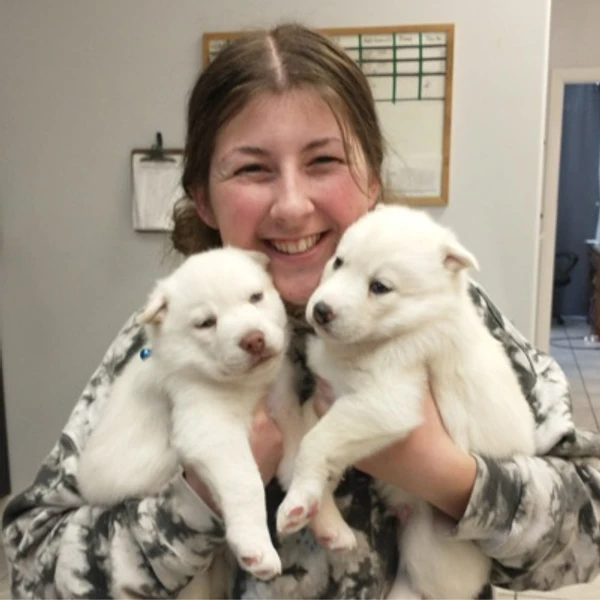
1.) My name is Kristin and I'm working on my bachelor's degree in Earth Science Education at Utah Valley University after completing my minor in Family Science. My goal is to become a middle school or high school Earth Science teacher. Our planet has always fascinated me. I've always wondered things like, "Why is the sky blue?". I want to share my curiosity with my future students.
Throughout college, I've spent countless hours volunteering and observing local classrooms. Doing this has made me realize that teaching is meant for me. I want my students to understand that science isn't all about memorizing fancy vocabulary words or fun facts for a test. To me, science is is about asking questions, solving problems, analyzing evidence, and truly understanding why our planet works the way it does.
If I could do anything with my life, I want to build a classroom where each student feels safe, validated, and comfortable being curious. I think a lot of people think scientists look like Albert Einstein, with the white hair and a lab coat. I want to teach my students that anyone can be a scientist, you don't have to look like Albert Einstein or Bill Nye to participate in science.
My motivation comes from my understanding that a teacher's influence can shape someone's life beyond the classroom. I want my students to be able to leave my classroom knowing it's okay to be curious and interested in the world around them, that doesn't make you a "nerd". I want them to leave my classroom feeling more confident in themselves and their abilities.
2.) What excites me the most about STEM is that there's always questions to ask and answers to find. My favorite thing about my content is the unknown. I love it when my professors say, "This is a process or system the Earth has but we're not sure of the exact reason why this happens." Studying Earth Science is multidisciplinary, I've explored our planet through geology, chemistry, physics, meteorology and math. I've used physics and math to measure geological structures such as fault lines or crater impacts, I've used chemistry to understand Earth Materials and minerology. I've used mapping technology such as GIS to map fault lines, mountains, and craters. Each of these disciplines are not separate and isolated from one another, they can work together to help find answers to real questions.
Tech is becoming more important to finding answers. Earth scientists rely on technology to collect and analyze data from things like volcano eruptions, earth quakes, weather climate, oceans, and changes on Earth's surface. As someone who is gong to be a teacher someday, I see information technology as a way to make this type of data and information more accessible to students.
I may not be pursing a traditional career in IT or tech, but technology has played an important role in my STEM career so far, I think it will continue doing so. I want my students to work with real digital mapping models, simulations, and data like I have during my time as a student. I think textbooks are valuable but having hands on experiences with the technology that geologists use in their jobs, is priceless. I also would like to teach my students that not all information is good or reliable information, I would like to teach them digital literacy. It's important to recognize credible scientific resources, instead of a click bait, fear mongering headline from an influencer.
I know I can make an optimistic impact by helping the next generation of scientific and technologically literate students. Some of my students may go on to have careers as engineers, programmers, researchers, professors or teachers themselves, and perhaps as a geologist. Even if my students don't want a career in Earth Science or in the sciences at all, I want to give them the confidence and skills to believe that they can accomplish hard things.
3.) The greatest challenge I’ve faced hasn’t been one single moment. It has been learning how to keep moving forward when several difficult experiences happened within a relatively short time span in my personal life.
On September 10, 2025, I was present during the tragic event involving Charlie Kirk on my college campus. Not to be too graphic, I ran off of campus that day, fearing for my life as I thought a mass casualty event was about to occur at my school. Returning to campus afterward was difficult. I still had classes to attend, assignments to complete, and a degree I wanted to finish. Presently, I sometimes struggle with the memory of this day. I have to walk past where the tragedy occurred, where I ran - fearing for my life - on a daily basis.
In January, I unexpectedly lost my grandmother, who was like a second mom to me and one of my biggest supporters. In May, I lost my uncle to health complications. He had spent his career as an elementary school teacher, and hearing his former students speak at his funeral about the impact he had on their lives reminded me why I want to become a teacher. During this time, my husband and I faced significant financial challenges. Between major dental expenses, unexpected car repairs, owing taxes, tuition, and reduced work hours while I attend classes, there's been many moments where I wonder if college is worth all this headache.
These experiences have taught me what resilience means. To me, being strong doesn’t mean that hard things don’t influence you. It means choosing to keep going even when life feels overwhelming. I can’t change what has happened in my past, and I don’t think moving forward means forgetting these difficult moments. For me, resilience means continuing to show up, work toward my degree, and not giving up on the future I’ve worked so hard for. So, why give up now? As the resilient scientist I am, I'm going to stay curious and keep finding answers to questions.