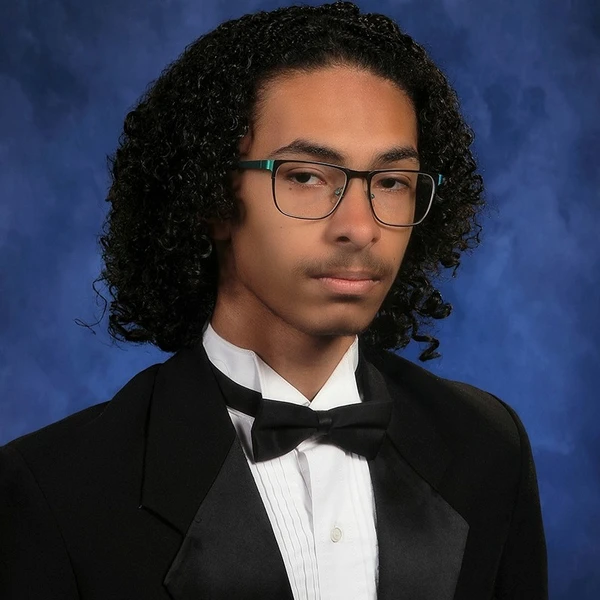
Ethnicity
Black/African
Kiran Patterson-Tanski
2x
FinalistKiran Patterson-Tanski
2x
FinalistBio
Kiran Patterson-Tanski is an aspiring composer and
multi-instrumentalist from Buffalo, New York. His love for
music began as a toddler, picking up a violin at age four.
Since then, he has excelled at the violin and turned his
attention to other stringed instruments. He taught
himself the fundamentals of viola, mandolin, and guitar
while composing original music scores and soundtracks.
Kiran was recently accepted into Howard University’s
Bachelor of Music in General Performance and plans to declare a Composition
major in his junior year. He hopes to develop his craft further and join a band or ensemble with his peers there. Classical composers, such as Béla Bartók, Brahms, and Sergei Rachmaninoff, and contemporary musicians like Little Cake and Simon Chylinski, inspired his compositions. He self-produces his work using Ableton and MuseScore 4. Kiran enjoys busking with his sister, playing video games, and reading science fiction. His long-term goals include writing for
ensembles, film, and media, publishing schools, and finding ways to mentoryounger musicians.
Education
Howard University
Bachelor's degree programMajors:
- Music
Minors:
- Visual and Performing Arts, General
Buffalo Academy For The Visual & Performing Arts
High SchoolMiscellaneous
Desired degree level:
Bachelor's degree program
Graduate schools of interest:
Transfer schools of interest:
Majors of interest:
- Music
Career
Dream career field:
Music
Dream career goals:
music career
Sports
Cross-Country Running
Varsity2022 – 20242 years
Arts
orchestra
Musichttps://linktr.ee/Aphidexe2011 – 2025
Public services
Public Service (Politics)
Independant Project — helped design and distribute qr code that led participants to a "rick-roll" and then a rock the vote link on their phones to increase youth voter registration2024 – 2024Volunteering
Independant Project — helped design and distribute qr code that led participants to a "rick-roll" and then a rock the vote link on their phones to increase youth voter registration2024 – 2024
Second Chance Scholarship
I struggle with dysgraphia, which affects my ability to write in a way that others can read. My disability has affected me throughout my childhood and into my college experience. I got poor grades in writing and spelling in elementary school because no one could read my work. It is a less common learning disability than dyslexia or ADHD, so it took a while for the correct diagnosis and treatment. Sometimes I think my teachers thought I was lazy, uncooperative, or just unintelligent.
Since I don't know what it's like to have legible handwriting, it's hard to say exactly how it affected me as a young child. Bad grades, a dislike of writing, frustration, lowered expectations, and tedious work assigned by teachers who underestimated me were some of the effects. It took a couple of years to get a diagnosis, therapy, and accommodations in elementary school. It was in 4th or 5th grade when I got a scribe for tests, a laptop, and typing instructions for classwork and homework.
Even if writing has never been my strong suit, my musical journey started as a toddler. I entertained myself by pretending to play a simulated violin with rubber bands tied around a macaroni box and a small stick under my chin. When I was four, I began playing the violin and attending weekly lessons. Throughout elementary and middle school, and even during the COVID-19 lockdowns, I continued taking violin lessons because my mother always wanted me to have something I could excel at. I struggled academically in elementary school but loved playing the violin. My parents found a locally respected African-American violin teacher named Mr. Henri Khan Mohammad. His influence significantly impacted my life positively. Before this, I had not had the experience and influence of an African-American man as a music teacher. As a result, I became more confident. This confidence improved my grades in high school and helped me get into Howard University. Music has been a source of hope and empowerment, showing that growth and success are possible despite challenges.
Now that I’m in college, I've struggled with my grades, especially on longhand written exams, but I've still succeeded in violin performance, music composition, and music overall. Next semester, I will seek more help with any assignments that require writing by getting in-class support, such as a scribe for exams, a note-taker, and digital aids like speech-to-text. Although I struggle with writing, I can lean on my strengths in music and the confidence I gain from technical achievement and self-expression to help me through college.
Lotus Scholarship
My parents divorced when I was 9 years old, and I am both African American and someone who struggles with dysgraphia. These identities have shaped my path by shaping how I was understood in school and by strengthening my confidence, resilience, and commitment to music, culture, and community.
I struggle with dysgraphia, which affects my ability to write in a way that others can read. I got poor grades in writing and spelling in elementary school because no one could read my work. It is a less common learning disability than dyslexia or ADHD, so it took a while for the correct diagnosis and treatment. My teachers thought I was lazy, uncooperative, or just unintelligent. Bad grades, frustration, lowered expectations, and tedious work assigned by teachers who underestimated me were some of the effects.
When I was 11, my mother had to move out of state to find work. Meaning my sister and I had to travel 4 hours for visits every other weekend. A direct result of growing up with low-income, single parents. As a result, I grew up in Buffalo, New York, and Pittsburgh, Pennsylvania, as a multiracial person, but I didn’t always have many positive Black influences. However, my parents found a respected local African-American violin teacher; I became more confident, and my high school grades improved, which helped me gain admission to Howard University. Music became a source of hope and empowerment, showing that growth and success are possible despite challenges. This connection to community and culture is vital for fostering pride and resilience.
I attend Howard University, an HBCU, to join a supportive community and to have closer ties to my history and culture. I am committed to music, education, and using my experiences to help create opportunity, confidence, and representation for others like me.
Dr. G. Yvette Pegues Disability Scholarship
I struggle with dysgraphia, which affects my ability to write in a way that others can read. My disability has affected me throughout my childhood and into my college experience. I got poor grades in writing and spelling in elementary school because no one could read my work. It is a less common learning disability than dyslexia or ADHD, so it took a while for the correct diagnosis and treatment. Sometimes I think my teachers thought I was lazy, uncooperative, or just unintelligent.
Since I don't know what it's like to have legible handwriting, it's hard to say exactly how it affected me as a young child. Bad grades, a dislike of writing, frustration, lowered expectations, and tedious work assigned by teachers who underestimated me were some of the effects. It took a couple of years to get a diagnosis, therapy, and accommodations in elementary school. It was in 4th or 5th grade when I got a scribe for tests, a laptop, and typing instructions for classwork and homework.
Even if writing has never been my strong suit, my musical journey started as a toddler. I entertained myself by pretending to play a simulated violin with rubber bands tied around a macaroni box and a small stick under my chin. When I was four, I began playing the violin and attending weekly lessons. Throughout elementary and middle school, and even during the COVID-19 lockdowns, I continued taking violin lessons because my mother always wanted me to have something I could excel at. I struggled academically in elementary school but loved playing the violin. My parents found a locally respected African-American violin teacher named Mr. Henri Khan Mohammad. His influence significantly impacted my life positively. Before this, I had not had the experience and influence of an African-American man as a music teacher. As a result, I became more confident. This confidence improved my grades in high school and helped me get into Howard University. Music has been a source of hope and empowerment, showing that growth and success are possible despite challenges.
Now that I’m in college, I've struggled with my grades, especially on longhand written exams, but I've still succeeded in violin performance, music composition, and music overall. Next semester, I will seek more help with any assignments that require writing by getting in-class support, such as a scribe for exams, a note-taker, and digital aids like speech-to-text. Although I struggle with writing, I can lean on my strengths in music and the confidence I gain from technical achievement and self-expression to help me through college.
Erin Lanae's HBCU Excellence Scholarship
I love attending Howard University, an HBCU, to be part of a supportive community and to foster closer ties to my history and culture. I grew up in Buffalo, New York, and Pittsburgh, Pennsylvania, and I didn’t always have many black influences as a child. I struggled academically in elementary school but loved playing the violin. My parents found a local African-American violin teacher. His influence had a profoundly positive impact on my life. As a result, I became more confident.
I’m also interested in history, especially the stories of African Americans. History will help teach us how to be better people. Initially, I wanted to minor in African American history to learn more about America’s history through the eyes of Black people and how it differs from the rest of the history. There are several reasons why I'd like to attend Howard University, and I believe I’d benefit from the campus. Of course, I want to improve my performance and composition skills during my undergraduate journey.
Diane Amendt Memorial Scholarship for the Arts
Music is my favorite thing and is an inherent part of my being. Without music, I would not know who I am. Music has always been a significant part of my life. I practice the violin, viola, mandolin, and guitar continually.
Additionally, I compose scores and soundtracks. My musical journey started as a toddler. I entertained myself by pretending to play a simulated violin with rubber bands tied around a macaroni box with a small stick under my chin. I started playing a real violin and attending weekly lessons when I was four. As time passed, I felt drawn to the cello, but a cello wouldn't fit in my family car, so I chose the violin. Around the age of six, I had my first concert. By seven, my parents would drive to Tonawanda (from Buffalo) for weekend lessons, even through winter. I continued my lessons, but I began weekly lessons locally in Buffalo by the time I was ten years old. At age fourteen, after a decade of working on my craft, I was accepted into Buffalo Academy for Visual and Performing Arts High School. Then I started playing in an orchestra, learned about the viola as a separate instrument, and began saving money to buy one for myself. So, after a year of saving money by busking, I purchased a lightly used viola and loved it despite its flaws and misgivings.
My relationship with music grew during COVID, and I began to study guitar. I play all my instruments frequently to improve because music is my passion. If accepted while attending Howard, I plan to join a band with classmates and graduate with honors. Longer-term goals include attending graduate school for performance, composing and publishing musical scores, and gaining representation from an agency. I’d also like to be part of a small string ensemble. During my undergraduate journey, I’d also like to research and prepare for financial independence, entrepreneurship, and ways to serve the community. Eventually, I’d like to start an annual scholarship, grant, or private fund to support musicians with financial constraints and help them reach their goals.
To support these goals, I will engage in informational interviews and seek mentorship from leaders. I keep myself balanced and grounded in my world by writing music, connecting with friends, drawing, cooking, camping, running cross-country, playing video games, and resting when necessary. I spend two hours per day writing music, in addition to practicing instruments. I use Ableton and MuseScore 4. I am proud to have self-published on Soundcloud. Inspirations include Béla Bartók, Johann Brahms, Little Cake, and Sergei Rachmaninoff. My process starts with the piano, finding a key to fiddle with, adding more instruments, and mixing them. I work in my studio sessions during the day and evening year-round.
There are many reasons why I would like to attend Howard. Primarily, I want to improve my performance and composition skills. I will be able to thrive at Howard. I struggled academically in elementary school, but I only loved the violin. My parents found a locally respected African-American violin teacher named Mr. Mohammad. His influence significantly impacted my life positively. Before this, I had not had the experience and influence of an African-American man as a music teacher. As a result, I became more confident. When I applied for the Buffalo Academy for Visual and Performing Arts, I was already well-versed in my musicianship and firmly committed to practicing. Howard is a tight-knit community where students can be mutually supportive and collaborate. It will bolster my success as a musician and composer and help me realize my dreams.
RonranGlee Literary Scholarship
The Weight of Memory in Jamaica Kincaid’s “Biography of a Dress”
In Jamaica Kincaid’s “Biography of a Dress,” she tells a story that starts out feeling simple—just a memory of a yellow dress. But once you get into it, it’s clear the essay isn’t just about clothing. Kincaid uses that dress, along with details like her ears being pierced and the food she grew up eating, to talk about bigger things: poverty, gender expectations, and the influence of colonialism. What first feels like nostalgia turns into something much heavier.
Kincaid writes from the perspective of her adult self, looking back on her childhood in Antigua. That’s what makes the story so layered. For example, she remembers having her ears pierced as a baby. At the time, it wasn’t her choice—it was just what was done. However, when she reflects on it later, she realizes it is tied to beauty standards and notions of femininity. The dress works the same way. It’s not just fabric; it becomes a symbol of pressure, identity, and culture.
One thing I noticed is how her story connects with different types of readers. People who grew up in the Caribbean might relate directly to her experience, while others—like me—might start to understand how much colonialism shaped everyday life there. Even something as simple as her meals, which she describes as consisting of cornmeal for breakfast, lunch, and dessert, goes beyond food. It shows how poverty shaped her childhood, but also how larger systems controlled what was available to families like hers.
The dress is at the heart of all this. She admits, “I never did find out what the occasion it was made for,” which says a lot. The dress was supposed to mean something, but its meaning never became clear—kind of like her own uncertain place in all those expectations. That’s why her tone flips back and forth. Sometimes the dress is a warm memory, but other times it feels like a symbol of obligation and standards she couldn’t escape.
One line that stuck with me is, “We were poor. The dress was not.” In just a few words, she shows the gap between her family’s reality and the value they placed on appearances. In the broader context, that line also highlights Antigua’s colonial history and the impact of British standards on everything from clothing to behavior.
What makes the essay even stronger is the fact that she wrote it after leaving Antigua. With that distance, she’s able to unpack her childhood in ways she couldn’t at the time. It shows that memory isn’t just about what happened—it’s about what it means when you look back later. For me as a reader, it made me think about how culture and history shape us, even in small details we don’t notice at first.
When I first read the essay, I mainly saw the dress as a symbol of femininity and how those expectations were placed on her at such a young age, as evident in her pierced ears. However, as I read again, the sections about poverty and food struck me harder. At first, I brushed past the constant mention of cornmeal because it didn’t seem necessary. I didn’t grow up poor, so I didn’t think much about it. But then I realized it showed how limited her family’s options really were. That made me reflect on how my own perspective shaped the way I read her story and how easily I can miss things because of my own background.
Ultimately, Kincaid’s essay demonstrates that memory isn’t merely personal—it is intricately tied to family pressure, gender roles, and colonial history. The yellow dress is a way into all of that. What starts off sounding like a childhood memory grows into something much bigger: a reflection on how culture shapes us, and how important it is to recognize our own biases when we read. That’s what makes her story powerful—it doesn’t just stay in the past, it keeps pushing readers to think about themselves, too.
Hines Scholarship
Educational Career and Life Goals
I intend to major in music. Music is my favorite thing and is an inherent part of my being. Without music, I would not know who I am. Music has always been a significant part of my life. I practice the violin, viola, mandolin, and guitar continually. Additionally, I spend time composing scores and soundtracks.
My musical journey started as a toddler. I entertained myself by pretending to play a simulated violin with rubber bands tied around a macaroni box and a small stick under my chin. When I was four, I started playing a real violin and attending weekly lessons.
My relationship with music grew during COVID-19. I practiced my violin for hours daily and began to teach myself guitar. By the age of fourteen, after a decade of working on my craft, I was accepted into Buffalo Academy for Visual and Performing Arts High School. Then, because of COVID-19, I played in an orchestra for the first time. I learned to communicate with an ensemble and the fun of playing with others.
When I applied to The Buffalo Academy for Visual and Performing Arts, I was already well-versed in my musicianship and firmly committed to practicing. However, even the best musicians don’t become successful on their own; I will receive a big launch in the music industry. I recognize it as a tight-knit community where students can be mutually supportive and collaborate. Howard will bolster my success as a musician and composer and support me in realizing my dreams.
While attending Howard, beyond gaining and improving intellectual abilities and musicianship skills, I plan to be part of an ensemble, create a band with classmates, and hope to graduate with honors. Longer-term goals include attending graduate school for performance, being part of a small string ensemble, composing and publishing musical scores, and gaining representation from an agency. I also plan to give back to my community through grants and education. I’m committed to music, and I believe that Howard’s Chadwick A. Boseman College of Fine Arts will prepare me to achieve my dreams. By joining a legacy of excellence and creativity, I’m confident that Howard will nurture my talents and empower me to make a meaningful impact.
I’m grateful for having an African-American violin teacher when I was younger; it gave me more confidence in my school work and myself. Education is the framework through which people take flight socially and economically to improve their community. This is why I plan to give back to my community through grants and education. I want to find ways to be of service to the community, perhaps by being that supportive teacher to a music student like myself. Bringing classical music to students who may never have had a teacher who reflects them. Eventually, I’d like to start an annual scholarship, grant, or private fund to support musicians with financial constraints and help them reach their goals. I’m committed to music, and the positive impact it can have on people and our world. I'm confident that Howard will nurture my talents and empower me to make a meaningful impact through research, service and education.
Pamela Branchini Memorial Scholarship
As a songwriter, I've come to realize that collaboration is not just a means of creating music but a catalyst for enhancing creativity. It's more than just seeking feedback on your work or spending hours in the studio with others. It's about expanding your horizons and gaining fresh perspectives. Collaboration is a transformative force in songwriting, making it one of the most valuable and productive aspects of the art. It allows others to delve into your work in ways you can't, or voice things differently, opening up new avenues of thought and refining how you express your ideas.
My earliest experiences in collaboration came from an unlikely place: playing duets with my little sister. When I was younger, my mother always made us practice together. At first, I dreaded it. My sister was just a bit behind me, and I often had to slow down or help her find the right notes. I didn’t realize then that I was learning something more important than just music. Through those sessions, I began to understand the value of teamwork and compassion. I knew that creating something beautiful often means meeting someone where they are and moving forward together. Sometimes she would even correct me, pointing out when I had rushed through a rhythm or missed a note, and I had to learn to take her criticism with grace. Those small lessons became the foundation for how I now approach musical collaboration. When two people work in harmony, they can create textures, harmonies, and melodies that neither could have achieved alone.
Collaboration is not just about playing music; it's a cornerstone of the writing process. The insights of collaborators can be a guiding light, helping to evolve your original idea.
In my personal experience, I recall a time when I was collaborating on a song with a friend and got stuck on a chord pattern. Her input not only helped me overcome the block but also guided me to the right chords to use, demonstrating the practical benefits of collaboration in overcoming creative hurdles and helping to build community, gain more knowledge, and expand my network.
In conclusion, collaboration is not just a tool for creating music but a catalyst for personal growth. Every song, in its unique way, is a conversation between emotions, experiences, and perspectives. By embracing collaboration, we not only create better music but also evolve as artists and individuals.
Diversity in Music Education Scholarship
Sloane Stephens Doc & Glo Scholarship
Educational Career and Life Goals
I intend to major in music. Music is my favorite thing and is an inherent part of my being. Without music, I would not know who I am. Music has always been a significant part of my life. I practice the violin, viola, mandolin, and guitar continually. Additionally, I spend time composing scores and soundtracks.
My musical journey started as a toddler. I entertained myself by pretending to play a simulated violin with rubber bands tied around a macaroni box and a small stick under my chin. When I was four, I started playing a real violin and attending weekly lessons.
My relationship with music grew during COVID-19. I practiced my violin for hours daily and began to teach myself guitar. By the age of fourteen, after a decade of working on my craft, I was accepted into Buffalo Academy for Visual and Performing Arts High School. Then, because of COVID-19, I played in an orchestra for the first time. I learned to communicate with an ensemble and the fun of playing with others.
When I applied to The Buffalo Academy for Visual and Performing Arts, I was already well-versed in my musicianship and firmly committed to practicing. However, even the best musicians don’t become successful on their own; I will receive a big launch in the music industry. I recognize it as a tight-knit community where students can be mutually supportive and collaborate. Howard will bolster my success as a musician and composer and support me in realizing my dreams.
While attending Howard, beyond gaining and improving intellectual abilities and musicianship skills, I plan to be part of an ensemble, create a band with classmates, and hope to graduate with honors. Longer-term goals include attending graduate school for performance, being part of a small string ensemble, composing and publishing musical scores, and gaining representation from an agency. I also plan to give back to my community through grants and education. I’m committed to music, and I believe that Howard’s Chadwick A. Boseman College of Fine Arts will prepare me to achieve my dreams. By joining a legacy of excellence and creativity, I’m confident that Howard will nurture my talents and empower me to make a meaningful impact.
I’m grateful for having an African-American violin teacher when I was younger; it gave me more confidence in my school work and myself. Education is the framework through which people take flight socially and economically to improve their community. This is why I plan to give back to my community through grants and education. I want to find ways to be of service to the community, perhaps by being that supportive teacher to a music student like myself. Bringing classical music to students who may never have had a teacher who reflects them. Eventually, I’d like to start an annual scholarship, grant, or private fund to support musicians with financial constraints and help them reach their goals. I’m committed to music, and the positive impact it can have on people and our world. I'm confident that Howard will nurture my talents and empower me to make a meaningful impact through research, service and education.
Everett J. Collins, Jr. Music Scholarship
I plan to attend Howard University, an HBCU, to have a supportive community and closer ties to my history and culture. I grew up in Buffalo, New York, and Pittsburgh, Pennsylvania, as a multiracial person, but I didn’t always have many black influences as a child. I struggled academically in elementary school but loved playing the violin. My parents found a locally respected African-American violin teacher named Mr. Henri Khan Mohammad. His influence significantly impacted my life positively. Before this, I had not had the experience and influence of an African-American man as a music teacher. As a result, I became more confident.
While attending Howard, beyond gaining and improving intellectual abilities and musicianship skills, I plan to be part of an ensemble, create a band with classmates, and hope to graduate with honors. Longer-term goals include attending graduate school for performance, being part of a small string ensemble, composing and publishing musical scores, and gaining representation from an agency.
Art and History are most important, and being involved in both has helped me grow as a musician but as a student in general. Especially art and history that celebrates the stories of African Americans. It shows how horrible things can be but how it is getting better. History will help teach us how to be better people. Initially, I might want to minor in African-American history to learn more about America’s history through the eyes of black people and how it differs from the rest of history. I’d like to explore Hip-Hop, and popular music more as a Howard student. I would bring my classical music training and love of history to these classes.
By researching African music and African American History, I could learn more about its long history, which has affected most, if not all, of the music from the American continent. From bosa nova to rap, hip hop, blues, and jazz, African American music has been essential and generally the most popular. This topic interests me because it affects popular culture, history, and, most importantly, past and present political movements. This is important to the world as it shows how culture and music have evolved and will co-evolve in the future. In time, these courses would attract a more diverse student body, which could result in more diverse music teachers, creators, and leaders in music production.
I’m grateful for having an African-American violin teacher when I was younger; it gave me more confidence in my school work and myself. Education is the framework through which people take flight socially and economically to improve their community.
I also plan to give back to my community through grants and education. I want to find ways to be of service to the community, perhaps by being that supportive teacher to a music student like myself. Bringing classical music to students who may never have had a teacher who reflects them. Eventually, I’d like to start an annual scholarship, grant, or private fund to support musicians with financial constraints and help them reach their goals. I’m committed to music, and the positive impact it can have on people and our world. I'm confident that Howard will nurture my talents and empower me to make a meaningful impact through research, service and education.
D. Cox Music Technology Scholarship
Music is my favorite thing and is an inherent part of my being. Without music, I would not know who I am. Music has always been a significant part of my life. I practice the violin, viola, mandolin, and guitar continually. Additionally, I spend time composing scores and soundtracks.
My musical journey started as a toddler. I entertained myself by pretending to play a simulated violin with rubber bands tied around a macaroni box under my chin with a small stick. When I was four years old, I started playing a real violin and attending weekly lessons.
As time passed, I felt drawn to the cello, but a cello wouldn't fit in my family car, so I chose the violin. Around the age of six, I had my first concert. By seven, my parents would drive to Tonawanda (from Buffalo) for weekend lessons, even through winter. I continued my lessons, but by the time I was ten years old, I began weekly lessons locally in Buffalo.
At age fourteen, after a decade of working on my craft, I was accepted into Buffalo Academy for Visual and Performing Arts High School. It was then that I started playing in an orchestra, learned of the viola's existence as a different instrument, and began to save money to buy one for myself.
So, after a year of saving money by busking, I purchased a lightly used viola and loved it despite its flaws and misgivings. My relationship with music grew during COVID, and I began to study guitar. I play all of my instruments frequently to get better at them because music is my passion. During my undergraduate journey, I’d also like to research and prepare for financial independence, entrepreneurship, and ways to be of service to the community. Eventually, I’d like to start an annual scholarship, grant, or private fund to support musicians with financial constraints and help them reach their goals. To support these goals, I will engage in informational interviews and seek mentorship from leaders.
I maintain balance and stay grounded in my world through activities like writing music, connecting with friends, drawing, cooking, camping, running cross country, playing video games, and resting when necessary. I spend two hours per day writing music, beyond practicing instruments. I use Ableton and MuseScore 4. I am proud to have self-published on Soundcloud.
Inspirations include Béla Bartók, Johann Brahms, Little Cake, and Sergei Rachmaninoff. My process begins with the piano, where I find a key to experiment with, and then I add more instruments and mix them. I work in my studio sessions during the day and evening year-round.
I struggled academically in elementary school, but the only thing I loved was the violin. My parents found a locally respected African-American violin teacher named Mr. Mohammad. His influence significantly impacted my life positively. I had not had the experience and influence of an African-American man as a music teacher before this. As a result, I became more confident.
When I applied for the Buffalo Academy for Visual and Performing Arts, I was already well-versed in my musicianship and had a steady commitment to practicing. Purchase is a smaller school where I will receive specific attention. I recognize it as a tight-knit community where students can be mutually supportive and collaborate. Purchasing this will bolster my success as a musician and composer, supporting the actualization of my dreams.
Jacob Kelly Memorial Scholarship for Arts and Music
Music is my favorite thing and is an inherent part of my being. Without music, I would not know who I am. Music has always been a significant part of my life. I practice the violin, viola, mandolin, and guitar continually. Additionally, I spend time composing scores and soundtracks.
My musical journey started as a toddler. I entertained myself by pretending to play a simulated violin with rubber bands tied around a macaroni box under my chin with a small stick. When I was four years old, I started playing a real violin and attending weekly lessons.
As time passed, I felt drawn to the cello, but it wouldn't fit in my family car, so I chose the violin. Around the age of six, I had my first concert. By seven, my parents would drive to Tonawanda (from Buffalo) for weekend lessons, even through winter. I continued my lessons, but by the time I was ten years old, I began weekly lessons locally in Buffalo.
At age fourteen, after a decade of working on my craft, I was accepted into Buffalo Academy for Visual and Performing Arts High School. It was then that I started playing in an orchestra, discovered the oboe as a distinct instrument, and began to save money to buy one for myself.
So, after a year of saving money by busking, I purchased a lightly used viola and loved it despite its flaws and misgivings. My relationship with music grew during COVID, and I began to study guitar. I play all of my instruments frequently to get better at them because music is my passion. During my undergraduate journey, I’d also like to research and prepare for financial independence, entrepreneurship, and ways to be of service to the community. Eventually, I’d like to start an annual scholarship, grant, or private fund to support musicians with financial constraints and help them reach their goals. To support these goals, I will engage in informational interviews and seek mentorship from leaders.
I maintain balance and stay grounded in my world through activities like writing music, connecting with friends, drawing, cooking, camping, running cross country, playing video games, and resting when necessary. I spend two hours per day writing music, beyond practicing instruments. I use Ableton and MuseScore 4. I am proud to have self-published on Soundcloud.
Inspirations include Béla Bartók, Johann Brahms, Little Cake, and Sergei Rachmaninoff. My process begins with the piano, where I experiment with a key, and then I add more instruments and mix them. I work in my studio sessions during the day and evening year-round.
Delories Thompson Scholarship
I plan to attend Howard University, an HBCU, to be part of a supportive community and to foster closer ties to my history and culture. I grew up in Buffalo, New York, and Pittsburgh, Pennsylvania, and I didn’t always have many black influences as a child. I struggled academically in elementary school but loved playing the violin. My parents found a local African-American violin teacher. His influence had a profoundly positive impact on my life. As a result, I became more confident. I’m grateful for having an African-American violin teacher when I was younger Education is the framework through which people take flight socially and economically to improve their community.
I also plan to give back to my community through grants and education. I want to find ways to be of service to the community, perhaps by being that supportive teacher to a music student like myself.
I’m also interested in history, especially the stories of African Americans. History will help teach us how to be better people. Initially, I wanted to minor in African American history to learn more about America’s history through the eyes of Black people and how it differs from the rest of the history. There are several reasons why I'd like to attend Howard University, and I believe I’d benefit from the campus. Of course, I want to improve my performance and composition skills during my undergraduate journey.
Marshall and Dorothy Smith Music Scholarship
Music is my favorite thing and is an inherent part of my being. Without music, I would not know who I am. Music has always been a significant part of my life. I practice the violin, viola, mandolin, and guitar continually.I spend time composing scores and soundtracks.
My musical journey started as a toddler. I entertained myself by pretending to play a simulated violin with rubber bands tied around a macaroni box with a small stick under my chin. I started playing a real violin and attending weekly lessons when I was four. As time passed, I felt drawn to the cello, but a cello wouldn't fit in my family car, so I chose the violin. Around the age of six, I had my first concert. By seven, my parents would drive to Tonawanda (from Buffalo) for weekend lessons, even through winter. I continued my lessons, but I began weekly lessons locally in Buffalo by the time I was ten years old. At age fourteen, after a decade of working on my craft, I was accepted into Buffalo Academy for Visual and Performing Arts High School. Then, I started playing in an orchestra, learned of the viola's existence as a different instrument, and began to save money to buy one for myself. So, after a year of saving money by busking, I purchased a lightly used viola and loved it despite its flaws and misgivings.
My relationship with music grew during COVID, and I began to study guitar. I play all of my instruments frequently to get better at them because music is my passion. If accepted while attending Howard, beyond gaining and improving intellectual and musicianship skills, I plan to join a band with classmates and graduate with honors. Longer-term goals include attending graduate school for performance, composing and publishing musical scores, and gaining representation from an agency. I’d also like to be part of a small string ensemble. During my undergraduate journey, I’d also like to research and prepare for financial independence, entrepreneurship, and ways to serve the community. Eventually, I’d like to start an annual scholarship, grant, or private fund to support musicians with financial constraints and help them reach their goals.
To support these goals, I will engage in informational interviews and seek mentorship from leaders. I keep balance and grounded in my world by writing music, connecting with friends, drawing, cooking, camping, running cross country, playing video games, and resting when necessary. I spend two hours per day writing music, beyond practicing instruments. I use Ableton and MuseScore 4. I am proud to have self-published on Soundcloud. Inspirations include Béla Bartók, Johann Brahms, Little Cake, and Sergei Rachmaninoff. My process starts with the piano, finding a key to fiddle with, adding more instruments, and mixing them. I work in my studio sessions during the day and evening year-round.
I want to improve my performance and composition skills. I will be able to thrive at Howard. I struggled academically in elementary school, but I only loved the violin. My parents found a locally respected African-American violin teacher named Mr. Mohammad. His influence significantly impacted my life positively. Before this, I had not had the experience and influence of an African-American man as a music teacher. As a result, I became more confident. When I applied for the Buffalo Academy for Visual and Performing Arts, I was already well-versed in my musicianship and firmly committed to practicing. Howard is a tight-knit community where students can be mutually supportive and collaborate. It will bolster my success as a musician and composer and help me realize my dreams.
Willie Mae Rawls Scholarship
How will I Give Back
I plan to attend Howard University, an HBCU, to have a supportive community and closer ties to my history and culture. I grew up in Buffalo, New York, and Pittsburgh, Pennsylvania, as a multiracial person, but I didn’t always have many black influences as a child. I struggled academically in elementary school but loved playing the violin. My parents found a locally respected African-American violin teacher named Mr. Henri Khan Mohammad. His influence significantly impacted my life positively. Before this, I had not had the experience and influence of an African-American man as a music teacher. As a result, I became more confident.
While attending Howard, beyond gaining and improving intellectual abilities and musicianship skills, I plan to be part of an ensemble, create a band with classmates, and hope to graduate with honors. Longer-term goals include attending graduate school for performance, being part of a small string ensemble, composing and publishing musical scores, and gaining representation from an agency.
Art and History are most important, and being involved in both has helped me grow as a musician but as a student in general. Especially art and history that celebrates the stories of African Americans. It shows how horrible things can be but how it is getting better. History will help teach us how to be better people. Initially, I might want to minor in African-American history to learn more about America’s history through the eyes of black people and how it differs from the rest of history. I’d like to explore Hip-Hop, and popular music more as a Howard student. I would bring my classical music training and love of history to these classes.
By researching African music and African American History, I could learn more about its long history, which has affected most, if not all, of the music from the American continent. From bosa nova to rap, hip hop, blues, and jazz, African American music has been essential and generally the most popular. This topic interests me because it affects popular culture, history, and, most importantly, past and present political movements. This is important to the world as it shows how culture and music have evolved and will co-evolve in the future. In time, these courses would attract a more diverse student body, which could result in more diverse music teachers, creators, and leaders in music production.
I’m grateful for having an African-American violin teacher when I was younger; it gave me more confidence in my school work and myself. Education is the framework through which people take flight socially and economically to improve their community.
I also plan to give back to my community through grants and education. I want to find ways to be of service to the community, perhaps by being that supportive teacher to a music student like myself. Bringing classical music to students who may never have had a teacher who reflects them. Eventually, I’d like to start an annual scholarship, grant, or private fund to support musicians with financial constraints and help them reach their goals. I’m committed to music, and the positive impact it can have on people and our world. I'm confident that Howard will nurture my talents and empower me to make a meaningful impact through research, service and education.
ESOF Academic Scholarship
How will I Give Back
I plan to attend Howard University, an HBCU, to have a supportive community and closer ties to my history and culture. I grew up in Buffalo, New York, and Pittsburgh, Pennsylvania, as a multiracial person, but I didn’t always have many black influences as a child. I struggled academically in elementary school but loved playing the violin. My parents found a locally respected African-American violin teacher named Mr. Henri Khan Mohammad. His influence significantly impacted my life positively. Before this, I had not had the experience and influence of an African-American man as a music teacher. As a result, I became more confident.
While attending Howard, beyond gaining and improving intellectual abilities and musicianship skills, I plan to be part of an ensemble, create a band with classmates, and hope to graduate with honors. Longer-term goals include attending graduate school for performance, being part of a small string ensemble, composing and publishing musical scores, and gaining representation from an agency.
Art and History are most important, and being involved in both has helped me grow as a musician but as a student in general. Especially art and history that celebrates the stories of African Americans. It shows how horrible things can be but how it is getting better. History will help teach us how to be better people. Initially, I might want to minor in African-American history to learn more about America’s history through the eyes of black people and how it differs from the rest of history. I’d like to explore Hip-Hop, and popular music more as a Howard student. I would bring my classical music training and love of history to these classes.
By researching African music and African American History, I could learn more about its long history, which has affected most, if not all, of the music from the American continent. From bosa nova to rap, hip hop, blues, and jazz, African American music has been essential and generally the most popular. This topic interests me because it affects popular culture, history, and, most importantly, past and present political movements. This is important to the world as it shows how culture and music have evolved and will co-evolve in the future. In time, these courses would attract a more diverse student body, which could result in more diverse music teachers, creators, and leaders in music production.
I’m grateful for having an African-American violin teacher when I was younger; it gave me more confidence in my school work and myself. Education is the framework through which people take flight socially and economically to improve their community.
I also plan to give back to my community through grants and education. I want to find ways to be of service to the community, perhaps by being that supportive teacher to a music student like myself. Bringing classical music to students who may never have had a teacher who reflects them. Eventually, I’d like to start an annual scholarship, grant, or private fund to support musicians with financial constraints and help them reach their goals. I’m committed to music, and the positive impact it can have on people and our world. I'm confident that Howard will nurture my talents and empower me to make a meaningful impact through research, service and education.