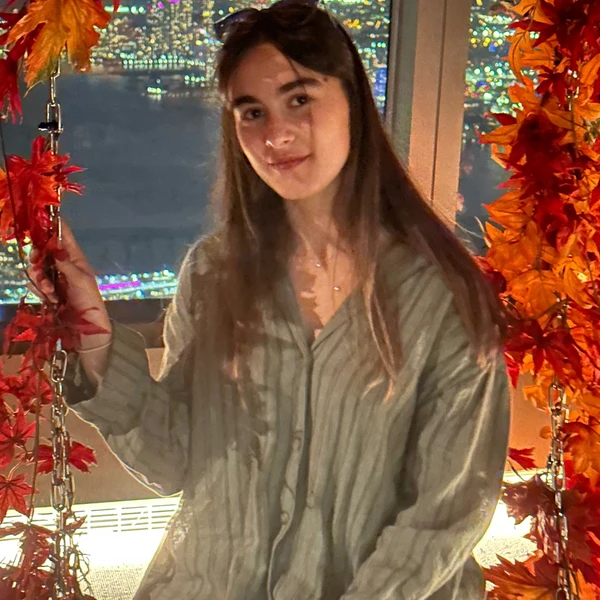
Karyna Boncheva
1x
Finalist1x
WinnerKaryna Boncheva
1x
Finalist1x
WinnerBio
My name is Karyna Boncheva, and I am a senior at John Dewey High School in Brooklyn, NY. Alongside my studies, I work part-time in the service industry and tutor elementary and middle school students in math, reading, and languages. Balancing school, work, and tutoring has taught me responsibility, patience, and strong communication skills. I plan to study economics or finance in college and aim to pursue a career in investment banking, where I can combine analytical thinking with leadership.
Education
John Dewey High School
High SchoolMiscellaneous
Desired degree level:
Master's degree program
Majors of interest:
- Finance and Financial Management Services
Career
Dream career field:
Banking
Dream career goals:
Minority Single Mother Scholarship
I was nine years old, walking home from school with a medal in my backpack and a thought I didn’t know how to name yet. That morning, I had won my school’s history Olympiad, and my teacher told me I would compete at the regional level. For me, it wasn’t just about history. It felt like proof—that even a girl from a family sinking deeper into poverty could still move upward. I already understood, in a quiet way, that success might be the only thing capable of pulling us out of the life my mother was stuck in. I didn’t say it out loud, but I carried it like a promise: if I did well enough, maybe things could change.
That promise broke the moment I opened the door to our apartment.
My mother was on the floor, crying, blood pooling beneath her. In the next room, my father sat drunk with his friends, laughing as if nothing had happened. I was terrified—more terrified than I had ever been—but there was no time to stop. I called the ambulanceand police. My hands shook as I tried to sound calm.The pride of the morning disappeared, replaced by fear and something sharper. I remember thinking, very clearly, that no one else was going to protect her. So I would. Whatever that meant.
After that day, choices stopped being abstract. Candy meant less money for milk.Toys were replaced by routines—counting bills, stretching paychecks, deciding what could wait.While other kids asked for birthday gifts, I learned how to keep things from falling apart.
When war broke out in Ukraine,that instinct to protect turned into movement. My mother, my younger brother, and I left everything and came to New York. She had no support system, so I became part of it. I worked long shifts, balanced school, translated systems that were never designed for us, and learned quickly how easy it is to be shut out when you don’t know the rules.I didn’t grow up with mentors.I became one—first for my brother, then for my mother, and eventually for myself.
I didn’t grow up faster because I wanted to.I learned to think carefully because mistakes were expensive.I learned early how bureaucracy drains dignity—how one missing document can mean no medicine,how policies don’t fail in general, but fail someone specific.Usually the quiet,families like mine.
This is why I want to study finance.Not because I imagine Wall Street,but because I’ve lived what financial instability does to people.When others talk about money, I think about what happens when there isn’t enough—and how every decision suddenly carries weight.To me, finance is about structure:how systems are built, who they protect, and who they leave exposed.
Stability, for my family, would have meant predictability.It would have meant paychecks that arrived on time, medicine that didn’t require sacrifice, a childhood where fear wasn’t part of daily planning.If families like mine had access to real financial literacy and fair systems, children wouldn’t have to grow up before they were ready.
I don’t dream of a career just for myself. I want to understand how systems can absorb pressure instead of collapsing under it—how survival can become growth. I want to learn not only how to rise out of instability, but how to change the conditions that create it.
My story has always been tied to my family’s survival. My future, I hope, will be tied to others’ ability to live without fear of the next bill, the next crisis, the next decision they cannot afford to make. That is what stability means to me—not the absence of struggle, but the presence of possibility.
Kristinspiration Scholarship
Education is important to me because it gave me language, structure, and power when my life felt unstable and uncertain. Before coming to the United States, my world was shaped by forces I could not control—economic insecurity, corruption, and the constant feeling that effort did not always lead to opportunity. When my family moved to America three years ago, education became the first system that felt fair: if I worked, learned, and persisted, I could move forward. It was not easy, but it was clear—and that clarity changed everything for me.
At first, school was overwhelming. I was learning in a new language while adjusting to a new culture, taking on responsibilities at home, and working part-time to support my family. But education gave me more than grades or credits; it gave me understanding. Through economics, history, and literature, I began to see patterns behind what I had lived through. I learned how financial systems shape inequality, how policy decisions affect real families, and why instability is often structural—not personal failure. For the first time, my past made sense. Education allowed me to transform fear and confusion into analysis and purpose, into goal, which is with me, I still carry in my heart.
Balancing school and work taught me discipline and resilience. I learned how to manage time under pressure, how to show up prepared even when exhausted, and how to advocate for myself in unfamiliar spaces. Education became my way of “engineering stability”—not just academically, but emotionally and financially. Each class, each exam, and each essay felt like a step toward control over my future, rather than reacting to circumstances around me.
Because of this, the legacy I hope to leave is one of access and stability. I want to build systems—through finance, policy, or education—that reduce uncertainty for others who grow up without safety nets. I don’t want success to feel accidental or reserved for a few; I want it to feel designed, reachable, and sustainable. I hope to mentor younger students, especially immigrants and first-generation students, showing them that confusion is not weakness and that asking questions is a form of strength.
My legacy is not about titles or wealth alone. It is about proving that education can be a bridge between survival and agency. I want people to say that I used what I learned not only to advance myself, but to create opportunities for others—to turn knowledge into structure, and ambition into something that lasts.
Dream BIG, Rise HIGHER Scholarship
My goals did not begin in comfort; they were born out of survival. Before coming to the United States, I lived in a home shaped by poverty, fear, and instability. I grew up watching my mother suffer and learned early that I could not rely on adults, on the system, or on luck. I could only rely on school. Education was the one place where effort mattered, where I felt safe, and where I believed that a different life might be possible. I became one of the top students not because learning was easy, but because education felt like the only door that could lead me and my mother away from the life we were trapped in.
My childhood was marked by corruption, scarcity, and constant uncertainty. There were days when I collected coins to buy bread, days when my parents drank because escaping reality felt easier than facing it, and days when I felt older than I was because survival demanded it. Financial instability wasn’t a concept to me—it was my daily life. Inflation wasn’t a chapter in a textbook—it was why food prices doubled overnight. Inequality wasn’t a statistic—it was the reason my family couldn’t afford basic things. These experiences taught me something long before any classroom did: if I wanted a different future, I had to create it myself, and education was the only tool I had.
Leaving my country was not a hopeful choice—it was a necessary one. My family left because staying meant danger, and leaving meant the slim possibility of safety. My father remained behind, and even though that separation was painful, it was also the moment I realized that survival sometimes requires letting go of what hurts you. We came to the United States with almost nothing—no savings, no stability, and no clear path forward. But we arrived with a fierce desire to rebuild our lives.
When I walked into my new high school three years ago, I carried both determination and fear. I couldn’t understand my teachers, I didn’t know the rules, and every hallway felt unfamiliar. I felt like I was starting from zero all over again. But I also knew that giving up was impossible. I had built my entire identity around effort, discipline, and the belief that education could save us. So even when I didn’t understand the language, I understood my purpose. And that was enough to keep me moving.
My understanding of education changed once I began taking subjects like economics and statistics in the U.S. Learning about supply, demand, inflation, and inequality was not just interesting—it was personal. For the first time, I had words and concepts that explained the conditions I grew up in. I could finally understand why families like mine struggled and why stability felt impossible. Studying economics didn’t distance me from my past—it clarified it. It showed me that what I lived through wasn’t just “bad luck,” but the product of systems, choices, and structures that failed the most vulnerable.
Taking college-level statistics through the University at Albany deepened that understanding even more. I learned that numbers can reveal truths emotions often hide and that data can expose problems society ignores. Each lesson made me realize how powerful financial knowledge can be. It can guide communities, protect families, and create opportunities where none existed. These classes did not just shape my interests—they gave me direction. They helped me understand that finance is not simply about money; it is about stability, protection, and change.
Working while studying was not a challenge—it was a necessity. When we arrived in America, we started from nothing. There were no savings to fall back on, no relatives to help us, and no safety net. So I began working as soon as I could. Some days I went straight from school to a shift and didn’t return home until late at night. Other days I studied on the bus or during short breaks. I wasn’t balancing school and work because I was ambitious; I was doing it because survival required it. These responsibilities didn’t weaken me—they taught me discipline, resilience, and the true value of every opportunity I earn.
At the same time, education opened doors for me to help others. I began tutoring younger students, especially recent immigrants who felt the same confusion and fear I once did. Watching them grow more confident and helping them understand subjects I had once struggled with reminded me of the real power of education. It isn’t just about success—it is about dignity, hope, and belief in oneself. Helping others made me realize that whatever career I pursue, I want it to involve giving others the tools to build their futures.
Today, my goals are clearer than ever. I want to study finance and eventually work in investment banking—not for prestige, but because financial literacy and access can transform lives. I want to create programs that teach financial education in underserved communities, develop resources for immigrant families, and make financial systems less intimidating and more accessible. I want to be the person my family needed when we first arrived here.
As I look toward my future, I know I will face new challenges in college, but I also know I am prepared. Every hardship I have overcome has built in me a strength that can’t be taught in classrooms: the ability to persist, to adapt, and to believe in change even when circumstances feel impossible. My education has never been just about grades—it has been about survival, transformation, and hope.
Education shaped my goals long before I ever set foot in an American classroom. It gave me direction when everything around me was unstable. And now, it gives me the power to imagine a future where I can help others build the stability I once dreamed of. If I can use what I learn to create even a small amount of safety and opportunity for people who grew up like me, then every struggle I endured will have been worth it.