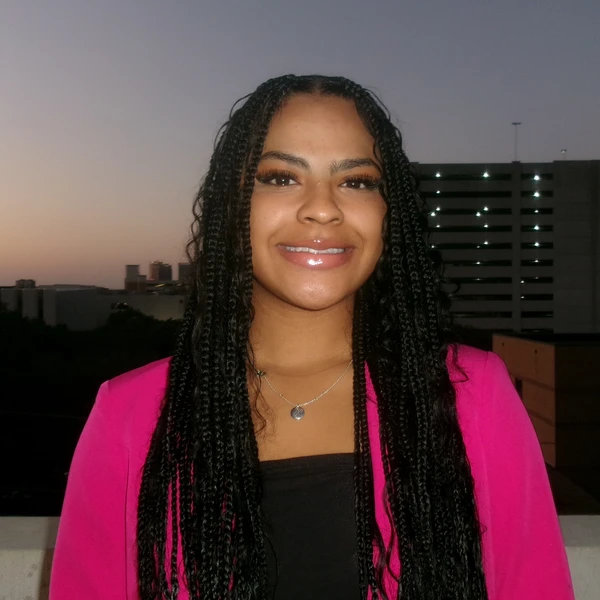
user profile avatar

Kamya Harper

1x

Finalist

Bio

I am a neuroscience student at Rice University pursuing a future in medicine with a focus on healthcare access, patient advocacy, and neurological disease. Through my work as a Senior Patient Navigator with Link Health and a Health Advocate Student Intern at Legacy Community Health, I have supported patients facing barriers related to food insecurity, transportation, language access, and financial strain. My research and volunteer experiences with Alzheimer’s and Parkinson’s disease have strengthened my goal of becoming a neurologist and physician-scientist focused on neurodegenerative disease and health disparities. As President of the Rice Chapter of the National Society of Black Women in Medicine, I am also committed to supporting Black women pursuing healthcare careers and building spaces rooted in mentorship, representation, and compassionate care.

Education

Rice University

Bachelor's degree program
2022 - 2026
  • Majors:
    • Neurobiology and Neurosciences

Miscellaneous

  • Desired degree level:

    Doctoral degree program (PhD, MD, JD, etc.)

  • Graduate schools of interest:

  • Transfer schools of interest:

  • Majors of interest:

    • Neurobiology and Neurosciences
  • Planning to go to medical school
  • Career

    • Dream career field:

      • Medicine
    • Dream career goals:

      Physician-Scientist

    • Health Advocate Student Intern

      Legacy Community Health
      2024 – 2024
    • Senior Patient Navigator

      Link Health
      2024 – 20262 years
    • Nursing Assistant

      Christ Hospital
      2021 – 20221 year

    Sports

    Volleyball

    Club
    2021 – 20265 years

    Awards

    • Most Valued Player

    Volleyball

    Varsity
    2019 – 20223 years

    Awards

    • Captain

    Research

    • Neurobiology and Neurosciences

      Think Neuro — Alzheimer’s Disease Research Associate
      2024 – 2024
    • Medicine

      Baylor College of Medicine/ Texas Children's — Research Assistant
      2025 – 2026
    • Neurobiology and Neurosciences

      UTHealth Houston/ McGovern Medical School — Research Assistant
      2024 – 2025
    • Biological and Biomedical Sciences, Other

      Rice University: RESP Program — Student Researcher
      2022 – 2022

    Arts

    • The Mayfair Performing Company

      Dance
      Recitals (Yearly)
      2008 – 2018
    • A Capella

      Performance Art
      2019 – 2022

    Public services

    • Advocacy

      Link Nonprofitv — Graphic Design Team Leader
      2023 – 2024
    • Volunteering

      Rice Pancakes for Parkinson’s — Volunteer
      2023 – 2026
    • Volunteering

      Rice All-Stars — Volunteer
      2024 – 2026
    • Advocacy

      Rice Chapter of the National Society of Black Women in Medicine — Rice Chapter President
      2024 – 2026
    • Volunteering

      Zeta Phi Beta Archonette — Secretary
      2019 – 2022
    • Public Service (Politics)

      Mikva — Phone Banker
      2019 – 2019

    Future Interests

    Advocacy

    Volunteering

    Entrepreneurship

    Henry Respert Alzheimer's and Dementia Awareness Scholarship
    Small ‌gaps ‌in ‌memory were the first sign. My great-grandfather would forget parts of his daily routine, the names of familiar people, or places he had visited many times. As his dementia progressed, those lapses became more severe. He struggled to understand the changing seasons, could not retain new information, and sometimes no longer recognized members of his own family. His confusion worsened as the day continued. Eventually, he could no longer dress himself, take his medication, or complete the ordinary tasks that had once allowed him to live independently. Dementia did not simply affect what he remembered. It changed how he moved through the world and gradually made him dependent on others for nearly every part of his care. Long before things got that hard, he’d made it clear he didn’t want outside caregivers. So my grandmother and her siblings split the work among themselves. I watched my grandmother try to hold onto her father’s dignity while carrying the fatigue and the constant vigilance that came with caring for him. Once, a mix-up in their rotating schedule meant he was left alone. He fell, and no one was there to help right away. That single moment made the point with painful clarity: even a devoted family can get stretched past its limits, and dementia doesn’t stay contained within one person’s diagnosis. It rearranges everyone’s role, interrupts the rhythm of a household, and presses on the emotional and practical lives of the people providing care. College put miles between me and what was happening, and distance came with its own kind of frustration. I could call, check in, and try to steady my family emotionally, but I couldn’t undo the decline or lift the weight from my grandmother’s shoulders. I kept thinking about my great-grandfather himself, how much he understood, and what those years felt like from the inside. Was he scared? Did he feel alone? Did he feel cared for? At the same time, I found myself thinking about my grandmother, too, watching her parent become more dependent while still trying to manage the rest of her responsibilities. Dementia in my own family is what first pulled me toward neuroscience. Before I even chose a major, I started reading on my own to make sense of what my relatives were living through. How could an illness so completely change memory, behavior, personality, and independence? As I learned more about the brain, my curiosity deepened. The biology behind cognition and neurological disease started to feel less like a distant academic topic and more like the key to understanding something personal. What began as an attempt to grasp my family’s experience turned into a genuine interest in neuroscience, and that path led me to major in it at Rice University. During college, classes kept feeding that interest, especially when we discussed neurodegenerative diseases like Alzheimer’s and Parkinson’s. I became drawn to the idea that changes in the brain can start years before a family realizes what’s happening. Neuroscience gave me language for parts of what I’d witnessed, but it also made it clear how much is still unknown. That uncertainty didn’t push me away. It pushed me toward research and service work aimed at understanding neurodegeneration while also helping the people affected by it. Because my interest began with dementia, I looked for ways to study Alzheimer’s beyond a lecture hall. As an Alzheimer’s research fellow, I worked with questions tied directly to the disease and saw how research can clarify the mechanisms behind cognitive and behavioral decline. What stayed with me most was how rarely there’s a single simple cause. Neurodegeneration shows up as layered change, unfolding across cells, networks, behavior, and time. Research helped me link the questions raised by my great-grandfather’s illness to the slow, careful work of building answers, and it kept reminding me how much remains to be done in early detection, treatment, and prevention. Service shaped my perspective differently. With Rice Alzheimer’s Buddies, I joined seasonal events and was paired with a community member living with Alzheimer’s disease. Time spent with people affected by the disease made one thing unmistakable: connection can still be real and meaningful even when memory isn’t. Yes, conversations sometimes had to circle back. Plans required patience and flexibility. But each person still deserved to be met with warmth, respect, and true curiosity. Volunteering also pulled me back to my great-grandfather, and I found myself wondering, again, whether he felt that same sense of being seen and supported near the end. At an Alzheimer’s walk, I saw the wider circle, not only patients and families, but caregivers, volunteers, researchers, and community members who understood the same strain. In a home, the experience can feel isolating, like something you’re trying to manage behind closed doors. At the walk, it was clear how many lives it touches. That visibility sharpened the need for research funding, public awareness, caregiver resources, and real community support. It also taught me that dementia work can’t be only scientific. Compassion matters, patience matters, and being present matters, even when there is no cure to offer. I saw that same mix of science and humanity again while shadowing at the UTHealth Neurocognitive Disorders Clinic. I watched cognitive testing and evaluations for patients with Alzheimer’s and other neurological conditions. I paid attention to how physicians adjusted their communication when patients were confused, couldn’t hold onto details, or struggled to answer questions. Caregivers were included in the discussion, but patients were still treated as participants in their own care. I also saw how heavy the caregiver role can become, especially as families described changes at home and tried to keep up with appointments and decisions. It brought my grandmother to mind immediately, and the responsibility she took on while caring for her father. Across my family’s experience, research, volunteering, and clinical exposure, one lesson has stayed consistent: science and compassion can’t be pulled apart. Research is needed to understand disease mechanisms and to build better diagnostic tools. At the same time, patients and caregivers need dignity, clear communication, and practical help. Families shouldn’t be left to absorb the full load of dementia care by themselves. And a person’s worth does not shrink because they can’t remember or function independently. Abilities change, but the person, their history, and their humanity remain. I hope to become a neurologist and physician-scientist focused on neurodegenerative disease. Over time, I hope to build my own lab studying early detection in Alzheimer’s disease and other dementias. I want to help identify neurological changes before severe memory loss and functional decline take hold, when families might have more time to prepare and when interventions might do more good. I also want to expand access to neurological care in underserved communities and help ensure caregivers have the guidance and support they need. My great-grandfather’s illness did more than introduce me to dementia. It pulled me toward neuroscience, strengthened my commitment to Alzheimer’s and Parkinson’s research, and shaped the kind of physician I want to become. His story still reminds me that every diagnosis belongs to a person whose dignity is still there, and to a family absorbing the impact alongside them. I hope to carry that lesson forward by advancing research, caring for patients with steady compassion, and working toward a future where neurodegenerative disease is recognized earlier and treated more effectively.
    Kamya Harper Student Profile | Bold.org