Caledonia, MI
Hobbies and interests
Orchestra
Violin
Advocacy And Activism
American Sign Language (ASL)
Babysitting And Childcare
Writing
Travel And Tourism
Drawing And Illustration
Volunteering
Community Service And Volunteering
Reading
Adult Fiction
Fantasy
Contemporary
Politics
Literary Fiction
Short Stories
Social Issues
Academic
Biography
Classics
Humanities
Action
Criticism
Sociology
Environment
I read books multiple times per week
Kai Miller
1x
Finalist
Kai Miller
1x
FinalistBio
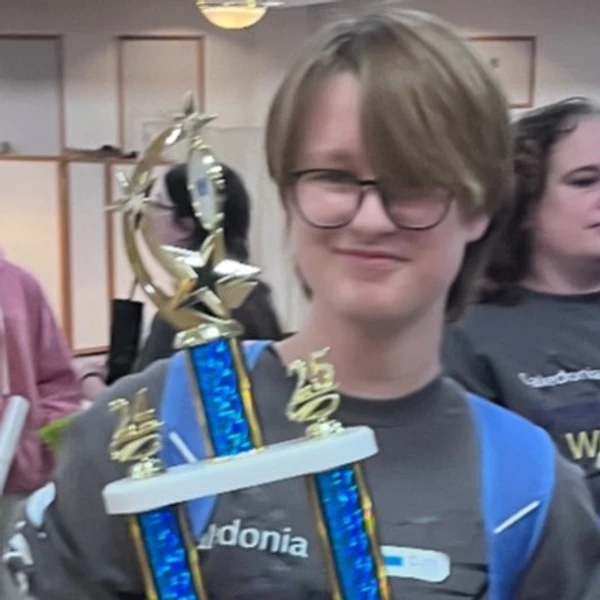
I am an LGBTQIA high school senior, class of 2026. I hope to pursue an education and career in journalism. Majors I am looking forward to applying to include English, Journalism, or political science.
I am very passionate about social issues, politics and sociology, English and language, and human rights. I plan on studying English or Journalism so I can best pursue these passions in my work.
I have been a part of Caledonia Orchestras for over six years, and I have been a part of Caledonia's Creative Writing Team for five. I often volunteer for my community, helping run and organize food banks and protests. I work as a barista and spend much of my time reading, making art, doing schoolwork, and working.
Education
Caledonia High School
High SchoolGPA:
4
Miscellaneous
Desired degree level:
Bachelor's degree program
Majors of interest:
- Journalism
- Political Science and Government
- English Language and Literature, General
Career
Dream career field:
Newspapers
Dream career goals:
Write a book
Crew Member
Caribou Coffee2025 – Present1 year
Sports
Horse Racing
Intramural2017 – 20225 years
Alpine Skiing
Intramural2020 – Present6 years
Research
English Language and Literature, General
Caledonia High School — Researcher, writer, designer2023 – 2023
Arts
Lake Michigan Writing Project - Summer Writing Course
Visual ArtsWritten Anthology2022 – 2025School of the Art Institute of Chicago
DrawingGallery Showcase2025 – 2025Caledonia Orchestras
Music2019 – Present
Public services
Volunteering
Grand Rapids Unite and Resist — Help build website and flyers2025 – PresentVolunteering
Feeding America — Worker2025 – PresentVolunteering
Caledonia — Run games, help organizers, etc2021 – PresentVolunteering
Caledonia Community Schools — Help run an elementary school event2024 – 2024
Future Interests
Advocacy
Politics
Volunteering
Philanthropy
Entrepreneurship
Christopher K. Swartz Scholarship
I have looked up to people in the journalism industry for my entire life. I’ve grown up listening to NPR, reading the comic strips on Sunday papers, and swearing to myself that I’ll see my name beneath a column title one day. Being someone people can trust for real information is exactly what draws me toward written journalism. I have spent much of my time this year, when I'm not working or studying, serving my community.
Such a large part of my identity is activist. Whether I was in the city helping people who requested aid during terrifying times of their lives, helping protestors organize their events safely, or organizing food into boxes at a mobile food bank for those scared to leave their homes, I found myself through service. Service in times like this isn’t always easy-- countless times at vigils, protests, and food banks, I’ve found myself overcome with emotion and wonder--how can someone see such terror in their communities and not help? Recently, I attended a vigil in Grand Rapids dedicated to those killed in ICE detention centers. The organizers took several minutes to list the names of each person killed in ICE detention centers. Police cars circled the block where we all peacefully stood, simply mourning. Passersby didn't spare a glance, instead scared off by the image protestors are given by the media. In this way, I notice parallels between my identities as an LGBTQIA+ person and an activist. We are given labels simply for existing.
While I helped people, I always noticed the people with 'PRESS' badges, taking notes on the passion they saw at whatever event they documented. Whether they were taking pictures of a food bank to spread the word, recording a speech with supporters rallying around them, or asking people about their experiences, they were making a difference with the words they crafted.
I have also always loved language. When I write a poem, write a short story, or draft an essay, my first thought is about what the audience will take from it. How can I effectively say something bigger than me? How can I accomplish something with my words? Language has always been what I want to study, but realizing these past few years that rhetoric is the subject I want to engage in and learn about for the rest of my life has shaped my college and career aspirations. My passion is in analysis of rhetoric and how writing affects people. I want to understand how writers say things about the world and how I can do that effectively in order to educate and be educated.
Justin Burnell Memorial Scholarship
I have looked up to people in the journalism industry for my entire life. I’ve grown up listening to NPR, reading the comic strips on Sunday papers, and swearing to myself that I’ll see my name beneath a column title one day. Being someone people can trust for real information is exactly what draws me toward written journalism. I have spent much of my time this year, when I'm not working or studying, serving my community.
Such a large part of my identity is activist. Whether I was in the city helping people who requested aid during terrifying times of their lives, helping protestors organize their events safely, or organizing food into boxes at a mobile food bank for those scared to leave their homes, I found myself through service. Service in times like this isn’t always easy-- countless times at vigils, protests, and food banks, I’ve found myself overcome with emotion and wonder--how can someone see such terror in their communities and not help? Recently, I attended a vigil in Grand Rapids dedicated to those killed in ICE detention centers. The organizers took several minutes to list the names of each person killed in ICE detention centers. Police cars circled the block where we all peacefully stood, simply mourning. Passersby didn't spare a glance, instead scared off by the image protestors are given by the media. In this way, I notice parallels between my identities as an LGBTQIA+ person and an activist. We are given labels simply for existing.
While I helped people, I always noticed the people with 'PRESS' badges, taking notes on the passion they saw at whatever event they documented. Whether they were taking pictures of a food bank to spread the word, recording a speech with supporters rallying around them, or asking people about their experiences, they were making a difference with the words they crafted.
I have also always loved language. When I write a poem, write a short story, or draft an essay, my first thought is about what the audience will take from it. How can I effectively say something bigger than me? How can I accomplish something with my words? Language has always been what I want to study, but realizing these past few years that rhetoric is the subject I want to engage in and learn about for the rest of my life has shaped my college and career aspirations. My passion is in analysis of rhetoric and how writing affects people. I want to understand how writers say things about the world and how I can do that effectively in order to educate and be educated.
Ryan Stripling “Words Create Worlds” Scholarship for Young Writers
In elementary school, my library card was my pride and joy. I was often found speed-walking toward the library as soon as my third grade school day ended, to pick up Roald Dahl or National Geographic books. I spent all my time reading, not only because I couldn’t put the books down, but because the feeling of learning more and more was so appealing to me. I couldn’t imagine not pursuing knowledge for my entire life, and seeing people not surround themselves with information shocked me. I would write letters to authors, fill notebooks with ideas and observations, and get early starts on assignments so I could say as much as possible. I’ll never stop writing, reading, and seeking knowledge.
When I write a poem, write a short story, or draft an essay, my first thought is about what the audience will take from it. How can I effectively say something bigger than me? How can I accomplish something with my words? Language has always been what I want to study, but realizing these past few years that rhetoric is the subject I want to engage in and learn about for the rest of my life has shaped my college and career aspirations. My passion is in analysis of rhetoric and how writing affects people. I want to understand how writers say things about the world and how I can do that effectively in order to educate and be educated.
In August 2025, I attended a college-level experimental art course where I spent a week constantly surrounded by artists. We formed bonds over our shared love for humanities, in turn improving our passion and work. This week in art school changed something in me. I went into my senior year confident, making experimental collages in AP Art class, and deciding to put my full effort into everything I do. I joined my school’s new art club, which has a focus on putting art around school and providing opportunities to young, new artists. In October 2021, I joined my school’s brand new Creative Writing Team. I’ve attended four years of this Team since, being one of the three remaining founding members. I've enjoyed my position as a founding member, helping the freshman members and the middle schoolers to find their voices and confidence in the creative writing world. These creative courses influenced my passion to stand up for humanities-centered subjects, something I wish to act on even more in the future.
This year, I’ve also found community in service. I have spent much of my time finding more ways to help people, and found myself aiding protest leaders in setting up speeches, organizing food for food banks, or setting up websites and spreading the word to aid struggling families. I hope to continue finding ways to help people throughout my career and education, helping others to find their own ways to stand up all the while.
Dr. William and Jo Sherwood Family Scholarship
I didn't believe one class could change my life until last year.
My sophomore year, I hesitantly signed up for AP Language and Composition. It wasn't that I didn't think I could do it-- I have always adored the English language, and searched for a higher challenge in every class-- but I was terrified to be near people who also cared about English. Going from being ahead in every English class due to dedication and passion to being on the same level as my peers who cared just as much seemed daunting.
When I actually began that class, though, I realized I did need that challenge all along. I finally let my passion for English show. I did hours of homework, from textual analysis to scribbled outlines for graded essays, and loved every second of it. I could feel my articulation and vocabulary skills developing within each assignment. I learned how to read closely and find meaning I actually wanted to find. I could see through all my classmates' complaining, too-- we all needed this. We all found what we were looking for.
College currently seems millions of times more daunting than AP Lang did. I'm terrified about finding the right place for me. I'm terrified I won't match my family and peers' expectations and work ethics.
I've also never been more hopeful! I want to be a journalist. I want to study English and Political Science. I hope to keep feeling what I did in AP Lang throughout the rest of my education. I hope to further my understanding of society and people's place in this world, especially regarding government. I hope to make a difference by utilizing my love for language to expose inequalities in our country.
One thing I want to change by telling stories through my love for language is the treatment of teenagers and young adults in America. I don't think we should have to work several jobs to be able to even imagine attending college and furthering our education. Every student deserves to find classes like AP Lang, to learn, and to expand their knowledge and experiences. Through equal access to rigorous academic courses, we can empower a generation to utilize their voice. With this scholarship, I would enroll in college to study language and spreading knowledge. I think putting good and information back into the world is the most valuable thing someone can do with their education and with scholarship money.
Olivia Rodrigo Fan Scholarship
Olivia Rodrigo herself said about the album, “[the album is] about the confusion that comes with becoming a young adult and figuring out your place in the world and figuring out who you want to be.”
To me, her track teenage dream is the epitome of adolescence. One lyric from this song that has stuck with me for years is, “When am I gonna stop being great for my age and just start being good?”
Being a writer and artist my whole life, I hold myself to high standards. When one is a young writer, they often hear compliments with “...for a middle schooler” tacked onto the end. A piece I wrote in seventh grade might be more highly loved than one I wrote in Junior year, even if they both won the same competition, simply because things aren't deemed as good if they’re expected.
Being “great for my age” is something I just can’t keep up with now that I’m seventeen. I’m no longer ahead in my college and scholarship research-- I'm expected to be exactly where I am now. The shift from being ahead (being great for my age) to being on track (being good) can make me feel like I’m miles behind.
This fear and struggle of mine truly presented itself my Junior year, when I joined AP Lang. I was face-to-face with the idea of being the same as my peers. I had always found myself far ahead of previous English classes, even letting my work ethic slip because I never got the challenges I needed. It was a terrifying idea to not be great, but the class also taught me to be good. I didn’t get a 9/9 on my first essay, and I wasn’t expected to. I spent the year working my way up to an 8/9, and being average in that class was the best thing that could’ve happened. I had desperately needed that challenge, both academically and mentally. Being mediocre in my favorite subject set me up to allow failure, stress, and adversity into my life.
Olivia frames being good as both a goal and a fear in this lyric. The previous line asks, “When am I gonna stop being wise beyond my years and just start being wise?” establishing the glazing that comes with youth as something she wants to escape. This sets greatness and something she wants to leave behind, yearning for the simple goodness that comes with growth. This inspires me to see goodness as something just as good as greatness. To be good is to be enough, to be seen. It’s something every teen spends their late teen years yearning for, whether they notice or not. Expectations for ourselves may go from great to good, but the shift to become a more genuine want, rather than an aspiration for perfection. The entirety of GUTS covers imperfection and self-perception, but teenage dream describes the real, raw fears and hopes we gain.
I want to be good. I want to be vulnerable, genuine, and seen for who I am and want to be. After high school, I want to study English and Journalism. I want to tell people’s stories, work on my language skills every day, and make a real difference by doing what I love. I want to keep learning and improving forever, and college is an amazing place for me to start my career and finish my school life. I want to aspire for greatness, but be seen as simply good. And as long as I can make a difference, that will be enough.